 Porchlight Tales
He Demanded a Refund for a Half-Eaten Cake. Then He Became My Intern.
Fiction. This is an original, made-up story: names, characters and events are invented, and any resemblance to real people or events is coincidental.
Full story · 9 chapters · Read in 5 parts instead
Listen to this story (5 parts)
Part 1 · 5 min
Part 2 · 5 min
Part 3 · 5 min
Part 4 · 5 min
Part 5 · 3 min
Chapter 1
"I WANT MY MONEY BACK NOW!"
The voice sliced through the warmth of cinnamon and yeast like a jagged blade. I stood frozen behind the mahogany counter of The Golden Whisk, watching a young man in a crisp linen shirt slam a cake box onto the glass display.
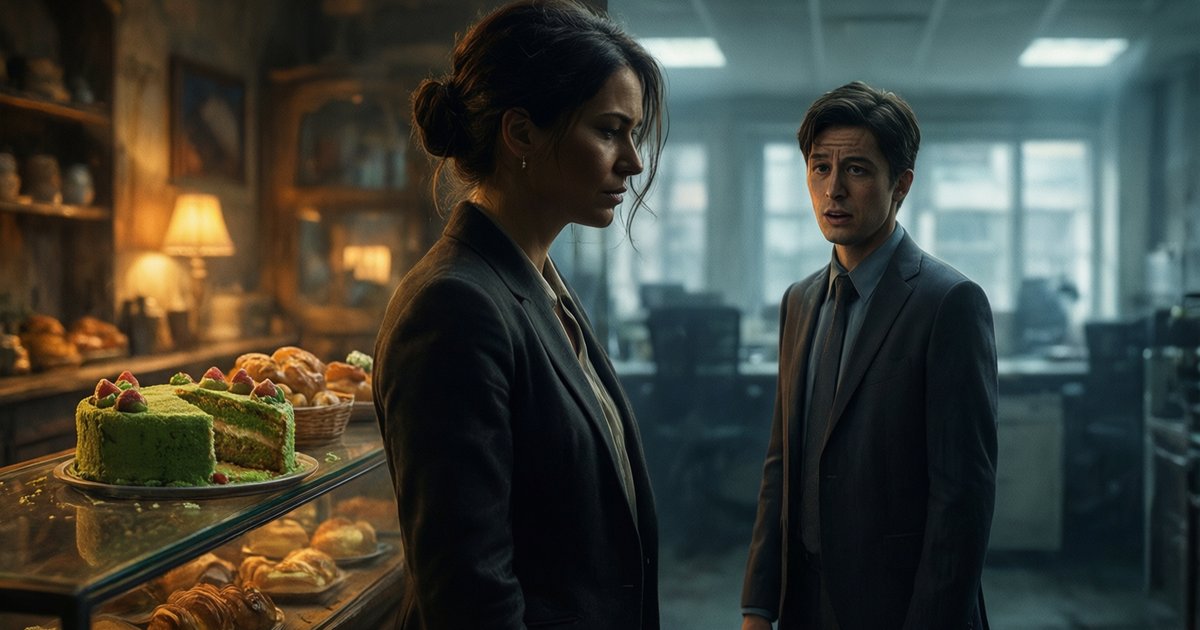
Inside the box lay a Sicilian Pistachio cake—or what was left of it. Only a few crumbs and a smear of pale green frosting remained. He had eaten nearly the entire thing.
Tess, my head baker, looked small beside him. Her hands were trembling, dusted in white flour, her eyes wide with shock and hurt. He didn't see her as a person; he saw her as a vending machine that had malfunctioned.
"It's inedible!" he barked, his face flushing a deep, arrogant red. "I've had better desserts at a gas station. This is an insult to my palate."
I didn't speak. I didn't scream. I simply watched the way he towered over Tess, the way he enjoyed the power of his own volume. It was a familiar shadow, one that reminded me of a house I had fled forty years ago.
But to understand why I stayed silent in that moment, you need to know how it all began. Three weeks earlier, I had decided to step back from the daily grind of the bakery to focus on my corporate role, leaving Tess in charge of the floor. I had spent my life avoiding the roar of angry people, a habit born from a father who believed volume equaled authority.
I had spent decades building a fortress of politeness, thinking it was a virtue. I didn't realize it was a shield for my fear. Until this young man walked through my door and decided that Tess was someone he could break for sport.
I reached under the counter and pulled out my leather-bound ledger. I didn't call the police. I didn't argue. I simply wrote down the date, the time, and a detailed description of the man's behavior.
I knew something he didn't. I knew that the world is very small, and the wheels of justice often turn in the most unexpected offices.
Chapter 2
Three weeks before the cake incident, I had been spending my mornings in the back office of The Golden Whisk, savoring the quiet hum of the ovens. At sixty-two, I had achieved a precarious balance: I owned the bakery, but I also served as a Regional Director for a corporate consulting firm that managed high-end hospitality groups across Georgia.
I loved the bakery. It was my sanctuary. The air carried the sweet cream of vanilla beans and the earthiness of toasted hazelnuts. It was a place where people came for comfort, not conflict.
Then came the young man. He started visiting twice a week. He didn't come for the community; he came to be seen. He wore clothes that cost more than my first car and spoke in a tone that suggested everyone around him was a slow learner.
I remember the first time I saw him interact with Tess. She had pointed out that the seating area was full and asked him to wait five minutes for a table.
"Do you know who I am?" he had asked, leaning over the counter. His voice wasn't loud yet, but it was dripping with a curated disdain. "I don't do 'waiting.' My time is significantly more valuable than your frosting."
Tess had looked at me, her eyes pleading for help. I felt that old, cold knot tighten in my stomach. My father's voice echoed in my mind: Don't disturb the peace, Adeline. Just keep your head down.
I didn't step in. Not because I didn't care for Tess, but because I was paralyzed by the sudden surge of old anxiety. Instead, I retreated to my office and opened my ledger.
I began to document everything. The date. The time. The specific words he used. It felt like a coward's way out, but as I wrote, I noticed something changing. The fear was being replaced by a cold, analytical curiosity.
I watched him through the security monitor. He was a study in entitlement. He treated the staff like furniture. He didn't realize that while he was playing the role of the conqueror, I was simply keeping a record of his debts.
Chapter 3
The day of the Sicilian Pistachio cake arrived on a humid Tuesday afternoon. The bakery was packed, the air heavy with the tang of fresh sourdough and the chatter of locals.
He walked in and ordered our most expensive specialty cake. I had sourced the pistachios from a small grove in Sicily; they were vibrant, salty, and cost me a fortune to import. It was the pride of my kitchen.
I watched from the office as he took the cake to a corner table. He ate with a focused intensity, slice after slice disappearing. He didn't look around. He didn't smile. He simply consumed.
Then, as if a switch had flipped, he stood up and marched to the counter. He slammed the nearly empty box down, the remaining crumbs scattering across the glass.
"This is a disaster," he declared, loud enough for every customer to stop talking. "The texture is grainy. The flavor is cheap. It's practically inedible."
Tess blinked, looking at the empty box. "Sir, you ate almost the whole thing. If it was that bad, why—"
"Because I was trying to find a single bite that wasn't an insult!" he screamed. He leaned in, his voice dropping to a lethal hiss. "You people are uneducated. You run a pathetic little shop and think a fancy name makes it gourmet. I want a full refund. Now."
Tess looked at me. I stepped out from the office, my face a mask of professional neutrality. I could see the vein pulsing in his neck. He expected me to cower. He expected me to apologize for the 'crime' of his dissatisfaction.
"Of course," I said softly.
I reached into the till, pulled out sixty dollars in cash, and placed it on the counter. I didn't look him in the eye. I just slid the money toward him.
"Thank you for your feedback," I added.
He snatched the money, gave Tess one last look of pure contempt, and swept out the door. Tess sighed, her shoulders slumping.
"Why did you give it to him, Adeline?"
I picked up the receipt and tucked it into my ledger. "Because, Tess, some people pay for their meals with money. Others pay with their reputation. He just gave me a very detailed map of his character."
Chapter 4
Monday morning arrived with a sterile, sharp energy. I traded my flour-dusted apron for a charcoal-gray power suit and a pair of pointed heels. The transition from 'Bakery Adeline' to 'Director Sterling' always felt like donning a suit of armor.
My office was a glass-walled sanctuary in downtown Savannah, overlooking the cobblestone streets. It was a world of spreadsheets, KPIs, and strict hierarchies. Here, the rules were written in ink, and I was the one who held the pen.
My assistant had briefed me on the new intake of junior interns. We only took one from the top-tier university program each year. This year's candidate was a standout—top of his class, an Ivy League degree, and a recommendation letter that praised his 'unrelenting drive' and 'confidence.'
At 9:00 AM, there was a knock on my door.
In walked a young man beaming with a level of confidence that bordered on delusional. He was wearing a slim-fit navy suit and carrying a leather briefcase. He looked like he had already decided he owned the building.
"Good morning!" he announced, not waiting to be invited in. He stepped toward my desk and extended a hand. "Grant Delgado. I'm the new junior intern. I've read your regional reports, Director Sterling. Very impressive, though I think there's significant room for optimization in the logistics sector."
I looked at him. Truly looked at him.
Grant didn't recognize me. To him, I was no longer the quiet woman in the apron who had handed him sixty dollars. I was the gatekeeper to his career. I was the authority.
I didn't shake his hand immediately. I let the silence stretch for five seconds, then ten. I watched his smile flicker, just for a moment, as the lack of an immediate response registered.
"Welcome, Mr. Delgado," I said, my voice devoid of emotion. "Please, take a seat. We have a lot to discuss regarding your expectations—and mine."
As he sat, he adjusted his tie, his arrogance returning. He had no idea that the ledger from the bakery was currently sitting in my top drawer.
Chapter 5
For the first three days, I played a dangerous game of observation. I wanted to see if the man in the suit was different from the man in the bakery.
He wasn't.
Grant treated the office like his personal kingdom. He was polite to me—because I held the power—but he was a nightmare to everyone else. I watched him from my glass walls as he spoke to Joanne, the receptionist.
"Joanne, is this the updated filing system?" he asked, tossing a folder onto her desk. "It's incredibly archaic. I don't know how you manage to function with such inefficient tools. Maybe you should look into a basic course on digital organization."
Joanne, a woman who had been with the company for fifteen years, just stared at him, her mouth slightly open. Grant didn't notice her discomfort; he was too busy admiring his own reflection in the glass partition.
He believed his degree was a license to belittle anyone who didn't have one. He saw the 'invisible' workers—the cleaners, the receptionists, the assistants—as obstacles rather than people.
I felt a slow, simmering heat in my chest. It wasn't just anger; it was a sense of protective justice for Tess and Joanne. I remembered the way Tess's hands had shaken in the bakery.
I called Grant into my office on Thursday afternoon.
"Grant, how are you finding the transition?" I asked, leaning back in my chair.
"It's a bit slower than I expected, Director," he replied, leaning forward with a smirk. "I feel I'm capable of much more than just shadowing. I'm ready for high-level analysis. My professors at Yale mentioned that my grasp of market dynamics is—"
"Your professors aren't the ones signing your evaluation, Grant," I interrupted.
He paused, the smirk faltering.
"I've noticed you have a very... distinct way of communicating with the staff," I continued. "Tell me, do you believe that technical skill excuses a lack of basic courtesy?"
He laughed, a short, dismissive sound. "I just believe in efficiency, Director. Some people simply can't keep up.
I smiled. It was the first real smile I had given him. "I agree. Efficiency is vital. Which is why I've decided to change your first project."
Chapter 6
The moment of recognition happened on Friday morning.
I had called Grant into my office and placed a photo on the desk. It wasn't a professional headshot. It was a grainy still from my bakery's security camera—a shot of him screaming at Tess over the pistachio cake.
Grant froze. The color drained from his face so quickly he looked like he might faint. He looked at the photo, then at me, then back at the photo.
"You..." he whispered. "The bakery."
"The Golden Whisk," I corrected. "The one with the 'inedible' cake and the 'uneducated' staff."
The power dynamic shifted with a violent, silent snap. Grant's posture collapsed. The confidence that had filled the room for a week evaporated, leaving behind a terrified twenty-three-year-old who suddenly realized he had insulted his boss's livelihood.
"Director Sterling, I... I didn't realize... I was having a bad day, and the cake really was—"
"The cake was made with Sicilian Pistachios, Grant. They are the finest in the world," I said, my voice low and steady. "The only thing 'cheap' in that interaction was your behavior."
He started to stammer, an apology forming that sounded like a rehearsed script. He tried to pivot, to charm his way out of it. "I truly apologize. I've always held your firm in high regard, and I hope this personal misunderstanding won't affect my professional standing."
I didn't scream. I didn't fire him on the spot. That would have been too easy. Instead, I handed him a stack of papers nearly four inches thick.
"These are the raw data entries for our regional waste audits from the last five years," I told him. "I want them digitized, cross-referenced by zip code, and formatted into a spreadsheet. By Monday."
It was the most tedious, soul-crushing work in the company. It was grunt work. It was 'invisible' work.
"But I'm an Ivy League graduate!" he protested, his voice cracking.
"And right now," I replied, "you are an intern who needs to learn how to be a human being. Get to work."
Chapter 7
Grant spent the next two weeks in a state of perpetual misery. He tried every trick in the book to escape the data entry. He brought me expensive coffees. He tried to brag about his father's connections in the banking industry.
I ignored it all. Every time he tried to pivot back to his 'potential,' I simply pointed to the spreadsheets.
Then, I gave him his first real assignment.
"I want you to conduct a cost-efficiency analysis on our premium ingredient sourcing for the bakery division," I instructed. "I want to know if the Sicilian Pistachios are worth the import cost or if we should switch to a domestic supplier."
Grant's eyes lit up. This was the 'high-level analysis' he had been craving. He spent three days diving into the logistics, the shipping manifests, and the quality-control guidelines I had written years ago.
I had intentionally left a specific set of strict guidelines in the archive—a manual on why certain ingredients are chosen not just for taste, but for the heritage and the community they support.
As Grant crunched the numbers, he discovered something. The Sicilian Pistachios weren't just a luxury; they were sourced from a cooperative that employed widowed women in a struggling village. The premium price wasn't just for flavor; it was a lifeline for fifty families.
He also discovered the actual cost per ounce. He realized that the sixty dollars he had demanded back was a fraction of the value of the labor and the rare materials involved in that single cake.
On Thursday, he came into my office. He wasn't beaming anymore. He looked tired. His suit was slightly wrinkled, and he didn't lead with a brag.
"I finished the report," he said, placing it on my desk. "The domestic alternative is cheaper, but it's... it's devoid of the quality. And it doesn't support the cooperative."
"And the cost of the pistachio cake?" I asked.
He looked down. "It's an undervalued masterpiece. I was... I was incredibly wrong."
"Are you apologizing for the cake, Grant?" I asked. "Or are you apologizing because you want a promotion?"
He hesitated. The silence told me everything. He was still calculating. He was still playing the game.
Chapter 8
The final evaluation arrived on a rainy Friday afternoon. Grant walked into my office and presented his findings with professional poise. He had done an excellent job on the report, but his tone was still slightly superior, as if he were doing me a favor by being right.
"I believe this analysis proves my value to the firm, Director," he said. "I've identified three other areas where we can optimize."
I didn't look at the report. I opened my desk drawer and pulled out the leather-bound ledger from the bakery.
"Your technical skills are impressive, Grant. Your analysis is sharp. But there is a clause in your internship contract—the Professionalism Clause. It states that the intern must demonstrate the ability to work collaboratively and respectfully with all levels of staff."
I slid the ledger across the desk. He saw the dates. He saw the descriptions of his behavior toward Tess and Joanne.
"I have a log of your conduct from three weeks ago," I said. "In the corporate world, your degree gets you in the door. But your character is what keeps you in the room. Based on this record, you have failed the most important part of your internship."
Grant's face went pale. "Are you firing me?"
I leaned forward. "I could. But I think that would be a waste of a good mind. Instead, I'm offering you a different kind of education."
I handed him a new contract. It wasn't a promotion. It was a mandate.
"You will remain an intern here. But for the next month, every Saturday and Sunday, you will report to The Golden Whisk. Not as a customer, and not as a consultant. You will work as a paid assistant to Tess. You will scrub the floors, you will wash the trays, and you will learn exactly how much work goes into a sixty-dollar cake."
Grant looked at the contract. He knew he had no leverage. His Ivy League degree couldn't scrub a floor.
"If you refuse, I'll send this ledger and the security footage to your university's ethics board as part of your final evaluation," I added calmly.
He signed the paper without another word.
Chapter 9
The following Saturday, I drove to the bakery. I didn't go inside; I stayed in my car, watching through the front window.
It was 6:00 AM. The street was gray and misty. Inside, the lights were warm, casting a golden glow on the flour-dusted surfaces.
I saw Grant. He was wearing a plain white t-shirt and a heavy-duty apron. He looked out of place, like a fish out of water. Tess was standing next to him, her arms crossed, her expression stern but fair.
She pointed to a large, stainless steel tray covered in dried batter and burnt sugar. She handed him a scrub brush and a bucket of soapy water.
I watched him. At first, he looked disgusted. He held the brush as if it were contaminated. But as the hour passed, and Tess continued to give him a relentless list of tasks—sweeping the walk-in freezer, polishing the display glass, hauling bags of flour—something shifted.
He stopped looking at the clock. He stopped sighing. He just worked.
At one point, Tess handed him a small piece of the Sicilian Pistachio cake—a scrap from the edge of a new batch. He took a bite. He didn't call it 'inedible.' He didn't complain about the texture. He just chewed slowly, looking at the woman he had once called 'uneducated.'
As he finished, he didn't toss the scrap in the trash. He carefully cleaned the counter where it had rested and handed the tray back to Tess with a quiet, "Thank you."
I started my engine and began to drive away.
For the first time in my life, I didn't feel the need to hide from the conflict. I had faced the roar, and I had turned it into a lesson. I felt a strength in my chest that I hadn't possessed as a child in my father's house.
I looked in the rearview mirror one last time. Grant was on his knees, scrubbing the floor, silent and humbled.
Justice doesn't always need a gavel. Sometimes, it just needs a scrub brush and a very expensive cake.
The End