 Porchlight Tales
My HOA President Fined Me for My Holiday Lights. She Forgot Who Truly Owned the Land.
Fiction. This is an original, made-up story: names, characters and events are invented, and any resemblance to real people or events is coincidental.
Full story · 10 chapters · Read in 5 parts instead
Listen to this story (5 parts)
Part 1 · 4 min
Part 2 · 5 min
Part 3 · 5 min
Part 4 · 5 min
Part 5 · 4 min
Chapter 1
"REMOVE THEM BY MIDNIGHT OR THE FINES DOUBLE!"
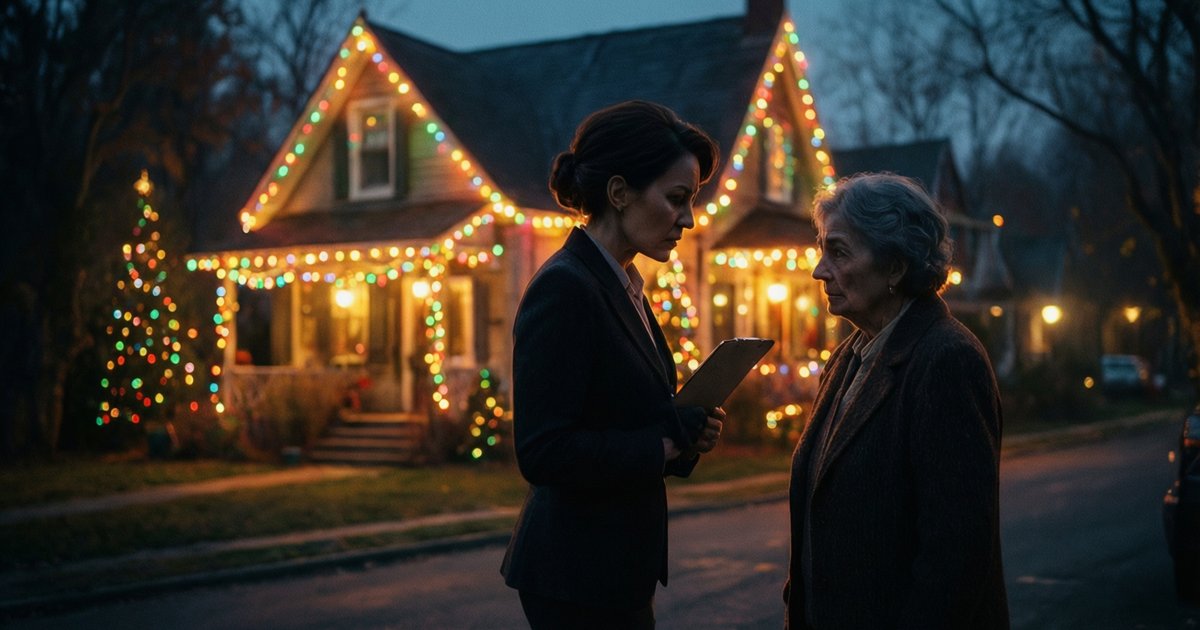
Beatrice Sterling’s voice sliced through the crisp Georgia air, sharp enough to draw blood. She stood on my driveway, her heels digging into the manicured turf, pointing a manicured finger at the multicolored LEDs draped across my porch.
I didn't move. I just held my breath, my heart hammering against my ribs like a trapped bird. I could feel the heat rising in my neck, that familiar, suffocating urge to apologize just to make the screaming stop.
For forty years, I had been the quiet wife. The one who smoothed over the arguments. The one who stayed in the background while others took the stage. But looking at Beatrice, with her rigid posture and her eyes cold as river stones, something in me finally snapped.
I didn't scream back. I didn't even blink. I just watched her walk away, the click-clack of her heels sounding like a countdown.
But to understand why I stopped being afraid, you need to know how it all began. Three weeks earlier, the air had smelled of pine and the first hint of woodsmoke, and I had felt a flicker of hope that this year would be different.
I had just pulled the heavy boxes from the attic. My husband, Henry, had spent every December for thirty years turning our modest cottage into a beacon of light. He called it 'The North Star of Oak Ridge.' When he passed last spring, the house felt too dark. Too silent.
I decided that the darkness ended this year. I didn't know that for Beatrice Sterling, a few strings of colorful lights were an act of war. I thought I was just honoring a memory. I didn't realize I was stepping into a battle for my home.
Chapter 2
The first set of lights went up on a Tuesday. I started small—warm white globes along the eaves and a few twinkling stars in the hedges. The smell of damp earth and cedar filled my lungs as I worked, feeling Henry's presence in the way the ladder creaked under my weight.
I was just stepping off the last rung when a silver Lexus screeched to a halt at the curb. Beatrice Sterling stepped out, not with a greeting, but with a clipboard.
"Mrs. Ruckert," she said, her voice a rehearsed melody of condescension. "I assume you're aware of Regulation 4.2? Non-standard holiday lighting is strictly prohibited between November 15th and January 5th. Only warm-white, steady-glow lights are permitted."
I blinked, clutching a tangle of wires. "It's just for a few weeks, Beatrice. Henry always—"
"The bylaws don't account for sentiment, Bonnie," she interrupted, her eyes scanning my property for other 'offenses.' "This is about property values. We cannot have the neighborhood looking like a carnival. I'll give you a warning this time. Take them down by Friday, or the fines begin."
I watched her drive away, my chest tightening. I retreated inside and walked to the hallway, where my old cedar chest sat. It was a heavy, aromatic piece of furniture that held the fragments of my life—old letters, lace doilies, and the original deed of trust from the 1950s.
I ran my hand over the rough wood. This house had been in the family long before the Oak Ridge Estates HOA was even a blueprint on a developer's desk. The deed felt thick and weathered, the ink fading on parchment that smelled of old libraries. I remember thinking back then that the document was too old for current laws, a relic of a forgotten era. I didn't know that the relic was the only thing that could save me.
Chapter 3
By the following Monday, the 'warnings' were over. I woke up to a neon-orange slip of paper tucked into my screen door. A fine of $100. For a single day of 'non-compliance.'
I didn't take the lights down. For the first time in my life, the thought of the darkness was scarier than the thought of the fine.
Every day, the slips arrived. Then came the 'compliance visits.' Beatrice would walk onto my lawn, her clipboard held like a shield, detailing every 'violation.' She didn't just talk about the lights; she criticized the height of my grass and the shade of my shutters.
"You're being stubborn, Bonnie," she sneered during one visit. "You're a retired librarian; surely you can read the handbook. You're risking your credit, your equity. Just stop this childish display."
I was trembling, but I wasn't alone. My grandson, Leo, a nineteen-year-old college student with a permanent smirk and a smartphone always in his hand, was standing behind me. He had been visiting for the holidays, and he hated Beatrice with a passion that only a teenager can muster.
"She's just bullying you, Grandma," Leo whispered.
As Beatrice launched into another tirade about 'aesthetic harmony,' Leo stepped forward, his phone held discreetly at his side. He recorded everything—the insults, the way she stepped on my flowerbeds on purpose, the sheer arrogance in her tone.
"I'm recording this for the archives, Mrs. Sterling," Leo said, his voice dripping with fake politeness.
Beatrice bristled, her face turning a mottled purple. "How dare you! I am the President of this Association! I am the law in this neighborhood!"
She stormed off, but as she left, I noticed something. She stopped by her own fence—a pristine, white picket boundary that she guarded like a fortress. She patted it affectionately, as if the fence were her only true friend.
Chapter 4
The harassment escalated. Beatrice didn't stop at fines; she started looking for ways to make my life miserable. On a rainy Thursday, two men in city uniforms arrived at my door. They weren't there to help; they were there to inspect my wiring.
"Mrs. Sterling reported 'unsafe electrical hazards' coming from your display," the lead technician said, sounding bored. "We have to verify the load on the grid."
They spent an hour poking around my porch. The wiring was perfectly safe—Henry had been a meticulous man—but the intrusion felt like a violation. Beatrice watched from her porch across the street, a small, triumphant smile on her lips.
That night, I couldn't sleep. I sat in the living room with a lamp and my husband's old journals. Henry had been obsessed with the history of this town. He had spent years researching the original zoning boundaries of the valley before the suburbs swallowed the farmland.
I flipped through the yellowed pages, reading his neat, architectural handwriting. He wrote about the 'Old Ridge Line' and the 'Heritage Plots'—pieces of land that were protected by a 19th-century covenant that the city had forgotten to repeal when they modernized the maps.
I remembered the deed in my cedar chest. I remembered the strange wording about 'perpetual easements' and 'historical anchors.'
I felt a spark of something I hadn't felt in years: curiosity. No, it was more than that. It was a realization. Beatrice believed the HOA rules were the ultimate authority because she had spent years manipulating them. But the HOA was a private contract. The city's zoning laws were the law of the land.
I looked out the window. My lights were still twinkling, defying the gray rain. I realized that if I could prove my house wasn't just a 'lot' in a subdivision, but a historical landmark, the HOA's rules would be nothing more than scrap paper.
Chapter 5
The following morning, I drove to City Hall. The building was a cold, concrete block that smelled of floor wax and old coffee. I waited in a plastic chair for two hours before I was called into the office of Marcus Thorne, the City Zoning Officer.
Marcus was a man who looked like he lived in a spreadsheet. His tie was perfectly centered, and his glasses were perched precariously on a sharp nose. He looked at my deed, then at the map of Oak Ridge Estates, and then back at me.
"This is... unusual," Marcus murmured. He leaned closer to the map, tracing a line with a silver pen. "Your property is listed as Lot 12, but according to this original 1952 survey, you're actually sitting on a 'Heritage Anchor' plot."
I leaned in. "What does that mean, exactly?"
"It means your land predates the incorporation of the HOA by nearly twenty years," Marcus explained. A small, mischievous smile played on his lips. "And because of a very specific, very old zoning law regarding historical preservation, any residential association that formed later cannot impose aesthetic restrictions on an Anchor plot. You are, for all intents and purposes, an island of independence in a sea of beige."
I felt a rush of warmth that had nothing to do with the office heater. "So the fines? The regulations about the lights?"
"Completely void," Marcus said. "In fact, since the HOA has been attempting to enforce rules on a protected historical plot, they've likely been operating outside their legal jurisdiction for years."
Marcus looked at me, really looked at me, and saw the tired lines around my eyes and the determination in my grip. He had clearly dealt with Beatrice Sterling before; he knew her reputation for calling City Hall to complain about the height of a neighbor's mailbox.
"I can verify this officially," Marcus said. "But it takes time to process the certification. Until then, I suggest you keep your head down."
I thanked him and walked out into the sunlight, feeling like I was walking on air.
Chapter 6
The 'Darkest Night' came three days later. I returned home to find a certified letter waiting for me. It wasn't a fine this time. It was a legal notice from the HOA's attorney.
Beatrice had moved for a lien against my home. She claimed that my 'accumulated unpaid fines' had reached a threshold that allowed the HOA to place a legal claim on my property title. If I didn't pay the thousands of dollars in fines by the end of the month, they could potentially force a sale of the home to recover the debt.
I sat at my kitchen table, the letter trembling in my hand. The room felt cold, the silence of the house pressing in on me. I looked at the lights outside, their colors blurred by a heavy December fog.
For a moment, I broke. I felt the old Bonnie returning—the one who just wanted the shouting to stop. I thought about how easy it would be to just take the lights down. To pay the fines with my savings. To go back to being the quiet widow who didn't cause any trouble.
I reached for the ladder. I actually stepped onto the porch, my hand touching the first string of LEDs. I thought of Henry, how he would have laughed at the absurdity of it all. He would have told me that a house isn't just wood and nails; it's the spirit you put into it.
"You're not doing it, are you?"
I turned to see Leo standing in the doorway. He had seen the letter on the table. He walked over and put his arm around my shoulders.
"She thinks she's won because she's louder than you, Grandma. But loudness isn't the same as power. Remember what you found at City Hall."
I looked at the lights, then back at the letter. I stepped off the porch and walked back inside. I didn't take the lights down. Instead, I went to my cedar chest and pulled out the deed, holding it tight against my chest like a shield.
Chapter 7
The phone rang on Friday afternoon. It was Marcus Thorne.
"Mrs. Ruckert, I have the certification in my hand," he said, his voice sounding almost gleeful. "Your property is officially designated as a Heritage Anchor. Not only is the HOA powerless to fine you, but any attempt to place a lien on your property based on their internal bylaws is a violation of city ordinance 114-B."
I closed my eyes, a single tear slipping down my cheek. "Thank you, Marcus. Truly."
"Don't thank me yet," Marcus replied. "I took the liberty of reviewing the surrounding plots while I was at it. It turns out the original zoning boundaries for the entire street were shifted during the 1980s expansion. There are a few other discrepancies that the HOA has been ignoring to keep things 'uniform.'"
I realized then that Marcus wasn't just doing me a favor; he was cleaning house. He had a long-standing distaste for the arrogance of the Oak Ridge board, and I had unwittingly provided him with the key to the lock.
"What does that mean for the rest of the neighborhood?" I asked.
"It means the 'uniformity' Beatrice Sterling loves so much is based on a legal fiction," Marcus explained. "The moment your status is formalized, it opens the door for a full zoning audit of the entire street. Every 'grandfathered' exception, every unauthorized fence, every illegal addition—it all comes under the microscope."
I thought of Beatrice's white picket fence. She had always bragged that it was 'grandfathered in,' despite the HOA rules forbidding fences in the front yards of other homes. She used that fence as a symbol of her status—the only one allowed to have a boundary because she was the one who drew the boundaries.
I felt a calm, cold clarity settle over me. I didn't want revenge, but I did want justice. I asked Marcus to send the certified documents via overnight mail.
I spent the evening polishing the ornaments on my porch. I made sure every bulb was working. I wanted the house to be the brightest thing in the county.
Chapter 8
The confrontation happened exactly as it started, but the ending was different. Beatrice arrived at my driveway, her face a mask of fury. She was holding another orange slip.
"REMOVE THEM BY MIDNIGHT OR THE FINES DOUBLE!" she screamed, her voice cracking. "I've already filed the paperwork for the lien, Bonnie! You are losing this house!"
I didn't flinch. I didn't apologize. I didn't even tremble.
I reached into my mailbox and pulled out a thick, cream-colored envelope. I walked toward her, my steps slow and deliberate. As I reached her, I handed her the certified letter from the City of Georgia.
"Read it, Beatrice," I said, my voice quiet but steady.
Beatrice scoffed, ripping the envelope open. As she read, I watched the color drain from her face. The mottled purple disappeared, replaced by a ghostly, ash-gray. Her eyes darted across the page, scanning the words 'Heritage Anchor' and 'Void of Jurisdiction.'
"This... this is impossible," she whispered. "You can't just... the HOA rules are absolute!"
"The HOA rules are a contract, Beatrice," I replied. "But this is the law. My house predates your association. You have no authority here. Not over my lights, not over my shutters, and certainly not over my title."
Beatrice looked at me, and for the first time, I saw something in her eyes other than contempt. I saw panic. She realized that the power she had used to crush others had just vanished, leaving her standing on my driveway with nothing but a useless clipboard.
"You'll regret this," she hissed, though the venom was gone, replaced by a desperate tremor.
"I don't think I will," I said. "In fact, I think I'm finally starting to enjoy the view from my porch."
I turned and walked back into my house, leaving her standing in the glow of my multicolored lights. I didn't look back.
Chapter 9
But I wasn't finished. The next morning, I called Marcus Thorne back. I didn't ask for a favor; I requested a formal zoning audit for the entire block, citing the discrepancies Marcus had mentioned.
Within a week, the city sent out inspectors. They didn't care about 'property values' or 'aesthetic harmony.' They cared about the code. And the code was very clear about front-yard fences in the Oak Ridge district.
Beatrice's beloved white picket fence—the symbol of her untouchable status—was ruled an illegal structure. Because it wasn't actually grandfathered in (the original plot maps proved it had been installed after the zoning change), she was hit with a city violation.
Unlike the HOA fines, which were internal, these were city mandates. The fines were steep—$250 a day until the fence was removed.
I watched from my window as the crew arrived to tear down the fence. Beatrice stood on her lawn, screaming at the workers, her face a mask of desperation. The neighbors, who had spent years fearing her, didn't come out to help. Some of them even stood on their porches, sipping coffee, watching the walls of her empire crumble.
Beatrice tried to call me, pleading for me to use my 'historical status' to help her find a loophole. I didn't answer the phone.
She had spent years using the law as a weapon to make people feel small. Now, she was discovering that the law is a mirror—it reflects exactly what you give to it. She had demanded a neighborhood of strict, uncompromising rules. Now, she was finally living in one.
By the end of the month, Beatrice had paid thousands of dollars to the city. Her house, once the center of power in Oak Ridge, now looked exposed and bare, the gap where the fence had been looking like a missing tooth in a smile.
Chapter 10
The final blow didn't come from a lawyer or a zoning officer. It came from me.
I sent Beatrice a short, handwritten note. I told her that I had no intention of suing her for the harassment or the attempted lien. I didn't want her money; I wanted her gone.
I offered her a 'peace treaty.' If she resigned as HOA president immediately and issued a formal apology to the neighborhood for her overreach, I would not report her other property violations—a small, illegal shed in her backyard—to the city council.
Beatrice Sterling resigned three days later. She didn't apologize publicly, but she disappeared from the board, retreating into her house and closing the blinds.
I spent the first night of January sitting on my porch with a steaming cup of cocoa. The air was freezing, but I felt warm. Beside me, the old cedar chest was open, the weathered deed resting on top.
I looked down the street. Now that the reign of terror was over, other lights were appearing. A few strings of blue LEDs here, a glowing reindeer there. The neighborhood was no longer a sterile, beige gallery; it was becoming a home again.
My lights shone the brightest of all, a vibrant, multicolored canopy that reached toward the stars. I could almost hear Henry laughing in the breeze, his voice blending with the distant sound of carols.
I had spent too many years being the quiet wife, the one who faded into the wallpaper. But as I watched the neighborhood twinkle in the dark, I realized that the most beautiful thing about the lights wasn't the color.
It was the fact that I was the one who turned them on.
The End