 Porchlight Tales
My Neighbor Sued Me Over a Two-Inch Fence. He Forgot Who Owned the Easement.
Fiction. This is an original, made-up story: names, characters and events are invented, and any resemblance to real people or events is coincidental.
Full story · 9 chapters · Read in 5 parts instead
Listen to this story (5 parts)
Part 1 · 5 min
Part 2 · 5 min
Part 3 · 5 min
Part 4 · 5 min
Part 5 · 2 min
Chapter 1
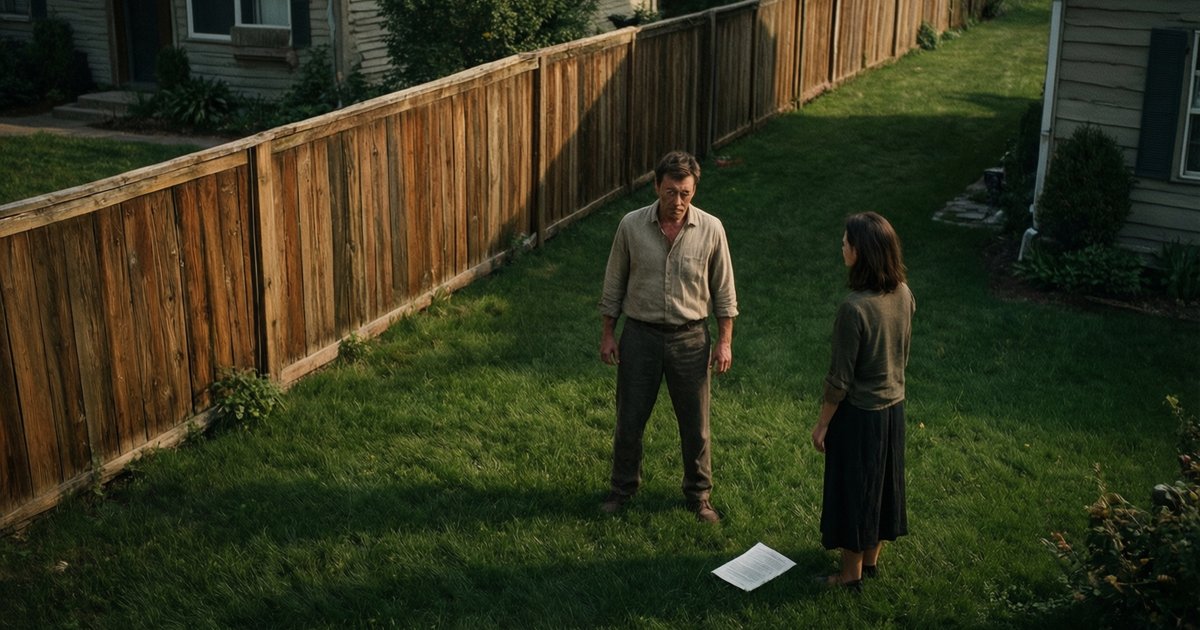
"THIS CEDAR MONSTROSITY IS EXACTLY TWO INCHES OVER MY PROPERTY LINE!"
I froze, the hammer still heavy in my hand. My pulse thrummed in my fingertips. I didn't look at him; I looked at my mother, June, who was staring at a butterfly with a distant, glassy smile.
But to understand why a few inches of wood became a war, you need to know how it all began. Three weeks earlier...
The aroma of freshly sawn cedar usually brought me peace, but as I hammered the final nail into the four-foot fence, I felt a prickle of anxiety. I wasn't building a fortress; I was building a sanctuary. My mother was standing by the porch, her eyes drifting toward the horizon with that familiar, vacant longing. Her early-stage dementia made the world a confusing place, and the fence was the only way to ensure she didn't wander into the street while admiring the hydrangeas.
I was just wiping the sweat from my forehead when a shadow fell across the lawn. Sterling stood there, clad in a pressed linen shirt despite the humid July heat of Maplewood, Connecticut. He didn't wave. He didn't smile. He simply held a manila envelope with the rigidity of a soldier holding a rifle.
"Ms. Holloway," he said, his voice a dry rasp. "I've had my own measurements taken. This cedar monstrosity is exactly two inches over my property line. I don't tolerate encroachments."
I felt that old, familiar tightening in my chest. Growing up, I had spent a decade as the unpaid mediator between my parents' screaming matches, learning how to shrink myself to avoid the blast radius. My instinct was to apologize, to offer to move it immediately. But I looked at my mother, who was humming a disjointed tune, oblivious to the man who looked like he wanted to evict her from the earth.
"It's only two inches, Mr. Sterling," I said, my voice trembling slightly. "I'm sure we can work something out."
He didn't listen. He stepped forward and handed me the envelope. It wasn't a friendly note; it was a formal cease-and-desist order. "I don't 'work things out' with people who steal land, Tessa. You have seventy-two hours to remove the fence, or my next visit will be with a process server."
He turned on his heel and marched back to his pristine colonial house, leaving me standing in the dust of sawdust and sudden, suffocating dread.
Chapter 2
By the second week of August, the 'two-inch war' had escalated into a full-scale legal siege. Sterling wasn't just a retired lawyer; he was a man who treated the neighborhood like a feudal kingdom and himself as the High Inquisitor. He didn't just want the fence gone; he wanted a victory. He filed a formal lawsuit for trespass and reported me to the Maplewood Homeowners Association for 'unauthorized structural alterations.'
I spent my Saturday afternoons not sketching garden plans, but scouring through my father's old mahogany desk. Deep in the bottom drawer, beneath a stack of yellowed tax returns, I found the original 1950s property deed. The paper was brittle, carrying the musty weight of an old archive. I spent hours tracing the ink lines, reading the archaic descriptions of boundaries and markers. There was something about the way the original plots were carved out that felt... imprecise.
Meanwhile, my bank account was bleeding. I was a freelance landscape architect, and while I had a steady stream of clients, the cost of a defense attorney was eating through my savings. Every time I tried to call Sterling to settle, he would let it go to voicemail or answer with a clipped, "Speak to my counsel."
My mother noticed the tension. One evening, she touched my hand, her eyes momentarily clear. "Why is the man with the loud voice so angry, Ellie?"
"He's just confused about the lines, Mom," I whispered, kissing her forehead.
I looked out the window at the fence. It was such a small thing—two inches of wood and nails. But to Sterling, it was a breach of his sovereignty. He didn't realize that by pushing me into a corner, he was forcing me to stop shrinking. I stopped looking for a way to apologize and started looking for a way to fight. I kept the 1950s deed tucked under my pillow, a paper shield against a man who thought he owned the horizon.
Chapter 3
I decided to try one last time to avoid a courtroom. I walked over to Sterling's porch, my chest tightening with every step. I had a proposal: I would pay him a small fee to legally purchase those two inches of land, or I would move the fence back if he dropped the lawsuit and the HOA complaints.
Sterling was sitting in a wicker chair, sipping an iced tea that looked as cold and sharp as his expression. He didn't even stand up. He looked at me with a glint of superiority, as if I were a child asking for a cookie.
"You lack a professional spine, Tessa," he sneered, leaning back. "A real architect understands the sanctity of a boundary. You thought you could just slide a few inches over and I wouldn't notice? Your incompetence is only matched by your naivety."
"I'm trying to be reasonable, Sterling," I replied, my voice gaining a steadiness I didn't know I possessed. "This is about a sliver of grass. Is it really worth the legal fees and the bad blood?"
"It's not about the grass," he snapped, his eyes narrowing. "It's about the principle of ownership. I want the entire fence demolished. Not moved. Demolished. And I want you to pay for the restoration of my sod. I won't have my land scarred by your lack of precision."
I stood there for a long moment, the humid air clinging to my skin. I could see the smug satisfaction in his eyes—the look of a man who enjoyed the exercise of power more than the actual result. He wanted me to crawl. He wanted me to admit defeat in front of the neighborhood.
As I walked back to my house, I didn't feel the usual urge to apologize. Instead, I felt a cold, hard clarity. Sterling didn't want a solution; he wanted a victim. And for the first time in my life, I decided I was tired of playing that role.
Chapter 4
The day of the official city survey arrived with an oppressive heat that made the asphalt shimmer. Donovan Garrison, the city surveyor, arrived in a dusty white truck, carrying a tripod and a transit level that looked like a piece of artillery. He was a pragmatic man with sun-damaged skin and a voice that sounded like gravel grinding together.
Sterling was there immediately. He didn't just observe; he hovered. He followed Donovan like a shadow, pointing out every blade of grass that dared to lean toward his side of the line.
"Make sure you check the northern corner, Garrison," Sterling barked. "I suspect she’s cheated me by at least three inches there."
Donovan sighed, a long, weary sound. He had clearly dealt with people like Sterling before. "Sir, the equipment doesn't lie. Just give me some space to work."
I stood back by my porch, holding a glass of ice water for Donovan. During a brief lull in the measurements, Donovan stepped over to me. He looked at the fence, then at the sprawling, oversized driveway Sterling had poured a few years prior—a massive slab of gray concrete that stretched far beyond what was necessary for two cars.
"You've got a strange layout here," Donovan noted, squinting at his notes. "Looking at the old city maps, there's a mention of a shared drainage corridor and a utility easement that runs right through this section. It's an old design, barely used since the fifties."
"A drainage corridor?" I asked, frowning. "I've never heard of that."
"Most people haven't," Donovan replied. "It's just a legal strip of land the city keeps access to. Usually, it's just grass. But if someone builds a permanent structure on it... well, that's a different story."
Sterling shouted from across the yard, "Garrison! Stop chatting and get back to the boundary!"
Donovan gave me a knowing, almost sympathetic look. "He's a real piece of work, isn't he?" he whispered before trudging back into the heat.
Chapter 5
The survey results were delayed by a week due to a backlog at the city office. For Sterling, this waiting period was an opportunity for psychological warfare. He didn't just wait for the law; he acted as if the verdict had already been delivered.
On Tuesday morning, I woke up to the sound of a heavy metallic thud. I walked to my bedroom window and gasped. Sterling had installed a massive, six-foot-tall 'Private Property' sign right on the edge of the disputed line. It wasn't a subtle sign; it was a glaring piece of galvanized steel that completely blocked my view of the sunrise over the valley.
It was an obnoxious, towering middle finger of a sign. Whenever I looked out my kitchen window, all I saw was the word 'PRIVATE' in bold, red letters.
I tried to ignore it for the sake of my mother, but the sign became a focal point for her confusion. One afternoon, she stood by the window, her brow furrowed. "Ellie, why is there a wall in the garden? Did we move?"
"No, Mom, it's just a sign," I explained, though my breath came fast and shallow.
Sterling spent his evenings sitting on his porch, watching me. Whenever I stepped outside, he would give me a small, triumphant wave, as if to remind me that my defeat was inevitable. He had already started calling the HOA board members, complaining that my 'eyesore' of a fence was lowering the property values of the entire street.
I felt the walls closing in. My savings were nearly gone, my mother was distressed, and the man next door was treating my life like a game of chess. I spent my nights staring at the 1950s deed, my finger tracing the words 'easement,' 'corridor,' and 'access rights.' I didn't fully understand how they applied yet, but I knew that the map Donovan was drawing wasn't just about two inches of cedar. It was about something much larger.
Chapter 6
The breaking point came on a Tuesday in late August. The air was thick and sticky, the kind of heat that makes tempers fray. My mother had one of her 'wandering' episodes. She had wandered out of the garden, bypassed the fence, and stepped about three feet into Sterling's manicured lawn, drawn by a cluster of yellow marigolds.
Sterling didn't see a confused elderly woman. He saw an intruder.
I heard him screaming before I saw him. "Get off my land! Now!"
I sprinted across the lawn, finding my mother frozen in place, her face twisted in fear. Sterling was standing over her, his face purple, pointing a finger at her chest.
"This is trespassing!" he yelled. "I've already sued the daughter; I'll have no problem filing charges against the mother! This is my private property, and I will not have it trampled by the senile!"
Something inside me snapped. The childhood years of mediating, the years of shrinking, the fear of confrontation—it all vanished, replaced by a white-hot rage. I stepped between Sterling and my mother, pushing him back with a force that actually surprised him.
"Don't you ever speak to her like that again," I said, my voice low and dangerous.
"You can't protect her from the law, Tessa!" he spat, though he stepped back. "The survey is coming, and you are going to lose everything. I'll see that fence torn down and your bank account emptied."
I didn't argue. I didn't plead. I simply guided my mother back into the house and locked the door. I sat at my desk and called my lawyer.
"I don't want to settle anymore," I told him. "I want the full survey report the second it hits the city's server. And I want you to look into the 1950s deed I sent you. Specifically, the section regarding the shared drainage corridor and the city easement."
I wasn't playing defense anymore. I was preparing the counter-attack.
Chapter 7
The official survey map arrived via email on a Friday afternoon. I opened the PDF with shaking hands.
Donovan Garrison had been precise. The map confirmed that my cedar fence was indeed over the property line by exactly two inches. On paper, Sterling had won. He had the legal right to demand those two inches back.
But as I scrolled down to the overlay of the city's historical easements, I stopped breathing.
Donovan had mapped the 'shared drainage corridor' he had mentioned. It was a ten-foot-wide strip of land that ran diagonally across the boundary. According to the 1950s deed and the city's current zoning, this easement provided legal access and drainage rights to the adjacent property—my property.
Then I looked at the placement of Sterling's driveway.
Sterling had expanded his driveway three years ago, pouring a massive slab of reinforced concrete to accommodate his luxury SUVs. According to the new map, nearly forty percent of that driveway—the entire right lane and the turnaround area—sat directly on top of that city easement.
In the eyes of the law, Sterling hadn't just built a driveway; he had illegally obstructed a city-protected easement that belonged to the legal access rights of my lot. He had built a permanent, non-permitted concrete structure over a corridor that the city could demand be cleared at any moment for maintenance or drainage.
I leaned back in my chair, a slow smile spreading across my face. Sterling had spent months obsessing over two inches of cedar, while he was sitting on thousands of square feet of illegal concrete.
He had played the game of precision, but he had forgotten to check his own foundation. I called my lawyer and told him to draft a very specific set of documents. Not a settlement. Not an apology. A demand.
Chapter 8
Monday morning, I invited Sterling over for a 'discussion' on my porch. He arrived with his usual aura of superiority, wearing a smug grin. He held a printed copy of the survey in his hand.
"I assume you've seen the results, Tessa," he said, leaning against the railing. "Two inches. I told you so. Now, about the demolition schedule..."
I didn't say a word. I simply handed him a folder. Inside was the survey map, but with a bright red highlight over his driveway.
Sterling's grin flickered. He looked at the map, then at the deed excerpt I had included. He read the words 'City Easement' and 'Illegal Obstruction' several times. The color drained from his face, turning him a sickly shade of gray that matched his concrete.
"This is a mistake," he stammered. "This is an old corridor. It's not even used!"
"The city doesn't care if it's used, Sterling," I said, my voice calm and steady. "They care if it's blocked. And since this easement provides legal access to my property, your driveway is an illegal encroachment on my land rights. I've already spoken to the city building inspector. They're very interested in non-permitted concrete structures blocking municipal drainage."
Sterling's hand began to shake. "What do you want?"
"It's simple," I replied. "You drop the lawsuit immediately. You withdraw every single complaint you filed with the HOA. You pay for the permanent installation of my fence—including the two inches you're so fond of—and you sign a legal waiver acknowledging that I have permanent control over the easement area."
"You can't be serious," he hissed. "You'd have me rip up my driveway?"
"I won't have to," I said. "The city will. And they'll fine you every single day until it's gone. Or, you can sign the papers, and I'll keep the city out of it. Your choice, Sterling. Precision, remember?"
He looked at the map, then at me. For the first time, he looked small.
Chapter 9
Sterling signed the documents in a silent, miserable office on Tuesday. He didn't look at me once. He signed the waiver, paid the damages, and officially ceded the legal control of that strip of land to me. He had spent a fortune in legal fees to fight over two inches, only to lose control of the very ground his cars rested on.
That afternoon, the sun was finally breaking through the August clouds. I spent the day in the garden with my mother. We weren't talking about lawsuits or boundaries; we were planting peonies. The fragrance of damp earth and fresh cedar filled the air, a scent of victory and peace.
I looked over at the driveway. To any outsider, nothing had changed. It was still a slab of gray concrete. But in my hand, I held the deed that made it mine. Sterling's 'kingdom' was now subservient to my garden.
As I watched, Sterling stepped out of his house to move his car. He saw me watching him. He stopped, his shoulders slumping. He looked at the spot where I had already marked the ground with white spray paint—the exact location where I planned to build a new, elegant garden shed, right on the edge of the easement, forcing him to park his cars in a cramped, awkward angle for the rest of his life.
He didn't say a word. He just got into his car and drove away, carefully avoiding the two inches of cedar that had cost him everything.
I sat back in my chair, listening to my mother hum a song from her youth. I realized that I didn't need to shrink myself anymore. The world was still confusing for her, but for me, the lines had never been clearer. I closed my eyes and breathed in the peonies, finally at home in my own sanctuary.
The End