 Porchlight Tales
The Chipped Blue Bowl and the Taste of Home
Fiction. This is an original, made-up story: names, characters and events are invented, and any resemblance to real people or events is coincidental.
Full story · 10 chapters · Read in 5 parts instead
Listen to this story (5 parts)
Part 1 · 4 min
Part 2 · 4 min
Part 3 · 5 min
Part 4 · 4 min
Part 5 · 4 min
Chapter 1
"GET THAT OUT OF HERE!"
Vivian’s voice sliced through the hum of the church hall like a blade. I froze, my fingers tightening around the rim of my ceramic bowl. A few people stopped talking, their eyes darting between the town's social leader and my modest dish.
But to understand why, you need to know how it all began. Three weeks earlier...
Steam from boiled potatoes clouded the windows of my small kitchen. Usually, this smell was a sanctuary, but today it felt like a map of everything I'd lost. It had been three years since Everett passed, yet the silence in the house still felt like a physical pressure against my collarbones.
I am sixty-eight, a retired librarian from Fairweather. I moved with a slow, practiced rhythm, reaching for my faded recipe card. Its edges were curled, marked by a single, ancient smudge of cinnamon.
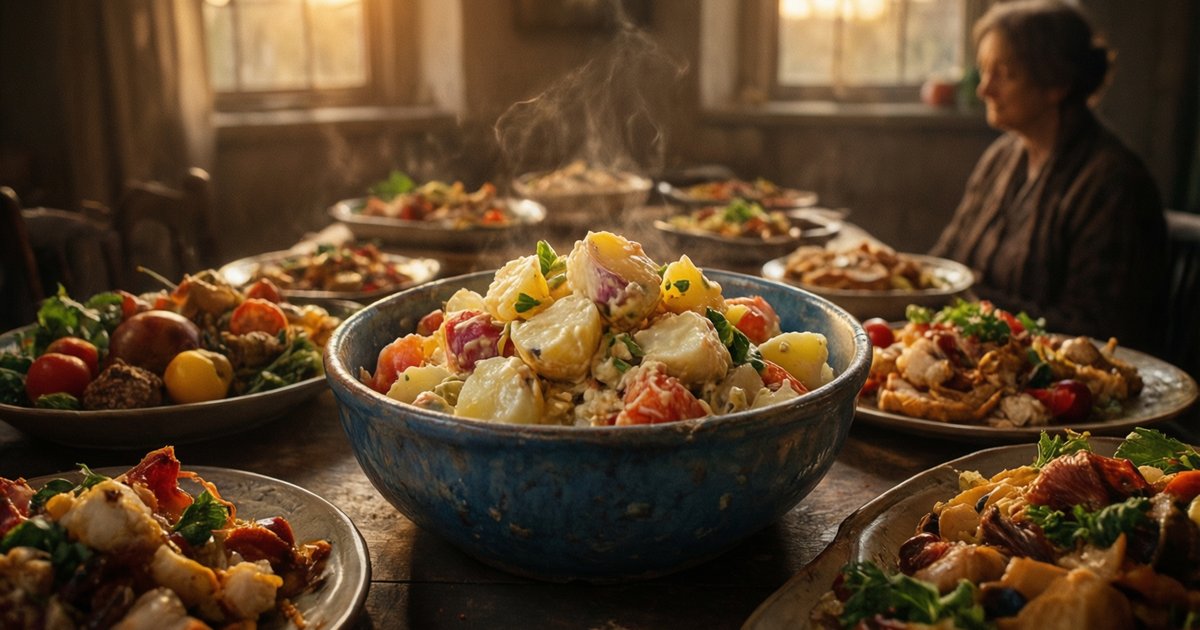
I stirred the dressing, my eyes lingering on the vessel—a chipped blue ceramic bowl. It was weathered and uneven. Everett had always called it 'sturdy,' but as I looked at it now, I only saw something outdated.
In a town like Fairweather, where the autumn leaves turned a gold so vivid it looked painted, everything felt like a competition in aesthetics. I felt myself fading into a gray blur, a ghost of the woman I had been when Everett was the one handling the introductions.
I covered the salad with plastic wrap. This was the annual Grace Community Church potluck. I used to love it. Now, the thought of walking in alone made my stomach twist. I didn't have a gourmet platter. I just had a modest salad and a heart that felt too heavy for my chest.
As I grabbed my coat, I caught my reflection in the hallway mirror. A plain woman in a plain cardigan. I sighed, the sound echoing in the empty hallway, wondering why I was bothering to go at all.
Chapter 2
The Grace Community Church hall was a symphony of excess.
As I stepped inside, the air hit me with a clash of truffle oil, roasted garlic, and expensive vanilla. Long trestle tables groaned under professional catering. There were tiered seafood towers and salads that looked like contemporary art installations, plated with microgreens and edible flowers.
I paused at the entrance, clutching my chipped blue bowl. Beside me, a woman arranged a platter of smoked salmon that likely cost more than my weekly grocery budget.
The contrast felt violent. My potato salad looked humble, almost pitiful, sitting in its worn ceramic home. No garnish. No fancy label. Just food made from a recipe passed down through generations, intended to nourish rather than impress.
I navigated the crowd, feeling the familiar pinch of displacement. People shifted around me, their conversations buzzing like a hive of bees, talking about summer homes in Maine and new galleries in the city. I found a small gap at the end of the table and gently slid my bowl into place.
It looked like a pebble among diamonds.
I took a step back, suddenly wishing I were back in my quiet kitchen. The laughter around me felt performative, a social dance I no longer knew the steps to. I watched as the town's elite admired each other's contributions, their eyes skimming over my dish without a second glance.
For a moment, I felt a surge of panic. I wanted to grab the bowl and flee before the invisibility became permanent.
Just then, a sharp voice cut through the chatter. I realized I had caught the attention of the one person I dreaded most.
Chapter 3
Vivian Montgomery didn't just lead the church committee; she curated it.
With perfectly coiffed blonde hair and a silk scarf that probably cost a month's rent, she treated the potluck like a high-stakes gallery opening. She stopped in front of my bowl, her gaze lingering on the chipped rim with a look of polite bewilderment.
"Oh, Hattie, how... traditional," Vivian said, her voice tilting upward like a critique. "It’s so brave to stick with the classics. Most of us are leaning toward the fusion trend this year. I’ve brought a deconstructed quinoa medley with a pomegranate reduction. It’s very modern, don't you think?"
I felt my face heat up. I gripped the strap of my handbag, the leather digging into my palm. "It's just a potato salad, Vivian. My family has made it for years."
Vivian gave a thin, tight smile that didn't reach her eyes. "Of course, dear. There's a certain charm to the... simpler things. Though I do worry the palate of Fairweather is evolving. We wouldn't want the spread to feel dated."
She moved on to praise a nearby shrimp cocktail, leaving me standing in a wake of subtle dismissal.
'Dated.' The word echoed in my mind. To Vivian, this dish was a relic, a sign of a woman who had stopped moving forward. I felt a sudden, sharp impulse to pick up the bowl and walk straight out the double doors. I was tired of being the 'traditional' one, the widow who existed as a footnote in the town's social register.
I turned to leave, my eyes stinging, when I noticed a man standing a few feet away.
He was dressed in a charcoal suit that looked slightly too tight across the shoulders, his tie loosened, and a look of profound exhaustion etched into his face. It was Mayor Grant Sterling, and he was staring directly at my potato salad.
Chapter 4
Mayor Grant Sterling was a man who lived his life by a calendar and a checklist.
At fifty-five, he was the engine of Fairweather, a workaholic who measured success in zoning permits and budget surpluses. But as he stood in the crowded hall, the noise of the political posturing felt like static in his ears. He was tired of the handshakes, the veiled requests for favors, and the polished facades of the town's elite.
He found himself drawn to the end of the table, away from the seafood towers and the quinoa medleys. There, sitting in a chipped blue bowl, was a simple potato salad. It didn't look like art; it looked like dinner.
Without thinking, Grant picked up a small plastic spoon and took a tentative bite.
He froze.
The taste didn't just hit his tongue; it hit a memory. The creaminess, the sharp tang of the vinegar, and a faint, elusive warmth—something spicy and sweet that he couldn't quite name. Suddenly, he wasn't in a church hall in October; he was six years old, sitting at a scrubbed pine table in a sun-drenched kitchen, watching his mother stir a pot with a wooden spoon. He could almost smell the laundry soap and the old newspapers in her house.
It was a taste of absolute safety.
It was the flavor of a time before the spreadsheets and the stress, before his mother had passed away and left him with a void he had tried to fill with professional achievements. The intensity of the emotion caught him off guard, bringing a sudden, unexpected lump to his throat.
He looked up and saw me. I was shrinking back, my expression guarded, as if I expected him to comment on the lack of garnish.
Grant didn't see a 'plain' widow. He saw the woman who had just unlocked a door in his heart that had been bolted shut for decades. He stepped forward, ignoring the socialite who was trying to flag him down for a conversation about the new town square.
Chapter 5
"This is incredible," Grant said, his voice sounding raspier than usual. He stepped closer, his eyes searching mine. "Where on earth did you get this recipe?"
I blinked, startled. I had expected a polite nod or, worse, another comment about 'tradition.' "Oh, it's just... it's a family recipe. Nothing special, really."
Grant shook his head, his gaze drifting back to the blue bowl. "You're wrong. This is exactly... it's exactly how my mother used to make hers. I haven't tasted anything like this in thirty years. The spice—there's something in here, isn't there?"
I felt a flicker of pride, but it was quickly dampened by a sudden insecurity. I saw the way people were watching us. Grant was the most powerful man in town, and he was talking to me—the invisible librarian. I misinterpreted the intensity of his stare as curiosity about my simplicity, as if I were a museum exhibit of a bygone era.
"I'm sure your mother's was much better," I replied, my voice tightening. "I'm just using an old bowl and a smudge of a recipe. I didn't realize the Mayor had such an appetite for 'plain' food."
Grant frowned, realizing his intensity had come across as overbearing. "I didn't mean—"
But I had already stepped back. The vulnerability of the moment was too much. I felt exposed, as if he were mocking my attempt to fit in. I gave him a stiff, formal nod and turned away, slipping through the crowd toward the side exit.
Grant reached out to stop me, but a group of city council members swarmed him, their voices blending into a wall of noise. He watched me disappear through the door leading to the church garden, the taste of the salad still lingering on his lips, feeling a sudden, sharp sense of regret.
Chapter 6
The church garden was a sanctuary of damp earth and dying marigolds.
I sat on a weathered stone bench, the cool October air biting through my cardigan. I leaned my head back and closed my eyes, listening to the distant hum of the party. I felt foolish for reacting so sharply, but the feeling of being a 'charity case' for the Mayor's nostalgia was more than I could bear.
"I don't like it in there either," a small voice said.
I opened my eyes to find a boy of about ten sitting on the grass a few feet away. He was wearing a blazer that was slightly too big for him and had a mop of unruly dark hair. It was Toby, the Mayor's grandson. He was holding a worn paperback book, the cover depicting a lone ship in a stormy sea.
"Too many people talking about things that don't matter," Toby added, looking up at me. "My grandpa says it's called 'networking.' I think it's called 'boring.'"
I smiled, a genuine one this time. "I've always found networking to be a bit like a choreographed dance. If you don't know the steps, you just end up stepping on toes."
Toby shifted closer, showing me the book. "I'm reading *The Old Man and the Sea*. It's my favorite. The library has the hardcover, but it's too heavy to carry."
My eyes lit up. The librarian in me surged forward, overriding the grief. "Ah, Hemingway. The struggle of the individual against nature. You know, we have a first-edition printing in the archives at the library. It has these beautiful hand-drawn maps of the Gulf Stream."
For the next hour, the two of us forgot about the party. We talked about stories, about the way a good book can make you feel less alone in the world. I realized that while I might be invisible to the socialites, I was a beacon to this lonely boy.
For the first time in years, I felt a spark of purpose. I wasn't just a widow; I was a keeper of stories.
Chapter 7
The atmosphere inside the hall had shifted from celebratory to chaotic.
A sudden, violent autumn storm had rolled in, a typical New England surprise. A bolt of lightning struck a transformer nearby, and with a loud *pop*, the lights flickered and died, plunging the church hall into sudden, oppressive darkness.
Panic rippled through the crowd. The elegant mood vanished instantly. Screams of surprise turned into complaints as people stumbled over chairs. In the darkness, Vivian Montgomery’s elaborate dessert tower, perched precariously on a folding table, succumbed to the commotion. A loud crash echoed through the hall as the gourmet cakes and pomegranate reductions collapsed into a sticky, multicolored heap on the floor.
"My display!" Vivian wailed, her voice shrill in the gloom. "Someone get a flashlight! This is a disaster!"
The community, so polished moments ago, began to fray. People were arguing about where the emergency exits were, and the hunger that had been suppressed by social etiquette suddenly became a pressing issue. The professional catering was ruined or inaccessible in the dark, and the 'fusion' dishes were mostly decorative.
Outside in the garden, Toby and I watched the chaos through the glass doors. I saw the flashing lights of the emergency generators failing to kick in. I looked at the boy, who was clutching my arm, and then I looked back at the hall. I saw a room full of people who were suddenly very cold, very hungry, and very frightened.
I thought about my blue bowl. It was still sitting there, sturdy and simple, filled with food that didn't require a fancy plate or a spotlight to be nourishing.
The fear that had paralyzed me all afternoon vanished, replaced by a sudden, clear resolve. I didn't need to fit into their world; I could offer them a piece of mine.
Chapter 8
I walked back into the hall, my footsteps steady.
I didn't look for the light; I knew exactly where my bowl was. I found a few thick pillar candles on the altar and lit them, the golden glow pushing back the shadows.
"Everyone, please! Quiet down!" I called out. My voice wasn't loud, but it had the authority of a woman who had spent thirty years managing a quiet library. The room fell silent.
Grant was standing by the ruined dessert table, looking defeated. I walked straight to him and then turned to the crowd. "We have food. It's not fancy, and we don't have a menu, but we have enough to share if we stop worrying about the presentation."
I began to scoop my potato salad into small bowls, passing them out to the nearest people. Then, I encouraged others to find their simpler dishes—the homemade breads, the basic fruit platters—the things that had been ignored in favor of the gourmet displays.
"I can't believe I'm eating potato salad in the dark," someone whispered, but their voice was warm.
Grant stepped forward, his voice booming through the hall. "Hattie is right. Look at us. We spend so much time polishing the surface that we've forgotten what the center tastes like. This dish... this is the soul of Fairweather. It's honest. It's home."
Inspired, the facade broke. A city councilman started talking about his father's farm; Vivian, stripped of her status symbols, admitted she had been terrified of failing the committee. The darkness, which should have been a disaster, became a cocoon. People stopped networking and started talking. They shared stories of loss, of childhood, and of the simple things they missed.
I stood in the center of it all, no longer invisible, but the anchor holding them together.
Chapter 9
As the storm settled into a rhythmic rain against the windows, Grant found me sitting on the edge of a table. He held the chipped blue bowl in his hands, looking at it with a strange intensity.
"My mother had a bowl just like this," he whispered. "Hand-thrown local pottery from the kiln that used to be on Cedar Run. I thought they were all gone."
I smiled, my heart feeling lighter than it had in years. "I bought it at a craft fair forty years ago. Everett always loved it because it survived everything—drops, heat, and time."
Grant reached into his pocket and pulled out a small, weathered piece of paper. "I found this in my mother's old recipe box after the power came back on and I went home to check on things. It's her potato salad recipe. Look at the bottom."
I took the paper. At the bottom was a small, brown smudge of cinnamon, exactly like the one on my own card.
"Our mothers were friends," Grant realized, a look of wonder on his face. "They used to swap recipes through the mail. My mother always said the woman in the next town had the 'golden touch' with root vegetables. I never knew who she was."
We sat in silence for a moment, the connection bridging the gap between our grief. We weren't just two people in a town; we were two pieces of a larger, forgotten story. I realized that the 'plainness' I had hated about myself was actually my greatest strength. It was the bridge that allowed people to be real.
"I don't want this feeling to end when the lights come back on," Grant said softly.
"Then don't let it," I replied. "I think the library could use a kitchen. A place for people to learn how to make things that actually taste like home."
Chapter 10
Three months later, the Fairweather Public Library opened its 'Community Hearth' program.
Every Tuesday evening, the aroma of garlic, cinnamon, and roasting vegetables wafted through the stacks of books. I didn't wear a cardigan to hide myself anymore; I wore a bright apron and a smile that reached my eyes.
I taught a dozen locals how to make the basics: a hearty stew, a perfect loaf of sourdough, and, of course, the legendary potato salad. The class wasn't about culinary perfection; it was about connection. People came for the food, but they stayed for the conversations, turning the library into a living room for the entire town.
Toby was my most dedicated student, often helping me prep the vegetables while telling me about the books he was reading. Grant was a frequent visitor, no longer the exhausted workaholic, but a man who took his Tuesday nights off to sit in the back of the room and watch me lead.
On the final day of the autumn session, I set the chipped blue bowl on the center table. It was still chipped, and the glaze was still uneven, but it no longer looked ugly to me. It looked like a trophy of survival.
As the class ended and the students filtered out into the crisp November air, Grant stayed behind. He walked over to me and placed a hand gently on my shoulder. We didn't need many words; the silence between us was now a comfortable, shared space.
We sat together in the quiet hall as the golden light of the setting sun streamed through the windows, illuminating the dust motes. Between us sat the blue bowl, simple and sturdy. I looked at it and realized I was no longer a ghost in my own town. I was finally home.
The End