 Porchlight Tales
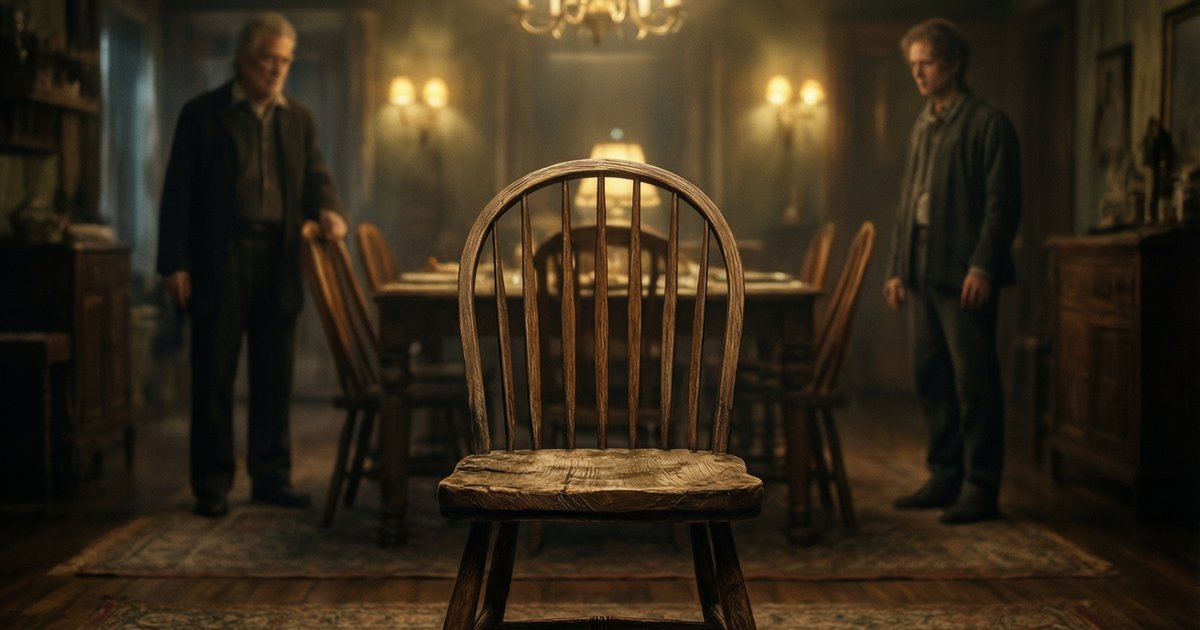
The Empty Chair at the Graduation
Fiction. This is an original, made-up story: names, characters and events are invented, and any resemblance to real people or events is coincidental.
Full story · 9 chapters · Read in 5 parts instead
Listen to this story (5 parts)
Part 1 · 4 min
Part 2 · 4 min
Part 3 · 4 min
Part 4 · 5 min
Part 5 · 2 min
Chapter 1
“YOU DON’T GET TO SIT AT THIS TABLE UNTIL YOU SAY IT!”
I didn't raise my voice often, but when I did, the room froze. Kaelen stood by the dining room door, his frame thinner than it should have been, his eyes averted. Sylvia gasped, her hand flying to her mouth, the smell of roasted chicken turning greasy and oppressive in the humid Connecticut air.
“Dad, please,” Kaelen whispered. His voice was a dry rasp.
“No ‘please.’ No excuses,” I snapped, leaning back in my chair. “You ruined that trip three years ago. You were reckless, you were dishonest, and you have never once offered a sincere apology. I will not attend your ceremony tomorrow if you continue to treat my respect as an optional accessory.”
Kaelen didn't fight back. He simply turned and walked away, the screen door slamming with a sharp, metallic crack that echoed through the house.
I sat there in the silence, the air heavy with unspoken resentment. Sylvia looked at me with a look of exhausted disappointment, but I ignored her. I believed in order. I believed in accountability. My entire career as a Superior Court Judge had been built on the premise that every action has a consequence.
But to understand why a three-year-old road trip had become a wall between us, you need to know how it all began. Three weeks earlier, the house had been quiet, but the air was already heavy with the coming storm.
Chapter 2
Retirement had been a strange transition. For thirty years, my word was law. Now, I spent my mornings polishing my old silver cufflinks and staring at the manicured lawn of our suburb. I wanted my home to be a sanctuary of integrity, but Kaelen had become a stranger living under my roof.
He was twenty-one now, finishing his degree, but in my mind, he was still the boy who had shattered my trust during our trip to the Grand Canyon. It was supposed to be a bonding experience—a father and son venturing west. Instead, it had been a disaster.
Halfway through the trip, Kaelen had become erratic. He missed scheduled stops, argued over the smallest things, and eventually vanished for twelve hours in a small town in Arizona, leaving me stranded at a motel with a dead car battery and a growing sense of betrayal. When he finally returned, he was pale and shaking, offering a vague story about getting lost and losing his wallet.
He had been reckless. He had been irresponsible. Most galling of all, he had never properly apologized for the chaos he caused. To me, it wasn't about the missed sights or the dead battery; it was about the lack of remorse.
My own father had walked out on me when I was twelve without a single word of explanation. He had taught me that silence is a weapon and that a man without accountability is a man without character. I refused to let Kaelen become that.
As the graduation date approached, I saw the distance between us widening. Kaelen spent more time locked in his room, avoiding my gaze. He looked exhausted, his skin a sallow gray that clashed with the bright May sunlight streaming through the windows.
Chapter 3
“Clifford, let it go,” Sylvia told me one Tuesday afternoon. She was folding laundry, the floral notes of lavender detergent drifting through the hallway. “He’s graduating. This is the moment he needs you.”
“He needs to learn that respect is earned, Sylvia,” I replied, not looking up from my newspaper. “He thinks he can breeze through life leaving a trail of wreckage behind him. A formal apology is the bare minimum.”
I viewed Kaelen’s silence as a form of arrogance. Every time I brought up the trip, he would shut down, his shoulders hunching as if he were trying to disappear into himself. He didn't argue; he just withdrew.
I watched him from the kitchen window as he walked toward the mailbox. He moved slowly, his gait heavy. There was a fragility to him that I mistook for laziness or depression. I wanted to reach out, to tell him that I loved him despite his failings, but the judge in me wouldn't allow it. The rules had to be followed.
“He’s not arrogant, Cliff,” Sylvia whispered, standing beside me. “He’s hurting.”
“We are all hurting,” I snapped. “I am hurting because my son treats his father like an inconvenience.”
That evening, I saw Kaelen in the hallway. He looked as if he hadn't slept in days. Dark circles bruised the skin under his eyes, and he was leaning heavily against the wall. For a second, the father in me wanted to ask if he was okay, but the judge reminded me that he still hadn't said the words I required. I simply nodded curtly and walked past him, leaving him alone in the dim light of the corridor.
Chapter 4
A few days later, Kaelen knocked on my study door. He didn't come in; he stayed in the threshold, looking small.
“Dad? I was wondering... could I borrow two hundred dollars? For some advanced textbooks for my final credits.”
I looked at him, my eyes narrowing. I knew his tuition was paid, but I also knew he had been secretive about his spending. I thought back to the Arizona trip—the lost wallet, the missing hours. I suspected he was spending his savings on things he shouldn't be.
“No,” I said firmly.
Kaelen flinched. “I really need them, Dad.”
“You’ve had plenty of opportunities to manage your finances, Kaelen. Accountability isn't just about saying 'sorry'; it's about taking responsibility for your life. If you can't even apologize for your past behavior, why should I subsidize your present?”
He didn't beg. He didn't even argue. He just stood there for a long moment, his hands trembling slightly at his sides. The look of desperation in his eyes was visceral, but I interpreted it as the panic of a caught liar.
“I see,” he whispered.
He turned and left the room. I felt a flicker of guilt, but I suppressed it. I believed I was doing him a favor. I was teaching him the hard lesson that the world doesn't hand out favors to those who lack integrity. I went back to my books, convinced that my rigidity was actually a form of love, a way to mold him into a man of substance.
Chapter 5
The following weekend, while Sylvia was at her garden club, I decided to help clean the attic. While moving some old boxes in the hallway near Kaelen's room, I noticed his bedroom door was slightly ajar.
I shouldn't have gone in. But the habit of investigation was ingrained in me.
I didn't search his clothes or his computer. But as I straightened his bedside table, I spotted it: a small, rusted metal box tucked deep into the bottom drawer. It looked like an old biscuit tin, the paint peeling, with a heavy padlock securing the lid.
I picked it up. It was heavy. I shook it slightly, hearing the rustle of paper.
I didn't open it. My principles forbade me from invading his privacy without cause, but my suspicions flared. Why the secrecy? Why a locked box? To me, this was further evidence of Kaelen’s dishonesty. He was hiding something—perhaps the very reason for his recklessness three years ago.
I placed the box back exactly where I found it, but the discovery fueled my resolve. I told myself that as long as he kept secrets, he was not worthy of my presence at his graduation. I began polishing my silver cufflinks that night, the rhythmic rubbing of the cloth a way to soothe my growing agitation. I wanted everything to be perfect—the suit, the shoes, the image of the successful father—but I would only wear them if Kaelen broke his silence first.
I spent the rest of the evening in a cold war of silence, watching Kaelen drift through the house like a ghost, avoiding the very man who held the keys to his approval.
Chapter 6
The breaking point came two days before the ceremony. The humidity had peaked, and the house felt stifling. I caught Kaelen in the kitchen, and for the third time that week, I brought up the Grand Canyon.
“Just say it, Kaelen. ‘I am sorry for being reckless and lying to you.’ That’s all it takes. One sentence, and I’ll be in the front row tomorrow.”
Kaelen snapped. It was the first time I had seen him truly angry. He slammed his glass on the counter, water splashing across the granite.
“I can’t!” he screamed, his voice cracking. “I can’t give you the apology you want because the ‘mistake’ wasn't a mistake! You just want me to admit I'm a failure so you can feel like a success!”
“How dare you—” I started, stepping toward him.
“You didn't even ask!” Kaelen yelled, tears finally breaking through. “You just judged! You sat in your chair and passed sentence without ever looking at the evidence!”
He was shaking violently now, his breath coming in ragged gasps. His face went from pale to a terrifying shade of gray. Suddenly, his eyes rolled back, and he collapsed. He didn't fall gracefully; he hit the linoleum floor with a sickening thud, unconscious before he even landed.
Panic, raw and cold, surged through me. I dropped to my knees, shouting his name. Sylvia rushed in, screaming, and we spent the next hour in a blur of adrenaline and terror, waiting for the paramedics. As they loaded him into the ambulance, the paramedic looked at me with a questioning glance.
“Has he been struggling with this for a long time?” the medic asked.
“Struggling with what?” I asked, my voice trembling.
“The kidney failure,” the medic replied casually. “It’s all in his chart.”
Chapter 7
Kaelen spent the night in the hospital for observation and stabilization. He was exhausted, his body pushed to the brink by chronic stress and a failing organ. He slept fitfully, his face sunken against the white pillows.
While he slept, I went home to retrieve his insurance papers. I walked straight to his bedroom and pulled out the rusted metal box. This time, I didn't hesitate. I used a pair of pliers to snap the lock.
Inside, there were no drugs, no stolen items, no evidence of rebellion. Instead, there were stacks of medical bills, insurance claim denials, and a handwritten journal.
I read through the entries from three years ago. The Arizona trip hadn't been a whim of recklessness. Kaelen had been experiencing severe pain and hematuria. He had collapsed in that small town, found help at a local clinic, and discovered he had a rare, aggressive kidney condition.
He had spent the last three years fighting a silent war. He had used every cent of his savings—and the money he’d earned from part-time jobs—to pay for treatments and medications that weren't fully covered, all to avoid worrying me. He knew I valued 'strength' and 'integrity.' He thought that being sick was a weakness, a flaw that would disappoint the Great Judge Clifford Gorski.
He hadn't been lying to be deceptive; he had been lying to protect my image of him. He had carried the burden of a chronic illness alone, in the shadows, while I had been lecturing him on accountability.
I sat on the edge of his bed, the papers scattering around me. I looked at my silver cufflinks sitting on the dresser, polished and perfect. They looked hideous. A cold knot of shame tightened in my stomach as I realized that for three years, I had been punishing my son for the very resilience I claimed to admire.
Chapter 8
The morning of the graduation arrived with a crisp, clear sky. I woke up at 6:00 AM, the house silent. Kaelen was back home, resting, though he didn't expect me to come. He hadn't asked again.
I stood before the mirror, holding my silver cufflinks. For years, these had represented my standard—the polished surface of a life lived by the book. I looked at them and thought of the rusted metal box. I thought of Kaelen’s pale face on the kitchen floor.
I had a choice. I could still go, play the part of the supportive father, and maintain the facade that everything was fine. Or I could admit that I had failed the most basic test of a father: the ability to see his child.
I didn't put on the cufflinks. I left them on the dresser, tarnished and forgotten.
I arrived at the university stadium just as the processional music began. The crowd was a sea of gowns and cheering parents. I found my seat—the one that had been reserved for me, the empty chair that had become a symbol of my pride.
I watched as the students began to walk across the stage. When Kaelen’s name was finally called, he walked with a slight limp, his expression guarded. He didn't look toward the section where I was supposed to be. He looked straight ahead, a lonely figure in a black robe.
As he reached the center of the stage to take his diploma, I didn't stay seated. I stood up. I didn't shout, and I didn't make a scene. But I stood and I applauded. I clapped louder than anyone else in that stadium, my eyes locked on my son.
Kaelen froze. He turned his head and saw me. For a long moment, we just looked at each other across the distance. There were no words, but the tension that had spanned three years finally snapped. He didn't smile, but he breathed—a deep, shaking exhale that seemed to release a lifetime of held breath.
Chapter 9
We spent the evening on the back porch. The humid May air had finally cooled, and the smell of freshly mown grass drifted around us. We sat in two wicker chairs, a small table between us.
Kaelen was quiet, staring out at the twilight. I reached over and placed a glass of lemonade in front of him.
“I am sorry,” I said.
Kaelen looked at me, surprised. “For what?”
“For being a judge when I should have been a father,” I replied, my voice thick. “I spent three years waiting for an apology from you, never realizing that I was the one who owed it. Your strength... the way you handled everything alone... it puts my version of 'integrity' to shame.”
Kaelen didn't say it was okay. He didn't have to. He just reached out and took a sip of the lemonade, his shoulders finally dropping from his ears.
Inside the house, on my dresser, the silver cufflinks remained. I knew I would eventually throw them away or give them to a museum of things I no longer needed. I no longer cared about the polished image of a perfect family. I preferred the messy, honest reality of a son who was sick and a father who was flawed.
We sat there in the gathering dark, not talking, just existing in the same space without a courtroom between us. The silence didn't feel like a weapon. It felt like peace.
We shared the lemonade in a comfortable, heavy quiet, while the silver cufflinks sat forgotten on the table, slowly tarnishing in the salt air.
The End