 Porchlight Tales
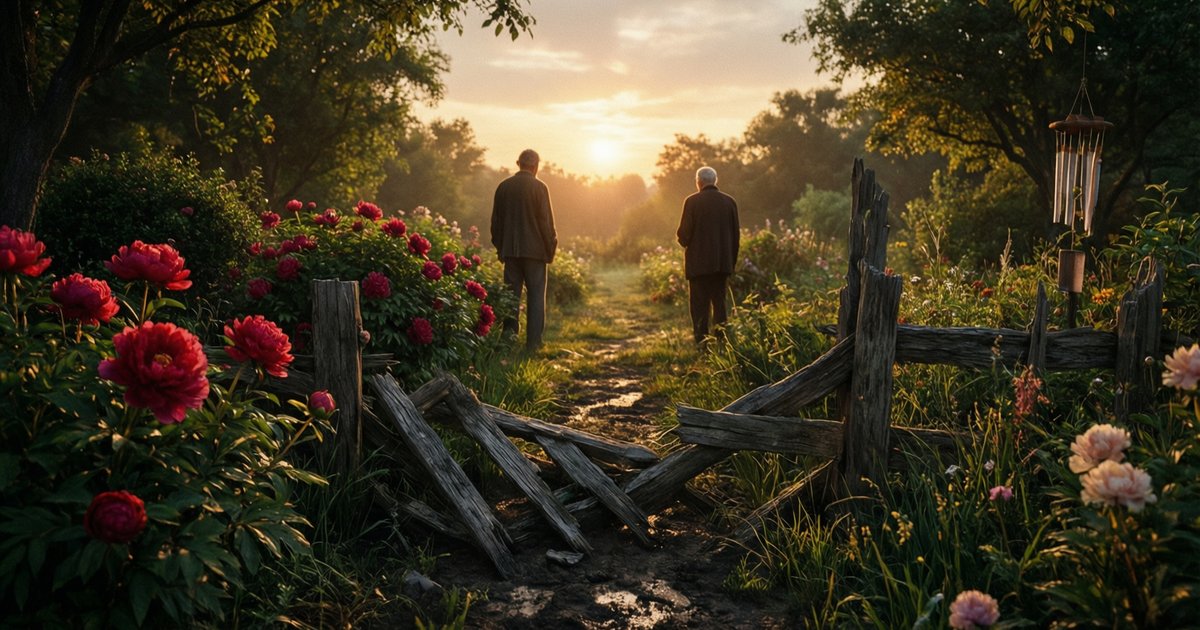
The Gate Where the Fence Used to Be
Fiction. This is an original, made-up story: names, characters and events are invented, and any resemblance to real people or events is coincidental.
Full story · 10 chapters · Read in 5 parts instead
Listen to this story (5 parts)
Part 1 · 5 min
Part 2 · 5 min
Part 3 · 5 min
Part 4 · 5 min
Part 5 · 5 min
Chapter 1
"GET YOUR DAMN HANDS OFF MY PROPERTY!"
I didn't blink. I just tightened my grip on the cedar plank, my skin stretching tight over my joints, staring into Vernon Delgado's wide, panicked eyes. The air between us tasted of ozone and wet dirt. For ten years, we had existed as ghosts in each other's periphery, separated by a wooden wall and a grudge that had grown as thick as the ivy climbing it.
Vernon was gesturing wildly toward a patch of crushed peonies, his voice cracking with a mix of anger and desperation. I wanted to scream back. I wanted to tell him that these flowers were all I had left of Loretta. Instead, I just stood there, frozen in a stalemate over a few inches of mud.
But to understand why a simple fallen fence could trigger a shouting match that woke up half the cul-de-sac, you need to know how it all began. Three weeks earlier, the silence was still perfectly intact.
I lived my life by the clock and the ruler. Every morning at 6:00 AM, I stepped into my garden in Oak Creek, Oregon. I didn't just garden; I curated. My peonies were the crown jewels of the neighborhood—deep, velvety reds and pale pinks that carried the sweetness of a memory from 1985.
I pruned them with surgical precision, always leaving exactly two inches of space between the stems and the fence line. That fence wasn't just cedar and nails; it was the border of my sanctuary. On the other side was Vernon, a man who treated his yard like a jungle gym for physics experiments and loud jazz music. We hadn't exchanged a word since the Great Boundary Dispute of 2014, a fight over a six-inch strip of land that neither of us actually needed, but both of us refused to yield.
I kept my distance. I kept my pride. And on my nightstand, I kept a rusted brass key that I never used, a relic from a time when the fence didn't exist.
Chapter 2
The cold war of Oak Creek was a quiet affair. I didn't throw rocks or call the city council; I simply erased Vernon from my reality. When I saw him hauling a bag of mulch, I suddenly found a very interesting weed to pull. When he waved—which he did occasionally, the optimist—I looked through him as if he were made of glass.
My routine was my armor. After thirty years as a postal worker, I appreciated the comfort of a set route. Wake up, coffee, prune the peonies, read the paper. The two-inch gap between my flowers and the fence was a sacred law. If a petal dared to lean over the boundary, I clipped it back. It wasn't about the plant; it was about control. Since Loretta passed four years ago, the world had felt like a series of things slipping through my fingers. The garden was the only thing that stayed where I put it.
Vernon, meanwhile, was the embodiment of chaos. He was a high school physics teacher who seemed to believe that gravity was merely a suggestion. His yard was a riot of mismatched perennials and oversized wind chimes that clattered in the breeze. He wore sandals with socks and hummed songs that didn't have a discernible melody.
Occasionally, I'd catch him staring at my peonies. He didn't look with envy, but with a sort of puzzled longing. I’d immediately turn my back, my shoulders rigid. I remembered the day the silence started. A surveyor's map, a heated argument about a fence post, and a sentence I couldn't take back. I had told him he was as disorganized in his soul as he was in his yard.
He hadn't spoken to me since. Neither had I. We existed in a state of balanced hostility, two old men pretending that the other didn't exist, while sharing a wall that held back a decade of unspoken apologies.
Chapter 3
The storm hit on a Tuesday in late June. It wasn't the usual Oregon drizzle; it was a violent, howling gale that turned the sky a bruised shade of purple. I spent the afternoon pacing my living room, watching the rain lash against the windows, my chest tight with a drumming anxiety. I kept thinking about the peonies.
Around 3:00 AM, a sound like a gunshot echoed through the house. I bolted upright in bed. I didn't need to look outside to know what had happened. The wind had reached a crescendo, and the old cedar fence—already leaning from years of neglect—had finally surrendered.
When the sun rose, the devastation was absolute. The fence hadn't just fallen; it had collapsed in a domino effect, scattering panels across both our yards. But the real tragedy was in the dirt. A massive section of the fence had fallen directly onto my prize-winning peonies, pinning them into the mud. Worse, the wind had swept a dozen of the blooms over into Vernon's yard, where they lay scattered like dropped confetti on his overgrown lawn.
I stepped outside, the damp musk of rain-soaked cedar filling my lungs. I felt naked. The wall was gone. For the first time in ten years, I could see everything. I saw Vernon's rusted grill, his mismatched lawn chairs, and the chaotic heap of my flowers lying in his grass.
I didn't think. I just marched across the property line, my boots sinking into the muck. I reached down to grab a crushed red bloom, my fingers trembling.
"Morning, Ray," a voice said.
I froze. Vernon was standing five feet away, holding a chipped ceramic mug. He looked tired, his gray hair sticking up in three different directions. He didn't look angry. He looked sad. He looked at the fallen fence, then at me, and sighed. The barrier was gone, and suddenly, the silence felt far heavier than the wood ever had.
Chapter 4
I didn't answer him. I just kept gathering my peonies, clutching them to my chest like wounded birds. My breathing was shallow. The sheer openness of the yard felt exposing, as if he could see right through my skin to the loneliness I spent every day hiding.
"The wind really did a number on the cedar," Vernon said, his voice soft. He took a step closer, though he stayed on his side of the invisible line. "I've got some heavy-duty stakes in the garage. I can help you prop those up before the roots rot."
I stood up abruptly, clutching the mud-stained flowers. "I can handle my own garden, Vernon. I've handled it for ten years."
He didn't flinch. He just nodded slowly. "Right. Of course. But look, it's a hot one today. I just made a pitcher of lemonade. Real lemons, not the powder stuff. Want a glass?"
I looked at him—really looked at him. He had the same tired lines around his eyes that I did. He was offering a branch, and my first instinct was to snap it. The pride that had served as my only companion for a decade roared in my ears. If I accepted a drink, I was admitting that the fence falling was a tragedy instead of a nuisance. I was admitting that I missed the conversation.
"I don't want your lemonade," I snapped.
I turned and marched back to my porch, leaving him standing alone in the rain-dampened grass. As I slammed my screen door, I heard the faint clink of ice against glass. I went to my bedroom and stared at the brass key on my nightstand. I wondered if he still had the other one. I wondered if he remembered the shed we'd built together when we were still friends, before the map and the pride had torn us apart.
Chapter 5
Kelsey arrived on Friday for the holiday weekend, bringing a cloud of jasmine perfume and the energy of someone who still believed problems could be solved with a conversation. She walked into the backyard and stopped dead, staring at the wreckage of the fence.
"Dad, what happened? It looks like a tornado hit the property line," she said, stepping over a fallen rail.
I tried to explain it as a simple weather event, but Kelsey wasn't listening to the logistics. She was watching Vernon, who was currently attempting to prune a hedge with a pair of scissors that looked far too small for the job.
"You're still not talking to him, are you?" she asked, her voice dropping.
"We have nothing to say," I replied, meticulously cleaning a garden tool.
Kelsey stepped toward me, her expression softening. "Dad, look at those peonies. They're dying because they're bent. You can't fix this fence alone. You're sixty-seven, not twenty. Your back can't take those heavy panels."
"I'll manage," I muttered, though my lower back was already throbbing.
"No, you won't," she insisted. "The garden is for living, Dad. Not for mourning. Loretta wouldn't want you spending your golden years guarding a six-inch strip of dirt like it's the border of a sovereign nation. Just ask him for help. Please. For me."
I looked at my daughter, then at the ruins of the fence, and then at Vernon. He had stopped pruning and was looking at us, his expression unreadable. He didn't wave; he didn't smile. He just waited.
For the first time, the two-inch gap felt less like a boundary and more like a canyon. I didn't want to cross it, but I looked at the wilting peonies and realized I was losing them. I sighed, the sound heavy with defeat.
"Fine," I grumbled. "But I'm in charge of the measurements."
Chapter 6
The next three days were an exercise in tension. Working with Vernon was like trying to dance with a whirlwind. I wanted every nail driven in a straight line; he wanted to "experiment" with the angle of the support beams to better withstand the wind.
"Physics, Ray! If we angle the bracing, the wind flows around the structure instead of pushing against it," he'd explain, gesturing with a hammer.
"It's a fence, Vernon, not a wind tunnel," I'd snap back.
Despite the bickering, we were making progress. There was a rhythm to it—the thud of the hammer, the aroma of fresh cedar, the shared silence of hard work. But on Monday afternoon, while we were digging a new post hole near the center of the line, my shovel hit something hard. Metal.
We both knelt in the dirt, brushing away the soil. It was an old galvanized steel box, rusted and sealed with wax. My pulse quickened. We both knew what it was. A time capsule. Fifteen years ago, back when we were best friends and our wives spent afternoons drinking tea on the porch, we had buried a "friendship vault" to be opened in a decade.
We had forgotten about it. Or rather, I had forced myself to forget.
Vernon pried the lid open with a crowbar. Inside were two letters, a set of old photographs, and a small wooden carving of a bird. I looked at the letters and felt a surge of raw anger. The sight of our younger, happier selves triggered every resentment I'd stored up since the dispute.
"This is ridiculous," I said, my voice shaking. "We spent ten years hating each other over six inches of grass, and now we're digging up old letters? It doesn't change the fact that you tried to steal my land, Vernon!"
"Steal?" Vernon shouted, standing up. "I didn't try to steal anything! I tried to suggest a shared path so we could both reach the creek! You were the one who turned a suggestion into a war!"
We stood there in the mud, shouting words that had been fermenting for a decade, the time capsule lying open between us like an unhealed wound.
Chapter 7
The silence that followed the argument was different from the ten-year cold war. It wasn't cold; it was exhausted. We both sat on the grass, breathing hard, the Oregon sun beating down on our necks.
Vernon reached into his pocket and pulled something out. It was a small, weathered photograph, laminated and worn at the edges. He handed it to me. It was a photo of us from twelve years ago, standing arm-in-arm at a town barbecue, laughing so hard our eyes were closed. We looked like brothers.
"I kept my half of the capsule in my desk," Vernon said quietly. "I didn't bury it all. I kept the photo and the letter I wrote to you. I read it every few years. In the letter, I told you that I didn't care about the land. I just wanted a friend who understood what it was like to be the only guy in the neighborhood who liked physics and bad jazz."
I looked at the photo, then at the man beside me. I thought about the brass key on my nightstand. I thought about how many times I had looked at his house and felt a pang of loneliness that I had mislabeled as anger.
"I thought you hated me," I whispered.
"Ray, I'm a physics teacher," Vernon chuckled, though his eyes were misty. "I know that for every action, there's an equal and opposite reaction. You pushed, so I stepped back. I was just waiting for you to stop pushing."
I looked down at the soil. The pride I had carried felt like a heavy coat that no longer fit. I realized that my obsession with the boundary wasn't about the land at all. It was a wall I had built to keep the grief of losing Loretta from overwhelming me. If I could control the fence, I could control my life.
"I'm sorry," I said. The words felt clumsy, like a language I hadn't spoken in years. "I'm sorry about the land. I'm sorry about the soul comment."
Vernon smiled—a real, genuine smile that reached his eyes. "Apology accepted. Now, let's get this damn fence finished before the fireworks start."
Chapter 8
The final stretch of the fence was a collaborative effort. We stopped arguing about the physics and started arguing about the aesthetics. We were almost done, with only one final section left to install—the area right where my most prized cluster of peonies grew.
As I measured the distance, I realized something. Because the ground had shifted during the storm and the new posts were deeper, the new fence line was going to sit three inches further into my yard than the old one.
I stopped. The ruler in my hand shook. Three inches. It was a small amount, but it was the exact distance that would cause the new cedar plank to crush the stems of the red peonies—the ones Loretta had planted the year we moved in.
I had a choice. I could force the fence to be perfectly straight, maintaining the rigid boundary I had defended for a decade, but I would have to kill the flowers. Or, I could shift the fence line, creating a slight curve that would save the peonies but officially give Vernon a few extra square inches of my property.
Vernon noticed my hesitation. He looked at the flowers, then at me. He didn't say anything. He didn't push. He just stood there with the hammer, waiting for me to decide.
I looked at the red petals, vibrant and stubborn, pushing through the mud. I thought about the ten years of silence. I thought about the photo in Vernon's pocket.
"Shift the post," I said.
"What?" Vernon asked.
"Shift it three inches to the left," I commanded, though my voice was soft. "Save the flowers. The land doesn't matter, Vernon. The flowers do."
Vernon beamed. He didn't make a joke about it; he just nodded and moved the post with a precision that would have made me proud. We weren't building a wall anymore. We were building a compromise.
Chapter 9
July 4th arrived with a blast of heat and the scent of charcoal grills drifting through the neighborhood. The fence was finished, but it looked different. Instead of a solid wall of cedar, we had installed a wide, swinging wooden gate right where the original dispute had started.
Kelsey was there, grilling burgers on my patio, her face glowing with a satisfaction that told me she had won. She kept glancing between me and Vernon, who was currently showing her a very complicated way to calculate the trajectory of a sparkler using a piece of string and a protractor.
"Told you the garden was for living," she whispered, sliding a plate of food toward me.
I didn't argue. I just watched Vernon. He had brought over a cooler of beer and a side of potato salad that looked suspiciously like it had been bought from a store, but I didn't care.
As the sun began to set, casting long, golden shadows across the grass, I felt a sense of lightness I hadn't known in years. The boundary was still there, but it was no longer a weapon. It was just a line in the dirt, and we both knew how to cross it.
We spent the evening in our lawn chairs, positioned on opposite sides of the new gate. We talked about the time capsule, about our wives, and about the absurdity of fighting over six inches of Oregon soil. We laughed about the 'soul' comment, and for the first time, the laughter didn't feel forced.
As the first firework exploded in the sky—a brilliant burst of crimson that matched the color of the peonies—I reached over and clinked my beer bottle against Vernon's.
"To the physics of friendship," Vernon toasted.
I smiled, looking at the gap in the fence. "To the gate," I replied.
Chapter 10
The morning after the holiday was quiet. The neighborhood was littered with a few stray pieces of confetti and the lingering smell of gunpowder. I woke up and looked at my nightstand. The rusted brass key was still there, but it no longer felt like a secret I had to keep.
I walked outside and found Vernon already in his yard, struggling to organize a pile of rusted garden shears and old bags of potting soil. He looked overwhelmed by the clutter.
I walked over to the gate, opened it, and stepped into his yard. I didn't stop at the boundary. I walked right up to him and held up the key.
"The shared shed," I said. "The one we built fifteen years ago. I still have the key. I think it's time we opened it up and put our tools in one place."
Vernon stopped what he was doing and stared at the key. A slow smile spread across his face. "I thought you'd thrown that thing in the river a decade ago."
"I thought about it," I admitted. "But I decided I liked having a way back in."
We walked together to the back corner of the property, where the old shed sat hidden behind a curtain of overgrown willow trees. The lock was stiff, but with a bit of oil and a firm turn of the brass key, the door creaked open. The air inside smelled of old sawdust and memories.
We spent the afternoon cleaning it out, tossing old scraps and organizing our tools side-by-side. My precise labels sat next to his chaotic piles, and for the first time, the contrast didn't bother me. It actually felt right.
As I walked back to my porch, I glanced at the peonies. They were leaning slightly over the fence line, their petals brushing against Vernon's grass. I didn't reach for my shears. I just let them grow.
The End