 Porchlight Tales
The Glovebox Secret of the 1964 Cadillac
Fiction. This is an original, made-up story: names, characters and events are invented, and any resemblance to real people or events is coincidental.
Full story · 7 chapters · Read in 4 parts instead
Listen to this story (4 parts)
Part 1 · 3 min
Part 2 · 3 min
Part 3 · 3 min
Part 4 · 2 min
Chapter 1
The garage smelled of old gasoline, mothballs, and decades of suppressed memories. Martha, my mother-in-law, was finally moving into the 'Golden Oaks' senior community in suburban Ohio, leaving behind a lifetime of clutter. I spent my Saturday scrubbing grease off concrete and sorting through rusted garden tools, while my husband, David, avoided the work by 'organizing' the attic.
In the far corner, draped under a heavy, gray canvas tarp, sat the crown jewel: a 1964 Cadillac DeVille in a faded shade of powder blue. Martha had treated that car like a holy relic for forty years, forbidding anyone—even David—from sitting in the driver's seat. She claimed the upholstery was too fragile, but the way she locked the garage door every night suggested something more.
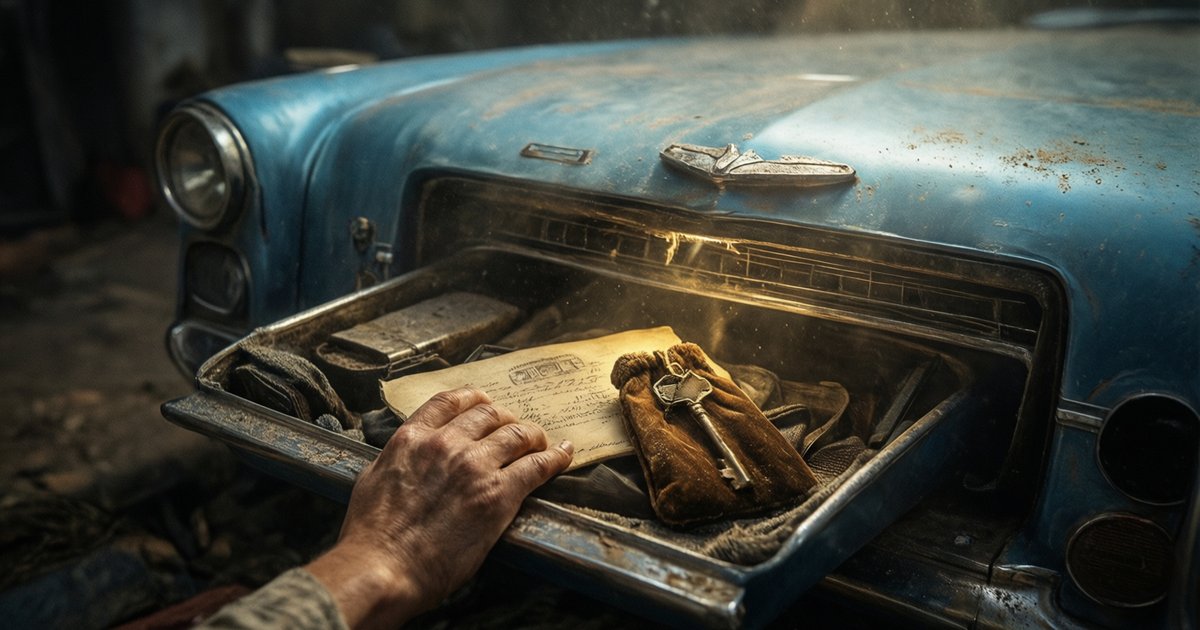
As I dusted the chrome bumper, I noticed the passenger door was slightly ajar. On a whim, I reached inside and popped open the glovebox. It didn't contain a manual or napkins. Instead, tucked inside a velvet pouch, was a heavy brass key and a yellowed property deed for a cottage in Maine that none of us had ever heard of.
Chapter 2
I stared at the document, the ink blurring under the dim garage light. The deed was in Martha's name, dated 1972, but it was signed by a man named Julian Thorne. I had never heard that name in all my ten years of marriage. Martha had always described her late husband, David's father, as her one and only true love, a man of steadfast loyalty and quiet strength.
'What are you doing in there, Claire?' David's voice echoed through the garage. I jumped, nearly dropping the velvet pouch. I looked at my husband—the image of his father—and felt a sudden, sharp hesitation. If Martha had kept a second home and a secret connection in Maine for fifty years, what else was she hiding?
I slid the deed back into the glovebox just as David stepped closer. 'Just cleaning the dash,' I lied, my heart hammering against my ribs. 'Your mom really needs to let go of this car.'
David shrugged, oblivious. But as I watched him, I realized the property wasn't just a piece of land. The deed mentioned a 'legacy trust' that expired the moment Martha entered a care facility. The clock was ticking.
Chapter 3
The move to Golden Oaks happened on a drizzly Tuesday in October. Martha was frail, her voice a thin reed, but her eyes remained sharp, like a hawk watching its prey. She clung to her handbag as if it held the secrets of the universe, ignoring the nurses who tried to help her into the wheelchair.
That night, unable to sleep, I drove back to the house. I told myself I was just checking if the movers had missed anything, but I went straight to the garage. I retrieved the brass key and the deed, tucked them into my coat, and spent the next four hours researching Julian Thorne online.
I found a digital archive from a small Maine newspaper. Julian Thorne had been a renowned architect who vanished from public life in the mid-seventies. There was one photo: a man with the same piercing blue eyes as David, the same stubborn set of the jaw. My stomach churned.
I wasn't just looking at a secret lover. I was looking at a genetic mirror. I realized then that the Cadillac wasn't a luxury item; it was a bridge to a life Martha had surgically removed from our family history.
Chapter 4
I didn't tell David. I couldn't. Not until I knew the truth. I took a three-day weekend, claiming I needed a 'solo retreat' to handle the stress of Martha's transition, and drove twelve hours north to the coast of Maine.
The cottage was a weathered cedar shingle house perched precariously on a cliff overlooking the Atlantic. The salt air stung my cheeks, and the wind howled through the pines. When I slid the brass key into the lock, it turned with a heavy, satisfying click.
Inside, the house was a time capsule. A record player sat in the corner, a half-finished painting of the coastline rested on an easel, and the scent of sandalwood lingered in the air. On the mahogany dining table sat a stack of letters, tied with a blue ribbon.
I opened the first one. It wasn't a romance. It was a series of apologies. As I read, I discovered that Julian Thorne wasn't Martha's lover—he was David's biological father, a man Martha had paid to disappear so she could marry for stability and social standing in their small Ohio town.
Chapter 5
The letters revealed a heartbreaking bargain. Julian had wanted to be part of David's life, but Martha had threatened to use her family's influence to ruin his career if he ever contacted them. In exchange for his silence, she had bought him this cottage, providing him a sanctuary where he could paint and write to a son who would never know he existed.
I sat on the floor, surrounded by sketches Julian had made of a baby boy—David. He had tracked David's life from afar, clipping newspaper articles about his graduation and his promotion at the law firm.
I felt a wave of nausea. Martha hadn't just lied; she had stolen David's identity, erasing a man's existence to maintain a facade of a perfect, traditional marriage. The 'legacy trust' in the deed wasn't for money; it was the house and the archives, left to David if he ever found them.
Just as I reached for the last letter, my phone buzzed. It was a text from David: 'Mom is acting strange. She keeps asking if you've been to the garage. Claire, what did you find?'
Chapter 6
I drove back to Ohio in a trance, the letters heavy in my lap. When I walked through the front door, I found David and Martha sitting in the living room. The atmosphere was thick, the kind of silence that precedes a storm. Martha looked at me, and for the first time, I saw fear in her eyes—not for herself, but for the image she had spent fifty years crafting.
'Give them back, Claire,' Martha said, her voice trembling but commanding.
David looked between us, confused. 'Give what back?'
I didn't hesitate. I placed the letters and the deed on the coffee table. I told David everything—about Julian, the cottage, and the price Martha had paid for her 'perfect' life.
David didn't scream. He didn't even move. He simply picked up a sketch of himself as a toddler, drawn by a man he had never met. He looked at Martha, the woman who had raised him with a tenderness that now felt like a lie. 'Was any of it real?' he whispered.
'My love for you was the only thing that was,' Martha sobbed, collapsing into her chair. 'I did it to protect you from his instability, David. I wanted you to have a father who was present, even if he was a lie.'
Chapter 7
The fallout lasted months. David didn't forgive Martha immediately, and the visits to Golden Oaks became sporadic and strained. However, the truth acted like a cauterizing iron—it hurt, but it stopped the bleeding of a lifetime of secrets.
David eventually traveled to Maine. He spent a week in that cedar cottage, reading every letter and painting every horizon Julian had seen. He didn't find a replacement father, but he found a piece of himself that had been missing—a creative spark and a restlessness that finally made sense.
Martha passed away in the spring, just as the cherry blossoms began to bloom in Ohio. In her final will, she left the 1964 Cadillac to me.
I didn't sell it. Instead, I spent a summer restoring the powder blue paint and polishing the chrome until it mirrored the sky. Every Sunday, David and I drive it up to the coast of Maine. We don't talk about the lies anymore. Instead, we sit on the cliffside and talk to the wind, honoring the man in the glovebox and the complicated, broken, beautiful truth that finally set us free.
The End