 Porchlight Tales
The Guest Ledger of Cedar Creek Cabin
Fiction. This is an original, made-up story: names, characters and events are invented, and any resemblance to real people or events is coincidental.
Full story · 10 chapters · Read in 5 parts instead
Listen to this story (5 parts)
Part 1 · 5 min
Part 2 · 5 min
Part 3 · 5 min
Part 4 · 5 min
Part 5 · 4 min
Chapter 1
The air in the Catskills tasted of damp pine and decaying leaves. Gideon Holt stepped out of the SUV, his boots sinking into the soft, October mud. Beside him, Mira sighed, her breath a pale ghost in the chilling air. She looked at the cedar-plank cabin, a hunched structure draped in oppressive gray fog, and then at Gideon. He hadn't truly looked at her in months, not since his sister's funeral. His eyes were always scanning, searching for a pattern or a missing piece of a puzzle that didn't exist.
"It's secluded, just like you wanted," Mira said, her voice tentative. She wanted this trip to be a reset, a way to pull Gideon out of the suffocating silence of his grief. Gideon didn't answer; he was already noticing the way the porch groaned under his weight and the smell of old paper wafting from the open screen door.
Inside, the cabin felt like a held breath. Mrs. Gableton, the property manager, had left the keys on the heavy oak table alongside a small, ceramic bowl filled with coarse white salt. Gideon frowned at the salt, a quaint superstition that felt out of place in his world of categorized archives.
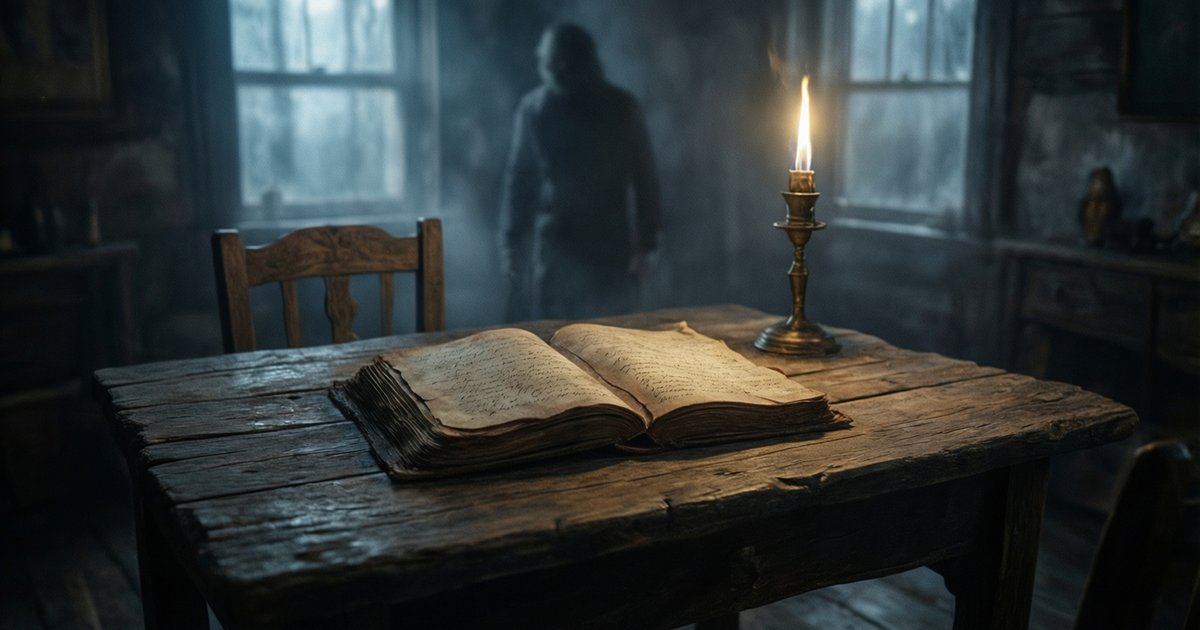
That evening, while Mira was unpacking in the kitchenette, Gideon noticed a slight misalignment in the bedroom's floorboards. His archivist's instinct—the need to fix what was broken, to complete the record—took over. He knelt, prying a loose plank with a pocketknife. Beneath the dust and spiderwebs lay a heavy, leather-bound ledger. The cover was scarred, the leather cracked like ancient skin. As he blew the dust off the gold-embossed spine, he felt a strange, electric thrum in his fingertips. He opened the first page, and a metallic tang and raw cedar filled his lungs. The entries began in 1952, written in a precise, looping cursive that seemed to vibrate on the yellowed parchment.
Chapter 2
Gideon spent the first three days consumed by the ledger. He treated it like a sacred text, mapping the guests of Cedar Creek Cabin across decades. The handwriting remained identical throughout the years—never aging, never faltering. Mira watched him from the doorway, her arms crossed, the practical landscape architect in her recoiling at his obsession.
"It's just a diary, Gideon. A hobby for a bored owner," she said. But Gideon wasn't looking for a hobby; he was looking for the logic of the place.
On the fourth morning, he turned to a section dated October 14, 1984. He stopped breathing. There, in that same timeless cursive, was an entry: 'October 14, 1984. Arrival: 3:12 PM. Gideon Holt and Mira Holt.'
He felt a cold spike of adrenaline. It wasn't just their names. The entry described them with haunting precision: 'He carries the burden of a lost sibling in his shoulders; she wears a forest-green cardigan and a look of quiet desperation.' Gideon looked down at Mira, who was indeed wearing her favorite green cardigan. He checked his watch. They had pulled into the driveway exactly at 3:12 PM on the day they arrived.
"Mira, come here," he whispered, his voice cracking. He pointed to the ink. The date was forty years before they were even adults, yet the description was a mirror. He searched for a logical explanation—a prank, a coincidence, a shared ancestral history—but the ledger was too specific. It mentioned the exact scar on his left thumb from a childhood accident. As he flipped the page, he found a silver pocket watch pressed between the leaves, its glass cracked, the hands frozen at 3:12. He slipped the watch into his pocket, unaware that he had just accepted a token of a cycle that had already claimed dozens before him.
Chapter 3
"It's a psychological trick," Mira insisted, though her voice lacked conviction. She refused to look at the book, fearing that acknowledging it would make the impossible real. "Maybe the owner knows your family. Maybe they've been stalking your social media."
Gideon didn't listen. He was diving deeper into the October entries. He noticed a chilling pattern: every guest who arrived in October lacked a checkout date. There were no notes of 'departed' or 'left for the city.' The entries simply stopped, leaving a void of white space on the page.
Then, he saw it. In a narrow margin next to a 1972 entry, a name was scribbled in a frantic, jagged hand: 'Lydia.'
Gideon felt the room tilt. Lydia was his sister's name. He traced the letters, his pulse thrumming in his throat. Why would his sister's name be in a ledger from the seventies? She had died three years ago in a car accident in Ohio. There was no connection to New York, no connection to this damp, rotting cabin.
He began to obsessively cross-reference the names. He found a guest from 1965 who shared his sister's middle name; a guest from 1958 who described the same recurring nightmare Gideon had suffered since childhood. The ledger wasn't just recording guests; it was harvesting identities.
As the sun dipped below the jagged peaks of the Catskills, the fog pressed against the windows like a wet wool blanket. Gideon realized the book wasn't predicting their arrival—it was claiming them. He looked at the silver watch in his palm. The ticking had started. It was faint, a rhythmic clicking that sounded less like a clock and more like a heartbeat. He wondered if the guests without checkout dates were still here, hidden in the walls or dissolved into the cedar scent that now seemed to cling to his skin.
Chapter 4
By the fifth day, the weather turned violent. A heavy autumn storm slammed into the mountains, turning the driveway into a river of mud and slicing the power lines. The cabin plunged into a dim, amber twilight, lit only by the flickering hearth.
Just as the wind began to howl through the eaves, a sharp knock sounded at the door. Gideon opened it to find Mrs. Gableton, drenched and shivering, holding a crate of canned goods and kerosene. Her eyes immediately darted to the dining table, where the ledger lay open.
She gasped, her face draining of color. The eccentric, airy demeanor she had maintained during their check-in vanished, replaced by genuine terror. She didn't step inside; she stayed on the threshold, her boots splashing in the salt bowl she had left for them.
"Put it back, Mr. Holt," she rasped, her voice trembling. "Put it behind the board and forget you ever saw it."
"What is this?" Gideon demanded, clutching the book. "Why are my name and my sister's name in here?"
Mrs. Gableton stepped back, her gaze flickering to the dark attic stairs. "Some records are meant to stay closed. This house... it doesn't just host people. It remembers them. It takes pieces of who we are to fill the gaps in its own history. If you keep reading, you're not just observing the record—you're signing it."
Before Gideon could press her for more, a thunderclap shook the cabin, rattling the windowpanes. Mrs. Gableton retreated into the rain, her warning echoing in the sudden silence: "The loop only breaks when the record is finished, but the record is never finished."
Gideon slammed the door, but the salt in the bowl had been scattered, the protective circle broken. He felt a sudden, oppressive heat in the room, and the smell of cedar became heavy and sweet, like lilies left too long in a funeral parlor.
Chapter 5
Driven by an agonizing need for answers and professional curiosity, Gideon spent the night searching the ledger for a hidden mechanism. He knew every archival binding he'd ever encountered; this book had a secret. After hours of probing the spine, he found a slim, hidden compartment tucked into the rear leather casing.
He slid out a weathered, sepia-toned photograph. His breath hitched.
The photo showed a couple standing in front of the same cedar cabin in October 1984. The man was an exact double of Gideon—the same sharp jawline, the same anxious slope of the shoulders. The woman was a mirror image of Mira, right down to the way she tilted her head when she smiled. Most disturbing of all, they were wearing the exact same clothes Gideon and Mira had arrived in: the forest-green cardigan and the charcoal wool coat.
"This is impossible," he whispered.
He looked at the photo, then at the ledger, then at Mira, who was sleeping fitfully on the sofa. He began to wonder if they were even individuals, or if they were merely iterations—echoes of people who had lived and died in this cabin over and over again.
He turned to the silver watch. The hands were moving now, but they weren't moving forward. They were sweeping backward, ticking away the seconds of a life he didn't remember living. He remembered a flash of a memory—not his own, but a feeling of cold water and the smell of old paper.
He realized the ledger wasn't a diary of guests; it was a blueprint. The cabin required specific souls to maintain its existence, and it lured them in using the vulnerabilities of their hearts. For Gideon, it was the hole left by Lydia. For Mira, it was the fear of a dying marriage. The house was feeding on their voids, weaving them into a tapestry of repetition that spanned decades. He wasn't just an archivist anymore; he was a specimen being cataloged.
Chapter 6
The turning point came on the sixth morning. Gideon woke up to find the ledger open to a page he hadn't seen before. The date at the top was simply: 'Tomorrow.'
Underneath, the cursive described a scene with surgical precision: 'The tension breaks. A violent argument erupts over the book. Mira attempts to throw the ledger into the fire; Gideon defends it with a desperation that borders on madness. Words are spoken that cannot be unheard. The bond snaps.'
Gideon stared at the words, a cold sweat breaking across his brow. He realized the ledger wasn't predicting a future that might happen—it was recording a loop that had happened. He and Mira were playing roles in a script written forty years ago. Every gesture, every argument, every look of longing was already inked into the page.
"I can change it," he told himself.
He decided to test the book. He spent the day being unnaturally kind to Mira, bringing her coffee, praising her work, avoiding any mention of the ledger. He thought he was winning. But as the sun set, he noticed something horrifying. The ledger was changing in real-time.
New words appeared on the 'Tomorrow' page, shimmering into existence as if written by an invisible hand: 'He attempts to deceive the record with false kindness, believing he has found a loophole. His arrogance only deepens the inevitable tragedy.'
Gideon slammed the book shut, his pulse racing. The house seemed to tighten around them. The walls felt closer, the ceiling lower. The sweet scent of cedar was now suffocating, smelling of rot and formaldehyde. He looked at the front door, and for the first time, he noticed that the door handle felt warm to the touch, almost like skin. The cabin wasn't a building; it was a predator, and the ledger was its digestive tract.
Chapter 7
Tensions peaked on the seventh day. Mira had found Gideon's secret notebook, where he had been documenting their every movement, timing their conversations and recording their reactions to see if they matched the ledger's predictions.
"You're treating me like a lab rat!" she screamed, her voice echoing through the cramped living room. "You've completely lost it, Gideon! This isn't about healing; this is a sickness!"
Gideon tried to explain, but the words felt clumsy. He looked at the ledger on the table. The 'Tomorrow' entry was unfolding. The argument was happening exactly as scripted. The more he tried to resist, the more he leaned into the role. The anger in Mira's eyes was a perfect match for the woman in the 1984 photograph.
"Get rid of that book!" Mira yelled, reaching for the ledger.
Gideon lunged to protect it, not out of love for the object, but out of a desperate, archivist's need to find the end of the record. He didn't want to be a ghost in a loop; he wanted the closure he never got with Lydia.
"We can't just leave it! We have to know how it ends!" he shouted.
As they struggled, the cabin responded. The lights flickered and died. The wind outside ceased instantly, leaving a silence so absolute it felt deafening. The scent of cedar became an overwhelming wave, choking the air. The house was no longer mimicking a home; it was shedding its disguise. The shadows in the corners began to stretch and bleed, merging with the darkness of the hallway. Mira let go of the book, her face pale.
"Gideon," she whispered, looking toward the front door. "The door... it's gone."
He turned. Where the heavy oak door had been, there was now only a seamless wall of cedar planks. They were sealed in. The record was closing.
Chapter 8
The low point arrived with a crushing finality. Gideon crawled to the ledger, his movements sluggish, as if the air had turned to syrup. He flipped to the very last page of their entry.
'October 21. Final Entry: The guests merge with the cedar. They become the silence between the pages. They will never leave the cabin.'
He looked at Mira. She was huddled in the corner, shaking. The silver pocket watch in his pocket began to vibrate violently, the ticking now a loud, rhythmic thumping that matched the pulse in his temples.
He tried the door again, clawing at the wood, but there was no handle, no seam, no way out. The cabin had digested their exit. He felt a terrifying numbness creeping up his legs, and when he looked down, he saw his skin taking on a grainy, wooden texture. The house was claiming them, turning their flesh into the very planks that held them captive.
Panic surged, but beneath the panic was a flicker of his professional training. He began to analyze the ledger one last time, not as a victim, but as an archivist. He searched for the flaw. Every record has a flaw—a smudge, a typo, a missing date.
He went back to the 1984 entry of the couple who looked like them. He scanned the lines meticulously. He found it. A tiny, almost invisible gap in the date of their departure. The original couple hadn't just vanished; they had left a void. A missing piece of data.
He realized the loop didn't depend on the people, but on the record of the people. The ledger was the anchor. As long as the record existed, the loop was mandatory. If the record was destroyed, the anchor would snap. But the house wouldn't let him reach the hearth. The floorboards began to shift, sliding like a conveyor belt, pushing him away from the fire.
Chapter 9
Gideon fought the house. He didn't rely on strength—he relied on the obsession that had nearly destroyed him. He used the silver pocket watch, jamming it into the shifting floorboards to create a momentary wedge.
With a guttural scream, he lunged toward the hearth, clutching the leather-bound ledger to his chest. The cabin shrieked, a sound of grinding wood and breaking glass. The scent of cedar turned acrid, smelling of ozone and old blood.
"Gideon, no!" Mira cried, fearing he was destroying their only link to understanding.
"This isn't a link!" he roared. "It's a leash!"
He thrust the ledger into the roaring orange flames.
For a moment, nothing happened. Then, the book began to scream. Not a human scream, but the sound of a thousand voices trapped in ink and parchment. The flames turned a brilliant, blinding white. Gideon watched as the pages curled and blackened, the names of a hundred forgotten guests vanishing into ash. He felt the numbness in his legs recede. The wooden texture of his skin dissolved, returning to warmth and blood.
As the final leather cover vanished into the embers, a massive concussive wave threw him and Mira backward. The wall where the door had been shattered, the cedar planks exploding outward into the fog.
They didn't wait. They scrambled to their feet and sprinted for the SUV, not looking back at the cabin. As they roared down the muddy driveway, the oppressive gray fog began to lift, revealing a crisp, clear October sky for the first time in a week. Gideon felt a weight lift from his chest—not the grief for Lydia, but the crushing certainty of a predestined end. He had chosen the chaos of the unknown over the safety of a script.
Chapter 10
Two miles down the road, Gideon pulled the car over. He was shaking, his hands still smelling of smoke and old paper. Mira sat beside him, her hand gripping his, her breathing finally steady.
"We're okay," she whispered. "We're actually okay."
Gideon looked at her, and for the first time in years, he didn't see a pattern or a symptom of grief. He saw his wife. He saw a future that wasn't written in a ledger.
As he shifted the car back into drive, he glanced in the rearview mirror. There, fluttering in the wake of their departure, was a single piece of parchment. It had somehow survived the fire, caught in a draft and blown across the driveway.
It was a page from the ledger.
Gideon slowed the car for a split second to look closer. The page was completely blank. There were no names, no dates, no predictions. The ink had been wiped clean, leaving nothing but the scent of cedar and the promise of a void.
He accelerated, leaving the blank page to be swallowed by the wind. He didn't need a record anymore. He was ready to start writing his own story, one day at a time, with all the unplanned, messy, and beautiful uncertainty that came with being alive. The silver watch was gone, left behind in the ruins of the floorboards, its hands finally still at 3:12.
The End