 Porchlight Tales
The Leather Journal of Windsor Creek
Fiction. This is an original, made-up story: names, characters and events are invented, and any resemblance to real people or events is coincidental.
Full story · 9 chapters · Read in 5 parts instead
Listen to this story (5 parts)
Part 1 · 5 min
Part 2 · 5 min
Part 3 · 5 min
Part 4 · 5 min
Part 5 · 3 min
Chapter 1
“GET OUT OF MY HOUSE!”
Mrs. Holloway’s voice cracked like a whip, echoing off the peeling white paint of her porch. She didn't just say it; she screamed it, her small frame shaking with a sudden, violent energy.
I stood frozen, clutching a weathered leather book to my chest. My sneakers felt heavy on the welcome mat. I wanted to explain, to tell her that this belonged to her, that the past was calling. But the door slammed shut with a sound that felt final.
Silent.
I stared at the wood grain, my pulse thumping against my collarbone. I had spent weeks chasing this ghost, and now the ghost was shouting at me to vanish.
But to understand why I was standing on that porch, you need to know how it all began. Three weeks earlier.
It started in the basement of the Windsor Creek University library. The air down there tasted of damp concrete and decaying glue. I was a sophomore History major, drowning in a world of PDFs and digital archives. I craved something tangible. Something that carried the weight of decades.
I was tasked with cataloging the 'Unsorted Local History' section—basically a graveyard of forgotten ledgers and municipal reports. I pulled a heavy, cloth-bound volume from the shelf, a 1954 guide to Massachusetts flora. As I opened it, a small, leather-bound journal slid out and hit the floor with a soft thud.
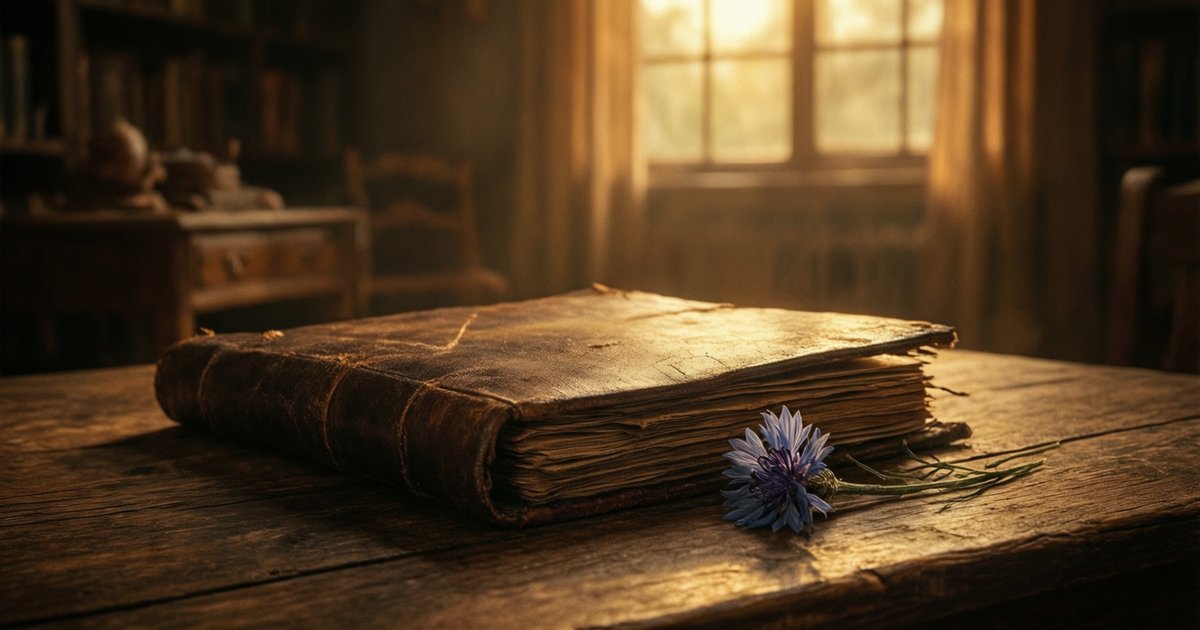
It was small, bound in dark brown calfskin, with a frayed ribbon marking a page. I picked it up, feeling the grain of the leather under my fingertips. It wasn't a library book. It was a private sanctuary.
I opened the first page and saw a name written in elegant, looping cursive: Adeline Holloway, 1956.
Beside the name sat a pressed blue cornflower. It was faded, brittle, and translucent, like a piece of old parchment. I didn't know then that this flower was a map to a tragedy. I only knew that I couldn't let it stay in the dust.
Chapter 2
I spent the first three nights in my dorm room reading the journal by the glow of a desk lamp.
Adeline had been eighteen in 1956. Her writing was breathless, filled with the kind of longing that only happens once in a lifetime. She wrote about the scent of rain on hot asphalt and the way the town square looked under the amber streetlights of Windsor Creek.
But the center of her world was a man named Cassian.
They were from different worlds—she was the librarian’s daughter, a girl of rules and silence; he was a restless spirit with a guitar and a dream of leaving Massachusetts behind. Their romance was a series of stolen moments: whispered conversations behind the stacks of the public library, walks through the autumn woods, and secret notes tucked into the pages of poetry books.
"He promised me the world," one entry read. "He says that when the cornflowers bloom in the square, we will decide our future. June 12th. The clock tower. Noon."
I became obsessed. As a History major, I was taught to analyze facts, but this wasn't a textbook. This was a heartbeat captured in ink. I felt a strange kinship with the young Adeline. My own grandfather had died when I was ten, leaving behind a house full of locked drawers and unspoken secrets. I had spent years wondering who he had been before he became the quiet man in the armchair.
I wanted to give Adeline her story back. I wanted to find the 'perfect ending' that my own family had lacked.
I started mapping out the timeline. June 12, 1956. The town square. I looked at the final entries of the journal. They shifted abruptly. The looping cursive became jagged. The entries grew shorter, then stopped entirely.
The last sentence was a jagged line of ink: "He didn't come."
I stared at the pressed blue cornflower, now taped into a plastic sleeve for protection. I had to find her. I had to know what happened after the silence fell.
Chapter 3
Finding Adeline Holloway was harder than I expected. Windsor Creek was a town that guarded its ghosts.
I spent my afternoons in the municipal archives, cross-referencing old census records and yellowed yearbooks. Every time I got close, I hit a wall.
"You're digging in a graveyard, Fairbanks," Mr. Sterling told me.
He was the head of archives, a man who looked like he was made of old parchment and tobacco. He wore thick glasses that magnified his eyes, making him look perpetually suspicious. He didn't like me moving things. He didn't like my 'passion.'
"It's just a journal, Mr. Sterling," I argued, sliding a photocopy of a 1960 city directory across his desk. "I think this is her. Adeline Holloway. She lived on Maple Street."
Sterling didn't even look at the paper. He just leaned back in his creaky wooden chair, the spring groaning under his weight.
"Some things are lost for a reason, kid. People spend decades building walls around their memories so they can finally sleep at night. You come along with your history degree and try to knock those walls down? That's not research. That's trespassing."
I frowned. "But she lost this. It's a part of her life."
"Maybe she wanted to lose it," he snapped.
Despite his warnings, I kept searching. I found a current property tax record. A small cottage on the edge of town, surrounded by overgrown hydrangeas and a rusted iron fence.
I felt a rush of anticipation. I imagined the scene: I would knock on the door, hand her the journal, and she would weep with joy. She would tell me the whole story, and I would be the one to bridge the gap of sixty years.
I was so focused on the 'meaning' of the discovery that I ignored the warning in Sterling's eyes. I thought I was rescuing a memory. I didn't realize I was disturbing a wound.
Chapter 4
The cottage had an aroma of cedar and old tea. It was tucked away at the end of a gravel drive, where the trees leaned in as if trying to keep a secret.
I walked up the porch steps, the wood creaking under my feet. I rang the bell, my nerves humming.
When the door opened, I didn't see a fragile old woman. I saw a fortress.
Adeline Holloway was small, but her presence filled the doorway. Her hair was a stark, polished white, pulled back into a tight bun. Her eyes were a sharp, piercing blue, looking at me as if I were a smudge of dirt on a clean floor.
"Yes?" she asked. Her voice was dry, like autumn leaves.
"Mrs. Holloway? My name is Wes Fairbanks. I'm a student at the university. I found something in the library archives—a journal. Your journal. From 1956."
I held out the leather book. I expected a gasp. I expected her to reach for it with trembling hands.
Instead, she recoiled.
She didn't touch the book. She didn't even lean forward to look at it. Her hand went instinctively to her neck, clutching a small silver locket that hung from a thin chain. She gripped it so hard her knuckles turned white.
"I don't know what you're talking about," she said. Her voice had lost its softness; it was now a wall of ice.
"But your name is inside! The entries about the town square, the cornflowers—"
"I said I don't know what you're talking about," she interrupted. "I don't keep journals. I don't remember any such thing. Now, please leave my property."
She didn't wait for me to respond. She closed the door.
I stood there in the silence of the afternoon. The smell of woodsmoke drifted from a neighbor's chimney. I looked down at the journal in my hands. Why would someone deny their own heart?
I realized then that Mr. Sterling was right. I wasn't just returning a book; I was trying to force a woman to look into a mirror she had spent half a century avoiding.
Chapter 5
I couldn't let it go. The thought of that journal—and the pain inside it—remaining unacknowledged felt like a failure.
I didn't go back to her porch to argue. Instead, I started leaving things. Small things.
I remembered a passage in the journal where Adeline described her favorite tea—a blend of Bergamot with a hint of lavender that her mother used to brew on rainy afternoons. I found a specialty shop in the city that still sold a similar blend.
I wrapped a small tin of the tea in brown paper and left it on her porch steps with a short note: *I thought you might remember the smell of this.*
Two days later, the tin was gone, but there was no note in return.
Next, I found a vintage postcard of the Windsor Creek town square from the 1950s. It showed the clock tower and the flower beds in full bloom. I left it tucked under her door. *The cornflowers were beautiful that year,* I wrote.
I waited. I watched from my car at the end of the driveway.
One afternoon, I saw the curtain in her living room twitch. She was watching me. She didn't come out, but she didn't call the police.
I began to realize that my approach had been too aggressive. I was treating her like a historical puzzle to be solved. I had to treat her like a person who was hurting.
I stopped the notes. I stopped the gifts. For a week, I did nothing. I let the silence settle between us, just as it had settled for her for decades.
On the eighth day, a small piece of paper was slid under my dorm room door. It was a scrap of old stationery.
*The library. Tuesday. 4:00 PM. Bring the book, and then you leave me alone forever.*
My spirits lifted. I had cracked the fortress. But as I packed my bag, I noticed the handwriting on the note. It wasn't the elegant loop of the 1956 journal. It was shaky, tired, and heavy with a resignation that made me feel a sudden, sharp pang of guilt.
Chapter 6
The library was nearly empty on Tuesday afternoon. The golden light of late October filtered through the high windows, illuminating dust motes that danced in the air.
Adeline was waiting for me in the reference section, sitting at a heavy oak table. She looked smaller here, surrounded by the towering shelves of books.
I placed the journal on the table between us. For a long time, neither of us spoke. The only sound was the distant hum of the heating system.
Slowly, she reached out. Her fingers trembled as she touched the leather cover. She didn't open it at first; she just let her palm rest on the surface, as if she were feeling a pulse.
"I hated that book," she whispered.
She opened to the page with the pressed blue cornflower. Her eyes clouded over.
"Cassian was the only person who ever saw me," she said. "Not the librarian's daughter. Not the 'good girl.' Just me. We had a plan. We were going to leave Windsor Creek. He was going to play his music in New York, and I was going to study literature."
I leaned in. "What happened on June 12th?"
Adeline's hand went to the silver locket. She didn't open it, but she traced the edge of the metal.
"I waited," she said. "I waited until the sun went down and the streetlights flickered on. I waited until the square was empty and the air turned cold. He never came. No letter, no message, nothing. Just... silence."
She looked at me, and for the first time, I saw the raw wound behind the ice.
"I spent years wondering what I had done wrong. Was I not enough? Did he realize I was too boring for his world? The silence became my only companion, Wes. I stopped writing because there was nothing left to say to a man who had simply erased me from his life."
She closed the book with a sharp snap.
"You think you've found a romantic mystery. But you've only found a record of a girl who was discarded. This isn't a treasure, Wes. It's a ghost that doesn't want to be woken up."
Chapter 7
The air in the library felt suddenly cold. I wanted to tell her it couldn't be that simple, but I had no proof.
"Maybe there was a reason," I suggested softly. "Maybe something happened to him."
Adeline let out a short, bitter laugh. "People don't just vanish without a trace in a town this small. If he wanted to find me, he would have. He chose to leave."
She stood up, her face hardening again.
"I lived a quiet life, Wes. I married a kind man, a clerk from the city. He was a good husband, but he wasn't Cassian. I spent forty years pretending that the hole in my heart had closed, but it never did. It just scarred over."
She pushed the journal toward me.
"Take it. Burn it. I don't care. But I don't want it in my house. I don't want to be eighteen and hopeful again, only to remember that the hope was a lie. Please, just end this torture."
I watched her walk away, her footsteps echoing in the hollow silence of the library. I felt a knot of sickness in my stomach. I had come here seeking 'meaning,' and all I had done was rip open a sixty-year-old scar.
I sat at the table for an hour, staring at the leather book. I thought about the pressed cornflower. I thought about the way she clung to that locket.
I didn't burn the journal. Instead, I went back to the archives. I went back to Mr. Sterling.
"I messed up," I told him. "I pushed too hard."
Sterling looked at me over his glasses. He didn't say 'I told you so,' which was the kindest thing he had ever done.
"Check the original ledgers," he muttered. "Not the books, the ledgers. The ones from the library's transition in 1957. Sometimes things get misfiled during a move. If there was a letter that never reached her, it might have been swept up in the administrative chaos of the time."
I spent the next three days in a fever, digging through dusty lists of lost mail and misdirected parcels. I didn't eat. I didn't sleep. I just searched.
Chapter 8
I found it on a Friday afternoon, tucked inside a heavy, gray ledger from November 1956.
It wasn't a book; it was a single, yellowed envelope. It had been filed under 'Unclaimed Correspondence—Local.'
I opened it with shaking hands. The letter was from Cassian.
*Dearest Bea,*
*I tried to get to the square. I swear on my life I tried. The accident on the north road took my bike and my leg, and I've been trapped in the county hospital for three weeks. They took my things, including the address I had for you. I'm writing this the second I can sit up. Please, if you see this, know that I never stopped thinking of you. I'm coming for you as soon as I can walk again.*
There was no return address, only a hospital room number that had long since been reassigned.
I felt a prickle of ice on my skin. He hadn't abandoned her. He had been broken, trapped in a bed while she waited in the square. And because of a filing error in a small-town library, a letter had sat in a ledger for six decades, mocking her grief.
I didn't go to the library. I didn't call her.
I drove straight to her cottage. I didn't ring the bell this time. I walked up the porch steps and waited.
When the door opened, Adeline looked at me with an expression of pure exhaustion.
"I told you to leave me alone, Wes,"
But before she could close the door, I spoke.
"He didn't leave you, Adeline."
She froze.
"He had an accident. He was in the hospital. He wrote to you. The library lost the letter."
I held out the yellowed envelope.
This was the moment from the beginning. The tension, the screaming, the desperation. But this time, I didn't push. I didn't try to force a 'happy ending.' I simply stood there, holding the truth in my hand, and waited for her to decide if she wanted to hold it too.
Chapter 9
The silence that followed was different from the others. It wasn't a wall; it was a bridge.
Adeline took the letter. She read it slowly, her lips moving as she processed the words. As she reached the end, she finally opened the silver locket.
Inside was a tiny, faded photograph of a young man with a guitar and a mischievous grin.
She didn't scream. She didn't cry. She just leaned against the doorframe and let out a long, shuddering breath, as if she had been holding it since 1956.
"All this time," she whispered. "I thought I was unlovable."
I didn't try to hug her or offer platitudes. I just stood there.
"What do you want to do with the journal?" I asked. "I can still burn it if you want."
She looked at the leather book in my other hand, then back at the letter.
"No," she said softly. "I think... I think it's time it was read. Not as a tragedy, but as a reminder. We spend so much time assuming the worst about the people who leave us. We build prisons out of our own assumptions."
Over the next few months, Adeline and I worked together. We didn't keep the journal a secret. We organized a small local history exhibit at the Windsor Creek library, titled *The Unsent Letters of Windsor Creek*.
We invited the town. We shared her story, and in response, others came forward with their own ghosts—lost letters, forgotten apologies, and old regrets. The exhibit turned the library into a place of healing rather than just a place of storage.
I learned that history isn't about the 'perfect ending.' It's about the truth, however messy it is.
On the final day of the exhibit, Adeline took the pressed blue cornflower from the journal. She didn't put it back in the book. She had it professionally framed and hung it in the library attic, right where the light hits the wall at noon.
It was a small, brittle flower, but it looked vibrant in the sun. It wasn't a symbol of a missed encounter anymore. It was a symbol of a love that had been paused, and finally, peacefully, allowed to rest.
The End