 Porchlight Tales
The Mitten Swap of Maple Street
Fiction. This is an original, made-up story: names, characters and events are invented, and any resemblance to real people or events is coincidental.
Full story · 9 chapters · Read in 5 parts instead
Listen to this story (5 parts)
Part 1 · 4 min
Part 2 · 4 min
Part 3 · 4 min
Part 4 · 4 min
Part 5 · 2 min
Chapter 1
My classroom at Maple Street Elementary was a sanctuary of right angles and color-coded bins. Every pencil was sharpened to the same length; every alphabet poster was perfectly centered. For me, order wasn't just a preference—it was a shield. I grew up as the 'invisible girl' in a district where my classmates wore cashmere and I wore hand-me-downs that smelled of mothballs. I had spent my adult life ensuring that no detail in my professional world ever slipped, because chaos felt too much like poverty.
Then came Leo. He was a quiet six-year-old with wide, observant eyes and a coat three sizes too large, cinched at the waist with a frayed blue velvet ribbon. It was a jarring splash of worn-out fabric against the crisp December morning. As the students filed in, shivering from the Vermont frost, I noticed Leo’s left hand was bare, red and raw from the wind. His right hand wore a single, pilled gray mitten.
'Leo, honey, where is your other mitten?' I asked, my voice soft but my mind already calculating the lack of symmetry.
Leo pulled his bare hand into his sleeve, glancing nervously at the other children. 'I misplaced it, Ms. Thorne,' he whispered. He didn't look me in the eye. He looked at the floor, where the linoleum was polished to a mirror finish.
I looked at his coat—thin, water-logged, and clinging to his small frame. A child who simply 'misplaces' a mitten usually has another pair at home. A child who arrives shivering in a coat held together by a scrap of ribbon is fighting a different battle. I felt a familiar, uncomfortable tug in my chest, a ghost of the girl I used to be. I wanted to fix it immediately, to bring him back into the alignment of my perfect world, but Leo’s jaw was set in a line of fierce, silent pride.
Chapter 2
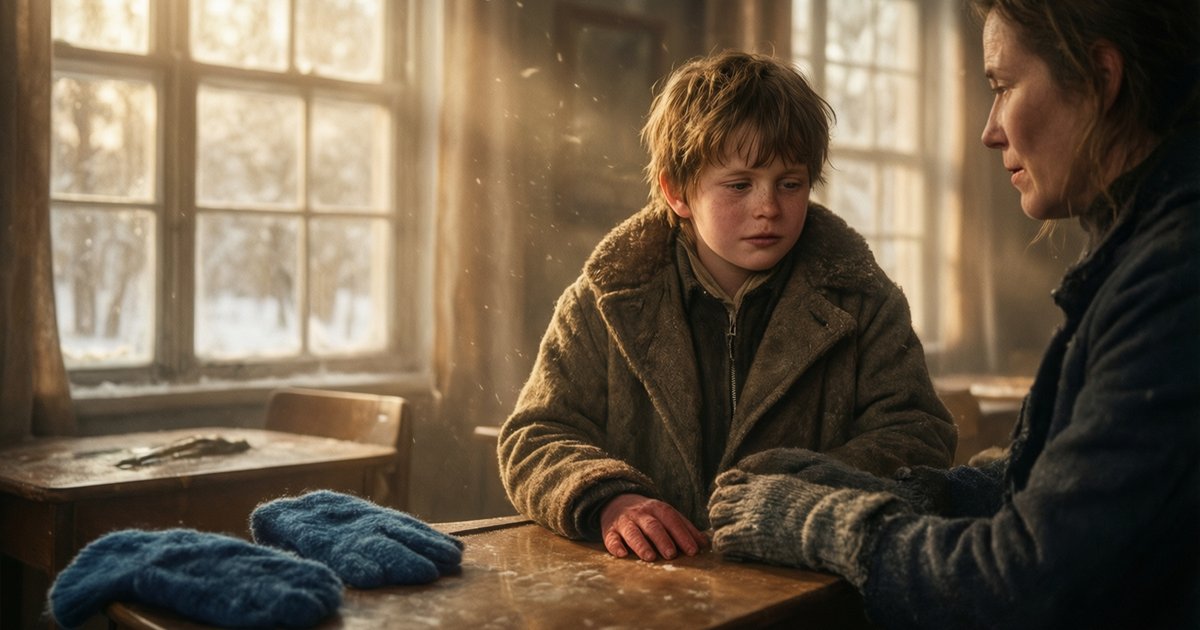
I reached into my desk and pulled out my emergency kit. It was a pristine plastic box containing everything from extra bandages to a spare set of mittens I'd bought three years ago and never touched. I liked knowing the kit was there; the existence of the solution was more comforting than the act of using it. I held out the bright blue mittens, the wool soft and smelling of new fabric.
'Here, Leo. I have an extra pair. You can keep them,' I said, offering a small, encouraging smile.
Leo stepped back, his boots clumping heavily on the floor. He didn't reach for them. Instead, he tucked his frozen hand deeper into his pocket. 'No, thank you,' he said. His voice wasn't shy; it was intense, almost defensive.
'It's okay, Leo. It's just a loan until you find yours.'
'I don't want to owe,' he replied sharply. He looked at me then, and for a second, I saw something in a six-year-old's eyes that belonged to a man twice his age—a deep-seated fear of a debt that could never be repaid. He wasn't rejecting the warmth; he was rejecting the vulnerability that came with it.
I stood there, holding the blue mittens, feeling the sudden rigidity of the air between us. In my world, a problem had a logical solution: a missing item is replaced by a spare. But Leo wasn't a problem to be solved. He was a person with a boundary I didn't understand. I put the mittens back in the box and closed the lid with a click that sounded far too final. As the morning bell rang, I watched him walk to his desk, his one gray mitten contrasting sharply with his bare, shivering hand, a small, stubborn island of defiance in my perfectly ordered room.
Chapter 3
The breaking point came during Tuesday's art project. The classroom was humming with the sound of safety scissors and the scent of washable glue. I was circulating the room, checking that the glue sticks were capped, when I heard a snicker from the back table.
'Why do you only have one mitten, Leo?' a boy named Toby asked, his voice loud enough to draw the attention of the surrounding students. 'Did you lose it in the trash? Or did you forget how to dress yourself?'
Leo didn't answer. He froze, his shoulders hunching toward his ears, his small hand gripping a piece of construction paper so hard it wrinkled. The other children began to whisper, their eyes darting between Leo's bare hand and his oversized coat. The symmetry of my classroom was still there—the bins were straight, the clocks were synced—but the atmosphere had turned toxic.
I stepped in quickly, silencing the group with a firm look. 'Toby, that's enough. We use kind words in this room.' I turned to Leo, expecting him to look relieved, but he was staring at the blue velvet ribbon on his coat, his expression vacant.
I realized then that my obsession with order was a lie. I had spent years creating a sterile environment where everything looked correct, but that 'correctness' was actually a veil. By focusing on the polish of the room, I was ignoring the pain of the children inside it. My rules didn't protect them; they just made the gaps in their lives more obvious. I looked at Leo's red knuckles and felt a surge of genuine anger—not at Toby, but at my own blindness. I didn't want a perfect classroom anymore. I wanted a place where a child didn't have to feel the weight of the world on their shoulders while trying to draw a Christmas tree.
Chapter 4
That night, I didn't organize my lesson plans. Instead, I went to my garage and found an old cedar chest. I spent three hours sanding it down and painting it a cheerful, sunny yellow. I used a thick black marker to write in bold, friendly letters: THE MITTEN SWAP. Below that, I added: TAKE ONE, LEAVE ONE.
On Wednesday morning, before the students arrived, I placed the bin in the hallway, right next to the coat hooks. I filled it with several pairs of mittens and scarves from my own closets—things that were clean and warm, but not brand new. I didn't want them to look like charity; I wanted them to look like a community resource.
'What is this, Clara?' Sarah, the second-grade teacher, asked as she walked in. She was the opposite of me—her desk was a whirlwind of glitter and ungraded papers, but her students adored her. She leaned over the bin, a smile playing on her lips.
'A way to normalize missing gear,' I explained, my heart racing. 'If everyone is swapping, then no one is 'the kid with the missing mitten.' It turns a deficit into a game.'
Sarah beamed and immediately reached into her bag, pulling out a pair of knitted gloves her grandmother had made. 'I love it. Embracing the mess, huh?'
As the children arrived, there was a flurry of excitement. The 'Mitten Swap' became an instant sensation. Kids who had lost gloves three weeks ago suddenly found pairs that almost matched. The hallway was chaotic, noisy, and completely disorganized. It was a nightmare for the old me, but as I watched Leo stand by the bin, staring at the pile of wool, I felt a strange sense of peace. He didn't take anything that morning, but for the first time, he didn't hide his hand in his sleeve.
Chapter 5
The honeymoon phase lasted exactly four days. On Friday, as I was helping a student tie her shoe, the sharp click of heels echoed down the hallway. Mrs. Gable, the principal, stood over the yellow bin with her arms crossed. She was a woman who viewed the school budget as a sacred text and standardized testing as the only true measure of a human being.
'Ms. Thorne,' she said, her voice like a paper cut. 'Why is there a heap of second-hand textiles blocking the fire egress in my hallway?'
'It's a Mitten Swap, Mrs. Gable,' I replied, standing tall. 'It's helping the students stay warm and fostering a sense of community.'
Mrs. Gable looked at the bin as if it were a pile of garbage. 'Maple Street Elementary is an institution of academic excellence, not a charity ward. We cannot encourage a culture of dependency, nor can we have unregulated items entering the building due to health codes.'
'The items are clean, and the need is real,' I countered. I could feel the heat rising in my neck. For the first time in my career, I didn't care about the protocol.
'I don't care about the 'need,' Clara. I care about the rules. This bin is a distraction from the curriculum,' she snapped. 'You have until Monday morning to remove this. If it's still here, I'll consider it a direct violation of my directives, and it will be noted in your permanent file.'
She turned on her heel and marched away, leaving a vacuum of silence in her wake. I looked at the bin, then at the students who were already glancing toward it. The 'order' Mrs. Gable craved was the same kind of order I had used to hide my own poverty, and suddenly, it felt suffocating.
Chapter 6
Monday arrived with a biting wind that rattled the classroom windows. I had moved the bin to a discreet corner of the room, defying Mrs. Gable's order by keeping it in the building. But as the week progressed, I noticed something strange. Leo wasn't using the bin. He still had his one gray mitten, and he still had his bare hand.
During recess, while the other children were playing tag in the snow, I watched Leo from the window. He wasn't playing. He was sitting on a wooden bench, tucked away in the shadow of the gym wall. He had something in his lap.
Curiosity got the better of me. I stepped outside, the cold air hitting my lungs like a physical blow. As I approached, I saw that Leo had a small, rusted sewing needle and a spool of thick, mismatched thread. He wasn't sewing for himself. He was carefully stitching a tear in a blue mitten that belonged to a girl in the third grade.
'You're very good at that, Leo,' I whispered.
He jumped, nearly dropping the needle. He quickly tried to hide the thread. 'I just... I know how to fix things,' he muttered.
I looked closer. Beside him were three other mittens, all torn or frayed, which he had quietly collected from the Mitten Swap bin. He wasn't taking the warmth for himself; he was spending his only free time repairing the items so others could use them. He was acting as the silent guardian of the bin, ensuring that the 'charity' lasted longer.
He looked up at me, and for a moment, the fierce pride was gone, replaced by a raw, aching exhaustion. He looked small—too small for the oversized coat and the burden he was carrying. I realized then that Leo didn't just want to avoid owing a debt; he felt a responsibility to provide, even when he had nothing.
Chapter 7
The weather turned vicious on a Thursday in late December. A sudden blizzard slammed into Vermont, dumping ten inches of snow in six hours. The wind howled, shaking the school's old timber frames. When the bell rang for the first period, Leo wasn't in his seat.
He arrived twenty minutes late, slipping through the door like a ghost. He was soaking wet, his oversized coat drenched and clinging to him. He had no mittens at all—not even the gray one. His skin was a ghostly, translucent white, and his expression was vacant, his eyes sunken with a fatigue that no six-year-old should know.
'Leo!' I rushed to him, wrapping him in a dry towel from my emergency kit. He didn't even shiver; he just stood there, staring at nothing.
I led him to the nurse's office, but as I did, I noticed his shoes. They were sneakers, not boots, and they were saturated with slush. He was trembling now, not from the cold, but from a deep, systemic shudder.
'Where is your mother, Leo?' I asked, my heart hammering against my ribs.
He didn't answer for a long time. He just gripped the towel, his knuckles white. 'She's sleeping,' he finally whispered. 'The car is too cold, so she has to sleep a lot.'
The words hit me like a physical blow. My mind raced—the oversized coat, the blue velvet ribbon, the refusal to 'owe' anything, the repairing of other people's clothes. The pieces clicked together with a devastating clarity. He wasn't just poor; he was disappearing. I ignored the nurse's confused look and took Leo's hand, leading him back to my room. I knew I couldn't follow the rules anymore. The rules were for people who had homes to go back to.
Chapter 8
I spent the afternoon on the phone, my voice shaking. I discovered that Leo's mother had been laid off from the local mill three months ago. They had been living in their 2012 sedan, parked in various supermarket lots to avoid being towed. Leo had been giving his only pair of warm boots and his best mittens to his four-year-old sister, who stayed in the car during the day at a cheaper, unlicensed daycare.
I went to Mrs. Gable's office without an appointment. I didn't knock; I walked in and slammed a photo of the frozen, shivering Leo on her desk.
'He is living in a car, Mrs. Gable,' I said, my voice ringing with a clarity I'd never possessed. 'And while you're worried about fire egress and health codes, a six-year-old is repairing mittens for other kids because he's too proud to ask for help for himself.'
Mrs. Gable looked at the photo, then at me. For a second, the mask of the administrator flickered. I saw a flash of something—perhaps a memory, perhaps regret.
'Clara, we cannot intervene in family matters without social services,' she said, though her tone had lost its edge.
'I'm not asking for a policy change,' I replied. 'I'm asking for a Warmth Drive. Now. We open the gym, we call the parents, and we get this family a hotel voucher and a winter wardrobe. If you report me for violating the rules, do it. But do it after we get that boy a bed.'
Mrs. Gable stared at me for a long minute. Then, she reached for her phone. 'I'll call the board. But you're the one who has to organize the logistics, Ms. Thorne. And for heaven's sake, make sure the gym is organized.'
I smiled. It was the first time I didn't mind the thought of a logistical nightmare.
Chapter 9
The community response was an avalanche of kindness. The 'Warmth Drive' brought in more than just coats and boots; parents brought bags of groceries, gift cards, and a collection of funds that secured a small apartment for Leo and his mother for six months. The town's socioeconomic divide didn't vanish, but for one weekend, it bridged over a pile of wool blankets and hot cocoa.
Mrs. Gable didn't give me a formal reprimand, though she did spend a week lecturing me on the 'improper use of school facilities.' I didn't mind. I had learned that true order isn't the absence of chaos—it's the presence of compassion. My emergency kit was no longer a pristine box of 'what-ifs'; it was a messy, used, and frequently replenished station of care.
On the last day before winter break, I called Leo to my desk. I handed him a small gift-wrapped box. Inside were a pair of bright red, heavy-duty mittens, the kind that could withstand a blizzard.
'There's something else,' I said. I reached into my pocket and produced a brand new, shimmering blue velvet ribbon, much stronger and wider than the one on his old coat.
Leo took the mittens and the ribbon. He didn't say he didn't owe me. He didn't look at the floor. He looked me straight in the eye and gave me a small, knowing smile.
As the final bell rang, I watched him walk toward the bus. He was wearing the red mittens, tied securely with the blue ribbon. He didn't slouch, and he didn't hide his hands. He stepped out into the falling snow with his head held high, no longer an invisible boy in a perfect world, but a visible child in a warm one.
The End