 Porchlight Tales
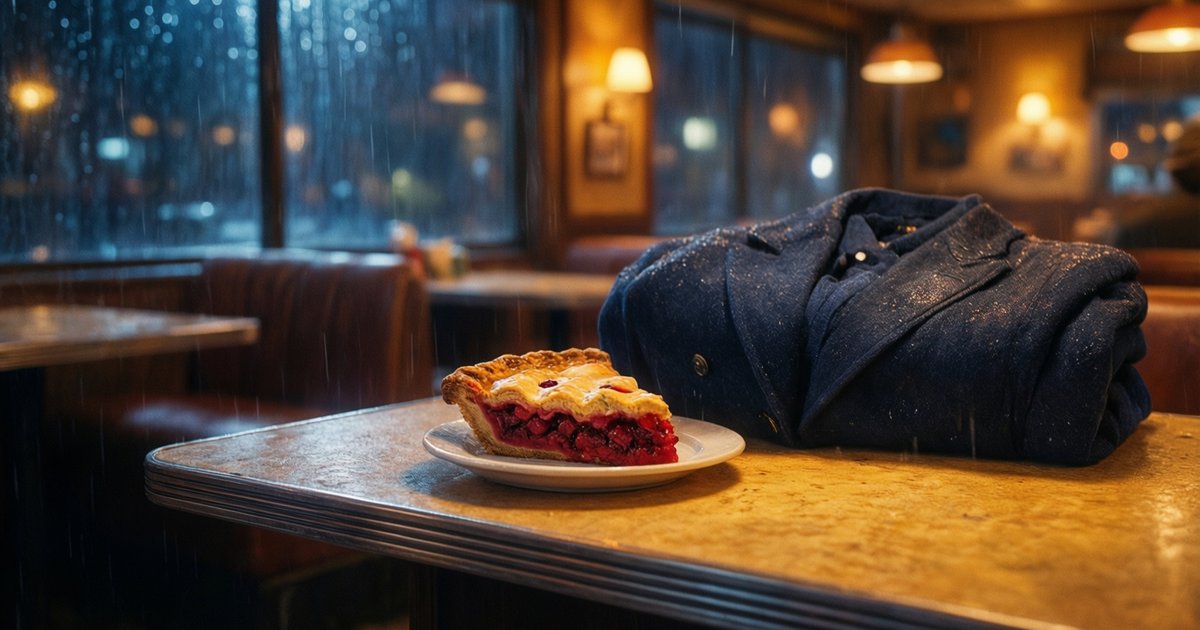
The Navy Jacket and the 3 AM Cherry Pie
Fiction. This is an original, made-up story: names, characters and events are invented, and any resemblance to real people or events is coincidental.
Full story · 9 chapters · Read in 5 parts instead
Listen to this story (5 parts)
Part 1 · 5 min
Part 2 · 5 min
Part 3 · 5 min
Part 4 · 5 min
Part 5 · 3 min
Chapter 1
"YOU MISSED A SPOT BY THE JUKEBOX, EMMET!"
I flinched, the mop handle slipping in my grip. My lower back throbbed in sync with the irritating buzz of the fluorescent lights above.
I didn't look up. I just nodded and pushed the mop closer.
But to understand why I let a stranger shout at me, you need to know how it all began. Three weeks earlier...
At fifty-two, I had mastered the art of becoming invisible. I moved through the grease-slicked aisles of Joe’s 24-Hour Diner in Fairweather, while the smell of burnt coffee and old frying oil clung to my skin.
I paused for a second, fingers fumbling with a loose thread on my wool coat. The fabric was fraying at the cuffs, and the top button was missing. A gap remained that let the November chill seep straight into my bones. I’d tried to sew it back on three times, but my hands shook too much these days.
Every penny I earned was earmarked for Lila. My eighteen-year-old daughter played the cello with a passion that terrified me—not because of the music, but because of the cost. The tuition deadline for the conservatory was looming. The savings we’d scraped together were a joke compared to the actual bill.
The guilt of my late wife’s medical bills, which had swallowed our life savings years ago, felt like a cold stone sitting in my chest. I refused to ask for help. A provider didn't ask for handouts.
That was when Gideon usually appeared. He was a regular who arrived every night at 3 AM, occupying the same corner booth. He was a sharp-featured man of sixty-eight with eyes that looked like they had seen too many blueprints and too few smiles.
He always ordered a slice of cherry pie, but he never ate more than one bite. He just stared at the red filling as if it were a puzzle he couldn't solve. To me, Gideon was the embodiment of everything I disliked: wealthy, abrasive, and profoundly lonely. I avoided eye contact. I didn't need a conversation; I needed a miracle.
Chapter 2
The rain didn't just fall in Fairweather; it attacked. By midnight, the drizzle had turned into a freezing November deluge that turned the parking lot into a gray, swirling lake. Inside the diner, the humidity made the windows fog, blurring the neon 'OPEN' sign into a bleeding red smudge.
I was in the middle of a rhythm—wipe, mop, empty—when a sudden crash echoed from the breakfast nook. A tourist had knocked over a gallon of maple syrup. The sticky amber liquid was spreading rapidly toward the carpeted lounge area.
Joe, the owner, shouted from behind the counter, "Get over here, Emmett! Before it sets!"
In a frantic rush to save the carpet, I sprinted toward the back. In my haste to grab the heavy-duty absorbent powder, I shed my wool coat, tossing it carelessly onto a bench in the locker room. I spent the next hour on my hands and knees, scrubbing the floor until my knuckles were raw and the syrup was gone. By the time I stood up, the adrenaline had faded, leaving me shivering.
When I finally returned to the locker room to retrieve my coat, my heart sank. The bench was empty.
I searched every corner, checked the lost-and-found bin, and even peeked into the walk-in freezer, but the fraying wool garment was gone. I stood there in my thin uniform shirt, the air-conditioned chill of the back hallway feeling like ice against my skin.
I walked back into the main dining area, hugging my arms tightly across my chest. I felt exposed.
From the corner booth, Gideon watched me. The old man didn't say a word, but his gaze lingered on my shivering shoulders. He took one small bite of his cherry pie, set the fork down, and looked away. I wondered if he was judging my clumsiness, or if he simply didn't care that a man was freezing in his own workplace.
Chapter 3
The rest of the shift was a blur of shivering and teeth-chattering. By the time I clocked out at 6 AM, the rain had turned into a sleety mist. I walked to my rusted sedan, the damp air clinging to my shirt, feeling a deep, hollow sense of defeat. The loss of the coat felt symbolic—the last piece of stability I was clinging to had literally vanished.
Two nights later, I returned to my locker with a sense of dread. I had spent the intervening days wearing an oversized flannel shirt that didn't stop the wind. As I opened the metal door of locker 14, something navy blue caught my eye.
Folded neatly on my shelf was a high-end, waterproof jacket. It was heavy, made of a technical fabric that felt smooth and expensive to the touch. It was a deep navy blue, with a reinforced collar and a hood that looked capable of withstanding a hurricane. Tucked into the pocket was a small, cream-colored piece of stationery.
'For the man who keeps this place shining,' the note read. There was no signature, just a few precise, architectural lines of ink.
I stared at the jacket, then at the empty space where my old wool coat had been. I didn't feel gratitude; I felt a surge of panic. I didn't know who had left it, but the quality of the garment screamed luxury. This wasn't a gesture of friendship; it was a charity case. I remembered the way my father had talked about dignity—about earning your way and never taking a shortcut.
I left the jacket on the shelf for the first hour of my shift, staring at it as if it were a trap. But as a fresh blast of freezing rain began to lash against the diner's windows, the cold began to seep through my flannel shirt again. My joints ached. I could feel a cough starting in my chest.
I couldn't afford to get sick. I couldn't afford to miss a single shift. Slowly, with trembling hands, I put the jacket on.
Chapter 4
The jacket fit perfectly, as if it had been tailored for me. I felt a warmth that didn't come from a heater, a sensation I hadn't known in years. I felt a strange sense of dignity; the jacket made me look less like a ghost in the hallways and more like a man. However, the gift felt like a debt I couldn't repay.
Throughout the night, I kept glancing at the customers, trying to deduce who the benefactor was. I looked at the regulars, the truckers, and the late-night students. Finally, my eyes landed on Gideon. The old man was in his usual booth, staring at a slice of cherry pie he hadn't touched. Gideon's expression was stoic, almost bored, but he didn't look away when I caught his eye.
"Nice coat," Gideon remarked, his voice like grinding gravel.
"I'm trying to find the owner," I replied, my voice stiff. "It was left in my locker. I think there's been a mistake."
Gideon let out a short, dry laugh that didn't reach his eyes. "Maybe the owner wanted you to have it. Some people find it easier to give things away than to keep them."
"I don't take handouts," I said, my pride flaring. "I've worked every hour of my life for what I have."
Gideon leaned back, his gaze sharpening. "Pride is a fine thing, Emmett, until it's the only thing keeping you warm. You're shivering even in that jacket because you're too stubborn to admit you're cold."
I bristled, ready to snap back, but I stopped. I noticed the way Gideon looked at the empty seat across from him. There was a void there, a silence that felt louder than the diner's jukebox. For a moment, the abrasive exterior cracked, revealing a loneliness that mirrored my own.
I didn't return the jacket, but I didn't thank him either. I simply went back to mopping, the navy fabric shielding me from the drafty doors.
Chapter 5
Over the next week, the jacket became my armor. It wasn't just the warmth; it was the way I felt when I wore it. I stopped slouching. I noticed that Joe, the owner, started treating me with a bit more respect, perhaps seeing a man who looked like he belonged.
One night, while cleaning the table next to Gideon, I noticed a sketchpad tucked under the man's arm. It was filled with intricate drawings of buildings—sharp angles, sweeping arches, and detailed blueprints of structures that looked both modern and timeless.
"You're an architect," I said. It wasn't a question.
Gideon looked at the sketchpad and then at me. "I was. A long time ago. Before I learned that buildings are easier to fix than families."
I paused, the damp cloth still in my hand. "My daughter... she's a musician. Cello. She sees things in music the way you see them in lines. She thinks the world is a place where everything fits together if you just find the right key."
Gideon looked at me, really looked at me, for the first time. "Optimism is a dangerous luxury, but it's the only thing that makes the rain bearable. Does she have a place to play?"
"She's applying to the conservatory," I whispered. "But the money..."
"Don't tell me the cost," Gideon interrupted, his voice softening slightly. "Tell me about the music. Does she play Bach?"
For the next twenty minutes, the janitor and the grumpy regular talked. They didn't talk about money or poverty; they talked about structure, harmony, and the feeling of creating something from nothing. It was the first real conversation I had had with another adult in years.
As I walked away to empty the trash, I realized that the navy jacket wasn't just protecting me from the cold; it was opening a door I had kept locked for a decade.
Chapter 6
The bubble burst on a Tuesday morning. I arrived home to find a thick envelope on the kitchen table. It was a final notice from the conservatory. The deposit for Lila's seat was due in three days. If the payment wasn't received, her spot would be given to the next student on the waiting list.
I sat in the dim light of the kitchen, the envelope feeling like a lead weight in my hand. I did the math in my head for the tenth time. I was short by two thousand dollars. No matter how many overtime shifts I took at Joe's, no matter how many meals I skipped, I couldn't conjure that amount of money in seventy-two hours.
Lila entered the room, her cello case slung over her shoulder. She saw the envelope and the look on my face. She didn't cry; she just sat beside me and took my hand.
"We'll figure it out, Dad," she said, her voice filled with that terrifying optimism.
"I can't, Lila," I choked out. "I can't do it this time. I promised your mother I'd take care of you, and I'm failing."
"You aren't failing," she insisted. "You've worked every night for five years to get me here. That's not failure. That's love."
I looked at my daughter and felt a sharp desperation. I wanted to protect her from the harshness of the world, to be the wall that kept the storm out. But I was just a man in a borrowed jacket, and the wall was crumbling.
I spent the next two days in a fugue state, working through the pain, my mind spinning. I thought about selling my car, but it was barely worth a few hundred dollars. I thought about loans, but my credit was a ruin of medical debts. I felt the provider's guilt swallowing me whole, convincing me that I deserved this failure because I hadn't been enough.
Chapter 7
During a break at Joe's, I wandered into the town's small public library to escape a sudden burst of sleet. As I walked through the aisles, I stopped in front of a commemorative plaque near the entrance. It featured a photograph of a younger, confident Gideon standing next to a stunning glass-and-stone structure.
'The Fairweather Community Library - Designed by Gideon Holloway, AIA.'
I stared at the photo. Gideon wasn't just a former architect; he had been a visionary. He had designed the heart of our town. As I looked around the building, I noticed something else. The library had recently undergone several small, high-quality repairs—a new skylight, reinforced shelving, a restored reading nook. None of these had been billed to the city's meager budget.
I remembered Joe mentioning that some 'anonymous donor' had been paying for the new industrial dishwasher and the roof patches at the diner. The pieces clicked together. Gideon wasn't just a grumpy man in a booth; he was a man spending his fortune in secret, repairing the world around him because he couldn't repair the bridges to his own children.
I felt a surge of conflict. I knew Gideon had the means to solve Lila's problem with a single check. But the thought of asking—of truly asking for a handout—felt like a betrayal of everything I stood for. I imagined the look of pity on his face. I would rather see Lila lose her dream than lose my dignity.
But then I remembered Lila's face when she played the cello—the way she closed her eyes and seemed to drift into a world where everything was perfect. I realized that my pride was no longer a shield; it was a cage. I was protecting my own ego at the expense of my daughter's future. I walked back to the diner, the navy jacket feeling heavier than ever, knowing I had to make a choice.
Chapter 8
The following night, tragedy struck in a small, mundane way. A pipe in the ceiling of the locker room burst, sending a torrent of rusty water cascading down onto the benches. I rushed in to save my things, but I was too late. My old wool coat—the one I had kept despite the fraying cuffs and missing button—was soaked through, ruined by the caustic, metallic water.
I held the sodden garment in my hands, and suddenly, I wasn't in the locker room anymore. I was back in the hospital room, watching my wife sleep, feeling her hand in mine. She had been the one to buy that coat for me, telling me it would keep me warm during the winter shifts. It was the last thing she had ever bought for me.
I collapsed onto the bench, the ruined wool clinging to my fingers. I felt as though I had lost her all over again. The coat was a rag, but it had been a tether to a time when I felt capable, loved, and whole. Now, I had nothing left but a borrowed jacket and a daughter whose dreams were slipping through my fingers.
I walked out into the diner, drenched and trembling. I didn't go to my mop. I walked straight to the corner booth.
Gideon was there, as always, with his untouched cherry pie. He looked at my tear-streaked face and the ruined piece of wool in my hand.
"The pipe burst," I whispered, my voice breaking.
Gideon didn't offer a tissue or a platitude. He just looked at the coat and then at the man. "Some things can't be patched, Emmett. No matter how hard you sew."
I looked at the man, the pride that had sustained me for twenty years finally snapping. I didn't ask for money. I didn't beg. I simply leaned against the table and told him everything—about the conservatory, the deposit, and the girl who played the cello as if the world were a symphony. I told Gideon that I didn't want a handout, but I didn't know how to find a way forward alone.
Chapter 9
Gideon listened in silence, his expression unreadable. He didn't reach for his checkbook. Instead, he reached for his sketchpad and wrote down a name and a phone number.
"There is a foundation," Gideon said quietly. "The Holloway Legacy Fund. It doesn't give handouts; it gives grants to students who possess a rare kind of discipline. I'm the board chairman. I can't just give your daughter money, Emmett. That would be an insult to her talent. But I can give her an audition. If she's as good as you say, the scholarship will cover everything."
Two weeks later, Lila received a letter. She hadn't just won a scholarship; she had been awarded a full ride to the conservatory, including a stipend for living expenses.
I stood in the diner, watching the rain hit the windows. I was wearing the navy jacket, but it didn't feel like a borrowed garment anymore. It felt like a bridge. I realized that for years, I had mistaken vulnerability for weakness. I had thought that accepting help was a failure of manhood, but seeing the joy in Lila's eyes taught me otherwise. Accepting kindness was actually an act of bravery—it was an admission that we are all connected, and that none of us are meant to carry the world alone.
Joe walked over and slid a plate onto the table. It was a large slice of cherry pie, topped with a mountain of whipped cream.
"On the house," Joe grunted, though he winked at me.
I looked at the seat across from me. Gideon was already there, waiting. For the first time, Gideon didn't just take one bite. He picked up his fork and began to eat, a small, genuine smile touching his lips.
"So," Gideon said, gesturing to the pie. "Tell me more about this Bach concerto your daughter is practicing."
I smiled back, the warmth of the jacket and the friendship finally reaching my heart. We sat together in the neon glow of the 3 AM shift, two men no longer hiding from the rain, sharing the sweetness of a life finally shared.
The End