 Porchlight Tales
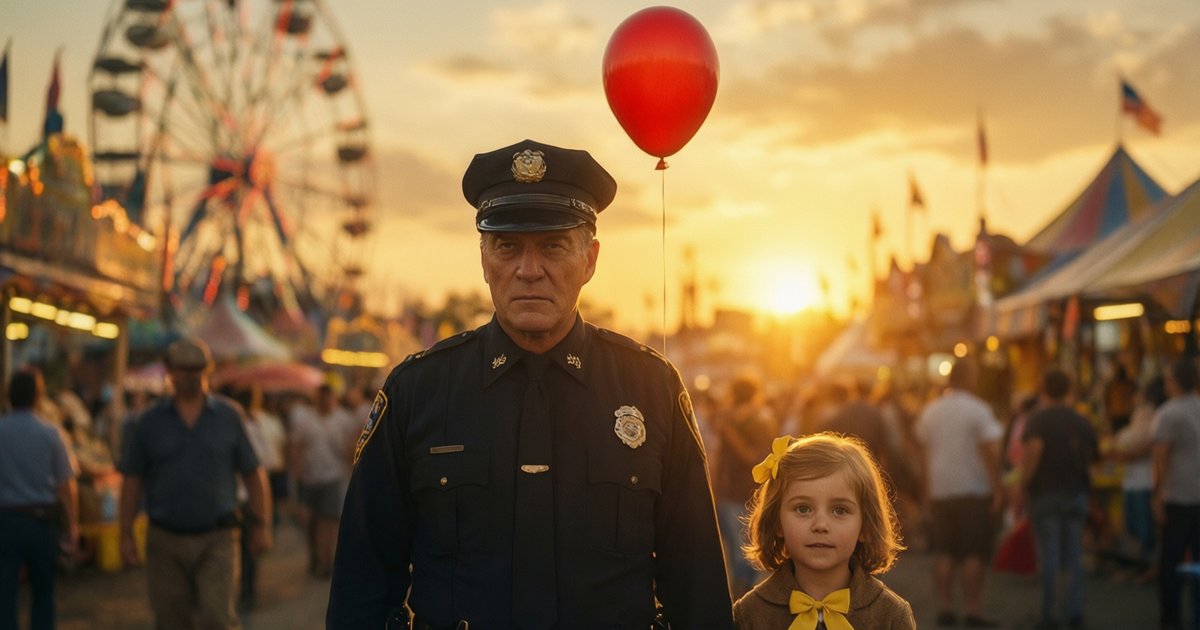
The Red Balloon of Fairweather County Fair
Fiction. This is an original, made-up story: names, characters and events are invented, and any resemblance to real people or events is coincidental.
Full story · 8 chapters · Read in 4 parts instead
Listen to this story (4 parts)
Part 1 · 5 min
Part 2 · 5 min
Part 3 · 5 min
Part 4 · 5 min
Chapter 1
"I DON'T CARE ABOUT THE RULES, I WANT MY BALLOON BACK!"
The scream ripped through the humid August air, sharp enough to cut through the noise of the Ferris wheel. I stood there, my boots planted firmly in the sawdust, staring at a six-year-old girl whose face was a shade of crimson that matched the object she was mourning.
A crowd had gathered. People were whispering, some smirking at the spectacle. My partner, Toby, looked at me with pity and hesitation. I felt the familiar tightening in my chest, the urge to shut it all down, to cite a regulation, to move the crowd along and return to the sterile safety of my schedule.
I looked at the girl. Her oversized yellow bow was crooked, and her small hands were clenched into fists. She wasn't just crying; she was grieving. It was a raw, unfiltered emotion that I had spent twelve years meticulously scrubbing from my own life.
I checked my watch. 6:12 PM. I was already late for the first date I'd had in a decade. The protocol was clear: a lost toy is not a police emergency. My reputation as 'The Stone Wall' was built on that kind of clarity. I didn't do emotions. I didn't do exceptions.
But as I looked into her eyes, the world around us blurred. The aroma of fried dough and diesel fuel faded, replaced by a memory of a bedroom that had been empty for far too long.
But to understand why a simple piece of latex and helium could break a man like me, you need to know how it all began. Three hours earlier...
Chapter 2
I spent twenty minutes in front of the mirror adjusting my tie. Every fold had to be precise. Every crease sharp. Order was the only thing that kept the chaos of the past from leaking into the present.
I checked my watch. 3:00 PM. I had precisely three hours of patrol left before my reservation with Joanne. Joanne owned the local diner and had a way of looking at me—really looking at me—that made me feel like my armor was made of glass.
"You're shaking, Calvin," Toby said, leaning against the patrol car. He was twenty-nine, eager, and wore his uniform like it was a suggestion rather than a requirement. He saw the human side of Fairweather; I saw the infractions.
"I am not shaking," I replied, my voice flat. "I am preparing."
"It's just dinner, not a deposition," Toby chuckled. He noticed me instinctively touching the small, faded red ribbon tied to my badge strap. It was a frayed piece of fabric, nearly colorless now, but it was the only thing I had left from a favorite dress. I didn't tell him that. I never told anyone.
"The fair is going to be a madhouse tonight," Toby warned, glancing at the horizon where the carnival lights were beginning to flicker on. "People get reckless when there's cotton candy and loud music involved."
I didn't care about the music or the candy. I cared about the clock. My life was a series of timed intervals, a carefully constructed fortress of punctuality. If I stayed on schedule, I could control the outcome. If I controlled the outcome, I didn't have to feel the void.
"Just keep the perimeter clear," I told him. "I want a quiet shift."
Fate, it seemed, had other plans for the Fairweather County Fair.
Chapter 3
By 4:30 PM, the fairgrounds were a sea of humidity and noise. The grit of sawdust and the sting of hot grease filled the air. I walked the main strip, my eyes scanning for disturbances, my pace rhythmic and unwavering.
That was when I saw her. A small girl in a bright yellow dress, clutching a red balloon as if it were a lifeline. She wasn't just holding it; she was whispering to it.
I stopped a few feet away. She didn't notice me.
"And then we'll go see the goats, Barnaby," she told the balloon. "And maybe we'll get a corn dog, but only if Mommy says yes."
I found the chatter irritating. It was illogical. A balloon is a sphere of air and rubber; it doesn't have a name, and it certainly doesn't have an opinion on corn dogs. I shifted my weight, my boots crunching on the gravel.
She looked up and caught my eye. Instead of the usual fear children had for the 'Stone Wall,' she beamed. It was a smile that reached her eyes, genuine and unfiltered.
"Hello, Officer!" she chirped. "This is Barnaby. He's my best friend for the day."
"It's a balloon, kid," I said, my voice devoid of inflection.
"He's not just a balloon," she insisted, hugging the string to her chest. "He's a brave explorer. He's helping me find the biggest pumpkin in the whole county."
I looked at my watch. 4:42 PM. I had no time for imaginative play. I gave her a curt nod and began to walk away, but as I did, I felt a strange prickle at the back of my neck. She reminded me of someone. A ghost of a laugh, a specific way of tilting her head.
I pushed the thought down. I didn't do ghosts. I did patrol routes. I kept walking, the rhythm of my boots masking the sudden, unsteady beat of my heart.
Chapter 4
It happened in a heartbeat. A sudden, violent gust of wind swept through the midway, knocking over a display of carnival games and sending napkins flying like confetti.
Maddie—I'd learned her name from the woman trailing behind her—gasped. The string slipped from her small, sweaty palm.
I watched in slow motion as the red balloon soared. It didn't drift away into the gray Ohio sky. Instead, it was sucked upward by a draft, dancing precariously before getting snagged in the high, rusted rigging of the 'Sky-High Spinner.'
It hung there, twenty feet up, vibrating violently in the wind. The string was wrapped tightly around a steel support beam, just out of reach of any ladder the fair staff possessed.
Maddie didn't scream at first. She just froze. Her eyes widened, tracking the red dot against the industrial gray of the ride. Then, the silence broke. A wail erupted from her that sounded less like a child losing a toy and more like a heart breaking in real-time.
"Barnaby!" she shrieked, reaching upward.
Her mother tried to soothe her, offering to buy another one. "Honey, look, there's a vendor right there. We can get a blue one, or a yellow one!"
Maddie backed away, shaking her head violently. "Not a blue one! I want Barnaby!"
I stood there, my hand resting on my utility belt. This was the moment where I should have stepped in as the professional. I should have told the mother that a balloon is replaceable. I should have reminded the child that objects are temporary.
But as I looked at Maddie's face—the absolute, crushing devastation of a loss she couldn't understand—the fortress I'd built around myself began to crack. I saw a seven-year-old girl in a red dress. I felt the coldness of a hospital room. The sharp, chemical tang of antiseptic that had haunted my dreams for twelve years rushed back.
I wasn't looking at a balloon anymore. I was looking at the end of a world.
Chapter 5
"It's just a toy, Calvin," Toby whispered, stepping beside me. "The kid will get over it in ten minutes. Besides, you've got that date. You're already pushing it."
I didn't answer. I couldn't. I was staring at the red balloon, fluttering like a trapped bird against the steel beam.
For twelve years, I had functioned as a machine. I woke up at 5:00 AM, I drank black coffee, I enforced the law, and I slept in a house that was too quiet. I had survived by deciding that feeling was a liability. If I didn't care about the small things, the big tragedy couldn't hurt me anymore.
But Maddie's grief was an invitation. It was a mirror reflecting the exact moment my own world had stopped turning. The desperation in her eyes wasn't about the rubber; it was about the attachment. The belief that something precious could be lost and never recovered.
I looked at my watch. 5:15 PM. The reservation was for 6:00 PM. Joanne would be waiting. She was a woman of kindness and patience, the first person in a decade who had made me feel like Calvin the man, rather than Officer Holloway the wall.
If I walked away now, I would save my date. I would maintain my reputation. I would stay safe in my numbness.
I looked at Maddie. She had collapsed into a small heap on the sawdust, her shoulders shaking. Her mother was talking, but the girl wasn't listening. She was staring at the sky, waiting for a miracle.
I felt a surge of something I hadn't felt in a long time: a desperate, irrational need to fix something that was broken.
"Toby," I said, my voice sounding foreign to my own ears. "Go find the ride operator for the Spinner. Tell him I need the ride powered down and a safety harness."
Toby stared at me. "You're joking. You're going to risk a safety violation for a balloon?"
"Go," I commanded. "Now."
Chapter 6
The next hour was a blur of friction and frustration. The ride operator, a greasy man named Sal, didn't want to stop the ride. It was peak hour, and every minute of downtime cost him money.
"It's a piece of plastic, Officer!" Sal yelled over the roar of the machinery. "I can't shut down the Spinner for a balloon!"
I didn't shout back. I didn't have to. I stepped into his space, my face an expressionless mask, and began reciting the specific safety codes regarding unsecured debris in the machinery of an amusement ride. I cited Section 4 of the County Fair Ordinance, referencing potential hazards to the public if the balloon were to pop and get sucked into the gears.
Sal groaned, but he knew my reputation. I didn't bend. I didn't negotiate. I used the very rigidity that people hated about me to force his hand.
When the ride finally groaned to a halt, I didn't wait for the maintenance ladder. I climbed the external scaffolding, my boots slipping on the metal rungs. The height made my head swim, and for a moment, the wind threatened to knock me off balance.
I reached the rigging, my fingers straining. I could see the red ribbon of the balloon just inches away. I lunged, my jacket snagging on a bolt, ripping the fabric of my uniform shoulder.
I didn't care. I grabbed the string.
As I descended, I felt the burden of the hour. I had spent sixty minutes arguing, climbing, and risking a reprimand for a toy. I had completely ignored the clock. I had broken the schedule.
When I reached the ground, I was covered in grease and sawdust. My uniform was torn. My hair was a mess. I looked like a man who had been in a fight with a carnival ride and lost.
Maddie was still there, her eyes wide. I walked over to her and held out the red balloon.
"Barnaby is back," I said.
She didn't just take the balloon; she threw her arms around my legs in a crushing hug. I froze. I didn't know how to react to a hug. I stood there, stiff as a board, while a six-year-old girl squeezed the breath out of me.
I checked my watch. 6:45 PM. I was forty-five minutes late.
Chapter 7
I arrived at Joanne's diner in a state of total disarray. I walked through the door, the chime of the bell sounding like a funeral knell.
Joanne was sitting in the corner booth, a glass of untouched iced tea in front of her. She looked at me, and her eyebrows shot up. She didn't see the 'Stone Wall.' She saw a man with a ripped shoulder, grease stains on his forehead, and a dirty red balloon tied to his wrist.
"Calvin?" she asked, her voice a mix of confusion and amusement. "What on earth happened to you? You look like you fought a lawnmower."
I slid into the booth, the vinyl sticking to my damp trousers. I felt exhausted—not physically, but emotionally. The wall had collapsed, and the wind was blowing through everything.
"I had a... situation at the fair," I muttered. "I'm sorry I'm late, Joanne. Truly."
Joanne didn't look angry. She looked curious. She reached out, her fingers brushing the red balloon. Then, her gaze shifted to my chest, to the faded, frayed red ribbon tied to my badge strap.
"I've seen you wear that ribbon for three years, Calvin," she said softly. "Every single day. You never talk about it. You never even look at it. But today... today you're holding a red balloon."
I looked down at the ribbon. For years, I had treated it as a relic, a piece of evidence of a crime committed by fate. I had kept it because I couldn't throw it away, but I had hidden it because looking at it felt like pressing a bruise.
"It belonged to my daughter," I whispered. The words felt heavy, like stones leaving my mouth. "Lily. She was seven. She loved red. Everything she owned was red."
Joanne reached across the table and took my hand. Her palm was warm, a stark contrast to the coldness I'd lived in for twelve years.
"Tell me about her," she said.
I started to speak. I told her about the laughter, the red dresses, and the sudden silence that had followed. I told her how I had tried to police my grief, to put it under arrest and lock it away. I realized that for the first time in a decade, I wasn't trying to control the time. I was just existing in it.
Chapter 8
The next morning, I didn't go straight to the station. I drove back to the fairgrounds during the cleanup shift. I found Maddie and her parents near the exit.
I didn't need the balloon back—I'd given it to her the night before—but I wanted to see her one last time. I wanted to make sure the world was still turning.
"Officer Calvin!" she yelled, running toward me. She was still wearing that oversized yellow bow, though it was now smeared with something that looked like blue cotton candy.
"Hello, Maddie," I said. I didn't stand as stiffly this time. I leaned down, meeting her at eye level.
"Thank you for saving Barnaby," she said, handing me a crumpled drawing of a red balloon and a police car. "You're a hero."
I took the drawing. A hero. It was a word I didn't feel I deserved, but as I looked at the crude crayon lines, I felt a lightness in my chest that I hadn't known since I was a father.
I returned to the station and saw Toby. He was grinning. "I heard you got a formal warning from the Captain for the 'safety violation' at the Spinner. Tough break, Stone Wall."
I looked at the warning on my desk. I didn't feel the usual surge of anxiety about my record. I didn't care about the protocol.
"I can live with a warning," I told him.
That evening, Joanne and I walked through the fairgrounds one last time, just to watch the lights dim. The humidity had broken, replaced by a cool breeze that carried the crisp edge of autumn.
I reached up and loosened my tie, pulling it away from my collar. I felt the red ribbon on my badge flutter in the wind. For the first time, I didn't try to pin it down. I didn't try to hide it. I let it dance, a small, frayed piece of red silk moving in time with the world around me.
The End