 Porchlight Tales
The Replica Gown of Oak Creek
Fiction. This is an original, made-up story: names, characters and events are invented, and any resemblance to real people or events is coincidental.
Full story · 8 chapters · Read in 4 parts instead
Listen to this story (4 parts)
Part 1 · 5 min
Part 2 · 4 min
Part 3 · 4 min
Part 4 · 5 min
Chapter 1
"I THINK THE BLUSH ROSES WOULD BE MORE 'BRIDAL,' DON'T YOU?" Marguerite’s voice sliced through the air, her eyes scanning my outfit for flaws. I stood frozen in her sprawling estate, the tightness in my chest returning. I am a museum archivist; my professional life is dedicated to order, preservation, and the quiet management of chaos. My personal life, however, had always been a precarious bridge. Having grown up with a father who treated the interstate like a permanent home, I craved stability. I wanted a seamless transition into Harrison’s family, a peace so absolute it felt like a sanctuary.
Marguerite didn't hug me. She patted my shoulder, her fingers fidgeting with a small, vintage pearl brooch pinned to her cream blazer. The brooch was an heirloom, a shimmering orb she touched whenever she was calculating her next move.
We walked toward the sunroom, where the floral arrangements for the weekend were being staged. Marguerite stopped abruptly, frowning at the ivory peonies. "The peonies feel a bit... rustic for a wedding of this stature."
I felt the familiar urge to swallow my protest. "I thought we agreed on the peonies, Marguerite. They're Harrison's favorite."
"Harrison is young," she replied with a thin, practiced smile. "He doesn't understand the optics of a legacy wedding."
I retreated to the guest room to unpack, my pulse thrumming in my throat. I opened my suitcase and reached for my observation journal—a habit from the archives where I documented every nuance of a collection. I noted: 'October 12, 4:00 PM. Floral dispute. Subject remains focused on optics over preference.'
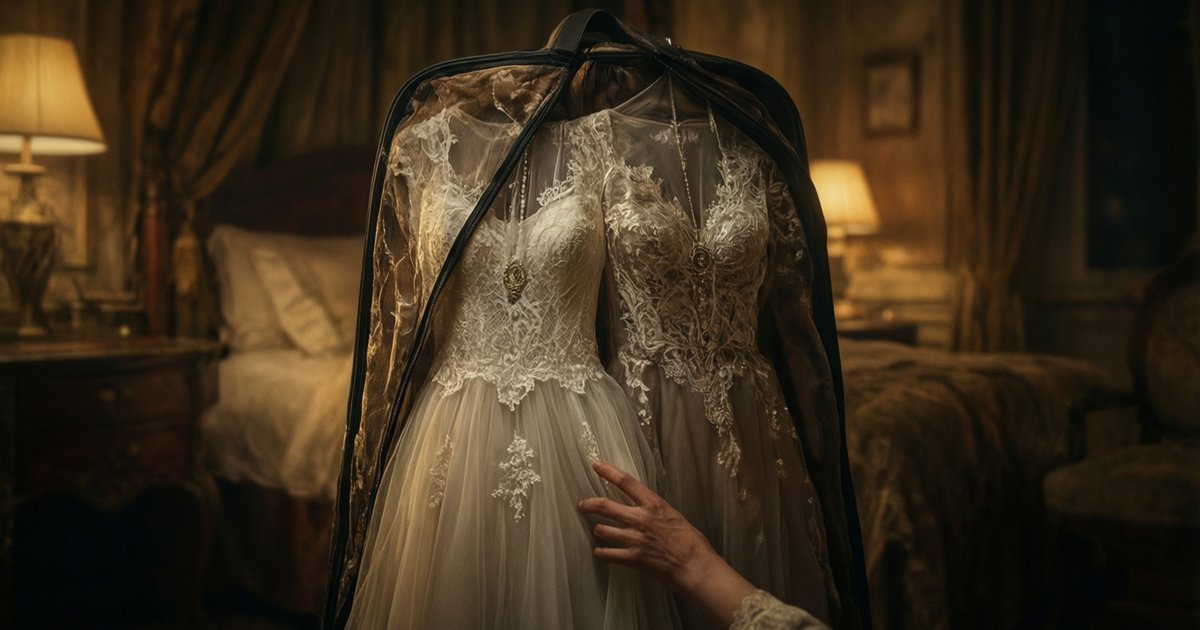
As I turned to hang my clothes, I noticed a heavy, locked garment bag tucked deep in the guest room closet. It wasn't mine. It was oversized, pristine, and hidden as if it were a secret.
Chapter 2
The lock on the garment bag was a simple slide-latch, easily bypassed. I told myself I was merely being a diligent archivist, documenting the contents of the room. But as the zipper slid open, the breath left my lungs.
Inside was a gown. Not just any gown, but an exact, mirror-image replica of my custom dress. The same architectural bodice, the same intricate Alençon lace trailing down the skirt, the same delicate silk buttons running down the spine. It was a masterpiece of theft. I had spent six months working with a designer in the city to create something unique, something that felt like me. Seeing it here, in Marguerite's house, felt like a violation of my very identity.
I stared at the fabric, my hands shaking. The sharp, sterile tang of industrial dry-cleaning fluid clung to the silk. How had she seen the sketches? Who had she paid? My mind raced through the possibilities, the avoidant part of me wanting to zip it back up and pretend I'd seen nothing. I couldn't handle the confrontation; I couldn't risk the stability I had fought so hard to build with Harrison.
"It's a stunning piece, isn't it?"
I spun around. Marguerite was leaning against the doorframe, her silhouette framed by the golden afternoon light. She didn't look guilty; she looked triumphant. She stepped into the room, her fingers again dancing over that pearl brooch.
"Marguerite, why on earth do you have my dress?" I whispered, my voice cracking.
She glided forward, touching the lace with a proprietary air. "My dear, it's not your dress. It's a tribute. I simply felt that your taste was so refined that it deserved to be echoed. I thought it would create a beautiful, cohesive visual theme for the family. A sort of... generational harmony."
I looked at her, the 'generational harmony' sounding like a threat. "You intend to wear this to the wedding?"
"The morning photos, at least," she replied, her voice as smooth as polished marble. "It's a tribute, Rosalind. Surely you aren't that selfish?"
Chapter 3
I found Harrison in the library, sketching a detail for his next project. He looked so peaceful, the soft light catching the line of his jaw. I loved him for that peace, but in this moment, it felt like a wall.
"Harrison, we have a problem," I started, my voice trembling. I told him about the dress, the replica, the sheer audacity of it. I expected him to be horrified, to tell his mother that this was crossing a line.
Harrison sighed, not looking up from his drafting table. "Rosalind, you know how Mom is. She’s a former pageant coach; she thinks in terms of production. It’s just a dress. She probably just wants to feel connected to you."
"Connected? She’s wearing my bridal gown!"
"It's only for a few photos," he urged, finally looking at me with those pleading, conflict-averse eyes. "Please, just let it go for the sake of the weekend. We've spent so much money on this venue, and she's paying for the catering. If we start a war now, the whole weekend will be miserable. Can't you just... be the bigger person?"
I felt a coldness settle in my stomach. I was being asked to play the martyr again, to suppress my boundaries for the sake of a superficial peace. I left the room without another word, retreating to the guest room.
While searching for a pen, I noticed a small slip of paper that had fallen from the garment bag’s inner pocket. It was a tailor's receipt from a boutique in Manhattan. The date was from four months ago.
Marguerite hadn't just seen my dress; she had planned this. She had commissioned the replica months before I had even finished my final fitting. This wasn't a spontaneous 'tribute.' It was a calculated ambush. I opened my journal and wrote: 'October 13. Harrison chooses silence over support. Subject’s plan was premeditated. Evidence: Receipt dated June 15.'
Chapter 4
The rehearsal dinner was held in the estate's glass-walled conservatory, surrounded by the vivid oranges and reds of the autumn foliage. The air was heavy with the aroma of roasted garlic and expensive perfume. I spent the evening smiling until my cheeks ached, while Marguerite played the perfect hostess.
As the wine flowed, Marguerite began her campaign of subtle erosion. She leaned toward a group of our extended relatives, her voice loud enough to carry across the table. "I actually guided Rosalind through the design process," she told them, glancing at me with a saccharine smile. "I felt the original sketches lacked a certain... maturity. I'm so glad she took my advice on the lace pattern."
I gripped my fork, the metal digging into my palm. I hadn't taken her advice; I had hidden my sketches from her.
"It's so wonderful when a mother and daughter-in-law are in such sync," an aunt chimed in.
"Exactly," Marguerite purred. Then, she paused for effect, the pearl brooch catching the light. "And because we are so aligned, I've decided to wear a similar white ensemble for the morning photos tomorrow. A little nod to the bride. I think it will add a certain ethereal quality to the album."
The table erupted in soft 'ohs' and 'ahs.' I looked at Harrison. He was staring at his plate, avoiding my gaze. He knew. He knew exactly what was happening, and he was letting it happen because it was easier than stopping it.
As the dinner wound down, a knot of tension tightened in my gut. This wasn't about a dress; it was about ownership. Marguerite didn't see me as a new member of the family; she saw me as a supporting character in her final grand production. I realized then that if I didn't draw a line, I would spend the rest of my marriage as a ghost in my own life.
Chapter 5
Sloane, my best friend and wedding planner, found me hiding in the kitchen, staring at a bowl of lemons. She didn't do 'subtle.' Sloane was a storm of efficiency and honesty.
"I heard the announcement," Sloane said, crossing her arms. "Rosalind, you cannot let this happen. You are the bride. Not her. Not 'them.' You."
"I don't want to ruin the weekend, Sloane. Harrison wants peace."
"Peace is not the same as submission," Sloane countered. "You're playing the martyr, and all you're doing is teaching Marguerite that your boundaries are negotiable. Demand she change the dress. Now."
Fueled by Sloane’s bluntness and a sudden, searing anger, I walked back into the living room. I found Marguerite alone, sipping a glass of Chardonnay.
"You cannot wear that dress tomorrow," I said, my voice steady for the first time all weekend.
Marguerite didn't even look up. "Excuse me?"
"The replica. It's unacceptable. Change your outfit, or I will ensure the morning photos don't happen at all."
Marguerite set her glass down with a sharp clink. The mask of the gracious hostess slipped, revealing a woman terrified of irrelevance. "You think you're replacing me, don't you? You think because you're the 'new' woman in the house, I'm just a relic. I built this family's image. I coached Harrison into the man he is. You are just a temporary addition."
"I'm his wife, Marguerite!"
"Not yet," she snapped, her eyes flashing. "And let me remind you that I am the one funding the venue and the catering. One phone call, and this 'seamless transition' of yours becomes a very expensive disaster. Now, go back to your room and remember your place."
I stood there, frozen. She had used the one thing I feared most—instability—as a weapon. The threat of financial ruin for the wedding was a leash, and she had just yanked it tight.
Chapter 6
That night was the darkest hour of my life. I lay in the guest bed, listening to the wind howl through the Hudson Valley. I felt trapped in a cage made of ivory lace and social expectations. I loved Harrison, but a devastating realization had taken root: Harrison would never stand up to her unless he was forced to see the cost of his silence.
He came into the room around midnight. "I heard you and Mom fighting," he said softly. "Rosalind, please. Just let her have this one thing. It's just one morning. Why does it have to be a battle?"
I didn't answer. I couldn't. I just pointed to my observation journal lying open on the nightstand.
Harrison frowned and picked it up. He began to read. He read the entry about the floral arrangements. He read the note about the tailor's receipt from June. He read my documentation of every subtle dig, every manipulation, and every time he had asked me to 'just let it go.'
I watched his face change. He wasn't reading a diary; he was reading an archive. He saw the pattern. For years, he had viewed his mother's behavior as 'eccentricity' or 'love.' Seeing it written down—dated, timed, and evidenced—stripped away the nostalgia. He saw that his mother didn't love him unconditionally; she loved the version of him that she could control.
"She ordered the dress in June?" he whispered, his voice hollow. "She told me you had suggested a matching theme for the family."
"She lied to you, Harrison. And you let her lie to me."
He looked at me, and for the first time, I saw a flicker of the man I knew he could be—a man who could protect something other than his own comfort. But the wedding was tomorrow. The trap was already set, and Marguerite was already dressed for victory.
Chapter 7
The morning of the wedding dawned crisp and clear, the frost clinging to the edges of the hydrangea bushes. I woke up feeling a strange, cold clarity. I was no longer the girl who feared the interstate; I was an archivist. I knew how to handle delicate materials, and I knew how to expose a fraud.
When I stepped into the hallway, I saw her. Marguerite was already dressed in the replica gown. She looked radiant, a silver-haired vision of ivory and lace. She stood at the top of the stairs, her hand resting on the banister, looking down at me with a triumphant glow. She didn't say a word; she didn't have to. The dress said it all: I am still the center of this world.
Sloane leaned in and whispered, "Are you really going to let her walk out there like that?"
I looked at Marguerite, then at the reflection of myself in the mirror—wearing the same dress, the same lace, the same silhouette. To an outsider, we would look like twins. To anyone who knew the truth, it was a grotesque pantomime.
"I'm not changing my dress," I told Sloane. "And I'm not asking her to change hers."
I had spent the morning making a few phone calls. I had spoken to the photographer, a young man who was more interested in 'artistic lighting' than social hierarchy. I had also spoken to Harrison, who was waiting for me in the foyer, his face pale and determined.
As I began my descent down the stairs, Marguerite smiled, expecting me to crumble or concede. Instead, I leaned in and whispered, "The lighting is going to be interesting today, Marguerite."
I didn't enter the church with a smile of submission. I entered with the knowledge that the archive was complete. The truth was no longer a secret kept in a journal; it was about to become a public record.
Chapter 8
The ceremony was breathtaking, but the tension was a physical weight. Throughout the morning photos, I had ensured the photographer used high-contrast, stark lighting. In the images, I looked like a bride—luminous and fresh. Marguerite, in the same gown, looked like a costume. The dress, designed for a twenty-eight-year-old's frame, hung awkwardly on her, making her look like a vintage eccentric playing dress-up. The 'tribute' had become a caricature.
But the real confrontation happened at the altar's edge, just before the vows. As the music swelled, I stopped. I looked at Harrison, then at Marguerite, who was seated in the front row, still radiating a delusional sense of victory.
I leaned into Harrison and spoke loud enough for the first three rows to hear. "I love you, Harrison. But I will not enter this marriage as a supporting character in your mother's production. I will not walk down this aisle unless you tell her, right here, that the manipulation ends today."
The guests gasped. The silence was absolute. Marguerite’s face tightened; she reached for the pearl brooch, her fingers twitching.
Harrison looked at his mother. He saw the brooch, the symbol of the 'matriarch,' and he saw the woman who had lied to both of us for a dress. For the first time in thirty years, Harrison didn't choose the path of least resistance.
"Mom," Harrison said, his voice echoing through the chapel. "The dress was a mistake. The lies were worse. You need to go to the vestry and change into the modest robe the venue provided for the guests. Now."
Marguerite looked as if she had been struck. The power shifted in a single heartbeat. She didn't fight; she couldn't. The public exposure was a blow she couldn't recover from. She rose slowly and walked away, the heavy lace of the replica gown trailing behind her like a defeated flag.
We finished the ceremony in a blur of genuine emotion. As we left the reception early to escape the gossip, I glanced back at the vanity in the bridal suite. There, lying forgotten on the marble surface, was the pearl brooch. Marguerite had left it behind—a surrendered crown. We drove away into the autumn mist, the road ahead open, stable, and finally, entirely our own.
The End