 Porchlight Tales
The Rusted Mustang and the Boy Who Didn't Run Away
Fiction. This is an original, made-up story: names, characters and events are invented, and any resemblance to real people or events is coincidental.
Full story · 6 chapters · Read in 3 parts instead
Listen to this story (3 parts)
Part 1 · 3 min
Part 2 · 3 min
Part 3 · 3 min
Chapter 1
Arthur didn't just dislike the neighborhood kids; he treated his pristine Kentucky Bluegrass lawn like a sacred sanctuary. At seventy-two, his voice had become a weapon, a gravelly roar that could send a group of biking ten-year-olds scattering in seconds. To the kids of Maple Street, he was simply 'The Grump,' a man whose heart was as hard as the concrete driveway he scrubbed every Saturday morning.
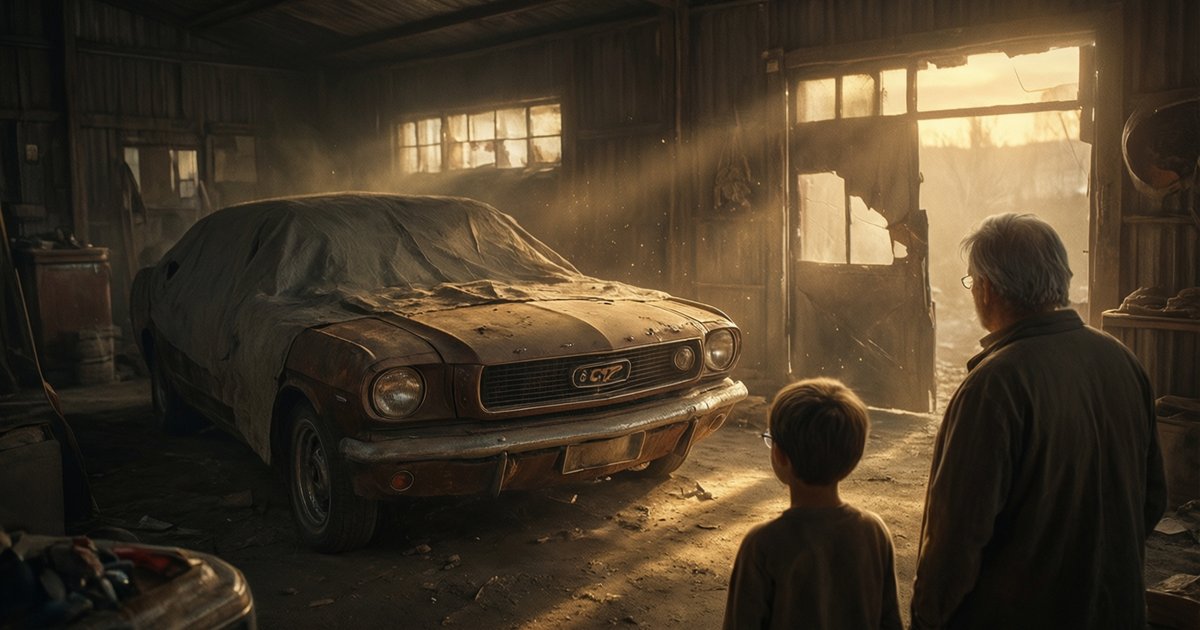
Leo was different. He was a skinny kid with oversized glasses and a fascination for things that were broken. While other kids dodged Arthur's porch, Leo spent his afternoons staring at the cracked garage door. Through a sliver of an opening, he had spotted it: the jagged, rusted silhouette of a 1967 Ford Mustang. It looked like a sleeping beast, covered in a thick shroud of gray dust and forgotten memories.
One Tuesday, Leo didn't run when Arthur yelled. Instead, he stepped right onto the forbidden grass, clutching a worn-out microfiber cloth in his small hand.
Chapter 2
"Get off my lawn, kid!" Arthur bellowed, his face reddening as he stepped onto the porch. The screen door slammed with a metallic crack that echoed down the street.
Leo didn't flinch. He pointed toward the garage. "Is it a Fastback?" he asked, his voice small but steady.
Arthur froze. The anger in his eyes flickered, replaced by a momentary look of profound confusion. He hadn't heard that word—Fastback—in nearly two decades. He looked at the boy, then at the garage, then back to the boy. The silence stretched, heavy with the scent of freshly cut grass and old engine oil.
"It's a heap of junk," Arthur spat, though the venom was gone. "Now beat it before I call your parents."
Leo didn't leave. "I have a polishing kit at home. My dad taught me how to bring out the shine on chrome. I can help you. For free."
Arthur scoffed and turned away, but as he walked back inside, he didn't lock the garage door.
Chapter 3
The agreement was silent. Leo showed up every day at 4:00 PM. For the first week, Arthur didn't speak; he simply stood behind the boy, arms crossed, watching Leo scrub the grime off the front bumper. The garage was a time capsule, smelling of stale tobacco and oxidized metal.
Slowly, the conversation shifted from the car to the mechanics of the engine. Leo talked about his dreams of becoming an aerospace engineer, and Arthur, almost unconsciously, began to share tips on torque and timing. He discovered that Leo wasn't just a helper; he had a natural intuition for machinery that mirrored Arthur's own youth.
One afternoon, as they worked on the driver's side door, Leo noticed a faded photograph tucked into the sun visor. It showed a young Arthur, beaming with pride, leaning against the same car, with a woman whose smile lit up the grainy black-and-white image.
"Who is she?" Leo whispered.
Arthur's posture stiffened, and for the first time, Leo saw the old man's hands shake.
Chapter 4
The mood in the garage shifted. Arthur stopped talking about the engine and started talking about Clara. She had been a nurse, a woman who loved the wind in her hair and the roar of the V8 engine on open highways. They had planned to drive across the country in that Mustang for their tenth anniversary, but a sudden illness had stolen her away before they could even pack the trunk.
"I couldn't look at it," Arthur admitted, his voice cracking. "Every time I saw the red paint, I saw the trip we never took. So I shut the door. I shut everything."
Leo looked at the car, which was now starting to glow with a deep, crimson luster. He realized that the car wasn't just a machine; it was a monument to a grief that had frozen Arthur in time for twenty years.
"Maybe the trip isn't over," Leo suggested softly.
Arthur laughed, a dry, hollow sound. "The engine is seized, kid. It's a paperweight."
Chapter 5
Leo didn't accept that answer. He spent his entire allowance on a vintage parts catalog and spent his weekends researching forums. He started bringing over specific tools—a socket wrench here, a new spark plug there. He convinced his father, a local mechanic, to swing by on a Sunday to give the car a professional diagnostic.
For three months, the garage became a sanctuary of grease and determination. Arthur found himself waking up early, not to yell at kids, but to prepare coffee for the boy. He started bringing out cookies his sister baked, and the neighborhood began to notice a change. The 'Grump' wasn't yelling anymore. He was laughing.
One rainy November afternoon, they reached the final stage. Arthur sat in the driver's seat, his weathered hand gripping the steering wheel. Leo stood outside, his face pressed against the glass, eyes wide with anticipation.
Arthur turned the key. The engine coughed, sputtered, and died. He tried again. Silence. On the third attempt, the engine roared to life with a thunderous growl that shook the very foundations of the garage.
Chapter 6
The neighborhood gathered on the sidewalk as Arthur slowly backed the shimmering red Mustang out of the driveway. The car looked brand new, a streak of fire against the gray autumn sky.
Arthur didn't drive to the grocery store or the post office. He drove to the local veterans' cemetery, with Leo sitting proudly in the passenger seat. He parked beside a modest headstone and placed a single red rose on the granite.
"We're a bit late for the anniversary, Clara," Arthur whispered, his voice thick with emotion. "But I brought a friend."
When they returned home, Arthur didn't go back inside. He stood on his porch and waved to the kids playing on the street, inviting them over to see the car. He realized that while he had spent years trying to keep the world out of his garden, he had accidentally let a ten-year-old boy plant something new in his heart.
Leo looked up at the old man and smiled. They weren't just neighbors anymore; they were a crew. And they had a whole lot of road left to cover.
The End