 Porchlight Tales
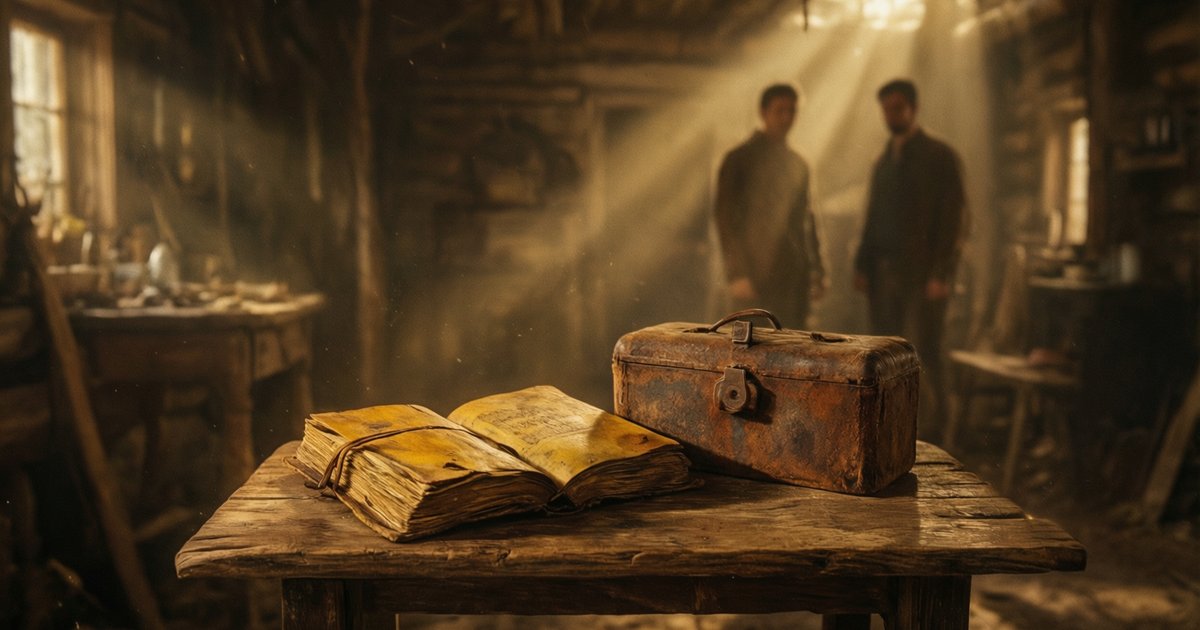
The Secret of the Lake Oconee Cabin
Fiction. This is an original, made-up story: names, characters and events are invented, and any resemblance to real people or events is coincidental.
Full story · 9 chapters · Read in 5 parts instead
Listen to this story (5 parts)
Part 1 · 5 min
Part 2 · 5 min
Part 3 · 5 min
Part 4 · 5 min
Part 5 · 3 min
Chapter 1
"WE JUST SIGN THE PAPERS, CLEAR THE JUNK, AND LEAVE," I snapped, my voice tight enough to snap.
Callum didn't even look at me. He just stood there, staring at the peeling gray paint of the porch like it held the secrets to the universe.
I adjusted my cufflinks, feeling the oppressive Georgia heat warp the crisp lines of my suit. The humidity of Lake Oconee clung to my skin like a wet wool blanket the moment I stepped out of my leased Audi. Beside me, my brother looked like he’d just rolled out of a van, wearing a faded flannel shirt and clutching a sketchbook.
We hadn't spoken in ten years—not since a blowout fight at our mother's funeral—and now we were here to liquidate the only thing we had left: a weathered cedar cabin that carried the sharp scent of damp pine and old mothballs.
"The buyer wants it closed by November," I added. "I don't have time for a trip down memory lane, Callum."
"Some of us actually value things that can't be measured in a billable hour, Garrett," he replied softly.
The tension was a living thing between us, thick as the stagnant water lapping against the shore. Inside, the cabin was a time capsule of 1992. Dust motes danced in the shafts of afternoon light, settling on moth-eaten curtains and a heavy oak table. While I began aggressively bagging old magazines, my foot caught on a loose floorboard near the hearth.
I paused, kneeling to pry the wood up, expecting a termite nest. Instead, I found a rusted, locked metal tackle box. It was heavy, its surface pitted with corrosion, looking as if it had been intentionally buried.
I stared at the lock. For a second, a surge of childhood longing hit me—the desperate need for the man who had walked out on us to have left something behind. But the feeling was quickly replaced by a cold, corporate pragmatism. I shoved the box into a corner, refusing to acknowledge the drumming of my heart.
"Just more junk," I muttered, though I didn't move it toward the trash pile.
Chapter 2
The second day began with the oppressive sound of cicadas screaming in the trees. Callum had spent the morning sketching the porch, his pencil scratching rhythmically against the paper. I, meanwhile, was attacking the old study, determined to strip the room bare.
I pulled open a heavy mahogany desk, its drawers sticking with age, until I noticed a false back in the bottom compartment. With a sharp tug, a leather-bound journal slid out. The cover was cracked, the pages yellowed and carrying the stale musk of old tobacco.
I opened it to the first entry, dated July 14, 1992. The handwriting was frantic, a sharp contrast to the steady hand I remembered from my father's few remaining postcards.
'I can't breathe in this house anymore,' the entry read. 'The pressure is mounting, and I can see the look in the old man's eyes. He thinks he can fix me, but he's just pushing me toward the edge. If I stay, I'll destroy the boys. If I leave, I might save them.'
I froze. The official story had always been that our father, Harlan, had simply grown tired of the burden of fatherhood and vanished into the ether of the American West. He was the villain of our childhood, the man who decided that a corporate law degree and a freelance photography career weren't enough reasons to stay.
"Find something?" Callum asked, leaning against the doorframe. He noticed the book in my hand and walked over, his expression shifting from curiosity to intensity.
We sat on the dusty floor, shoulder to shoulder for the first time in a decade, reading the early entries. The words suggested a different narrative: Harlan hadn't walked away from us; he had been pushed. The 'old man' mentioned in the diary was our grandfather, the patriarch of the family whose shadow still loomed over our lives.
I felt a flicker of doubt. All my life, I had chased success to prove I was 'enough' to make my father stay, but the diary suggested the exit was a forced move.
Chapter 3
By mid-afternoon, the air grew thick and heavy, mirroring the mood in the cabin. We had found an old Polaroid of the three of us—Harlan, Callum, and I—standing on the dock. I remembered that day as a triumph; I had just won a regional debate trophy, and my father had beamed with pride.
But Callum looked at the photo and frowned.
"You remember it wrong," he said softly. "That was the day he told me I had a 'gift' for seeing the world, but that gifts don't pay the mortgage. He sounded defeated, not proud."
"He was proud of me," I snapped, the old insecurity flaring. "I was the one who followed the rules. I was the one who did everything right. You were always the dreamer, the one he could just 'encourage' while I had to be the pillar."
"Is that what you think?" Callum stood up, his voice rising. "You think being the golden boy made you the favorite? You were so focused on the trophy that you didn't notice he was falling apart. You didn't see him crying in the garage the night before he left. I did."
The argument spiraled, dredging up years of resentment. I accused Callum of romanticizing a ghost; he accused me of being a hollow shell of a man who only cared about the sale price of the property. It was a collision of two different memories, two different traumas.
"Maybe we should just call the realtor and let them handle the clear-out," Callum shouted, grabbing his bag. "I can't do this with you."
He stormed toward the door, the screen door slamming shut with a violent crack that echoed across the silent lake. I stood alone in the center of the room, surrounded by the debris of a broken family. I looked back at the diary, then at the rusted tackle box in the corner. The anger was still there, but beneath it was a terrifying question: who had been lying to us all these years?
Chapter 4
The brothers reached a tentative truce over cold beers on the porch, the silence between us no longer hostile, but exhausted. We returned to the diary, reading the entries from August 1992. The prose became darker, more desperate. Harlan wrote about a 'secret debt'—not a financial one, but a moral one involving a business partner from his youth who had resurfaced with threats.
'He wants the land,' Harlan had written. 'The lakefront is worth a fortune now. He doesn't care about the boys; he just wants the deed. I've tried to negotiate, but the man is a shark. I can't let him near Garrett and Callum.'
As we read, a pattern emerged. Harlan had been trying to shield his sons from a dangerous associate, a man who dealt in the kind of gray-market land grabs that were common in the county back then. The entries described a series of escalating demands and a desperate attempt by Harlan to secure our future without tipping us off to the danger.
Then came a mention of a 'deal' made with the grandfather.
'Father says he can handle it,' the diary read. 'He told me there's a way to make the man go away, but it requires my total disappearance. He says if I vanish, the associate will lose interest in the property because the "weak link" is gone. He promised to take care of the boys. He promised they would have every advantage.'
I felt a sudden drop in my stomach, a coldness that had nothing to do with the breeze coming off the water. I remembered the mysterious trust fund that had paid for my elite law school—the money that had appeared just as I graduated high school. I had always been told it was a 'family legacy' gift from my grandfather.
"He didn't just leave," Callum whispered, his voice trembling. "He was paid to go away. He sold himself to buy our stability."
We looked at each other, the realization sinking in. Our father's exile wasn't an act of cowardice; it was a transaction. But as we turned the page, a new entry appeared, written in a different, shaky hand. It wasn't Harlan. It was our Aunt Margot.
Chapter 5
The sound of a car gravel-crunching up the driveway broke the silence. We looked up to see Aunt Margot's beige sedan pulling into the clearing. Margot, now sixty-two, had always been the quiet bridge between the brothers and our grandparents, the one who brought the Christmas presents and the gentle smiles. She stepped out of the car, clutching a small handbag, her expression guarded.
"I realized I left some of my old gardening journals in the shed," she said, her voice fluttering. "I thought I'd swing by before you two closed up the place."
She entered the cabin, her eyes immediately scanning the room. When her gaze landed on the open diary on the oak table, she stopped dead. The color drained from her face, leaving her skin looking like parchment in the dim light.
"Where did you find that?" she asked, her voice barely a whisper.
"In the desk," I said, standing up. I felt the lawyer in me take over, my tone becoming clinical, demanding. "Why is your handwriting in here, Margot? And why is there talk of a deal to make Dad vanish?"
Margot stepped back, her hand trembling as she gripped the strap of her bag. She looked at us—me in my expensive shoes and Callum with his artist's charcoal-stained fingers—and a look of profound sadness crossed her face.
"Some things are better left buried," she said, her voice gaining a sudden, sharp edge. "Your grandfather did what he had to do to protect this family's reputation and your futures. Your father was... unstable. He couldn't handle the pressure. The arrangement was the only way to ensure you both had a life of dignity."
"Dignity?" Callum shouted. "He was erased from our lives!"
Margot stepped forward, her eyes flashing. "You don't understand the world you grew up in. Burn that book, Garrett. Sell the house. Put the money in the bank and forget this weekend ever happened. It's the only way to find peace."
Chapter 6
I didn't burn the book. Instead, I cornered Margot in the kitchen, where the smell of old grease and cinnamon clung to the walls. I didn't shout; I used the voice I used in depositions—low, steady, and inescapable.
"Tell me about the money, Margot. The trust fund. The law school tuition. The 'legacy' gift."
Margot sighed, a sound that seemed to deflate her entire posture. She sat down at the small kitchen table and looked out at the lake. "Your grandfather didn't just want the associate gone," she revealed. "He wanted total control over your upbringing. He saw Harlan as a failure—a man of 'moods' and 'art' who couldn't run a business. He offered Harlan a massive sum of money to leave the state and never contact you again. He framed it as a rescue mission for the boys."
I felt a sudden, sharp nausea. "So my entire career... the prestige, the partner track... it was bought with blood money? I'm a success because my father was paid to be a ghost?"
"He did it for you," Margot whispered. "Harlan loved you both more than he loved his own freedom. He took the money and put it into those trusts, insisting that it only be used for your education and stability. He didn't spend a dime of it on himself. He lived in motels and diners for thirty years, just to make sure you never had to struggle the way he did."
Callum was silent, his face pale. The romanticized version of our father had been replaced by something much more painful: a man who had endured a lifetime of loneliness as a calculated investment in his children's lives.
"And you knew," Callum said, looking at Margot. "You helped him keep the secret."
"I wanted to protect you from the truth of your grandfather's cruelty," Margot replied. "I thought if you just believed he didn't want you, it would be easier than knowing he was forced to leave. I was wrong."
"Where is the key, Margot?" I asked, glancing toward the rusted tackle box. "The one to the box under the floorboards."
Chapter 7
The silence that followed was suffocating. Callum walked away from us, stepping out onto the porch and staring at the lake. He felt a profound sense of betrayal, not just by the grandfather who was long gone, but by the very walls of the cabin. This place, which he had viewed as a sanctuary of childhood innocence, was actually a monument to a transaction.
I felt the pressure of my own success pressing down on me. Every win in the courtroom, every promotion, felt tainted. I had spent two decades believing I was the 'better' son because I had achieved what my father couldn't, only to realize the game was rigged from the start.
"I can't stay here," Callum whispered, his voice cracking. "This whole house is a lie."
I looked at the tackle box. It was the last piece of the puzzle. I searched the study again, my mind racing. I remembered a specific book our father used to read to us—a worn copy of *The Old Man and the Sea*. I grabbed it from the shelf, and as I flipped through the pages, I found a rectangular section had been meticulously cut out of the center of the book.
Inside the hollowed-out pages lay a small, silver key, tarnished but intact.
I walked over to the tackle box. My hands were shaking. I felt the eyes of my brother and my aunt on me. This was the moment where the corporate lawyer vanished and the eight-year-old boy returned—the boy who used to wait by the window for a car that never came.
I inserted the key. It turned with a heavy, metallic click.
As the lid creaked open, we didn't find money or deeds or more secrets about debts. Instead, the box was filled with envelopes. Dozens of them. They were dated every single year, from 1992 to 2022. Each one was addressed to either 'Garrett' or 'Callum,' written in the same frantic, loving hand from the diary.
Chapter 8
I picked up the first letter. It was dated November 1993.
'My dearest Garrett,' it began. 'I saw a picture of you in the school newsletter. You look so much like your mother. I hope you're still debating. I hope you're still fighting for the truth, even when it's uncomfortable.'
Callum reached in and pulled out a letter from 2005. 'My Callum, I saw your first gallery show in the city. I stood in the back of the room for an hour, just watching people look at your photos. You see the world in colors I never could. I am so proud of you, my son.'
Margot began to sob quietly in the kitchen. "I intercepted them," she confessed. "Every single one. Harlan sent them to me, begging me to forward them to you. But your grandfather... he threatened to cut off the trust funds if any contact was made. He said it would 'destabilize' you. I thought I was protecting your future, but I was just stealing your father."
The brothers sat on the floor, surrounded by thirty years of unread love. We read through the night, discovering a father who had watched us from the periphery, who had celebrated our graduations from a distance, and who had spent his final years writing letters he knew might never be delivered.
We found a final letter, dated two years ago, just before Harlan passed away in a small apartment in Arizona.
'I don't care about the money or the land anymore,' the letter read. 'I just want you two to have each other. If you ever find these, know that the only thing I ever regretted was not holding you one last time. The cabin is yours. Do with it what you will, but do it together.'
I looked at the real estate contract sitting on the table. The payout was massive—enough to buy a penthouse in the Gold Coast. But as I looked at Callum, I saw the same reflection of our father's sadness and hope.
Chapter 9
The next morning, the autumn sun broke through the Georgia clouds, casting a golden light over Lake Oconee. I picked up my phone and called the realtor.
"Cancel the sale," I said, my voice firm. "The property is off the market."
Callum looked at me, surprised. "You're okay with that? The payout was..."
"The payout is blood money, Callum," I replied, a small, genuine smile touching my lips. "I think I've had enough 'success' to last a lifetime. I'd rather have a place where we can actually remember the truth."
We spent the rest of the weekend not cleaning out the cabin to empty it, but cleaning it to revive it. We scrubbed the floors, aired out the mothballs, and patched the hole in the floorboards. We didn't talk about the money or the grandfather; we talked about the letters. We talked about the man who had loved us enough to become a villain in our eyes so we could become heroes in our own lives.
As the weekend drew to a close, I didn't put on my suit. I stayed in a wrinkled button-down, my sleeves rolled up, my hands dirty from sanding the porch railing.
We sat side-by-side on the porch, the same spot where Harlan had once sat thirty years prior. Callum opened his sketchbook and began to draw the lake, while I watched the light hit the water.
The rusted tackle box sat open and empty on the railing beside us, no longer a vault of secrets, but a vessel of release. The golden light of 1992 seemed to return, bathing the cedar walls in a warmth that finally felt permanent. We weren't just brothers by blood anymore; we were brothers by choice, bound by a truth that was far more valuable than any inheritance.
The End