 Porchlight Tales
The Silver Locket from the Wrenwood Estate Sale
Fiction. This is an original, made-up story: names, characters and events are invented, and any resemblance to real people or events is coincidental.
Full story · 9 chapters · Read in 5 parts instead
Listen to this story (5 parts)
Part 1 · 5 min
Part 2 · 4 min
Part 3 · 4 min
Part 4 · 5 min
Part 5 · 2 min
Chapter 1
The air in Wrenwood tasted of damp cedar and decaying maple leaves, a heavy musk that clung to my wool coat as I wandered through the suburban maze. I’ve always been drawn to the discarded pieces of other people's lives; as an archival librarian, I find comfort in the order of the past. I stopped at a driveway where a handwritten sign pointed toward an estate sale. The house was a Victorian relic, gray and peeling, standing like a silent sentinel under the Oregon fog.
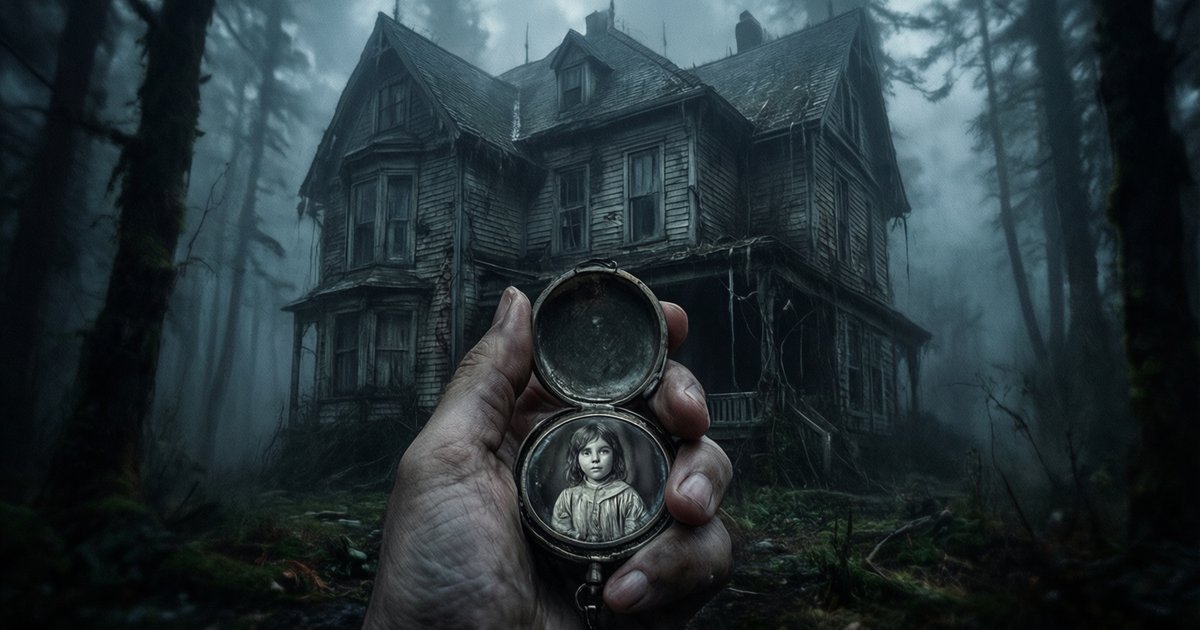
Near the edge of the porch, a cardboard box held a collection of tarnished trinkets. My eyes locked onto a small, silver jewelry box, its surface etched with faded vines. It felt unexpectedly heavy. I paid the woman running the sale five dollars, the bill damp in my hand. As soon as I reached my car, I clicked the latch open. Inside, resting on a bed of velvet, was a silver locket.
I pried it open, and the world seemed to tilt. Inside was a grainy, sepia-toned photograph of a five-year-old girl with wide, curious eyes and a small gap between her front teeth. It was me. Not someone who looked like me, but me. I knew that specific, crooked smile. I knew the way my hair had curled wildly at the ends. But I had never been to Wrenwood. My childhood, from age four to seven, was a static-filled void—a gap caused by a traumatic accident that had left me orphaned and raised by distant relatives in a different state.
I looked back at the house. A sudden, inexplicable pull tugged at my chest, a magnetic force drawing me back toward the porch. I felt as if the house were breathing, calling out a name I had forgotten how to speak. I didn't just want answers; I felt an urgent, physical need to return to that gray Victorian, as if my very existence were anchored to its floorboards.
Chapter 2
I walked back to the porch, the locket clutched so tightly in my palm that the metal edges dug into my skin. The woman, Mrs. Halloway, was rearranging a stack of old linens. She looked tired, her skin like parchment and her eyes clouded with a restlessness she couldn't quite hide.
"Excuse me," I said, my voice trembling. I held out the locket. "I just bought this box, and I found this photo. Do you know who this child is?"
Mrs. Halloway stopped moving. She didn't take the locket; she simply stared at it, her face draining of color. She stepped back, the linens slipping from her grip and fluttering to the driveway. Her breathing became shallow, a rhythmic wheeze that mirrored the wind whistling through the eaves of the house.
"I don't know," she whispered, her voice brittle. "It's just old junk. The house was full of it. You should go."
"But this is me," I pressed, stepping closer. "I've never been here, but this is my face. Who lived here?"
Mrs. Halloway's eyes darted toward the front door, a flicker of genuine fear crossing her features. For a second, her guard dropped, and she murmured something under her breath—a name. "Elara."
That word hit me like a physical blow. A flash of a memory ignited in my mind: a woman's voice, soft and melodic, whispering that same name while brushing my hair. The memory was gone as quickly as it had appeared, leaving me breathless.
"Who is Elara?" I demanded.
Mrs. Halloway suddenly snapped back into a rigid posture, her expression turning cold and dismissive. "I said I don't know. The sale is over for the day. Please leave my property."
As I walked back to my car, I looked at the crescent-shaped scar on my left wrist. I had been told for twenty years it came from a kitchen accident with a broken plate. But looking at the house, the scar began to itch, a phantom sensation of something far more violent than a clumsy mistake.
Chapter 3
I spent the night at a local inn, the locket sitting on the nightstand like a ticking bomb. I couldn't sleep; every time I closed my eyes, I heard a distorted lullaby, a melody that felt like a half-remembered dream. The next morning, I visited the Wrenwood Historical Society, a cramped building that smelled of old paper and floor wax.
That was where I met Callum Reed. He was in his mid-thirties, wearing a tweed blazer that looked a size too large, with a passion for the town's shadows that was almost palpable. When I showed him the locket, he didn't just look at it—he studied it with a magnifying glass, his brow furrowed.
"This design is distinct," Callum said, his voice hushed. "The engraving on the back—the interlocking lilies—belongs to the Sterling family. They were the original owners of that Victorian house on the edge of town."
I felt a chill. "The Sterlings?"
"They vanished," Callum explained, leaning back in his chair. "Twenty years ago, the entire family simply disappeared overnight. No struggle, no blood, no goodbye notes. The house was left frozen in time. Plates on the table, beds made, as if they had just stepped out for a walk and never come back. The town treated it like a ghost story, but for those of us who study the records, it was a tragedy. The house was eventually seized by the state before being sold off in pieces."
"I'm in the photo," I whispered. "I must be a Sterling."
Callum looked at me with a mixture of curiosity and concern. "If you are, Ivy, then you're a ghost returning to a crime scene. The Sterlings didn't just leave; they were erased. There was a feud—something about land and old money—that turned the family into targets. If you're connected to them, you're stepping into a history that people in this town have spent two decades trying to bury."
Chapter 4
The pull of the house became an obsession. I couldn't leave Wrenwood without knowing why my face was in a stranger's jewelry box. Two days later, I returned to the Victorian. Mrs. Halloway was still there, though she looked more frayed, as if the house were draining her energy.
I didn't go in as a seeker of truth; I went in as a donor. I brought a box of old books and linens, offering to help her clear out the remaining clutter. She was hesitant, her eyes scanning the street for something—or someone—before she finally sighed and unlocked the heavy oak door.
As I stepped inside, the air changed. It was colder, smelling of stale dust and old pennies. The moment my feet hit the hardwood, a sudden dizziness swept through me. I didn't need a map; my body remembered the way. I found myself walking down the narrow hallway, my hand instinctively gliding along the wallpaper, which was peeling away in long, yellowed strips.
I stopped at the end of the hall. There was a door, smaller than the others, painted a faded shade of blue. It was locked.
As I stood there, I heard it—the sound of a music box. It was faint, coming from behind the door. The melody was the same distorted lullaby from my dreams, skipping a beat every few seconds, creating an eerie, dissonant rhythm. My heart hammered against my ribs. I didn't know why I knew that the key was hidden inside the hollowed-out base of a nearby umbrella stand, but I reached for it without thinking.
I slid the key into the lock. It turned with a heavy, satisfying click. As the door creaked open, a gust of stagnant air hit me, and I realized I wasn't just entering a room—I was entering my own forgotten life.
Chapter 5
The room was a nursery, preserved in a shroud of gray dust. A small crib sat in the corner, and a rocking chair swayed slightly in the draft. It felt like a tomb for a childhood I had been robbed of.
I walked toward a wooden toy chest and opened it. Inside were a few moth-eaten blankets and a porcelain doll. The doll was beautiful, with a lace dress and painted blue eyes, but its left hand was missing, the ceramic snapped off jaggedly at the wrist.
I looked at the crescent-shaped scar on my own wrist. Suddenly, the void in my memory ruptured. I saw it: a flash of screaming, the sound of glass shattering, and the feeling of a heavy object crashing down. I hadn't had a kitchen accident. I had been hiding in this room, clutching this doll, when something—someone—had broken in. In the chaos, the doll had shattered, and a sharp piece of porcelain had sliced my wrist as I tried to pull away.
I collapsed to the floor, the memory flooding back with agonizing clarity. I remembered the terror, the smell of ozone and rain, and the sight of my mother’s face, pale and desperate, pressing her finger to her lips. "Stay quiet, Elara. Don't make a sound."
I wasn't Ivy Hines. I was Elara Sterling. The woman who had raised me wasn't a distant relative; she was a guardian hired to hide me from the very people who had destroyed my family.
"You weren't supposed to come back," a voice rasped from the doorway.
I spun around to see Mrs. Halloway. She wasn't looking at me with anger, but with a devastating, hollow sadness. She was leaning against the doorframe, her eyes filling with tears. "We thought you were safer if you forgot. We thought the void was a mercy."
Chapter 6
Mrs. Halloway sank into the rocking chair, the wood groaning under her weight. She revealed that she had been the Sterlings' housekeeper, a woman who had loved them like her own family. When the feud between the Sterlings and their business partners turned violent, Elara's mother had realized they were being hunted.
"Your mother knew they were coming for the estate and the children," Mrs. Halloway sobbed. "She didn't have time to fight. She only had time to save you. She paid a woman—a distant cousin of mine—to take you far away, to change your name, and to make sure you never remembered this place. She wanted you to have a life that wasn't haunted by the blood of a family war."
"What happened to them?" I asked, my voice sounding foreign to my own ears. "My parents?"
Mrs. Halloway looked away, her gaze landing on the broken doll. "The house was seized by the creditors, but the people who wanted your father gone made sure he never fought the seizure. There was an 'accident' on the highway. Your mother... she vanished shortly after. Some say she fled to Europe, others say she simply disappeared into the fog. But she left the locket and the jewelry box behind, hidden in the walls, hoping that one day, if you were safe, you'd find your way home."
I felt a surge of rage. My entire identity had been a carefully constructed lie, a shield designed to protect me, but it had left me empty. I had spent twenty-nine years feeling like a puzzle with missing pieces, while the truth had been rotting in this attic.
"There's more," Mrs. Halloway whispered, her voice trembling. "The people who did this... they didn't just want the money. They wanted the Sterling bloodline extinguished. If you're here, Ivy—Elara—you're not the only one who knows you've returned."
Chapter 7
I spent the next hour searching the jewelry box again, this time with a level of scrutiny I had learned from years of archiving. I noticed a slight misalignment in the velvet lining of the bottom compartment. I pressed a hidden spring, and a false floor popped open.
Inside was a folded piece of vellum, the ink faded but legible. It was a letter from my biological mother, dated November 12, twenty years ago.
"My dearest Elara, if you are reading this, it means you have found the strength to look back. I am sending you away not because I love you less, but because I love you too much to let you be a pawn in this war. Your 'relatives' have been paid to keep your identity a secret. Do not trust the name they gave you. Do not trust the stories they told you about the accident. You are a Sterling, and you are the rightful heir to the Wrenwood estate. Stay hidden until the world is quiet. Only then, come home."
As I read the words, a cold realization settled in my gut. My 'distant relatives' hadn't just been paid to protect me; they had been paid to monitor me. Every birthday, every school report, every move I made in my adult life had likely been reported back to someone.
I left the house in a daze and returned to my hotel. When I opened my mailbox in the lobby, I found a single, unsigned envelope. Inside was a typed note on heavy cream paper:
"You have a gift for finding things, Elara. But some things are better left buried. Leave Wrenwood by tomorrow morning, or you will discover exactly why your mother tried to erase you."
I stared at the letter, the aroma of cedar suddenly feeling like a chokehold. The hunters weren't gone; they were just waiting for me to remember enough to become a threat.
Chapter 8
The fear lasted for exactly ten minutes. Then, it was replaced by a cold, hard clarity. I was a librarian; I knew how to find the truth in the margins. I called Callum Reed. He arrived at the hotel an hour later, his face grave.
"They're still here," Callum said. "The descendants of the partners. They've spent years pretending to be pillars of the community, but they're terrified of a legal claim to the estate. If you prove you're the sole heir, you don't just get the house—you get the records your father kept. Records that could dismantle their entire empire."
I didn't flee. Instead, I invited the shadow into the light. I sent a message to the address linked to the 'relative' who had been monitoring me, telling them I had found the documents in the attic and was preparing to take them to the authorities.
By midnight, a man appeared at my hotel door. He was a cousin I had known as 'Uncle Lowell'—a man who had visited me once a year with stiff smiles and expensive gifts. Up close, his warmth was a mask; his eyes were calculating and predatory.
"Elara," he said, his voice a smooth, practiced purr. "You've made a mistake coming here. Just give me the letter and the locket, and I can make sure you're taken care of for the rest of your life. No more questions. No more gaps in your memory."
I looked at him, and for the first time, I didn't feel like the frightened five-year-old in the nursery. I felt the presence of the Sterling name. I had already digitized the letter and the evidence Callum had helped me gather from the town archives.
"I don't want your money, Lowell," I said, my voice steady. "I want the confession. Tell me where my mother is, or the police get the files on the Sterling embezzlement tonight."
He scoffed, but the flicker of panic in his eyes told me I had won. He confessed everything—the bribes, the staged accident, and the fact that my mother had been exiled, not dead, living in hiding in France to avoid being silenced. He had been the one ensuring I stayed 'broken' and distant.
Chapter 9
The legal battle was long, but the evidence was undeniable. With Callum's help and the confession I had squeezed out of Lowell, I reclaimed the Wrenwood estate. I sold my apartment in the city and gave up my life as Ivy Hines. I didn't need a borrowed identity anymore.
I spent the first few months transforming the gray Victorian into a sanctuary. I stripped the peeling wallpaper and replaced it with warm creams and golds. I opened the windows to let the Oregon fog roll through the halls, no longer as a ghost, but as a guest.
One rainy Tuesday in November, I sat in the nursery. I had spent weeks meticulously repairing the porcelain doll, using a special ceramic adhesive to attach its missing hand. It wasn't perfect—there was still a thin, silver line where the break had been—but it was whole.
I walked over to the mantelpiece in the living room. There, resting on a polished mahogany surface, was the silver locket and the repaired doll. They were no longer trophies of a tragedy; they were anchors of my identity.
I stood by the window, watching the autumn wind whip the maple leaves into a frenzy outside. I began to hum the lullaby—the one that had once been a distorted, frightening echo. Now, the melody was clear, sweet, and complete. I knew every note. I knew exactly who I was.
As the wind gave one final, powerful gust, the heavy front door swung shut with a firm, decisive thud, locking the world out and keeping my truth safe inside. I was home.
The End