 Porchlight Tales
The Third Ring of the Old Rotary Phone
Fiction. This is an original, made-up story: names, characters and events are invented, and any resemblance to real people or events is coincidental.
Full story · 10 chapters · Read in 5 parts instead
Listen to this story (5 parts)
Part 1 · 5 min
Part 2 · 5 min
Part 3 · 5 min
Part 4 · 5 min
Part 5 · 4 min
Chapter 1
The air at St. Jude’s Rest smelled of industrial lavender and old mahogany, a scent that failed to mask the underlying aroma of sterile decay. I had been a Licensed Practical Nurse for five years, but this was my first week in Oakhaven, Maine. The facility was a sprawling, Victorian-era relic draped in a constant gray mist that seemed to swallow the pine trees surrounding the property.
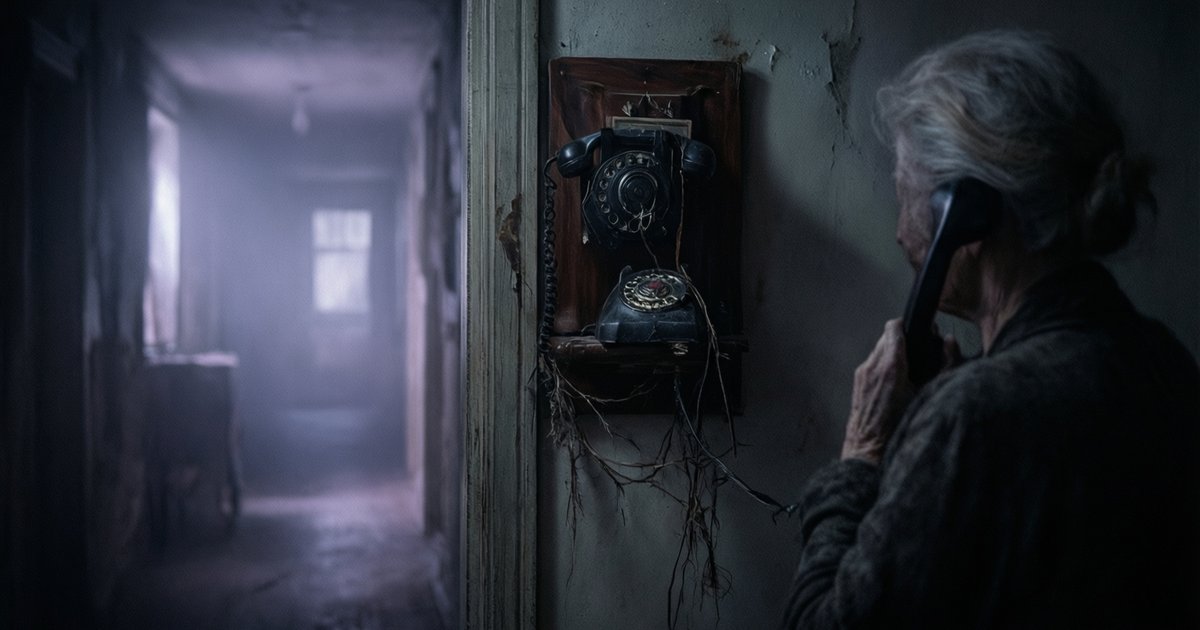
I spent my first few days adjusting to the rhythmic silence of the hallways, but on Thursday, the rhythm broke. It was exactly 6:15 PM. I was pushing a medication cart past the east wing when a sharp, metallic clang echoed through the corridor. It was a rotary phone, a heavy black piece of 1960s plastic mounted on a mahogany panel. The cord had been severed years ago, the frayed wires hanging like dead nerves against the wallpaper.
Then it happened. Ring. Ring. Ring. Three precise, jarring tolls.
Before I could even blink, the door to Room 212 swung open. Joyce Holloway, an 88-year-old woman with skin like crumpled parchment and eyes that held a terrifying clarity, stepped out. She didn't look surprised. She didn't look confused. With a tender, practiced motion, she lifted the receiver to her ear.
"I'm here, Leo," she whispered, her voice a fragile thread.
For a few minutes, Joyce stood perfectly still, listening to a silence that I knew was absolute. When she finally hung up and turned back to me, the smile she had worn vanished. In its place was a look of such profound, raw grief that I felt it in my own chest. It was the same expression I had seen in the mirror three years ago when I walked out of my father's hospital room for the last time, unable to say the things that mattered. I knew that look. It was the weight of a conversation that never truly ended.
Chapter 2
The next morning, I couldn't shake the image of Joyce's face. My habit of trying to fix things—broken faucets, fractured relationships, failing patients—kicked in. I waited until the hallway was empty and approached the phone. I reached behind the mahogany panel, expecting to find a hidden wire or a prankster's Bluetooth speaker.
There was nothing. The phone was completely dead. No power, no connection, just a hollow shell of plastic and copper.
"Poking around in the antiques, are we?"
I jumped, nearly knocking over a nearby vase. Caleb Vance, the facility manager, stood behind me. He was a man who wore his suits too tightly and his smile too thinly. His eyes scanned the hallway with a predatory precision, always looking for a liability or a smudge on the floor.
"I just thought I heard something," I lied, my heart hammering against my ribs. "The phone sounded like it was ringing."
Caleb’s expression flattened. "That phone hasn't worked since the Nixon administration, Ms. Abernathy. St. Jude’s has a reputation for stability and peace. We don't need nurses inventing ghost stories for the residents. Stick to your charts and stay out of the walls."
He walked away, his polished shoes clicking sharply on the linoleum. I watched him go, but my mind drifted back to Joyce. Later that afternoon, while helping her with her linens, I noticed her humming a tune.
"Who is Leo, Joyce?" I asked softly.
She looked at me, her gaze drifting toward the window where the Maine mist pressed against the glass. "Leo is the one who keeps his promise," she murmured. I checked her patient file immediately after leaving the room. There was no Leo listed in her emergency contacts, no Leo in her history, and no Leo in the facility's visitor logs. He didn't exist on paper, yet he called her every single day.
Chapter 3
By the second week, I found myself spending every spare moment in Room 212. Joyce was a treasure trove of fragmented memories, but she guarded one specific secret with a fierce intensity. One afternoon, while she was napping, I noticed a small, wooden nightstand drawer that hadn't been shut completely.
Inside lay a stack of envelopes, tied together with a faded blue ribbon. I knew I was crossing a professional boundary, but the need to fix this mystery outweighed my fear of Caleb. I opened the top letter. It was dated October 14, 1972.
'My Dearest Leo,' it began. 'The Autumn Gala is only two days away. I've marked the spot by the old creek in the Whispering Pines. I'll be waiting where the white birch bends. Please, just tell me you're coming.'
There were a dozen more letters, all unsent, all addressed to a Leo. They described a secret meeting spot, a promise of a life lived away from the suffocating expectations of Oakhaven. The letters grew shorter and more desperate as the weeks passed in 1972, ending abruptly in November with a single line: 'Why didn't you come?'
That evening, I stood in the hallway at 6:14 PM, waiting. I wanted to see if I could predict the phenomenon. The clock ticked. The air grew heavy, smelling of damp wool and old dust.
6:15 PM.
Ring. Ring. Ring. Ring.
I froze. Four rings. For the first time in my observations, the phone had rung four times instead of three. Joyce opened her door, but this time, she didn't smile. She looked terrified. She grabbed the receiver with a trembling hand and began to sob, her voice barely a whisper.
"What changed?" she wailed into the dead plastic. "Leo, why are you calling four times? What happened?"
She collapsed back into her room, leaving me standing in the cold hallway. The rhythm had changed, and the grief in her voice told me that the 'call' was no longer a comfort—it was a warning.
Chapter 4
"He didn't die, Wanda," Joyce told me the next morning. She was sitting in her wheelchair, staring at a gold locket around her neck. The locket was scratched and tarnished, and no matter how many times I saw her touch it, she never opened it. "He just stopped arriving. One night, the world simply swallowed him whole."
I sat beside her, the scent of the facility's industrial lavender suddenly feeling suffocating. "Joyce, maybe he had a reason. Maybe something happened on the way to the Whispering Pines."
"He wouldn't have left me," she snapped, a flash of the woman she must have been in 1972 emerging. "Leo was a man of his word. This phone... it's a bridge. He's trying to tell me something. He's trying to tell me where he is."
As she spoke, I felt a familiar, aching hollow in my chest. I thought of my father, dying in a sterile room in Seattle while I stayed away, terrified of the grief, terrified of the finality. I had spent years pretending that my absence didn't matter, but seeing Joyce's devotion made my own cowardice feel like a physical weight.
I realized I wasn't just investigating a mystery for Joyce; I was trying to save her from the same haunting silence that had followed me for three years. If I could find Leo, or at least find out what happened to him, I could provide a closure that I had denied myself.
I decided I couldn't do this alone. I needed a record, a fact, something that existed outside the walls of St. Jude's. I needed someone who knew the history of Oakhaven, someone who didn't care about Caleb Vance's sterile image of the town. I thought of Officer Miller, the town's aging cop who spent more time at the local diner than at the precinct. He looked like a man who had seen everything and forgotten half of it, but he was the only lead I had.
Chapter 5
Officer Miller leaned back in his creaky office chair, the scent of stale coffee and old tobacco clinging to his beige uniform. He looked at the name I had written on a scrap of paper: Leo Thorne.
"Thorne, huh?" Miller sighed, rubbing his eyes. "Let me check the archives. Give me a minute."
He disappeared into a back room filled with towering stacks of yellowed folders. When he returned, he was holding a thin, manila file from 1972. His expression was grim.
"You've got a good eye, kid. Leo Thorne. Nineteen years old. He vanished on the night of the Autumn Gala, November 12, 1972. His car was never found, and there were no witnesses. It was one of those cases that just... evaporated. The town moved on, his parents moved away a year later. Just a ghost story for the local kids."
I felt a chill that had nothing to do with the Maine autumn. "Is there any mention of the Whispering Pines?"
"Not in the official report," Miller said, sliding the file back across the desk. "But the search parties spent weeks in those woods. They found nothing but pine needles and silence."
When I returned to St. Jude's that evening, I arrived just as the clock struck 6:15. The rotary phone began to ring, but the sound was different—more violent, more insistent. As Joyce reached for the phone, she let out a piercing scream that echoed through the entire wing.
"He's here!" she shrieked, clutching the receiver. "He's telling me! He's under the pines! He's under the white birch!"
She collapsed into a fit of coughing, her face turning a frightening shade of gray. The staff rushed in, but I stayed by her side, my heart racing. The mystery was no longer a curiosity. It was a map, and Leo Thorne was finally screaming his location through a dead phone.
Chapter 6
The next few days were a blur of tension. Caleb Vance was breathing down my neck, his suspicion turning into outright hostility. He had noticed my frequent trips to the police station and my obsession with Joyce's history.
But while Caleb was watching me, I was watching the building. I began to notice a pattern. Every day at 6:10 PM, a deep, rhythmic thrumming began to vibrate through the floorboards. It grew louder and louder, peaking exactly at 6:15 PM. I followed the sound to the basement, where the facility's ancient steam heating system groaned to life for the evening cycle.
I realized the truth. The heating pipes ran directly behind the mahogany panel where the rotary phone was mounted. The pipes were old and loose; when the pressure hit a specific threshold at 6:15, they created a mechanical resonance—a vibration that physically shook the internal bell of the old phone.
It wasn't a ghost. It wasn't a bridge to the afterlife. It was physics. A fluke of engineering and timing.
For a moment, I felt a wave of disappointment, but then it was replaced by a terrifying realization. Joyce wasn't hearing Leo; she was projecting her lifelong grief onto a mechanical vibration. She was losing her grip on reality, her mind twisting a plumbing glitch into a lifeline. The 'calls' weren't messages; they were echoes of her own desperation.
But then I remembered the letters. The coordinates in the letters weren't hallucinations; they were real. The phone wasn't the source of the truth—it was merely the trigger that pushed Joyce to remember the details she had suppressed for fifty years.
As I climbed back upstairs, I saw Caleb waiting for me in the hall, his arms crossed, his face set in a hard line. He didn't look like a manager anymore; he looked like a jailer. I had found the mechanical answer, but the human mystery remained, and it was far more urgent than a vibrating pipe.
Chapter 7
"You're out, Abernathy."
Caleb's voice was cold, devoid of any emotion. He stood in the center of the nurse's station, holding a printout of my access logs. "Violating patient privacy, leaving your post to visit the police, and encouraging a confused resident to relive a trauma from fifty years ago. It's a liability nightmare."
"I'm trying to help her find peace!" I argued, but Caleb didn't care about peace. He cared about the facility's image.
"Pack your things. Now."
Before I could respond, a crash echoed from Room 212. I sprinted down the hall, pushing past Caleb. I found Joyce on the floor, her face skewed, one side of her mouth drooping. She was having a stroke.
The medical team rushed in, the hallway suddenly filled with the chaos of crashing carts and shouting voices. As they stabilized her, Joyce reached out and gripped my wrist with a strength I didn't know she still possessed. Her eyes were wide, terrified, and desperate.
She couldn't speak, but she pointed with a trembling finger toward the gold locket around her neck. Then, she pointed toward her bedside drawer.
She knew she was slipping away. She knew that the resonance of the pipes wouldn't be enough to bring her closure. She was giving me a mission.
As the doctors wheeled her away to the ICU, I looked back at the bedside drawer. Caleb was standing at the door, watching me with a narrow-eyed gaze. He knew I wanted that locket. He knew I was about to do something that would ensure I never worked in a licensed facility in this state again.
I didn't hesitate. I reached into the drawer and snatched the small, silver key that matched the lock on the gold heart. I slipped it into my pocket just as Caleb stepped forward. I had lost my job, but I had gained the only thing that mattered: a chance to finish a story that had been frozen in time since 1972.
Chapter 8
The rain in Maine in late November is a freezing, relentless drizzle that turns the earth into a gray slurry. I drove my old sedan deep into the Whispering Pines woods, using the coordinates I had scribbled from the locket's hidden slip of paper.
I hiked for two miles, the wind howling through the pines like a wounded animal. My boots sank into the mud, and the cold seeped into my bones, but I kept moving. I found the white birch—the one that bent sharply to the east, just as the letters had described.
And there, buried under decades of rotted pine needles and thick moss, was a glint of rusted metal.
I spent an hour digging with a folding shovel, my breath coming in ragged gasps. Slowly, the shape of a 1970s sedan emerged from the earth. It had slid off the narrow dirt track and plunged into a ravine, hidden by the overgrowth. The driver's side door was crushed, the windshield a spiderweb of cracked glass.
Inside the car, preserved by the cold and the airtight seal of the mud, was a skeleton draped in the remnants of a tuxedo. On the passenger seat sat a small, velvet-lined box.
I opened the box with trembling fingers. Inside was a delicate silver music box, its gears still intact despite the years. I wound the key slowly. A soft, tinkling melody began to play—a slow, romantic waltz that seemed to push back the gray mist of the woods.
It was the same tune Joyce had been humming in her room.
I sat there in the freezing rain, listening to the music, and I wept. I wept for Leo, who had died alone in the dark, and I wept for Joyce, who had spent fifty years listening to a dead phone. But mostly, I wept for my father. In this moment, surrounded by the wreckage of a lost life, I realized that closure isn't about fixing the past—it's about acknowledging the truth, no matter how heartbreaking it is.
Chapter 9
I didn't call Officer Miller immediately. I knew that if I did, the scene would be cordoned off, and the music box would become evidence in a cold case file. I wanted the music to belong to Joyce first.
I drove back to St. Jude's and bypassed the main entrance, slipping through the side service door I knew Caleb rarely checked. I entered the ICU and found Joyce pale and fragile, her breathing shallow. She was awake, but her eyes were vacant, the spark of hope finally extinguished.
I leaned in close, ignoring the risk of being caught and permanently blacklisted from my profession. I placed the silver music box on her bedside table and wound the key.
As the waltz began to fill the room, Joyce's eyes suddenly focused. A small, genuine smile touched her lips. She didn't need the phone anymore. She didn't need the vibrations of the pipes or the ghosts of the hallway. She had the physical proof that Leo had existed, that he had tried to reach her, and that he had carried a piece of music meant only for her.
She reached out and touched the silver box, her fingers grazing the metal. For the first time in weeks, her breathing slowed, becoming rhythmic and peaceful.
I stayed with her for an hour, holding her hand in the silence between the notes. I felt a weight lift from my own shoulders, a phantom pressure that had been there since the day I left my father's bedside. By giving Joyce this peace, I had finally given myself permission to forgive my own cowardice.
I slipped out of the room just as the night shift began. I didn't look back at Caleb or the facility. I had no job, no references, and a legal mess waiting for me in the woods, but for the first time in years, I felt like I could breathe.
Chapter 10
Joyce passed away that night, peacefully, with the music box still clutched in her hand. The staff called it a natural progression, but I knew it was a completion.
I left Oakhaven the next morning, driving away from the gray mist and the oppressive silence of St. Jude's. As I reached the edge of the town, I stopped the car and looked back at the facility one last time.
I thought about the rotary phone in the east wing. I thought about the steam pipes and the mechanical resonance that had tricked a grieving woman for years. I wondered if anyone else would hear the rings, or if the mystery would die with Joyce.
I remembered the final image I saw before I left the building. I had walked past the phone one last time to clear my locker. The hallway was silent. The heating system had shifted to its daytime cycle, and the vibrations had stopped.
But there, resting perfectly on the black plastic receiver, was a single, fresh autumn leaf—a vibrant, burning red maple leaf that had somehow drifted in from the outdoors, despite all the closed windows and sterile halls.
I smiled, started my engine, and drove south. The phone was silent now because the call had finally been answered, the debt of fifty years had been paid, and both Leo and Joyce were finally home. I drove toward the horizon, the melody of the silver music box still playing in my mind, guiding me toward a version of myself that was no longer broken.
The End