 Porchlight Tales
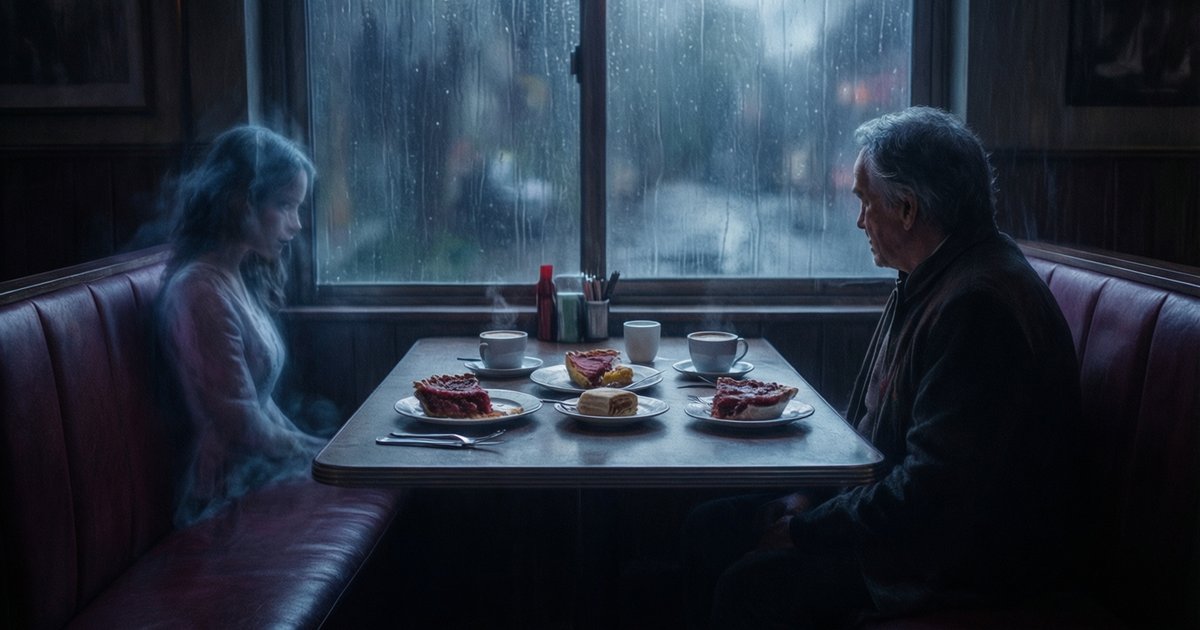
The Third Slice of Cherry Pie at Silver Lake
Fiction. This is an original, made-up story: names, characters and events are invented, and any resemblance to real people or events is coincidental.
Full story · 6 chapters · Read in 3 parts instead
Listen to this story (3 parts)
Part 1 · 3 min
Part 2 · 3 min
Part 3 · 3 min
Chapter 1
Silver Lake is the kind of town where the coffee is always burnt and everyone knows your business before you do. I’ve worked the morning shift at the Silver Lake Diner for six months, and in that time, Mr. Abernathy became my favorite puzzle. Every Sunday at 10:00 A.M. sharp, he walks in, smells of old peppermint and cedar, and takes the corner booth by the window.
He always orders three slices of cherry pie and three cups of black coffee. The strange part? He sits alone. He places the second and third plates carefully across from him, leaving a precise six inches of space between the silverware. He doesn't look sad; he looks expectant. He whispers to the empty vinyl seat, his voice a low hum that I can't quite catch over the sizzle of the grill.
I’ve tried to be subtle, but curiosity is a heavy thing. One rainy Tuesday, I noticed a small, leather-bound notebook he left behind. When I picked it up to return it, I saw a date written in shaky ink: November 12, 1964. Beside it was a name I’d never heard in town: Clara.
Chapter 2
The next Sunday, I watched Mr. Abernathy more closely. He didn't touch the other two slices of pie. Instead, he spent an hour talking, gesturing with his hands, and occasionally laughing—a dry, rattling sound. He treated the empty space as if it were occupied by someone vibrant and argumentative.
'You always did love the crust too much, didn't you?' he murmured, sliding the second plate a fraction of an inch forward.
My manager, Barb, warned me to leave the old man alone. 'Some people have their rituals, Maya. Let him have his ghosts,' she said, scrubbing the counter with a vinegar-scented rag. But the notebook had sparked something in me. I started researching the town archives during my breaks, looking for a Clara who vanished or died in 1964.
I found nothing. No death certificates, no missing person reports, no one named Clara Abernathy in the local records. It was as if she had never existed in Silver Lake at all. That’s when I noticed the envelope tucked into the back of his notebook, addressed to a house on Miller Road—a house that had been abandoned for thirty years.
Chapter 3
I shouldn't have gone, but the rain had stopped and the curiosity was an itch I had to scratch. Miller Road was a winding stretch of gray asphalt flanked by overgrown oaks. The house was a Victorian wreck, its white paint peeling like sunburnt skin. A 'For Sale' sign had fallen over in the mud, half-buried by autumn leaves.
As I stepped onto the porch, the wood groaned under my sneakers. The air smelled of damp earth and something sweet, like rotting apples. The front door was unlocked, swinging open with a slow, rhythmic creak. Inside, the house was frozen in time. A crochet doily sat on a side table; a half-finished crossword puzzle lay on the coffee table, the ink faded to a ghostly brown.
I walked into the dining room and stopped dead. There, on a dusty mahogany table, were two place settings. Two plates, two forks, and two glasses of water that had long since evaporated, leaving white mineral rings. But there was a third spot. A third plate was missing, leaving a clean, circular void in the dust of the tablecloth.
Chapter 4
The following Sunday, I approached Mr. Abernathy with a trembling hand. I didn't tell him about the house, but I asked about Clara. He looked up at me, his pale blue eyes clouding over. For the first time, he didn't smile.
'Clara didn't leave,' he whispered, his voice sounding like dry leaves scraping pavement. 'She just stopped being visible. We had a deal, you see. A way to keep the conversation going even when the clock stopped.'
He reached into his pocket and pulled out a small, tarnished silver bell. He placed it on the table and rang it once. The sound was sharp, cutting through the diner's chatter. Suddenly, the temperature in the booth dropped. I felt a sudden, icy draft brush past my arm, and for a split second, I saw it—a shimmer in the air, a distortion like heat rising off a highway in July.
'She says you're too curious for your own good, Maya,' Mr. Abernathy said, looking not at me, but at the empty seat. He then slid the third slice of pie toward me. 'Eat. You look thin.'
Chapter 5
I couldn't eat. I spent the next week obsessing over the 'deal' he mentioned. I went back to the archives, digging deeper into the town's founding families. I found a handwritten ledger from the 1920s, mentioning a 'Silver Lake Pact.' It wasn't a legal document; it was a folklore entry about a local tradition involving the preservation of memory through shared rituals.
According to the ledger, if a couple performed the same act every single week without fail, the bond wouldn't break at death. The memory of the departed would be anchored to the physical world by the repetition of the act. The cherry pie wasn't just a meal; it was a beacon.
I began to wonder what would happen if the ritual was broken. If Mr. Abernathy stopped coming, or if the diner closed, where would Clara go? Or more importantly, would she be forced to find a new anchor? I noticed that every time I stood near the booth, I felt a strange, tugging sensation in my chest, as if someone were trying to hold my hand.
Chapter 6
Sunday came again. I arrived early, but Mr. Abernathy wasn't there. 10:15 passed. 10:30. By 11:00, Barb was worried. We called his home, but there was no answer.
I rushed to his small cottage on the edge of town. I found him sitting in his favorite armchair, his eyes closed, a peaceful expression on his face. He had passed away in his sleep. Beside him on the end table was a final note addressed to me: 'The anchor is gone, Maya. But she’s always hated being alone.'
I felt a sudden, freezing chill settle on my shoulders. I turned around, and there, in the reflection of the hallway mirror, I saw a woman standing directly behind me. She was wearing a 1960s floral dress, her face a blur of soft light. She wasn't scary; she looked lonely.
She leaned in, and I heard a whisper in my ear—not a voice, but a thought that wasn't mine: 'I hope you like cherry pie.' I looked down at the mirror again, and saw her hand resting gently on my shoulder, her fingers shimmering like moonlight.
The End