 Porchlight Tales
The Tuesday Order for Table Four
Fiction. This is an original, made-up story: names, characters and events are invented, and any resemblance to real people or events is coincidental.
Full story · 6 chapters · Read in 3 parts instead
Listen to this story (3 parts)
Part 1 · 3 min
Part 2 · 3 min
Part 3 · 3 min
Chapter 1
I've worked the graveyard shift at ‘The Neon Oasis’ for three years. It’s a chrome-and-vinyl relic sitting in the middle of the Nevada dust, where the only things that move at 2:00 AM are the tumbleweeds and the occasional long-haul trucker. But every Tuesday, like clockwork, the bell above the door chimes, and Elias walks in.
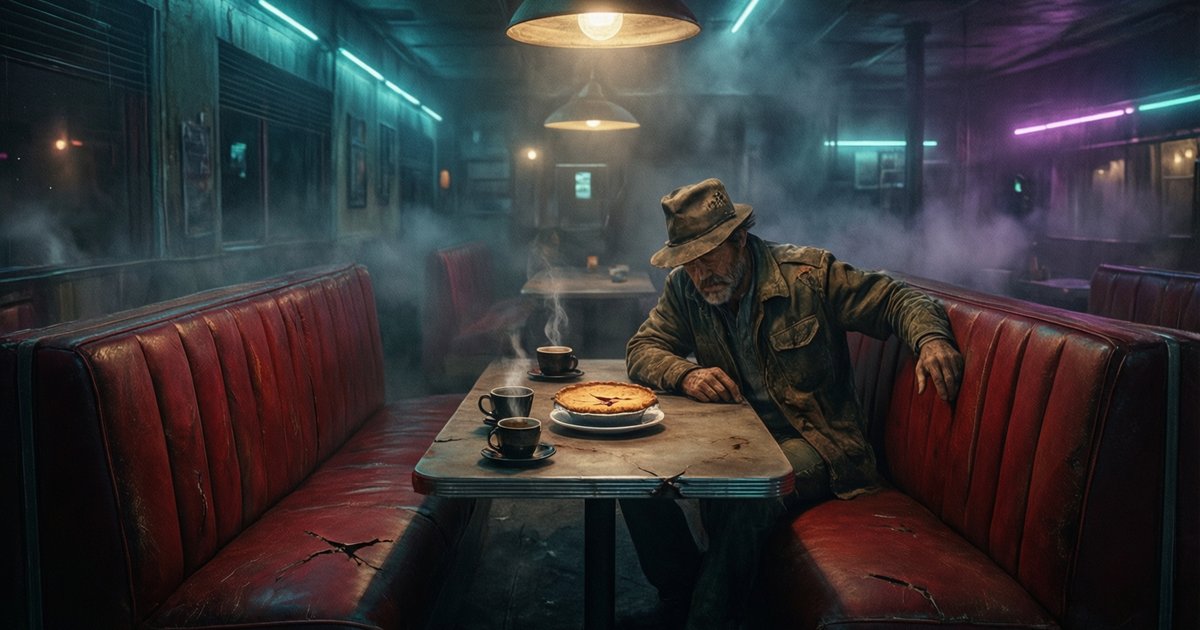
Elias is a man who looks like he’s made of weathered leather and old regrets. He always takes Table Four—the corner booth with the cracked red vinyl and a view of the shimmering heat haze on the horizon. He doesn't look at the menu. He doesn't look at me. He just sits down, adjusts his fedora, and waits.
'Two black coffees, and a slice of cherry pie,' he says, his voice sounding like gravel grinding together. He always orders for two, but he always arrives alone. The second seat remains empty, a vacant space that feels oddly heavy, as if someone is actually sitting there, invisible and waiting.
Chapter 2
For months, I watched the routine. I’d slide the steaming mugs across the counter and bring the pie, carefully placing the second coffee exactly six inches from the edge of the table. Elias would never touch the second cup. He’d let it steam, then go cold, then sit forgotten until the end of his visit.
What bothered me wasn't the order—it was the whispering. Elias would lean in close to the empty seat, his lips barely moving, sharing secrets with the silence. He’d chuckle softly or shake his head in disagreement, his eyes reflecting a grief so profound it made the air in the diner feel thick and cold, despite the 85-degree desert night.
One Tuesday, curiosity got the better of me. As I wiped the counter, I leaned in and asked, 'Who are you waiting for, Elias?' He stopped mid-sentence, his gaze snapping to mine. For the first time, I saw a flicker of something like panic in his eyes. 'She’s already here, kid,' he whispered. 'You just aren't listening.'
Chapter 3
After that encounter, I started noticing things. Small things. The way the second coffee cup would sometimes slide an inch to the left when no one was touching the table. The way the air around Table Four smelled faintly of gardenias and old perfume, a sharp contrast to the smell of burnt grease and stale tobacco that filled the rest of the Oasis.
I began researching the town's history during my breaks. The Oasis used to be a hub for travelers heading to Las Vegas in the fifties. I found an old clipping from a local gazette dated November 12, 1962. It mentioned a tragic accident on the highway just a mile from the diner—a couple's car had gone off the shoulder during a sandstorm.
The driver had survived, but his fiancée, a singer from a touring troupe, had perished instantly. The survivor's name was Elias Thorne. He had spent the next few decades disappearing into the desert, becoming a ghost of a man himself, haunting the edges of the town he couldn't leave behind.
Chapter 4
I felt a wave of pity for him, but then the pattern changed. On a rainy Tuesday in March, Elias didn't arrive at 2:00 AM. I kept checking the clock, the neon sign buzzing overhead like a trapped insect. 2:15. 2:30. 3:00. The door never chimed.
I spent the rest of the shift unsettled, glancing at Table Four. The booth looked colder than usual. I found myself wondering if he had finally found peace, or if he had simply given up. When the sun began to bleed orange over the mountains, I decided to do something I’d never done before: I walked over to Table Four and cleaned it thoroughly, wiping away the ghost of old coffee rings.
As I reached under the table to clear a stray napkin, my fingers brushed against something taped to the underside of the vinyl seat. It was a small, leather-bound diary, yellowed with age and smelling of that same haunting gardenia scent. I knew I shouldn't, but I took it to the breakroom and opened the first page.
Chapter 5
The diary wasn't Elias's. The handwriting was elegant, looping, and feminine. It belonged to Clara, the woman from the 1962 accident. The entries weren't memories; they were dated. Not from the sixties, but from every Tuesday for the last ten years.
'He still comes,' one entry read. 'He tells me about the world, about how the neon lights of the city have grown taller and colder. He thinks he is the one keeping me here, but he doesn't realize I am the one holding onto him.'
I felt a chill run down my spine. The entries described the diner in vivid detail—the crack in the red vinyl, the smell of the cherry pie, and even the way I looked when I served the coffee. The book was being written in real-time. The last entry was dated the previous Tuesday. It said: 'Elias is tired. He wants to come home now. I think tonight is the night I finally let him go.'
Chapter 6
The next Tuesday, Elias returned. He looked thinner, his skin almost translucent under the fluorescent lights. He didn't order the second coffee. He ordered one black coffee and one slice of cherry pie for himself.
He looked at me and smiled—a genuine, peaceful smile that reached his eyes for the first time. 'I don't need the extra cup anymore,' he told me softly. He ate his pie in silence, staring at the empty seat not with longing, but with a sense of completion. When he stood up to leave, he left a single, pristine gardenia flower on the table and walked out into the desert night.
I watched him disappear into the darkness, feeling a strange sense of relief. I went to clear the table, but as I picked up the flower, I noticed something on the tabletop. In the condensation of the single coffee cup he had finished, someone had traced a word with their finger.
'Thank you,' it read. But as I looked closer, I realized the writing wasn't on the table—it was etched into the glass of the cup from the inside, where no human finger could possibly reach.
The End