 Porchlight Tales
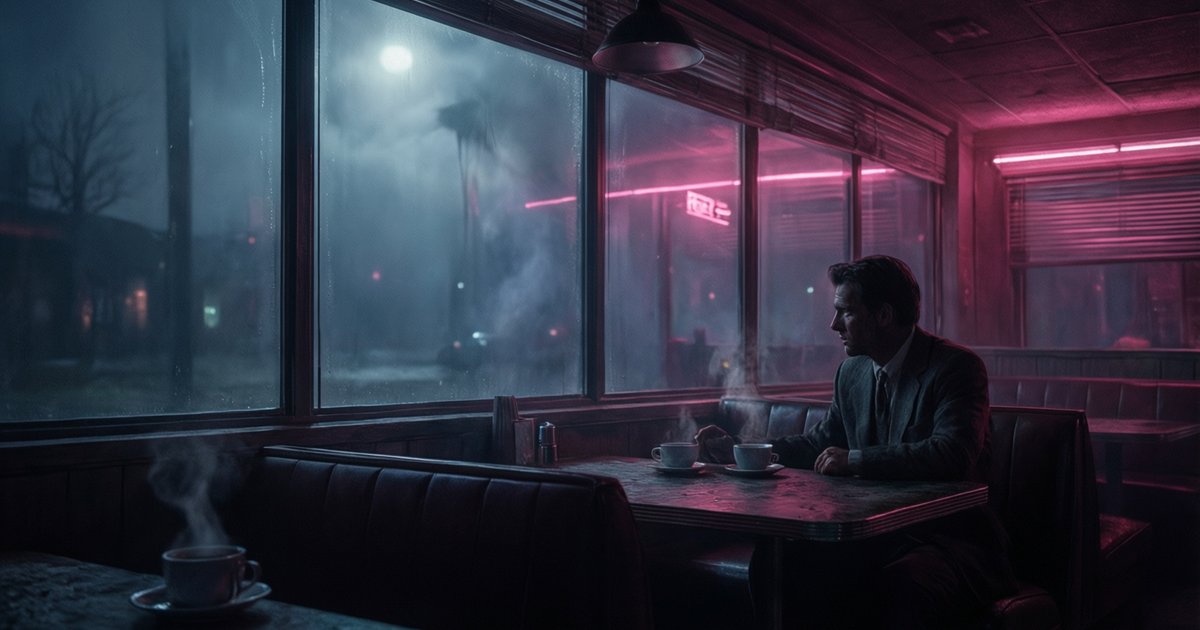
The Tuesday Ritual at the Dusty Rose Diner
Fiction. This is an original, made-up story: names, characters and events are invented, and any resemblance to real people or events is coincidental.
Full story · 8 chapters · Read in 4 parts instead
Listen to this story (4 parts)
Part 1 · 5 min
Part 2 · 5 min
Part 3 · 5 min
Part 4 · 5 min
Chapter 1
Linden Creek, Nebraska, felt like a town held together by rust and stubbornness. I drove back through the humid October haze, the grit of diesel and drying corn husks clinging to my skin. I was thirty-two, a journalist who made a living stripping the varnish off people's lies, yet I had spent ten years running away from the biggest lie of my own life: the day my father walked out on us without a word.
I stopped at the Dusty Rose Diner around 10:45 PM. It was a chrome-and-neon relic on a lonely stretch of Highway 30, its pink lights humming with a low, electric buzz. Inside, the air tasted of old grease and cinnamon. I sat in a corner booth, clicking my silver Zippo lighter—snap, click, snap. It was my father's gift, a beautiful piece of metal that had never once sparked a flame. I used it as a fidget, a rhythmic anchor to keep my anxiety from boiling over.
Exactly at 11:00 PM, the bell above the door chimed. A man in a charcoal-gray suit stepped in, his presence cutting through the diner's lethargy. He didn't look like he belonged in Linden Creek; his suit was pressed, his posture rigid. He didn't look at me, nor the few tired truckers at the counter. He walked straight to the far end of the counter and sat down.
'The usual, Hattie,' he said, his voice a dry rasp.
I watched as Hattie, the owner, sighed and began the routine. She didn't ask for an order. She didn't even smile. She simply started prepping two cups of black coffee and a single slice of apple pie. The man sat perfectly still, staring at the empty stool beside him as if someone were already there, waiting. He had ordered for two, but he was entirely alone. I felt that familiar itch under my skin—the need to know why. In my world, rituals were just masks for secrets, and this man was wearing a mask made of gray wool and silence.
Chapter 2
The ritual unfolded with a precision that felt almost religious. Hattie placed the two steaming mugs of black coffee and the apple pie on the counter. The steam curled upward, disappearing into the yellowed ceiling tiles. The man didn't touch the cutlery. He didn't even reach for the coffee. He simply sat there, his hands clasped on the laminate surface, staring at the second cup as if it were a holy relic.
I shifted in my booth, my eyes scanning the diner. Near the register, a faded 'Employee of the Month' photo from 1994 stared back at me. It was a woman named Maeve. She had a kind smile and a sharp gaze, but I noticed a tiny, barely visible tear on the corner of the photo, right where her shoulder met the frame. It looked like someone had tried to rip the photo out years ago but stopped halfway.
After exactly fifteen minutes of silence, the man reached into his breast pocket. He pulled out a small slip of paper and a pen. He wrote something quickly—his movements frantic, almost desperate—and slid the note across the counter toward Hattie. He didn't wait for a response, didn't pay for the food, and didn't take a single sip of the coffee.
He stood up and walked out into the humid Nebraska night, leaving the pie untouched and the coffee to grow cold. Hattie didn't chase him for the bill. She didn't even look surprised. She simply picked up the note with a trembling hand and tucked it into a wooden box beneath the register.
I waited until she turned her back to refill a sugar shaker and I slipped out of my booth. I didn't want to just observe; I wanted the evidence. As I passed the counter, I saw another note—one he had perhaps missed or dropped in his haste. I snatched it, the paper rough against my fingertips, and hurried out into the parking lot. My heart hammered against my ribs. I had come back for a funeral, but I had found a mystery that felt far more alive.
Chapter 3
The next morning, the sun was a pale disc behind a layer of gray clouds. I returned to the Dusty Rose at 10:00 AM, hoping to catch Hattie while the diner was empty. She was scrubbing the counter, the sharp sting of bleach overpowering the lingering cinnamon.
'I saw you last night,' she said without looking up. 'You have your father's eyes, Callum. But I hope you didn't inherit his curiosity.'
I flinched. I hadn't seen Hattie in a decade. 'I'm just trying to understand the man in the gray suit, Hattie. He comes every Tuesday? For ten years?'
Hattie stopped scrubbing. She leaned heavily on the counter, her face a map of deep lines and old regrets. 'Sterling is a harmless ghost of a habit. He comes, he orders, he leaves. It's a private arrangement. It doesn't concern anyone in Linden Creek.'
'He leaves notes for Maeve,' I pressed, stepping closer. 'The photo on the wall. Why is he writing to someone who retired thirty years ago?'
At the mention of Maeve's name, Hattie’s gaze shifted. She avoided my eyes, suddenly preoccupied with a smudge on the chrome toaster. The shift was subtle, but to a journalist, it was a neon sign. She wasn't protecting Sterling; she was protecting the memory of Maeve.
'Maeve was a good girl,' Hattie whispered, her voice losing its edge. 'But some things are better left in the cellar, Callum. Your father learned that the hard way. Now, if you aren't ordering breakfast, I've got a floor to mop.'
I left the diner, but the conversation left me unsettled. Hattie had linked the man in the gray suit to my father. The coincidence was too sharp to be accidental. I spent the afternoon in my father's old attic, surrounded by moth-eaten blankets and boxes of yellowed newspapers, searching for a thread that could tie this together.
Chapter 4
I spent hours in the attic, the air thick with dust and the musk of decaying paper. I kept clicking the Zippo—snap, click, snap—the sound echoing in the silence. I eventually found a small, leather-bound diary tucked inside an old toolbox. It belonged to my father. The entries were sparse, mostly lists of engine parts and weather reports, but one page from November 1994 was circled in heavy red ink.
'The ledger at the Rose,' the entry read. 'If Sterling doesn't fix this, Maeve will be the one to pay. I can't let her take the fall for a mistake that wasn't hers, but I can't stay if the truth comes out.'
I felt a cold prickle of realization. My father hadn't just walked out on us because he was tired of being a husband and a father. He had been running from something. And that 'something' involved a man named Sterling and a woman named Maeve.
I pulled out the note I had stolen from the counter the night before. The handwriting was jagged, the ink bleeding into the paper. 'The shared secret is a burden I cannot carry alone anymore. The debt remains, Maeve. It cannot be paid in cash, only in this weekly penance. I am sorry for the rain that night.'
'The rain that night.' I remembered the stories of the Great Flood of '94, the storms that had washed out half the bridges in the county. My father had disappeared ten years ago, but the seeds of his departure had been planted decades earlier in a diner with pink neon lights.
I looked at the 'Employee of the Month' photo in my mind—the tiny tear on Maeve's shoulder. It wasn't a tear from age; it was a mark of violence or a hurried attempt to erase her. I realized then that Sterling wasn't paying a debt to a retired waitress. He was paying a debt to a ghost, and my father had been the silent partner in that tragedy.
Chapter 5
Tuesday arrived again, bringing with it a suffocating humidity that made the air feel like a wet blanket. I didn't wait in a booth this time. I waited in my car, watching the clock. When Sterling stepped out of his car at 11:00 PM, I stepped out too, blocking his path to the diner.
'Who is Maeve?' I asked, my voice steadier than I felt.
Sterling stopped. He looked at me, his gray eyes devoid of emotion, yet there was a flicker of recognition. He didn't look surprised to see me. He looked exhausted. 'You have your father's habit of asking questions you aren't prepared to hear the answers to,' he replied.
'My father left because of you,' I accused, stepping closer. 'The notes, the coffee, the debt. What happened in 1994?'
Sterling sighed, a sound that seemed to drain the remaining strength from his shoulders. 'I wasn't her lover, Callum. I was the man who drove the car. It was a rainy night, the roads were slick, and I was arrogant. I caused an accident that nearly killed her and destroyed her career. She was a waitress, yes, but she was also the only person in this town who saw me for the coward I was.'
'So you buy her coffee for thirty years?' I scoffed. 'That's not penance. That's a performance.'
'It's the only way I can breathe,' Sterling whispered. 'Your father... he tried to help us cover it up. Not to protect me, but to protect her. He didn't want the scandal to ruin her life in a town as small as Linden Creek. He thought he could fix the ledger, hide the evidence of the negligence.'
'The ledger,' I repeated. 'Where is it?'
Sterling looked toward the diner, his expression darkening. 'Hattie has it. Or she did. But you should know, Callum, that Maeve didn't just retire. The accident wasn't the only thing that happened that night.'
Chapter 6
I stormed back into the diner, the bell chiming violently. Hattie was there, staring at Sterling through the window. I didn't go to the counter; I went straight to her.
'Where is the ledger, Hattie?' I demanded. 'Sterling told me everything. The accident, the cover-up. Why are you lying about Maeve?'
Hattie’s face crumpled. The mask of the stern business owner slid away, leaving behind a woman broken by a secret. 'You think you want the truth, Callum? Truth is a fire. It doesn't just light the way; it burns everything it touches.'
She leaned in, her voice a harsh whisper. 'Maeve didn't retire, you fool. She vanished three months after the accident. She didn't leave a note. She didn't say goodbye. She just disappeared into the cornfields. Sterling and your father spent months searching for her, but they found nothing but an empty house and a broken spirit.'
I felt the floor tilt beneath me. My father hadn't just helped hide a crime; he had been haunted by a disappearance. The 'walk-out' narrative wasn't a lie told to me—it was a lie my father had told himself to cope with the guilt of not finding her.
'He didn't abandon us,' I whispered, the realization hitting me like a physical blow. 'He was broken.'
'He was blackmailed,' Hattie corrected, her eyes cold. 'Someone knew about the accident. Someone told him that if he didn't leave Linden Creek and never come back, they wouldn't reveal the ledger and put Sterling in prison. He chose to sacrifice his life with you to save a man he hated and a woman who was already gone.'
I looked at Sterling, who was now sitting at the counter, staring at his cold coffee. He wasn't a villain; he was a shell of a man, trapped in a loop of grief and guilt that had lasted a lifetime. The pressure of the secret had crushed two men, and now it was resting on my shoulders.
Chapter 7
I spent the next three hours searching the diner. Hattie had tried to stop me, but I ignored her. I looked behind the paintings, under the floorboards, and inside the old cabinets. I was looking for the ledger—the physical proof of the negligence, the blackmail, and the sacrifice.
I found it in the most unlikely place: tucked inside the casing of the old, non-functional jukebox in the corner. It was a small, black book with leather edges, smelling of damp earth and old ink. I opened it, and there it was. The dates, the signatures, and a handwritten note from my father on the final page: 'I will go. Just make sure Maeve is remembered as she was, not as a victim.'
I held the book in my hands, and for the first time in my career, I felt a knot of nausea at the thought of a 'scoop.' This was the story of a lifetime. A journalist's dream: a decades-old conspiracy, a disappearance, and a secret sacrifice. I could publish this. I could expose Sterling's negligence and clear my father's name. I could turn the tragedy of Linden Creek into a headline that would make me famous.
But then I looked at Sterling. He was still sitting there, staring at the empty stool beside him. He wasn't asking for forgiveness; he was simply existing in the shadow of his mistake. If I published the ledger, Sterling would be ruined, Hattie would lose her diner, and the town of Linden Creek would be torn apart by a ghost story.
More importantly, my father had wanted the secret to stay buried. He had traded his presence in my life for this silence. If I broke that silence, was I honoring him, or was I erasing the only gift he had left me: the peace of not knowing the horror of that night?
I stood there in the dim light of the diner, the ledger heavy in my hand, facing the choice between my ambition and a dead man's wish.
Chapter 8
I walked out to the parking lot, the neon pink lights of the Dusty Rose blurring in the humid air. I looked at the ledger one last time, then I looked at the silver Zippo in my hand.
I didn't want a headline. I didn't want the fame. I wanted the burden to be gone.
I placed the ledger on the asphalt and flicked the Zippo. I clicked it once. Twice. On the third try, something happened. A spark jumped. A small, bright orange flame bloomed in the night, reflecting in my eyes. The lighter that had never worked for ten years finally sparked, as if the truth had finally unlocked it.
I set the corner of the ledger on fire. I watched as the ink curled and vanished, the secrets of 1994 turning into gray ash that the Nebraska wind carried away toward the cornfields. I felt a strange lightness in my chest, a sense of closure that no news article could ever provide.
I walked back inside the diner. Sterling was getting ready to leave. I didn't say a word. I simply walked to the counter and placed the silver Zippo next to the cold cup of coffee.
'Payment for the pie,' I whispered.
Sterling looked at the lighter, then at me. He didn't smile, but the tension in his shoulders seemed to ease. I walked out of the Dusty Rose and drove past the town limits, not looking back in the rearview mirror. The mystery of my father was solved, not with a revelation, but with a silence I had chosen for myself.
One week later, it was Tuesday again. Sterling arrived at 11:00 PM. He saw the Zippo still sitting on the counter, a silver sentinel. For the first time in ten years, Sterling didn't just sit in silence. He reached out, picked up the cup of black coffee, and took a slow, deliberate sip. He finally tasted the bitterness, and for the first time, he didn't mind it.
The End