 Porchlight Tales
The Unsent Letter in the Sewing Machine
Fiction. This is an original, made-up story: names, characters and events are invented, and any resemblance to real people or events is coincidental.
Full story · 9 chapters · Read in 5 parts instead
Listen to this story (5 parts)
Part 1 · 4 min
Part 2 · 4 min
Part 3 · 4 min
Part 4 · 4 min
Part 5 · 2 min
Chapter 1
"JUST SELL THE HOUSE, MOM!"
Caleb's voice boomed through the hallway, vibrating the crystal vases that had sat untouched for twenty years. He stood there in his expensive suit, looking at the dust motes dancing in the Georgia heat, his face tight with pragmatic impatience.
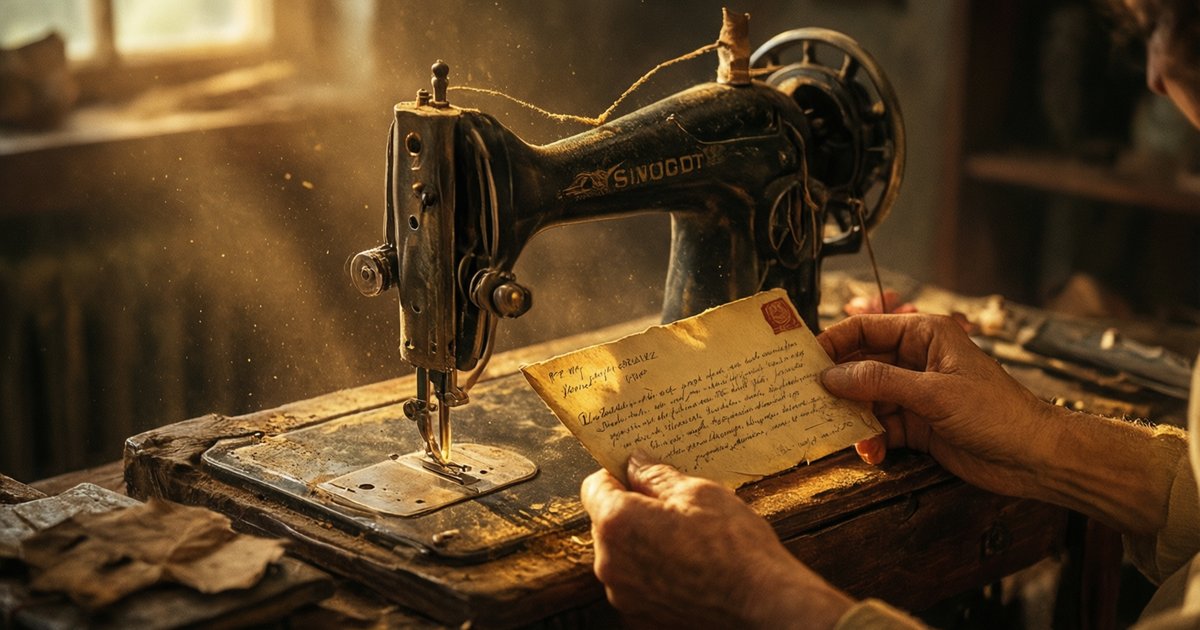
I didn't shout back. I never did. I just gripped the edge of the old Singer sewing machine, my fingers digging into the cold metal. As I shifted the heavy iron base, a sliver of yellowed paper fluttered out from a hidden seam in the fabric cover.
An envelope. Handwritten. Dated August 12, 1974.
I stared at the name on the front: Lydia. I had no sister. I was an only child, the sole recipient of my mother's exacting standards and cold, polished love.
Caleb sighed, checking his watch. "Are you even listening? The buyers are coming on Monday. We need this place empty."
I didn't answer. I couldn't. The air in the room suddenly felt too thick to breathe, heavy with the scent of machine oil and old secrets.
But to understand why a single piece of paper could stop my heart, you need to know how it all began. Three weeks earlier, when the silence of the house first became unbearable.
Chapter 2
The attic of my mother's ranch-style home carried the sharp tang of cedar, mothballs, and the suffocating weight of expectation. Estelle Haskins didn't do 'clutter.' Every box was labeled in precise calligraphy; every heirloom was wrapped in acid-free tissue.
I spent my days moving through the dust, feeling like a ghost in my own childhood. I was sixty-six, a retired librarian, yet in this house, I felt like the ten-year-old girl who had once been scolded for smudging a fingerprint on the mahogany dining table.
Estelle had been the pillar of our suburb—the woman who organized the church fundraisers and never had a hair out of place. She was a woman of absolute moral purity. Or so she wanted the world to believe.
As I sorted through a crate of her old linens, I found the blue jewelry box. It was a small, velvet-lined thing with a heavy brass lock. I remembered her voice, sharp and thin: "June, this stays locked until the day I am gone. Not a moment sooner."
I turned the key. My heart hammered against my ribs, expecting diamonds or perhaps a hidden diary.
It was empty.
Except for a single, small silver key taped to the bottom. No note. No explanation. Just a piece of metal that promised a door I wasn't sure I wanted to open.
I set the key on the dresser and looked at the calendar. August. The humidity was stifling, the kind of heat that makes everything feel slow and heavy. I thought about the 'Summer of '74.' Mother always called it her 'spiritual retreat' in Maine. She had vanished for three months, returning with a new, stricter devotion to the church and a gaze that seemed to look right through me. I had always accepted it. In the Haskins house, we didn't ask questions; we obeyed.
Chapter 3
The garage sale was supposed to be a cathartic exercise. I spent the weekend dragging out things that didn't fit into the 'perfect' image of my mother's life: chipped tea cups, outdated cookbooks, and the old sewing machine.
That was when I found it. Tucked into the lining of the machine's cover was the letter.
I took it inside and sat at the kitchen table, the humming of the air conditioner the only sound in the house. The handwriting was frantic, a sharp contrast to the measured script my mother used for her grocery lists.
'My dearest Lydia,' it began. 'The distance between us is a canyon I carved myself, but the guilt is a mountain I can no longer climb.'
I stopped breathing. Lydia.
I read on, my eyes blurring. The letter spoke of a mistake, a secret pregnancy in a coastal town, and a child given away to a family who could provide the stability Estelle felt she lacked. It was a plea for forgiveness, a confession of a love that had been suppressed by the need for social standing.
But the stamp was never cancelled. The envelope had never been mailed.
Estelle had written the truth and then buried it in the belly of a sewing machine for fifty years. She had spent her entire life pretending she was a saint while leaving a piece of herself—and another human being—in the cold.
I felt a sudden, violent surge of anger. Not at the secret, but at the lie. All those years I had spent trying to earn her approval, trying to be the 'perfect daughter,' and all the while, she was guarding a secret that rendered my perfection irrelevant.
I looked at the silver key on the dresser. The puzzle was starting to form, and for the first time in my life, I didn't care if I broke the rules.
Chapter 4
I spent the next four days in a fever of research. I used my old library skills, digging through digitized archives and census records. I searched for 'Lydia' and 'Maine' and any connection to the town Estelle had mentioned in her unsent letter: Fairhaven.
It didn't take long. There was a Lydia Sterling, now sixty-two, living in a small cottage by the coast. She was a painter, her work appearing in local galleries—abstract, moody pieces that looked like storms breaking over a gray ocean.
I stared at her photo on a community website. The resemblance was jarring. She had the same high cheekbones as my mother, the same slight tilt to her chin. We were mirrors of one another, separated by a choice made in a humid August half a century ago.
I realized then that the 'spiritual retreat' of 1974 wasn't about God. It was about erasing a mistake. Estelle hadn't gone to Maine to find her soul; she had gone to discard a part of it.
I felt a void open up inside me. I had spent decades feeling an inexplicable loneliness, a sense that my family tree was missing a branch. Now I knew why. I wasn't just an only child; I was the child who was kept while another was cast out to preserve a reputation.
I picked up the phone to call her, but my hand shook. What do you say to a stranger who shares your blood? 'Hello, our mother was a liar'?
I decided I couldn't do this alone. I needed the truth to be absolute. I needed to know if Lydia knew about us, or if she had been living her life in the same silence I had lived mine.
Just as I dialed the area code for Maine, the front door slammed shut. Caleb was home, and he looked like he was on a mission.
Chapter 5
"What are you doing, Mom?"
Caleb didn't even say hello. He walked straight to the kitchen table and saw the printouts of Lydia's life scattered across the mahogany. He picked one up, his brow furrowing.
"Who is this woman? Why are you looking into someone from Maine?"
I didn't hide it. I handed him the letter. "You have a half-aunt, Caleb. Or at least, I have a sister. Grandma had a daughter she gave up in '74."
Caleb's reaction wasn't shock. It was irritation. He dropped the letter back on the table as if it were contaminated.
"This is an obsession, Mom. A curiosity. Why on earth would you want to dig this up now?"
"Because it's the truth," I whispered.
"The truth doesn't pay the taxes on this estate," Caleb snapped. "Grandmother was a respected woman. This town looks up to the Haskins name. If word gets out that she abandoned a child, it tarnishes everything. It complicates the sale. It turns a clean transaction into a scandal."
I looked at my son—the lawyer, the pragmatist. He was so much like Estelle. He valued the facade over the flesh.
"She's a human being, Caleb. Not a complication."
"She's a stranger," he countered. "And you're a widow who needs to move into a smaller place. Let the past stay buried. It's easier for everyone."
He left the room, but his words lingered like a stain. For a moment, I hesitated. I thought about the quiet life I had led, the safety of the lie.
But then I looked at the blue key. I realized that the only thing more terrifying than the truth was the possibility of spending the rest of my life being a curated version of myself. I didn't call Caleb back. I finished the call to Maine.
Chapter 6
The diner in Fairhaven was small, smelling of burnt coffee and salt air. I sat in a vinyl booth, my palms sweating. I had told Lydia who I was in a long, trembling email. She had agreed to meet, though her tone had been guarded, almost cold.
When she walked through the door, the air seemed to leave the room.
She was wearing a paint-stained smock, her graying hair pulled back in a messy knot. She looked exactly like the woman I saw in the mirror every morning, only her eyes were harder, etched with a lifelong suspicion.
We sat in silence for a long time. The only sound was the clink of silverware from the next table.
"You look like her," Lydia said. Her voice was raspy, stripped of the polish that had defined the Haskins women.
"I do?" I asked.
"The jawline. The way you hold your shoulders. You look like a woman who spent her whole life trying not to make a mistake."
I flinched. "I didn't know about you. I found a letter. She never mailed it."
Lydia let out a short, bitter laugh. "She mailed some. For the first few years, I got letters. Every few months, a card or a note. But they weren't letters of love, June. They were tests."
I frowned. "Tests?"
"She would ask about my grades. My behavior. My 'moral standing.' It was as if she was auditing me from a distance, checking to see if I had turned into something 'shameful.' And the moment I failed—the moment I mentioned I wanted to paint instead of go to nursing school—the letters stopped. Completely."
I reached across the table to touch her hand, but she pulled away. The distance between us wasn't just miles; it was a canyon of resentment that Estelle had spent decades digging.
"I don't want your apology," Lydia said. "I want to know why she thought she had the right to judge me from a pedestal of lies."
Chapter 7
The drive back to Georgia was a blur of highway lines and heartache. I couldn't stop thinking about Lydia's eyes. She hadn't been abandoned once; she had been abandoned every time she failed to be the version of a daughter Estelle wanted.
When I got home, I went straight to the bank. I used the silver key on the safety deposit box Estelle had left in her will, though she had never given me the access code—only the key. I had to provide the death certificate and the legal documents Caleb had prepared.
Inside the box was a thick manila envelope.
I opened it to find legal proof of Lydia's birth and a trust fund. A substantial one. Estelle had saved money for Lydia for forty years. Thousands of dollars, invested and grown, sitting in a cold vault.
There was a note attached, written in that same rigid calligraphy: 'For Lydia, should she ever prove herself worthy of the Haskins name.'
I felt a jolt of disgust. Even in her final preparations, Estelle was playing the judge. She had the money, she had the means to help her daughter, but she had tied it to a condition of 'worth' that only she could define.
She had chosen control over love. Again.
I sat on the floor of the bank vault, the cold air humming around me. I thought of Lydia's paint-stained smock and her small, lonely cottage. I thought of the 'perfect' images of my mother that still hung in the hallways of my home.
I realized that the trust fund wasn't a gift; it was a leash. Estelle had intended to use it to buy Lydia's submission, or perhaps to keep her as a secret pet.
I gripped the documents tightly. My mother was dead, but her ghost was still trying to manage the estate. I decided right then that the management was over.
Chapter 8
The final garage sale was a chaotic affair. People from all over the neighborhood came to buy pieces of the 'legendary' Estelle Haskins' life. They praised her grace, her discipline, and her unwavering standards.
Caleb was in his element, shaking hands and ensuring the house was ready for the Monday closing. He looked at me, smiling. "See? Everything is handled. Clean and simple."
Just as he said that, a car pulled into the driveway.
Lydia stepped out. She didn't look like she belonged in our manicured suburb. She looked like a storm cloud in a field of daisies.
The neighbors stopped talking. The silence spread like a ripple in a pond. Caleb's face went pale.
"What is she doing here?" he hissed. "June, tell me you didn't invite her."
I stood on the porch, looking at the crowd of people who had loved a version of my mother that didn't exist. I looked at Lydia, who was staring at the house with a mixture of curiosity and disgust.
I had a choice. I could usher Lydia away, keep the secret, and maintain the 'pristine' legacy of the Haskins family. I could be the perfect daughter one last time.
Or I could be a sister.
I walked down the steps and met Lydia halfway. I didn't whisper. I didn't hide.
"Everyone," I said, my voice clear and steady, echoing across the lawn. "I'd like you to meet Lydia. She's my sister."
I saw the shock on the neighbors' faces. I saw the horror on Caleb's. But as I looked at Lydia, I saw something else. For the first time, her shoulders dropped. The tension that had held her rigid for sixty years finally broke.
Chapter 9
The legal transfer of the trust fund took two weeks, but I didn't let Caleb handle it. I did it myself, ensuring that every cent went to Lydia without a single condition attached. No 'worth' tests. No moral audits. Just a long-overdue payment for a lifetime of silence.
I sold the house on Monday. I didn't keep the mahogany table or the crystal vases.
On my last day, I stood in the living room. I looked at the large, gilded portrait of Estelle over the mantel—the one where she looked serene, untouchable, and utterly fake.
I took it down.
I walked to the donation bin at the end of the driveway and tossed the portrait inside, along with the other 'perfect' family photos. I didn't feel guilt. I felt light.
I moved into a small condo by the city, a place with too many windows and no room for secrets. On my mantel, there is only one photo. It's a candid shot taken on a pier in Maine. It's just Lydia and me, both of us squinting into the sun, laughing at something stupid, our hair windblown and messy.
We still have a lot to learn about each other. We argue about art, and we disagree on politics, and sometimes the silence between us still feels a bit too wide.
But last Tuesday, she sent me a painting. It wasn't a storm. It was a picture of a small, yellowed letter unfolding into a flock of birds.
I sat on my porch with a glass of cold tea, looking at the painting. I realized that for the first time in sixty-six years, I wasn't waiting for someone to tell me I was enough.
I finally was.
The End