 Porchlight Tales
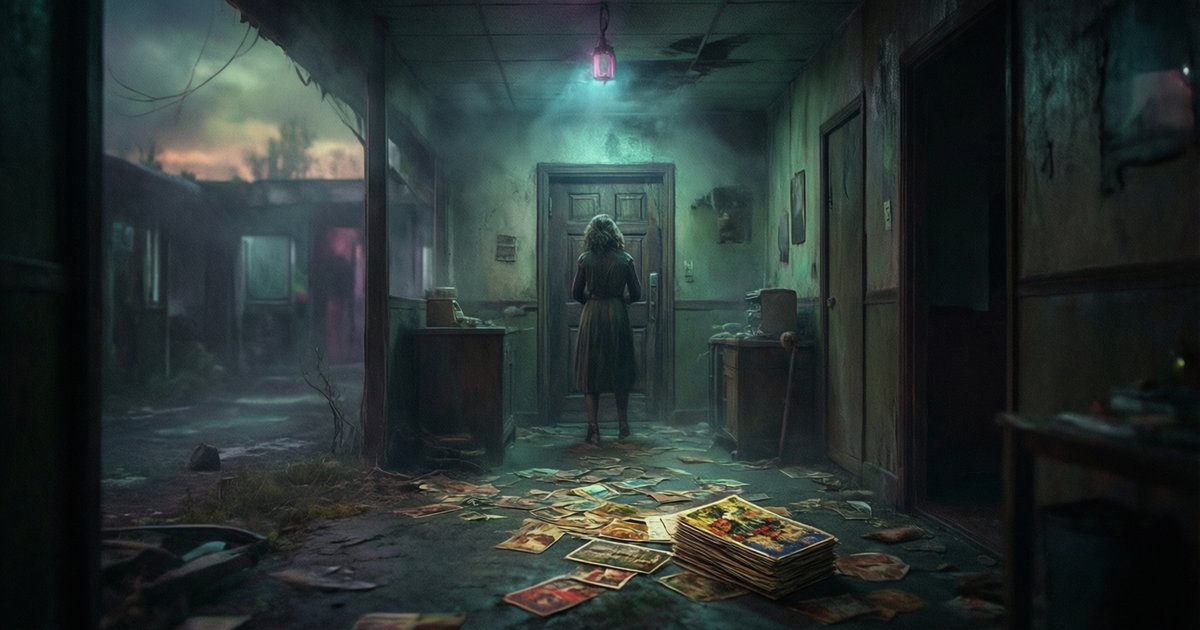
The Unsent Postcards of the Sunset Palms
Fiction. This is an original, made-up story: names, characters and events are invented, and any resemblance to real people or events is coincidental.
Full story · 8 chapters · Read in 4 parts instead
Listen to this story (4 parts)
Part 1 · 5 min
Part 2 · 5 min
Part 3 · 4 min
Part 4 · 5 min
Chapter 1
The heat in Arizona didn't just burn; it pressed down on you like a physical weight. Kayla Hollister stepped out of her dusty SUV, the scent of scorched sage and old asphalt filling her lungs. Before her stood the Sunset Palms Motel, a sun-bleached relic of the 1940s that looked more like a skeletal remain than a business. For Kayla, this wasn't just a renovation project; it was a lifeline. After the structural failure in Chicago—a disaster she hadn't caused but had been forced to sign off on—her reputation was in tatters. Her bank account was nearly empty, and her confidence was lower.
She spent the first few hours fighting with the lobby's floral wallpaper, which was peeling away in damp, yellowed strips. As she pried a particularly stubborn section near the baseboard, the plaster gave way with a wet crunch. Tucked into a narrow, intentional slot in the wall was a thick stack of postcards. They were pristine, their edges sharp, smelling faintly of old nicotine and cedar.
Kayla brushed off the dust and fanned them out on the lobby counter. They were all addressed to a woman named Rose. The stamps were colorful, depicting landmarks from across the United States—the Statue of Liberty, the Golden Gate Bridge, the Windy City. But as Kayla looked closer, she realized something unsettling. None of them had postmarks. They had never been mailed.
She picked up a card from 1947. 'My dearest Rose, the lights of New York are nothing compared to you. I am coming back for you soon,' it read. The handwriting was elegant but tight, the ink pressing deep into the cardstock as if the writer's hand had been shaking. Kayla felt a prickle of curiosity. Why would someone write dozens of travel postcards to a woman and then hide them inside a wall?
As the sun began to dip behind the red mesas, casting long, distorted shadows across the parking lot, Kayla heard a sound. It was a low, persistent hum, like a distant bee, vibrating through the floorboards. She followed it toward the back of the property, stopping right in front of the door to Room 14.
Chapter 2
Kayla spent the next evening obsessing over the cards. There were forty-two in total, spanning from late 1947 to mid-1948. The travelogues described cities the writer had supposedly visited—Seattle, Miami, Denver—but the tone shifted over time. The early cards were romantic and breathless. The later ones were desperate, almost pleading.
'Rose, please, I know you're still there. Why won't you answer?' one card from June 1948 asked. The handwriting had devolved from elegant script to a jagged, frantic scrawl. Kayla traced the lines, wondering who 'Rose' was and why she had vanished from the writer's life while remaining the sole recipient of these hidden messages.
She tried to find any record of a Rose at the Sunset Palms in the old ledger she'd found in the office, but the pages from 1948 had been neatly torn out. The void in the records felt intentional, a calculated erasure. The more she looked at the cards, the more she felt she was reading a conversation with a ghost.
That morning, Kayla drove to the only hardware store in town to buy more heavy-duty scrapers. The store was a cluttered cavern of rusted tools and smelling of motor oil. Behind the counter sat Earl Gorski, a man whose face looked like a dried-out riverbed. He didn't look up when she entered; he just continued sharpening a chisel with a rhythmic, grating sound.
'I need a dozen more industrial scrapers and some joint compound,' Kayla said, placing a photo of one of the postcards on the counter. 'By the way, do you know anything about a woman named Rose? She seems to have stayed here back in the forties.'
Earl stopped sharpening. He looked at the postcard, then looked at Kayla with eyes that were suddenly cold. He didn't take the photo. Instead, he leaned in, the smell of stale tobacco clinging to his flannel shirt. 'Some things in this town are better left buried under the sand, Ms. Hollister. If I were you, I'd focus on the lobby and leave the rooms alone. Especially Room 14. That room is meant to stay closed.'
Chapter 3
Earl's warning should have been a stop sign, but for Kayla, it was an invitation. Her entire career had been defined by things that were 'hidden'—structural flaws covered by cheap drywall, errors buried in reports. She knew that the truth usually lived in the places people told you not to look.
She returned to the motel and stood before the door of Room 14. The door was heavy oak, scarred with deep gouges near the handle. When she turned the key, the hinges screamed in protest. The room was a time capsule of mid-century decay. A rusted bed frame sat in the center, and the air was thick with the scent of desert dust and something metallic, like old coins.
As she stepped inside, the humming sound returned. It wasn't coming from the plumbing; it was too rhythmic, too mechanical. It seemed to be vibrating directly from the wall adjacent to the bed. Kayla pressed her ear against the wallpaper, feeling the vibration in her teeth. It sounded like air rushing through a narrow pipe, a constant, ghostly respiration.
While inspecting the floor for rot, Kayla noticed a floorboard that didn't sit flush with the others. She knelt, her jeans staining with grime, and pried it up with a screwdriver. Tucked in the joists was a small, leather-bound diary, its cover cracked and peeling.
She opened it to a random page dated May 12, 1948. 'He is listening again,' the entry read. 'I can hear his breath in the walls. He tells me I am safe here, that the world outside has forgotten me, but I know the postcards are a lie. He writes them to make me think he is traveling, to make me believe there is a world left to return to.'
Kayla's heart hammered against her ribs. The postcards hadn't been written by a longing lover; they had been written by a captor to deceive a prisoner. She looked up at the wall where the humming lived and realized the sound wasn't plumbing. It was a ventilation shaft, perfectly positioned for someone to stand in the next room and listen to every whisper in Room 14.
Chapter 4
The next afternoon, a vintage Cadillac pulled into the gravel lot. A woman stepped out, wearing a wide-brimmed hat and a floral dress that looked like it belonged in a painting. She introduced herself as Beatrice 'Bea' Vance. Her voice was thin but steady, and she looked at the motel with a mixture of grief and hatred.
'I heard someone was finally fixing this place,' Bea said, her eyes drifting toward Room 14. 'I haven't stepped foot on this property since 1949.'
Kayla invited her inside, her mind racing. She showed Bea the postcards and the diary. As Bea read the entries, her hands began to tremble. She sat down heavily on a dusty chair, her gaze fixed on the floor.
'Rose was the light of this town,' Bea whispered. 'She was a lounge singer at the club in the next valley. She had a voice that could make a stone cry. We were best friends—confidantes. Then she came to stay at the Palms for a few weeks to rest her voice before a big tour. She never came home.'
'What happened?' Kayla asked, leaning in.
'The police said she ran off with a musician from California,' Bea replied, a bitter smile touching her lips. 'But Rose loved her family too much to leave without a word. I always suspected the owner, Walter. He was a quiet man, but he had a darkness in him. He was obsessed with her. He used to watch her from the porch, never speaking, just staring.'
Bea looked at Kayla, her eyes pleading. 'The town just accepted the official story because Walter was a pillar of the community. But I knew. I knew she was still here, somewhere in these walls. I just didn't have the proof to make them listen.'
As Bea left, she gripped Kayla's hand. 'Be careful, dear. The Gorskis have lived in this town for three generations. They don't like people digging up the dirt.'
Chapter 5
Kayla couldn't sleep. The humming in Room 14 seemed to grow louder, a pulsing vibration that echoed her own anxiety. She spent the night in the lobby, the postcards spread around her like a map of a crime. She kept thinking about the 'visitor' mentioned in the diary—the man who pretended to travel while keeping Rose trapped.
Driven by a sudden impulse, Kayla returned to Room 14 at dawn. She began stripping the room, not for renovation, but for evidence. She tore away the moth-eaten curtains and pushed the rusted bed frame aside. When she reached the mattress, she noticed a strange lump near the headboard.
She ripped the fabric of the mattress, and there, sewn into the lining, was one final postcard. Unlike the others, this one wasn't addressed to Rose. It was written by her.
'To whoever finds this,' the note read, the ink faded and blurred. 'I am in the room, but I am not alone. He has built a space between the walls. He watches me through the grates. He tells me I am his masterpiece. He says he is saving me from a world that doesn't deserve me. I can hear him in the shaft, humming that same terrible tune. If you find this, please, look behind the mahogany paneling. He thinks the blue velvet ribbon I wore the night I arrived is gone, but I hid it where he can't reach.'
Kayla stood frozen. The 'humming' wasn't just air; it was the memory of a man's obsession. She looked at the mahogany paneling on the east wall. It was an architectural anomaly—a thick bump in the wall that didn't align with the rest of the building's layout. She realized the humming sound was currently being amplified by the wind whistling through the external vents, turning the hidden space into a giant flute.
Just as she reached for her hammer, the sky turned a bruised purple. A sudden, violent desert storm rolled in, the wind whipping the gravel into a frenzy and slamming the motel doors shut.
Chapter 6
The storm trapped Kayla inside. Rain lashed against the windows in sheets, and the power flickered and died, plunging the motel into a heavy, oppressive gray. The only sound was the roar of the wind and that persistent, rhythmic humming coming from the wall of Room 14.
With a flashlight in one hand and a sledgehammer in the other, Kayla approached the mahogany paneling. She felt a surge of the old fear—the fear that she was unqualified, that she was making a mistake. But then she remembered the blue velvet ribbon. This wasn't about architecture; it was about justice.
She swung. The first blow cracked the wood. The second shattered the panel. Behind the mahogany was a narrow, suffocating crawlspace, barely two feet wide. It was a hidden observation gallery, designed to overlook the room through tiny, disguised slits in the wall.
Kayla crawled inside, her flashlight beam dancing over dust-covered surfaces. The air was stagnant, smelling of ancient decay. As she reached the end of the shaft, her light caught something snagged on a rusted metal grating.
It was a scrap of fabric. A blue velvet ribbon, faded to a ghostly pale azure, caught in the grating. It had been there for seventy years, a silent witness to a struggle. Next to it lay a small, silver hairbrush and a single, gold earring.
Kayla recoiled, her heart hammering. This wasn't just a hiding spot; it was a cage. She realized the 'humming' she had heard was the wind passing through the very vents the captor had used to taunt Rose. The architecture of the room had been weaponized to create a psychological prison.
As she backed out of the shaft, she heard the front door of the motel creak open. Through the gloom of the hallway, a silhouette appeared. It was Earl Gorski, and he wasn't carrying any tools.
Chapter 7
Earl didn't look grumpy anymore; he looked tired. He stood in the doorway of Room 14, the flashlight in his hand casting long, distorted shadows across the walls. He looked at the shattered mahogany panel and the blue ribbon in Kayla's hand.
'I told you to leave it alone,' Earl said, his voice devoid of emotion.
Kayla stepped back, clutching the ribbon. 'Your father owned this place, Earl. He was the one who did this. He didn't just kill Rose; he kept her here. He turned this room into a torture chamber.'
Earl sighed and leaned against the doorframe. 'My father was a complicated man. He loved her in his own way. He thought he was protecting her from a world that would only break her. He didn't mean for it to end the way it did—an accident, a fall, a panicked cover-up.'
'An accident?' Kayla shouted. 'He trapped her in a wall!'
'The town survived because of this motel,' Earl countered, his voice hardening. 'My father built the economy of this stretch of Route 66. If the truth comes out, the Gorski name is mud, the estate is seized, and the history of this town is rewritten as a horror story. We can't have that.'
He stepped closer, his expression shifting to something resembling a plea. 'You're struggling, Kayla. I know about Chicago. You need this project to succeed to get your license back. If you burn that diary and seal that wall, I'll double your investment. I'll make sure you're the most successful architect in Arizona. You can save yourself, or you can destroy a town for a woman who has been dust for seventy years.'
Kayla looked at the blue ribbon, then at Earl. The choice was clear: her financial salvation or a dead woman's dignity.
Chapter 8
For a moment, the temptation was suffocating. Kayla pictured her bank balance, the prestige of a completed landmark restoration, the end of the impostor syndrome that had plagued her since Chicago. She could fix her life by simply ignoring the broken life of Rose.
But as she looked at the ribbon, she realized that her failure in Chicago hadn't been a lack of skill—it had been her willingness to stay silent while others lied. She had taken the fall to protect a company that didn't care about her. She had spent years being the person who covered up the cracks.
'I'm done fixing things that are broken on the inside,' Kayla said, her voice steady.
She didn't argue. She didn't scream. She simply stepped around Earl and walked to the lobby, where her phone was charging. She dialed the county sheriff.
Earl tried to grab her arm, but Kayla swung her heavy flashlight, catching him across the wrist. He stumbled back, shocked by her sudden defiance. By the time the sirens echoed through the desert valley, Earl was sitting on the floor of the lobby, defeated by a truth he could no longer bury.
The authorities spent three days excavating the area behind the false wall of Room 14. They found her—a skeletal remain wrapped in a faded floral dress, her hand still clutching a small, silver locket.
They identified her as Rose Vance. The news rocked the small town, but for the first time in decades, Bea Vance looked at peace. She attended the funeral, placing a fresh bouquet of lilies on the grave.
Kayla didn't make a fortune from the Sunset Palms. The legal battles over the Gorski estate tied up the property for months, and she lost her initial investment. But as she stood in the lobby one last time, she didn't feel like a failure. She had fixed the only thing that actually mattered.
She pinned the blue velvet ribbon to a small brass plaque in the lobby, marking the site as a memorial to Rose. As Kayla looked at her reflection in the lobby mirror, she didn't see a disgraced architect. She saw a woman who could finally look herself in the eye.
The End