 Porchlight Tales
What If the Apollo 11 Mission Had Failed?
Speculative fiction · Alternate history. Characters, documents and events in this story are imagined; real people, places and institutions appear only as historical backdrop.
Full story · 9 chapters · Read in 5 parts instead
Listen to this story (5 parts)
Part 1 · 5 min
Part 2 · 5 min
Part 3 · 5 min
Part 4 · 4 min
Part 5 · 3 min
Chapter 1
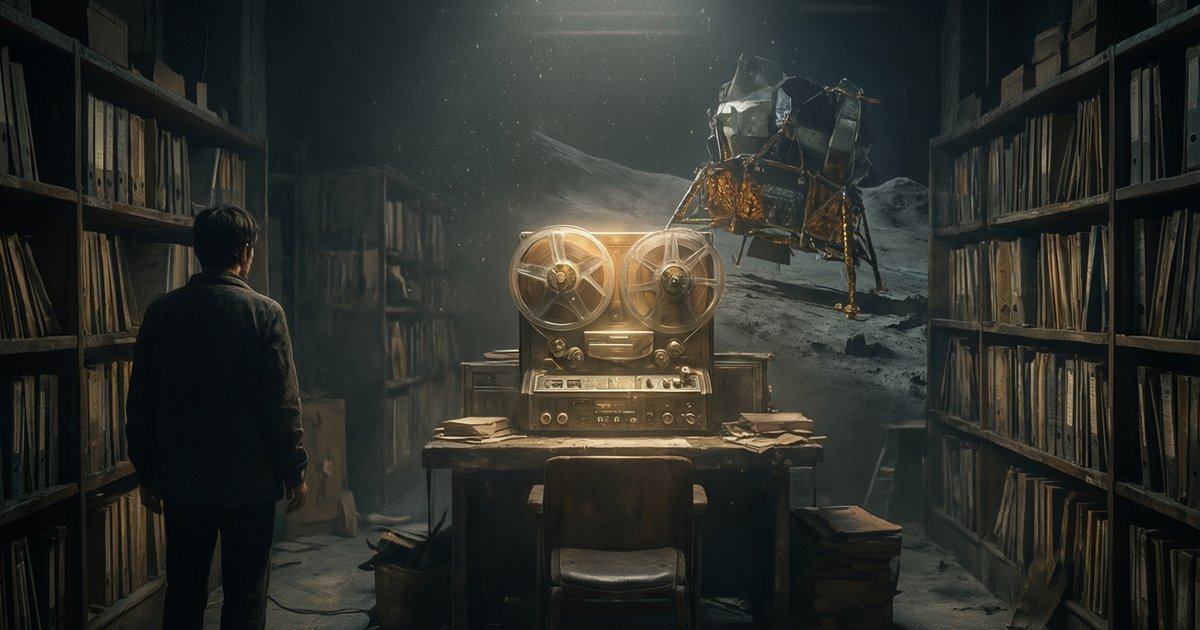
The basement of the National Archives stung with the sharp tang of ionized air and the musk of decaying cellulose. Sterling Penhaligon, 52, moved through the stacks with a precision that bordered on the pathological. He lived for the order of the files, a sanctuary from a world that had spent twenty-five years weeping for three dead heroes. Since the Lunar Module's engine failed during descent in July 1969, the United States had transformed. The 'Sacred Tragedy' wasn't just a memory; it was the cornerstone of the Lunar Mourning Act, a law that granted the federal government sweeping surveillance powers in the name of national resilience.
Sterling adjusted the 'Broken Eagle' medal pinned to his lapel, a heavy bronze piece given to the children of the Apollo support staff. His father had been a communications officer during the crisis, a man Sterling remembered as a shell of a human, haunted by a cowardice he never explained. Sterling’s obsession with objective truth was his only armor against that inherited shame. While his peers socialized, Sterling cataloged the silence of the dead.
While auditing a misfiled crate from the late sixties, Sterling found a reel of magnetic tape labeled 'Telemetry Backup - Restricted.' He fed it into the reel-to-reel player, the machine clicking with a mechanical rhythm. At first, there was only the hiss of cosmic radiation. Then, a voice broke through—distorted, breathless, but unmistakably human. It wasn't the sound of a crash; it was the sound of a man describing the lunar horizon. The transmission ended abruptly, replaced by a rhythmic, static-filled heartbeat that pulsed with an unnatural regularity. Below the recording, a handwritten note scribbled a set of coordinates: 37.2431° N, 115.7930° W. Nevada. Sterling felt a jolt of adrenaline. The official narrative stated that total signal loss occurred seconds before impact. If this voice existed, the history books were lying.
Chapter 2
Rain slicked the pavement of the D.C. alleyway, reflecting the gray, brutalist slabs of the surrounding government buildings. Sterling waited in the shadows, clutching the tape reel to his chest. Cassian Reed, a twenty-eight-year-old journalist with a hunger for a Pulitzer that outweighed his caution, arrived leaning against a brick wall, trailing the acrid haze of cheap cigarettes and the sharp bite of expensive cologne.
'You're risking a lot of pension funds for a few minutes of audio, Sterling,' Cassian said, his voice echoing in the narrow space. He looked at the tape with a look of greedy skepticism. He had spent his career chasing ghosts in the bureaucracy, but Sterling was the first source who actually had the keys to the vault.
Sterling didn't smile. He spoke in the clipped tones of a man who viewed conversation as a necessary evil. 'The Lunar Mourning Act didn't happen because we were sad, Cassian. It happened because the government needed a reason to institutionalize grief. If the crew survived, even for a moment, the narrative of the "Perfect Sacrifice" collapses.' He played a snippet of the tape on a handheld recorder. The heartbeat sound filled the alley, a rhythmic thrum that felt less like a biological heart and more like a beacon.
Cassian's expression shifted from doubt to intense focus. 'If this is real, it's not just a story. It's a regime change.' As Cassian reached for the tape, a black sedan with tinted windows rounded the corner, slowing to a crawl. The headlights cut through the rain like searchlights. Sterling grabbed the recorder and pulled Cassian deeper into the darkness. They weren't just being watched; they were being hunted. The realization hit Sterling with a cold clarity: the secret wasn't just buried in the archives; it was actively being guarded.
Chapter 3
The office of Director Margot Kinsley was a cathedral of mahogany and surveillance monitors. She sat behind a desk that looked like a monolith, her gray hair pulled back into a tight, severe bun. She didn't look like a villain; she looked like a grandmother who managed the world's most expensive secret. As Sterling stood before her, the oppressive vacuum of the room's silence pressed against his eardrums.
'Your father was a complicated man, Sterling,' Kinsley began, her voice a smooth, practiced velvet. She didn't ask why he was meeting with Cassian Reed; she simply stated that she knew. She slid a file across the desk—his father's personnel record. 'He did what was necessary to preserve the stability of the American psyche. Do you have any idea what would have happened if the world knew we failed due to a preventable technical glitch? The riots, the collapse of faith in the state... the chaos would have been apocalyptic.'
Sterling stared at the file, his fingers gripping the edge of the mahogany until his skin turned ghostly pale. 'The truth isn't a variable you adjust for stability, Director.'
Kinsley leaned forward, her eyes cold. 'The truth is whatever keeps the lights on and the people quiet. We didn't just fail in 1969, Sterling. We pivoted. The tragedy provided the political cover to build something far more potent than a public moon landing. We built a militarized lunar program, far from the prying eyes of taxpayers and congress.' She paused, letting the implication sink in. The 'Sacred Tragedy' was a smokescreen. The government had used the mourning period to divert billions into a secret colony. Sterling realized that his father hadn't been a coward; he had been a conspirator. The question was no longer whether the crew died, but why their deaths were required for the project to continue.
Chapter 4
The Nevada desert was a landscape of bleached white salt and shimmering heat haze. Sterling drove a rented sedan until the road simply vanished, leaving him at the coordinates. There, rising from the dust like a concrete tomb, was Site Echo. It was a brutalist bunker, windowless and imposing, its gray walls scarred by wind and sand. The security was light—nearly negligent—as if the government relied on the wasteland itself to keep intruders away.
Using a set of stolen credentials he'd spent three nights forging, Sterling slipped inside. The interior was a labyrinth of analog tapes and flickering CRT monitors. This was the graveyard of the 'Ghost Crew.' He found a series of manifests detailing subsequent missions: Apollo 12-S, 13-S. These weren't the missions the world knew. These were clandestine sorties sent to the moon after 1969 to establish a permanent, hidden presence.
As he navigated the archives, he found a terminal that was still active, its screen pulsing with a faint green glow. He typed in a sequence from the telemetry tape, and a window snapped open. It was a live feed. The image was grainy, black and white, showing a desolate lunar plain. In the center of the frame sat the original Lunar Module, the Eagle, tilted on its side, half-buried in gray dust. It looked like a discarded toy. Beside it stood a small, pressurized dome—a colony.
Sterling gasped as he saw a figure move across the screen. A person in a suit, moving with a slow, labored gait, waving a hand toward the camera. The rhythmic heartbeat he had heard on the tape suddenly echoed through the room's speakers. It wasn't a heart; it was a distress signal, transmitted on a frequency the world had been told was dead for decades. Someone was still up there, or something had been left behind to keep signaling into the void.
Chapter 5
Sterling spent hours digging through the handwritten logs of Site Echo, his eyes blurring under the flickering fluorescent lights. He found the 'Contamination Report' dated July 1969. The horror wasn't that the engine failed—the engine had actually worked. The Eagle had touched down. But the return fuel had been contaminated during the loading process at Cape Kennedy. The crew had enough oxygen to survive for weeks, but not enough fuel to leave the surface.
He read the transcripts of the final secret conversations between Houston and the crew. The astronauts had pleaded for a rescue mission, promising to find a way to survive. But the response from the top was chillingly pragmatic. The technical failure was too public, too embarrassing. If the government admitted the fuel was tainted, the entire space program would be dismantled by a furious public. The decision was made: the crew would be left to die in silence to preserve the 'perfection' of the mission's intent. The tragedy was curated; the grief was engineered.
'They were just numbers to them,' Sterling whispered, the sound of his own voice startling him. He thought of the 'Broken Eagle' medal on his chest. It wasn't a token of grief; it was a mark of complicity. His father hadn't just watched it happen; he had been the one to encrypt the signals, ensuring the crew's screams never reached the public.
Sterling felt a sudden, violent churning in his stomach. The 'Sacred Tragedy' was a lie designed to make the public feel a shared sense of loss, which in turn made them easier to control. The government had turned a corporate negligence crime into a national religion. Just as he began to copy the files to a portable drive, the heavy steel door of the archive slammed shut. The sound of boots echoed in the hallway, and the familiar, cold voice of Margot Kinsley filled the room. 'I told you, Sterling, the truth is a variable.'
Chapter 6
The betrayal came not with a bang, but with a handshake. Cassian Reed stood beside Director Kinsley, holding a leather briefcase. He looked at Sterling not with guilt, but with the predatory glint of a man who had just secured his future. In exchange for the tapes and Sterling's location, Kinsley had offered Cassian an exclusive, sanctioned biography of the 'Lunar Legacy'—a curated version of the truth that would make him the most famous journalist in America.
'Sorry, Sterling,' Cassian said, though he didn't sound sorry at all. 'The world doesn't actually want the truth. They want a story they can live with. Your obsession with objectivity is a luxury the rest of us can't afford.'
Sterling was tackled by four security guards, his face pressed into the cold concrete floor. They stripped him of the portable drive, the tapes, and his credentials. He was dragged through the bowels of Site Echo and thrown into a windowless room that smelled of damp limestone and old sweat. There was no furniture, only a single flickering lightbulb and a heavy iron door.
For two days, Sterling sat in the dark. He thought about the figure on the lunar feed, the lonely ghost waving at a camera that no one was supposed to watch. He realized that Cassian was right about one thing: the world was comfortable in its mourning. But he was wrong about the truth. The truth wasn't a luxury; it was the only thing that could break the cycle of state-mandated sorrow. As he sat in the silence, he felt the physical pressure of the 'Broken Eagle' medal against his skin. He had always viewed it as a burden, but as he rubbed the metal with his thumb, he felt a small, sharp ridge he had never noticed before. It wasn't a decorative flourish; it was a seam.
Chapter 7
The door creaked open, and Kinsley entered. She didn't bring food; she brought a confession. She sat on a small stool, looking at Sterling with a pity that felt like an insult. 'Your father didn't just encrypt the signals, Sterling. He was the one who signed the final order to cut the comms. He didn't do it out of malice. He did it because he believed in the Greater Good. He spent the rest of his life drinking himself into a stupor because he couldn't reconcile the man he was with the man the state needed him to be.'
Sterling's world shattered. The quest for redemption he had pursued for decades was a lie. He hadn't been fighting his father's cowardice; he had been chasing the ghost of a man who had committed a cosmic crime. He felt a void open up inside him, a coldness that mirrored the lunar surface. The man he had loved and hated was the architect of the silence.
'Now,' Kinsley said, standing up, 'you have a choice. You can sign a non-disclosure agreement, and I will restore your pension and give you a quiet life in the suburbs. Or, you can stay in this room until you become another forgotten archive. The world is happy, Sterling. Why ruin it for a few dead men?'
Kinsley left the room, leaving the door slightly ajar—a calculated gesture of mercy to tempt him. Sterling looked at the 'Broken Eagle' medal. He remembered his father's trembling hands and the way he used to stare at the moon with an expression of absolute terror. The medal wasn't a reward; it was a key. His father had left it to him not as a legacy of shame, but as a way out. Using a jagged piece of the concrete wall, Sterling pried the seam of the medal open, revealing a tiny, high-frequency override chip.
Chapter 8
The transfer was chaotic. Kinsley was moving Sterling to a more permanent facility, and the guards were distracted by a sudden power surge in the bunker's main grid. Sterling had waited for the moment the lights flickered, then he lunged, jamming the override chip from the medal into the security console of the transport vehicle. The doors hissed open, and he bolted into the server hub of Site Echo.
He reached the central transmitter, the massive array that linked the bunker to the lunar colony. He had two choices. He could use the terminal to erase every record of the Ghost Crew and his father's involvement, scrubbing the blood from the family name and ensuring a peaceful, if dishonest, existence. Or, he could use the transmitter to override the national broadcast system, a vulnerability he'd discovered in the archives months ago.
His heart hammered against his ribs. He saw the image of the lone astronaut on the screen, still waving, still signaling. He thought of the millions of Americans who woke up every day in a state of manufactured grief, their lives steered by a tragedy that was actually a crime. He thought of his father's silence.
'No more secrets,' Sterling whispered. He didn't choose the path of peace. He chose the path of noise. With a series of rapid keystrokes, he bypassed the Lunar Legacy Bureau's encryption. He didn't just leak a document; he opened a door. He routed the original, unedited audio from July 1969—the voices of the crew pleading for help, the sounds of the contaminated fuel alarm, and the cold, clinical order to cut the feed—directly into the emergency broadcast system. Every television, every radio, and every public square in America suddenly erupted with the sounds of the truth.
Chapter 9
The fallout was instantaneous. The 'Sacred Tragedy' myth didn't just crack; it vaporized. Within hours, the streets of Washington D.C. were filled with people who felt not just grief, but a profound, incandescent rage. The Lunar Mourning Act was torn apart by protests that shook the foundations of the capital. The government, stripped of its moral authority, collapsed into a series of frantic tribunals.
Sterling didn't run. He didn't hide. He walked out of the bunker and surrendered to the authorities, not to Kinsley's men, but to the new provisional government. He rejected every offer of a pardon, insisting on facing a public trial for espionage. He wanted his father's crime to be entered into the public record, alongside his own. Only then would the redemption be objective.
Months later, Sterling sat on a park bench in the autumn chill, wearing a thin coat and a look of exhausted peace. He held the 'Broken Eagle' medal in his hand—now just a piece of scrap metal, its chip gone, its secret spent. Beside him, a young girl was looking up at the sky, pointing at the pale crescent of the moon.
'Is it true they're still there?' she asked.
'No,' Sterling replied softly. 'They're gone. But now we know where they are.'
He looked up at the moon. It was no longer a symbol of a lost dream or a government lie. It was a graveyard, a cold and distant place that the world finally acknowledged. For the first time in twenty-five years, the silence he felt wasn't the silence of a secret, but the silence of a truth finally told. He closed his eyes, the image of the waving astronaut etched into his mind, finally allowed to rest.
The End