 Porchlight Tales
What If the Cuban Missile Crisis Had Escalated in October 1962?
Speculative fiction · Alternate history. Characters, documents and events in this story are imagined; real people, places and institutions appear only as historical backdrop.
Full story · 6 chapters · Read in 3 parts instead
Listen to this story (3 parts)
Part 1 · 2 min
Part 2 · 2 min
Part 3 · 2 min
Chapter 1
October 27, 1962. The air over the Atlantic is thick with static and desperation. In the real timeline, the world held its breath as Kennedy and Khrushchev navigated a razor's edge. But in this reality, at 10:14 AM, a faulty radar operator aboard the USS Essex misinterprets a flock of migrating birds and a momentary atmospheric glitch as a Soviet torpedo launch. The panic is instantaneous. Following strict engagement protocols, the Essex fires a defensive volley. The torpedoes don't hit a submarine, but they strike a Soviet transport vessel, killing hundreds of sailors in a bloom of orange fire and salt water. The signal is sent back to Moscow: the Americans have initiated an attack. The fragile bridge of diplomacy collapses in a heartbeat.
Chapter 2
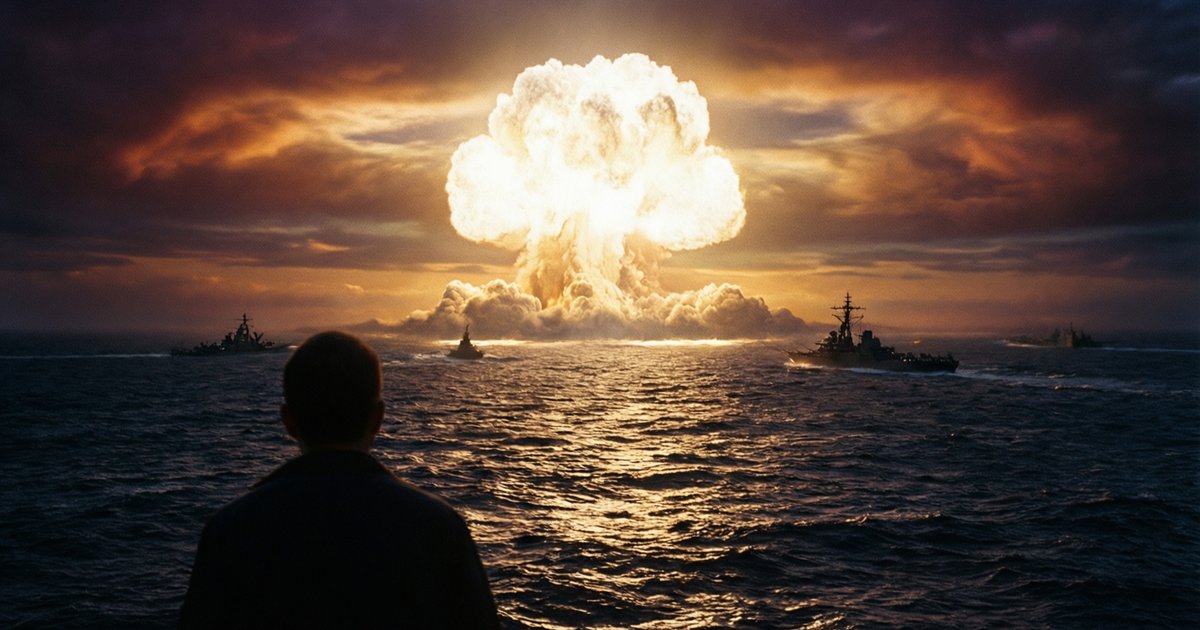
The escalation is a domino effect of fear. Khrushchev, pressured by hardliners in the Kremlin who view the sinking as an act of war, authorizes the tactical nuclear weapons already stationed in Cuba. He doesn't aim for Washington; he aims for the blockade. At 2:30 PM, three American destroyers are vaporized in flashes of blinding white light. The Caribbean Sea boils, turning a ghostly, iridescent gray. The shockwaves shatter windows in Miami and Havana, leaving a silence that is more terrifying than the explosions. In the White House, President Kennedy is faced with a binary choice: surrender the Western Hemisphere to Soviet influence or retaliate with the full weight of the Strategic Air Command. He chooses the latter, believing a limited strike can force a ceasefire.
Chapter 3
The 'Limited Exchange' begins. US B-52 bombers, launched from bases in Louisiana and Florida, drop tactical warheads on the Soviet missile sites in Cuba. Within an hour, the island of Cuba is no longer a Caribbean paradise; it is a landscape of glass and ash. However, the Soviet Union does not stop at Cuba. In a desperate attempt to maintain parity, Moscow launches a series of medium-range missiles at US naval bases in Norfolk and San Diego. The sky over the East Coast turns a bruised purple as EMPs knock out the electrical grid. Suddenly, the 1960s dream of space races and neon diners vanishes. The lights go out across America, replaced by the flickering glow of distant, burning horizons.
Chapter 4
The war doesn't end in a total global apocalypse—not because of morality, but because of mutual exhaustion. After seventy-two hours of terror, both superpowers realize that the next step is the 'Big One,' the ICBMs that would turn the planet into a charcoal briquette. A ceasefire is signed in a frantic, secret meeting in Reykjavik, Iceland. But the world that emerges is unrecognizable. The 'Nuclear Winter' isn't a total freeze, but a 'Nuclear Autumn.' Global temperatures drop by 5°F, causing crop failures across the Midwest and the Eurasian steppe. Hunger becomes the new global currency. The US and USSR don't disappear, but they retreat into paranoid, fortress-like states, forever scarred by the fire they nearly invited.
Chapter 5
Fast forward to 1975. I am walking through the 'Gray Zone' of what used to be Florida. The air always tastes of copper and ozone, a permanent reminder of the 1962 flashes. We live in a world of walled cities and ration cards. Technology didn't advance toward the internet; it advanced toward survival. We have massive air-filtration domes and lead-lined bunkers. The geopolitical map is a jagged mess of 'Neutrality Zones' and irradiated wastes. The United States is no longer a global policeman but a wounded giant, obsessively patrolling its borders with automated sensors, terrified that a single radar glitch might happen again. We don't talk about the 'lost decade'; we just look at the stunted trees and the colorless sky.
Chapter 6
The legacy of the Caribbean Exchange is a profound psychological scar on humanity. The optimism of the mid-century was incinerated in those few days of October. We learned that the 'balance of power' was an illusion held together by the competence of a few tired men in control rooms. In this timeline, the space race died in 1963; why go to the moon when the earth is struggling to breathe? We are a civilization of survivors, living in the shadow of the Great Mistake. As I look at the rusted remains of a 1962 Cadillac half-buried in radioactive sand, I wonder: did we actually survive, or did the world we knew die in October, leaving only these ghosts to wander the ash?
The End