 Porchlight Tales
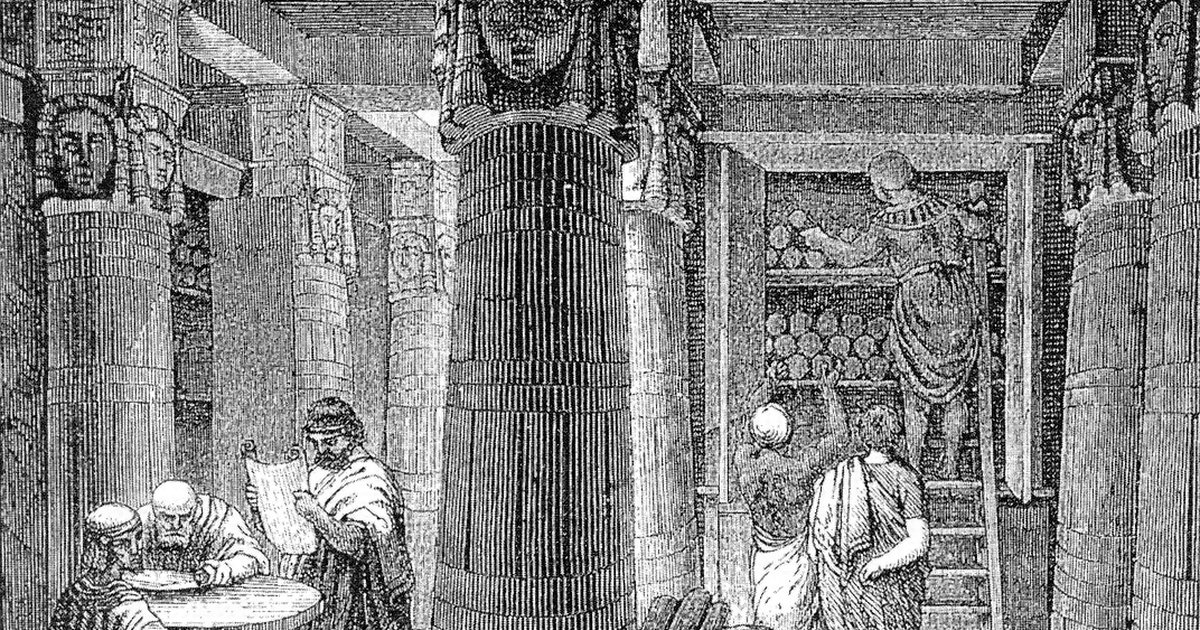
What If the Library of Alexandria Never Burned?
Speculative fiction · Alternate history. Characters, documents and events in this story are imagined; real people, places and institutions appear only as historical backdrop.
Full story · 7 chapters · Read in 4 parts instead
Listen to this story (4 parts)
Part 1 · 3 min
Part 2 · 3 min
Part 3 · 3 min
Part 4 · 2 min
Chapter 1
Theon smelled the smoke before he heard the shouting. From the roof of the scriptorium he watched the Egyptian fleet burn in the harbor below, orange light crawling up the masts of forty ships at once, embers lifting into the dark like a swarm of dying stars. Caesar's men had set the fire to deny the enemy their navy. No one, not even Caesar, had meant for it to spread.
For a long moment Theon believed he was about to lose everything he had spent thirty years cataloging — the complete astronomical tables of Hipparchus, the only copy of Aristotle's treatise on animal generation with its author's own corrections in the margins, four hundred thousand scrolls that existed nowhere else on earth. Then the wind turned. It simply turned, the way wind does, indifferent to history, and carried the fire back toward the water instead of up through the warehouse district toward the Library.
Theon did not sleep that night. He walked the stacks with an oil lamp, touching the spines of boxes he had cataloged himself, and understood — with a clarity that frightened him — that he had just watched the edge of something enormous. Not a miracle. A near miss. He began, before dawn, to write down everything he could remember of what had almost been lost, in case the wind changed its mind again.
Chapter 2
Three generations later, a mathematician named Philon stood in the same reading hall, running his finger down a scroll that Theon himself had once saved from a collapsing shelf. The text was Eratosthenes' full working notes — not just his famous estimate of the earth's circumference, but the failed drafts, the arguments with rival astronomers, the raw data from the well at Syene.
In the world Theon had almost lost, these notes would have survived only as a summary, quoted secondhand by a historian centuries later, stripped of the reasoning that made the conclusion trustworthy. Here, Philon could read the actual argument. He could disagree with it, test it, improve it. He spent four years re-measuring the angle of the sun at noon in six cities from Alexandria to Massilia, correcting Eratosthenes' figure by a fraction of a percent — a correction that would have been impossible without the original data.
It was a small thing. A number refined. But Philon's student would use that refined number to argue, successfully, that a western sea route to India was shorter than anyone assumed — an argument that reached a shipbuilder's guild in Carthage within his own lifetime, long before any Genoese captain would have needed to make the same case over a thousand years later.
Chapter 3
By the fourth century, the Library was no longer a single building. Fire remained a fear — a founder's fear, carried down as institutional memory — so the custodians had spent two hundred years pushing copies outward: to Pergamon, to Antioch, to a modest annex in Rome that the locals called, dismissively, "the Greek room." Every major scroll existed in at least five cities. No single catastrophe could erase it twice.
This was the quiet mechanism, more than any single genius, that let Hero of Alexandria's writings on pressure and steam reach an engineer in Byzantium three hundred years after Hero's death — intact, with diagrams, instead of surviving as a curious footnote in someone else's summary. The Byzantine engineer, a woman named Kassia who had inherited her father's foundry, read Hero's description of a steam-driven sphere and asked a question Hero himself had never asked: what if the force turned a wheel instead of merely spinning in place?
She never finished a working engine. The foundry lacked the metal tolerances for it. But she wrote the question down, in the margin of her own copy, and sent that copy — as custom now required — to Alexandria, to be duplicated and preserved, in case someone else might finish what she had started.
Chapter 4
Someone else did, eventually, though it took four more centuries and a change in ironworking that had nothing to do with libraries at all. By the time a workable steam pump was lifting water out of a silver mine in Anatolia, the Library had become something its founders would barely recognize: not a single archive but a standard, a method, copied by every court and monastery that wanted to be taken seriously. To found a library and fail to network it — to fail to send copies outward — was, by then, considered an act of civic negligence.
This was the real inheritance Theon had left, though he never knew it and would not have claimed credit for it. Not the scrolls themselves, which burned and were recopied and burned again in a dozen smaller fires over the centuries, but the habit of redundancy. The assumption, quietly built into how educated people thought, that knowledge too important to lose should never live in only one place.
A pump that could lift water from a mine was not, by itself, a revolution. But the habit that produced it — distributed, duplicated, deliberately hard to destroy — was already quietly rewriting how fast a good idea could travel from the person who had it to the person who could finally use it.
Chapter 5
It was not an uninterrupted rise. In the ninth century, a general who considered the Library's scholars a threat to his authority ordered it emptied and the buildings converted to a garrison. He succeeded, almost. Three wagonloads of the rarest scrolls were burned in the public square as a demonstration of his seriousness.
But the redundancy held. Pergamon had copies. Antioch had copies. A scholar named Ibn Rashid, who had spent a decade correcting errors in a borrowed copy of Hipparchus's star tables, smuggled his own annotated edition out through the harbor the night before the garrison arrived, hidden inside a shipment of dyed cloth. He carried it to Baghdad, where a different ruler, eager to outshine Alexandria rather than imitate its destruction, gave him a workshop and four assistants.
Within two generations, Baghdad's observatory held a more accurate star catalog than Alexandria's had ever produced — built, ironically, on the foundation of what Alexandria's own garrison had tried to erase. The lesson, when later historians wrote it down, was blunter than they intended: you can burn a building. You cannot, once the habit of copying has taken hold in enough places at once, burn an idea whose time has come.
Chapter 6
By the year 1000, three cities — Alexandria, Baghdad, and a reluctant newcomer in Córdoba — maintained observatories that compared notes by letter, arguing over the same data across three languages and two religions, more often as rivals than collaborators, but reading each other's work all the same. A Córdoban physician cross-referencing Alexandria's surviving medical texts with his own clinical notes isolated the pattern of a disease later generations would call smallpox, and proposed — correctly, though no one could yet explain why — that prior infection granted future protection.
He did not have the tools to prove it. His paper sat, mostly ignored, in an archive for sixty years until a student copying it for a different purpose noticed the claim and ran her own trial on a reluctant village, inoculating twelve children with matter from a mild case, against the furious objections of the local priest.
Ten of the twelve survived the epidemic that swept through six months later. The other fifty children in the village did not. It was not kindness that made the method spread after that. It was arithmetic that any parent could do for themselves, and a network of libraries built, three centuries earlier, specifically so that an answer this important would never again have to wait for the right building not to catch fire.
Chapter 7
A researcher in a modern reading room — climate-controlled now, the scrolls long since transferred to film and then to something more durable still — once asked Theon's name of a guide who had spent her career studying the Library's early custodians. The guide produced, almost apologetically, a short private notebook: not a scholarly work, just a man's nightly observations, written in the weeks after a fire that almost was.
There was nothing prophetic in it. Theon had not foreseen steam engines or inoculation or observatories arguing across three faiths. He had written, mostly, about which shelves needed repair and which scrolls were brittle enough to worry about. But on the last page, in a hand grown shaky with age, he had added a single line that the guide always read aloud to visitors, because it was the closest thing to a thesis the whole enterprise ever produced: *We did not save the books because we knew what they were worth. We saved them because we could not yet be sure, and it seemed unforgivable to guess wrong.*
The researcher copied the line into her own notebook before she left, in case, someday, someone needed to find it again.
The End