 Porchlight Tales
What If the US Had Joined the League of Nations?
Speculative fiction · Alternate history. Characters, documents and events in this story are imagined; real people, places and institutions appear only as historical backdrop.
Full story · 9 chapters · Read in 5 parts instead
Listen to this story (5 parts)
Part 1 · 5 min
Part 2 · 5 min
Part 3 · 5 min
Part 4 · 5 min
Part 5 · 3 min
Chapter 1
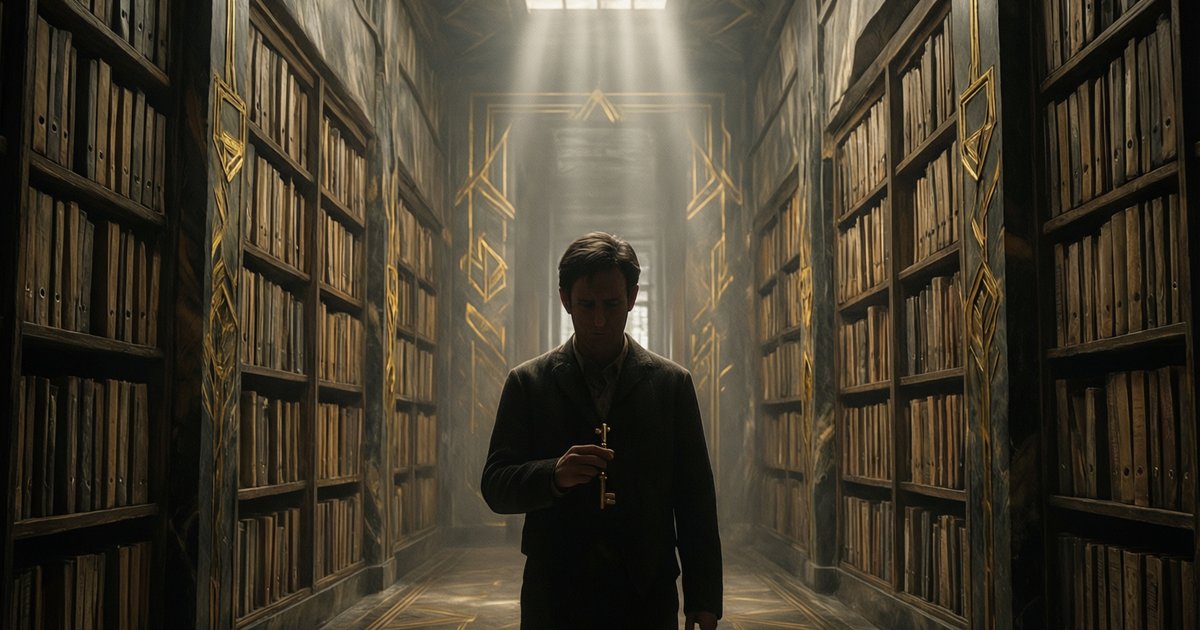
Alaric Finch lived his life in the muted tones of manila folders and dust. As the Senior Archivist at the League of Nations New York Headquarters, his world was a sprawling labyrinth of Art Deco marble and pneumatic tubes. The building was a monument to the 'Great Ratification' of 1920, the moment the U.S. Senate had voted yes, steering the world away from the chaos of the 1930s and into a managed, sterile harmony. Alaric’s days were spent cataloging the triumphs of this global hegemony, ensuring every document mirrored the official narrative of benevolent leadership.
He was a man of habit, driven by a quiet, gnawing void. His father, Osric, had been a rising star in the diplomatic corps until a sudden, scandalous fall from grace in the late thirties. The official record cited 'mental instability and treason,' a label that had left Alaric with a lifelong tremor in his hands whenever he spoke to a superior. He didn't want power; he wanted the ghost of his father's reputation to stop haunting his sleep.
One rainy Tuesday, while auditing the 'Founding Era' cabinets, Alaric found a dossier that shouldn't have existed. It was misfiled under a mundane trade agreement from 1921. The papers contained internal memos from the first U.S. delegation, detailing a series of clandestine agreements that contradicted the public Treaty of Versailles. Tucked inside was a scrap of vellum with a familiar, frantic handwriting. 'The peace is a mask, Alaric. Look for the lock that requires no key, only a memory,' it read.
Alaric felt a cold spike of adrenaline. He reached instinctively for the rusted, antique brass key hanging from a chain around his neck—the only thing his father had left him. For twenty years, he had treated it as a sentimental trinket. Now, staring at the forbidden ink of 1921, he wondered if the key was actually a map. If the foundation of the world's peace was a lie, what did that make the man who had tried to tell it?
Chapter 2
The next morning, the air in the headquarters felt thick, like the atmosphere before a summer storm. Alaric waited for Sybil Thornecroft in her office, a room that carried the scent of expensive sandalwood and old ink. Sybil was the quintessential League loyalist: sharp-suited, poised, and possessed of a gaze that could freeze boiling water. She had mentored Alaric for a decade, treating him with a maternal kind of discipline that always reminded him of a prison warden.
'Sybil, I found some discrepancies in the 1920 founding dossiers,' Alaric began, his voice barely above a whisper. He laid the photocopies on her mahogany desk. He didn't show her the note from his father; that was his only shield. 'The reports on the early border disputes in Eastern Europe... they don't match the public archives. There are mentions of 'containment protocols' that weren't in the charters.'
Sybil didn't even look at the papers. She leaned back, her eyes locking onto his. 'Alaric, the League isn't a library. It's a garden. Sometimes, to keep the garden beautiful, you have to pull the weeds and burn them so they don't return.' Her voice was soft, but the threat was a razor. 'Your father forgot that. He thought the world wanted the truth, but the world only wants to sleep soundly at night. I would hate for you to suffer from the same... delusions.'
As he walked back to the archives, the brass key pressed hard against his sternum, Alaric felt a sudden surge of nausea. The 'Global Peace' wasn't a result of diplomacy; it was a result of erasure. The League didn't solve conflicts; it deleted the evidence of them. He realized that every peaceful headline in the New York Times was a curated fiction. He looked around at his colleagues, all smiling and efficient, and wondered how many of them were simply well-trained actors in a global play. He had spent his life fearing authority, but for the first time, the fear was being eclipsed by a sickening curiosity.
Chapter 3
The Annual Peace Gala was a dizzying display of gold leaf and champagne. The ballroom was a sea of tuxedos and silk gowns, where delegates from every continent whispered in a choreographed dance of etiquette. Alaric felt like a ghost in his own suit, hovering near the hors d'oeuvres. He watched the Peacekeeping Force—the League's elite military wing—standing like statues along the perimeter. Their uniforms were a stark, clinical gray, their faces hidden behind mirrored visors.
'Still hiding in the shadows, Alaric?' A heavy hand landed on his shoulder. It was Gideon, his cousin and a high-ranking attaché for the Peacekeeping Force. Gideon was everything Alaric wasn't: broad-shouldered, decisive, and utterly convinced of his own righteousness. He viewed the world as a series of problems to be solved with precision and force.
'I was just thinking about the cost of this,' Alaric replied, gesturing to the opulence around them. 'The dossiers I've seen... they suggest the peace is maintained through a very specific kind of pressure. Not diplomacy, Gideon. Suppression.'
Gideon laughed, a short, barking sound. 'And thank God for that. You think the world would be this stable if we let every small-minded nationalist have a voice? We’ve prevented three world wars, Alaric. If that requires a few 'managed' regions, so be it. The alternative is the fire of 1914. I’d rather be a jailer than a corpse.'
As Gideon walked away, Alaric noticed a group of delegates from a South American protectorate being escorted out by the gray-clad soldiers. The delegates weren't protesting; they looked terrified, their eyes darting around as if they were being hunted. The tactics—the surrounding maneuvers, the tight grip on the arms—were identical to the imperialist crackdowns of the 19th century. The League hadn't ended the empire; it had simply created one single, global empire that called itself a union. The brass key felt hot against his skin, a silent demand for action.
Chapter 4
The 'Deep Vaults' were located three levels below the public archives, accessible only through a freight elevator that groaned under the burden of a century of secrets. Alaric waited until 2:00 AM, the building a tomb of silence, before slipping past the security checkpoints. He reached the heavy iron door of Sector 7, a place where no electronic keycard worked. Here, the League relied on old-world mechanics to ensure absolute privacy.
He took the brass key from his neck. His hand shook, but as he slid the metal into the lock, it turned with a buttery smoothness that felt like a greeting. The door creaked open, revealing a room filled with towering shelves of leather-bound ledgers and original telegraphs. This was the 'unredacted' history of the world.
Alaric spent hours under the dim glow of a handheld lamp, searching for a specific term Sybil had mentioned in passing months ago: 'The Harmony Protocols.' He found them in a heavy black binder dated 1932. As he read, the room seemed to shrink. The Protocols weren't a treaty; they were a manual for systemic dependence.
The League had been intentionally manipulating global currency values and food exports to ensure that no member nation could ever become self-sufficient. They triggered artificial recessions in dissenting regions to force them into 'Stability Loans,' which in turn gave the League total control over their internal laws. It was a financial leash, tightened whenever a nation dared to flirt with true democracy. The 'Global Peace' was actually a state of permanent, managed poverty for the periphery, all to fuel the gilded age of the center. Alaric sat on the cold concrete floor, the revelation stealing the air from his lungs. He wasn't just looking at files; he was looking at the blueprint of a planetary prison.
Chapter 5
Alaric dove deeper into the files, searching for his father's name. He found a series of internal disciplinary reports from 1938. There were transcripts of hearings, handwritten notes from the High Council, and a final, redacted order of expulsion. As he read the unredacted versions, the image of the 'unstable traitor' he had been taught to remember began to dissolve.
Osric Finch hadn't suffered a breakdown. He had discovered the Harmony Protocols just as Alaric had. The reports detailed Osric's attempts to bring the evidence to the U.S. Senate, hoping that the American spirit of liberty would recoil at such a betrayal of democratic values. But the Senate leadership was already deeply entwined with the League's financial web. They didn't just silence Osric; they dismantled his life. They forged letters to make him look like a spy for a fringe anarchist group and stripped him of his pension and dignity.
'He was trying to save us,' Alaric whispered, his voice echoing in the vault. The realization hit him like a physical blow. His father’s public downfall wasn't a source of shame; it was a badge of courage. The paralysis that had defined Alaric’s life—the fear of the boss, the hesitation to speak, the obsession with invisibility—was a poison inherited from a lie.
He looked at the brass key in his hand. His father had known the League would eventually try to erase him, so he had hidden the key to the Deep Vaults in plain sight, passing it to his son as a dormant seed of rebellion. Alaric’s tremor was gone. In its place was a cold, crystalline clarity. He no longer wanted to restore his father's reputation; he wanted to finish his father's work. He began to photocopy the Protocols, the rhythmic click of the machine sounding like a heartbeat in the silence of the tomb.
Chapter 6
The flash of a camera blinded him. Alaric spun around to find Sybil Thornecroft standing in the doorway, her face a mask of disappointed calm. She didn't look angry; she looked like a teacher catching a student cheating on a test. Behind her stood two Peacekeeping guards, their mirrored visors reflecting Alaric's terrified expression.
'I expected more from you, Alaric,' Sybil said, stepping into the room. She didn't call for the guards to seize him. Instead, she walked to the table and looked at the copies of the Harmony Protocols. 'You think you've found a smoking gun. You think the world will wake up and thank you for destroying the only thing keeping them from killing each other.'
She leaned in, her voice dropping to a seductive whisper. 'Your father was a romantic, and romantics end up in ruins. But you... you are a technician. You understand how things work. I can make this go away. In fact, I can promote you. Senior Director of Global Records. You would have a salary that would make your father's dreams look like pocket change. You would have the status, the power, and the ability to curate the history you want.'
It was the ultimate temptation: the restoration of the Finch name, bought with the price of his soul. For a moment, Alaric wavered. He saw the life of luxury, the end of his invisibility, the approval of the world. But then he remembered the terrified eyes of the South American delegates at the gala. He remembered the forged letters that had broken his father.
'My father didn't want status,' Alaric said, his voice steady for the first time in years. 'He wanted the truth.'
Sybil's expression shifted. The maternal warmth vanished, replaced by a clinical coldness. 'The truth is a luxury for people who don't have to run a world, Alaric. Take him.'
Chapter 7
Alaric was not taken to a prison, but to a 're-education suite' within the headquarters—a sterile white room where the lights never turned off. He was stripped of his belongings, including the brass key, which Sybil kept as a trophy. For days, he was subjected to a barrage of psychological pressure, told that his actions were a symptom of the same 'instability' that had ruined his father.
One afternoon, Gideon visited him. He didn't come to comfort him, but to show him something. He held up a tablet displaying live footage from a protectorate in Southeast Asia. The screen showed a city in flames. People were chanting for sovereignty, demanding an end to the League's economic strangulation. Then, the gray-clad Peacekeepers moved in. They didn't use diplomacy; they used sonic weapons and armored vehicles to crush the crowd into the pavement.
'This is what happens when the Protocols fail, Alaric,' Gideon said, his voice devoid of emotion. 'This is the 'democracy' you want. Blood in the streets and a city in ruins. I'm the one who ordered the sweep. I did it to prevent a wider war. I'm the villain in your story, but I'm the reason you've had a warm bed and a library to hide in for forty years.'
Alaric watched the screen, seeing a young man—perhaps his own age—dragged away by his hair. He realized that the 'civil disturbances' the League reported were actually the screams of people trying to breathe. The horror wasn't the violence; it was the justification. The League had convinced itself that oppression was the only form of peace. As Gideon left the room, Alaric felt the last remnant of his hesitation vanish. He wasn't just fighting a political system; he was fighting a religion of forced stability.
Chapter 8
Alaric's imprisonment was a calculated move; Sybil wanted him to break, to beg for the promotion, to become another loyal cog. But she had overlooked one thing: Alaric knew the blueprints of the building better than anyone alive. He had spent fifteen years mapping every vent, every defunct pipe, and every hidden crawlspace of the New York headquarters.
Using a sharpened piece of a meal tray, he spent three days picking at the ventilation grate in the ceiling. He worked in the blind spots of the cameras, timing his movements to the hum of the building's massive HVAC system. On the fourth night, he squeezed through the narrow duct, the cold steel scraping his skin, until he reached the central pneumatic hub—the heart of the building's communication network.
He didn't try to escape the building. Escape was for cowards. Instead, he navigated the vents to the Master Broadcast Suite, the room used to address the global summits. It was the most heavily guarded room in the facility, but the access panel for the audio override was located in the maintenance corridor just outside.
He found the panel and interfaced it with the digital copies of the Harmony Protocols he had managed to hide in a pneumatic tube days before his arrest. It was a gamble; he had to bypass three layers of encryption using the codes he had stolen from Sybil’s desk during his time as an archivist. As the guards began to realize he was missing, Alaric hit the 'Execute' command. He didn't just send a file; he triggered the public address system of the entire headquarters and the city-wide broadcast towers. The voice of the League was replaced by the cold, hard text of the Protocols, scrolling across every screen and booming through every speaker in the city. The illusion of the 'Great Ratification' was shattering in real-time.
Chapter 9
The aftermath was not a sudden revolution, but a slow, agonizing awakening. The broadcast had reached millions, and the contradictions were too glaring to ignore. Protests erupted not just in the protectorates, but in the heart of New York. The sterile harmony of 1958 was replaced by the roar of a public that had been lied to for nearly forty years.
Alaric didn't run. He sat on the floor of the broadcast suite, waiting for the guards to arrive. When they finally burst in, he didn't fight. He didn't even look up. He felt a strange, floating lightness. For the first time in his life, the tremor in his hands had completely stopped.
In the following months, the League of Nations didn't collapse overnight, but its moral authority was incinerated. The U.S. government, facing massive internal unrest, was forced to dismantle the Harmony Protocols and begin a painful process of reparations. Alaric was tried for treason and espionage. During the trial, Sybil Thornecroft tried to paint him as a madman, but the evidence he had leaked was the only testimony that mattered. The world had seen the blueprint of its own cage.
Alaric refused every plea deal offered to him. He rejected immunity and a quiet exile. He insisted on a public sentence, ensuring that his trial would be recorded as a permanent part of the new, honest archive. He wanted the world to see that the truth had a price, and he was willing to pay it.
The final image was one of quiet victory. Alaric sat in a gray prison cell, the light of a New York autumn filtering through the bars. In his hand, he held the brass key, returned to him by a sympathetic guard. He looked out at the skyline, where the towering banners of the League were being torn down by the wind, drifting like fallen leaves over a city that was finally, violently, awake.
The End