 Porchlight Tales
What If the US Had Never Purchased Alaska?
Speculative fiction · Alternate history. Characters, documents and events in this story are imagined; real people, places and institutions appear only as historical backdrop.
Full story · 10 chapters · Read in 5 parts instead
Listen to this story (5 parts)
Part 1 · 5 min
Part 2 · 5 min
Part 3 · 5 min
Part 4 · 5 min
Part 5 · 5 min
Chapter 1
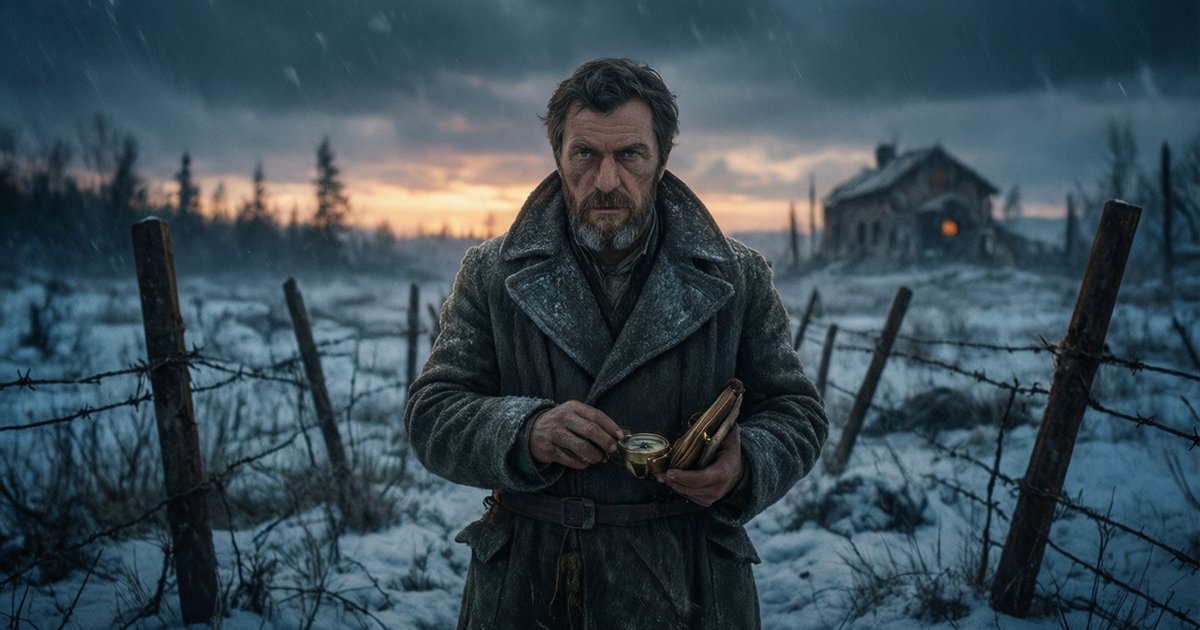
The wind in the Yukon didn't just blow; it screamed, carrying a fine, gray sleet that tasted of iron and diesel. Soren Hale huddled in his survey shack, the air thick with damp wool and stale coffee clinging to the walls. He was forty-two, but in the mirror of a cracked washbasin, he looked sixty. His eyes were bloodshot from staring at topographical charts, searching for the one mistake that would undo the legacy of his failure. Ten years ago, a miscalculation of three degrees in a mineral survey had ruined his mentor's career and stripped Soren of his USGS credentials. Now, he was a low-level contractor, measuring fence lines for a government that barely remembered his name.
While cross-referencing a new set of Russian border charts with American sightings, Soren noticed a gap. A sliver of land, barely four miles wide, had simply vanished from the official records. According to the Russian maps, the border shifted south, claiming a valley that should have belonged to the US. His heart hammered against his ribs—not from fear, but from the intoxicating pull of precision. He grabbed his antique brass compass, the one with the needle that always lagged by a fraction of a degree, and stepped into the sleet.
Two miles from the Seward Line, he found the body. A courier, half-buried in a snowdrift, his Russian Imperial uniform stiff with frost. The man's eyes were open, frozen in a stare of absolute terror. Clutched in his blue-skinned fingers was a leather-bound ledger, its pages damp but legible. As Soren flipped through the coded entries, he didn't see names or dates. He saw coordinates. Precise, mathematical coordinates that pointed toward the interior of the Russian territory, far beyond where any legal settlement should be. The Russians weren't just encroaching; they were hiding something. And for the first time in a decade, Soren Hale knew exactly where he was standing.
Chapter 2
The Army outpost at the Yukon border smelled of wet leather and desperation. Captain Garrett Reed, Soren’s younger brother, stood by the telegraph machine, his uniform pressed with a sharpness that felt like a reprimand. Garrett was the golden boy, the pragmatist who had climbed the ranks while Soren had sunk into the footnotes of cartography. To Garrett, the world was a series of orders to be followed, not a puzzle to be solved.
'It's a clerical error, Soren,' Garrett said, his voice flat, not even looking up from his reports. 'The Russians move a fence post ten feet to the left, and you think the Tsar is planning an invasion. We have a diplomatic ceasefire to maintain. The last thing Washington wants is a border skirmish over a few acres of frozen rock.'
Soren slammed the ledger onto the mahogany table, the thud echoing in the quiet room. 'This isn't a fence post, Garrett. This is a systematic shift. They’ve moved the line three miles south in the valley. Look at the ledger! These coordinates aren't for settlements; they're for something deep. Something they're guarding with soldiers.'
Garrett finally looked at him, but there was no curiosity in his eyes—only a weary kind of pity. 'You’re obsessed. This is the same mania that cost Professor Halloway his pension. Put the book away and go back to your shack before you make yourself a target.'
As Soren walked back into the sleet, he felt a coldness that had nothing to do with the weather. He noticed a Russian patrol on the opposite ridge, their gray coats blending into the mist. They weren't staying on their side of the line. They were watching the outpost. More specifically, they were watching him. The military command wasn't ignoring the incursions out of diplomacy; they were ignoring them by design. The realization hit him like a physical blow: the border wasn't a wall, it was a veil.
Chapter 3
The ambush happened in the dead of a Tuesday afternoon. Soren was checking a marker stone when a gloved hand clamped over his mouth and a cold steel barrel pressed against his temple. He was dragged into the brush, the sharp tang of pine needles and ozone filling his lungs. When the blindfold was ripped away, he found himself staring into the sharp, calculating eyes of a woman in a high-collared Russian officer's tunic.
'Captain Katarina Volkov,' she introduced herself, her English clipped and precise. 'You have something that belongs to the Imperial Intelligence. The ledger.'
Soren tried to stand, but his boots slipped in the mud. He felt the familiar surge of panic, the need to be precise, to explain the mathematical discrepancy he'd found. 'The border has shifted. You're violating the 1890 treaty.'
Katarina laughed, a short, dry sound. 'Treaties are for people who believe the world is static. We are not here for land, Mr. Hale. We are here for the anomaly.' She leaned in, her voice dropping to a whisper. 'The courier was a traitor. He tried to sell the coordinates to a third party. Now, you have a choice. You can be framed for his murder—which the Americans would gladly believe given your... colorful history—or you can help me.'
'Help you do what?' Soren asked, his voice trembling.
'Locate the center of the anomaly. The ledger is coded in a way that requires a specific type of topographical correction—a correction only a man with your particular obsession for precision could calculate.'
Katarina didn't offer him money or safety; she offered him a chance to be right. For a man who had lived ten years in the shadow of a mistake, it was an irresistible bait. He looked at the brass compass in his pocket, then back at her. He didn't trust her, but he trusted the math. He agreed to lead her into the heart of the Russian territory, knowing he was stepping into a cage.
Chapter 4
Crossing into Russian America felt like stepping into another century. As they traveled north, the landscape shifted from the wild, chaotic forests of the Yukon to the oppressive order of the Empire. They arrived at Novo-Arkhangelsk, the sprawling fortress city of Sitka. It was a cinematic nightmare of stone and steam. Giant iron pipes snaked through the streets, venting plumes of white vapor into a perpetually gray sky. The architecture was a clash of St. Petersburg opulence and frontier brutality—gilded domes perched atop reinforced concrete bunkers.
'It's a city of ghosts,' Soren whispered, staring at the rows of soldiers marching in perfect synchronization. The air tasted of sulfur and coal smoke. He felt a suffocating sense of scale; the Russians hadn't just occupied the land, they had rewritten it. Everything was mapped to a grid of absolute control.
Katarina led him to the Imperial Archives, a windowless monolith of granite. Inside, Soren saw maps that made his heart race. They weren't just mapping the surface; they were mapping the crust. Deep-bore drills, the likes of which the US hadn't even conceived, were being deployed in the interior. The Russians were digging, but they weren't looking for gold or oil.
'Why the secrecy?' Soren asked, tracing a line on a map that led toward a region labeled 'The Silent Tundra.'
'Because some discoveries are too heavy for the world to carry,' Katarina replied, her gaze softening for a fleeting second. 'If the Americans knew what lay beneath the permafrost, they wouldn't send diplomats. They would send an army.'
As they prepared to leave the city for the interior, Soren noticed a detail in the archives: a mention of 'The Silent Tundra' as a zone of total radio failure. He remembered the legends of the area—how compasses spun wildly and signals died. He realized the Russians weren't hiding the mineral from the US; they were using the natural electromagnetic interference of the land to hide a military installation of unprecedented scale.
Chapter 5
The trek into the Silent Tundra was a descent into a sensory void. The wind died down, replaced by a heavy, humming silence that vibrated in Soren's teeth. The gray sleet turned into a thick, oppressive fog. For days, he and Katarina navigated by the stars and the erratic pull of his brass compass. The tension between them shifted from hostility to a fragile, weary kinship.
'My father believed the Empire was the only thing keeping the North from sliding into anarchy,' Katarina told him one night over a small, flickering fire. 'He died defending a border that didn't exist on any map. He spent his life guarding a secret that slowly erased him.'
'Precision is a lonely business,' Soren replied, polishing the glass of his compass. 'When you see the world as it actually is, instead of how people want it to be, you stop fitting in.'
On the fifth day, they reached the center of the anomaly. They climbed a jagged ridge and looked down into a natural basin. Below them lay a vein of iridescent, violet-hued ore stretching for miles, pulsing with a faint, rhythmic light. It was a rare earth mineral, something that defied the known laws of geology. Soren realized that this substance could revolutionize electronics, amplify radio signals, and create weapons that would make the current artillery look like toys.
'It's a catalyst,' Soren whispered, his mind racing through the chemical implications. 'If this is integrated into vacuum tubes, the speed of communication would increase a thousandfold. The first nation to weaponize this will own the century.'
Katarina looked at the ore, then at Soren. For the first time, he saw fear in her eyes. She didn't see a scientific breakthrough; she saw a trigger for a global slaughter. The 'anomaly' wasn't a prize; it was a curse. And as they began the descent to report their find, Soren felt the crushing pressure of the discovery, more oppressive than the frozen earth above.
Chapter 6
The return journey was marked by a suffocating paranoia. As they approached the Seward Line, Katarina’s demeanor changed. She became distant, her hand never straying far from her holster. When they finally reached the American outpost, Soren expected to find Garrett waiting with a rescue party. Instead, he found his brother standing in a secluded grove of black spruce, meeting with a Russian liaison.
Soren watched from the shadows, his breath hitching in his chest. He heard Garrett’s voice—not the voice of a captain, but the voice of a man drowning in debt.
'The coordinates are verified,' Garrett whispered, sliding a folder across a camp table. 'The US command is still blind. They think it's just a border dispute. My reports continue to reflect the official narrative.'
In exchange, the Russian liaison handed Garrett a heavy envelope of rubles. Garrett had been on the Russian payroll for years, trading intelligence for a way out of his gambling debts. He wasn't the pragmatic soldier Soren had feared; he was a traitor who had been carefully curating the 'blindness' of the US Army. The reason the incursions were ignored wasn't diplomatic—it was because the gatekeeper was being paid to keep the door shut.
Soren felt a sudden, sharp nausea. His obsession with the truth had led him to a discovery, but his trust in his own blood had been the real error. He realized that the ledger he had carried was no longer just a map to a mineral; it was a death warrant for his brother. If the US discovered Garrett’s betrayal, he would be hanged. If the Russians felt Garrett was no longer useful, he would simply disappear into the tundra. Soren stepped out from the trees, the brass compass clutched in his hand like a weapon, his face pale in the moonlight. 'Hello, Garrett,' he said, his voice sounding like breaking glass.
Chapter 7
The betrayal was swift. Garrett didn't apologize; he didn't even look surprised. He signaled his men, and within seconds, Soren and Katarina were pinned to the frozen ground. Garrett’s face was a mask of cold desperation.
'You always had to be the smartest man in the room, Soren,' Garrett spat, his voice devoid of affection. 'Your need for precision is a disease. You can't just let a line be a line; you have to know exactly where it is. Now, because of your curiosity, we're both in danger.'
Garrett didn't want to kill Soren—not yet. He needed the ledger and the final corrected coordinates to secure a permanent exit from the US Army and a comfortable life in the East. He locked Soren and Katarina in a frozen cellar beneath the outpost, a concrete box that smelled of mold and old blood. The temperature dropped to ten degrees Fahrenheit, and the walls seemed to shrink around them.
Soren sat in the dark, shivering violently. He felt the old failure returning—the ghost of Professor Halloway, the shame of the miscalculated degrees. He had tried to find redemption by being precise, but precision had only led him to this hole. He looked at Katarina, who sat in the opposite corner, her eyes reflecting the dim light from a ceiling grate.
'He's going to hand us over to the High Command,' Katarina whispered. 'They don't keep prisoners of war in the Silent Tundra. They keep secrets.'
As the hours passed, Soren felt a strange clarity. He realized that for his entire life, he had been obsessed with the correct map, the correct coordinate, the correct truth. But the truth didn't save people. The truth often burned everything down. In the silence of the cellar, he felt the brass compass in his pocket—the one that was slightly off-center. He remembered that the compass had been a gift from Halloway, a flawed tool designed to teach him that perfection is a lie.
Chapter 8
The escape began not with a plan, but with a flaw. As a blizzard roared outside, turning the world into a white void, Soren realized that the guards were relying on standard-issue military compasses. But the outpost was built on a secondary magnetic vein—a ripple effect of the violet ore. The standard compasses were drifting, but Soren's flawed brass compass, with its specific off-center offset, was actually aligning perfectly with the local distortion.
'Follow me,' he whispered to Katarina. 'And don't trust the map. Trust the error.'
Using a rusted pipe to jemmy the lock during a guard change, Soren led Katarina out into the blinding white. They moved through the storm, not in a straight line, but in a series of calculated arcs, navigating the 'blind spots' of the terrain that Soren had memorized from the Russian archives. He used the subtle gradients of the slope and the specific hum of the wind against the ridges to guide them.
At one point, they encountered a Russian patrol. Katarina stepped forward, using her rank and a forged order to divert them, her voice steady and commanding despite the frost on her lashes. It was a gamble, but the soldiers, disoriented by the blizzard and the magnetic interference, obeyed without question.
As they reached the crest of the final ridge, they saw the US diplomatic outpost in the distance, its lights flickering like dying stars. But Katarina stopped. She looked at the coordinates in Soren's hand, then at the man who had spent his life chasing a perfect line.
'If you give them this,' she said, 'the Americans will launch a full-scale invasion to seize the vein. Thousands of boys will die in the snow for a rock that glows. Is your redemption worth a war?'
Soren looked at the map—the most precise document he had ever created. It was his masterpiece. It was the proof that he was no longer a failure. And it was a blueprint for a massacre.
Chapter 9
The final walk to the diplomatic outpost felt like a mile-long climb up a mountain of glass. Soren could see the officers inside, the tea steaming in porcelain cups, the oblivious peace of men who believed the border was secure. He held the map in his hand, the ink crisp and the coordinates absolute. All he had to do was hand it over, and he would be hailed as a hero. He would be the man who discovered the secret of the North. His name would be scrubbed clean of every mistake he had ever made.
He stepped into the warmth of the office. The commanding officer, a man of starch and medals, looked at him with curiosity. 'Hale? What the hell are you doing here in this weather?'
Soren looked at the map, then through the window at the horizon, where the Russian and American lines met in a blur of gray and white. He thought of Garrett’s greed, Katarina’s fear, and the thousands of anonymous soldiers who would be fed into the meat grinder of a mineral war. He realized that the only way to truly fix his past mistake wasn't to be perfectly right, but to be intentionally wrong.
Without a word, Soren walked to the cast-iron stove in the corner of the room. Before the officer could react, he thrust the map into the coals. The parchment curled, the violet coordinates turning to black ash in seconds.
'What the hell are you doing!' the officer screamed, lunging forward.
'Correcting a mistake,' Soren replied, his voice calm for the first time in ten years.
He had destroyed the evidence of the mineral vein. He had erased the only proof of his genius. By destroying the map, he had ensured that the 'Seward Line' remained a lie—a fragile, imaginary fence that kept two empires from tearing each other apart. He was no longer a hero, and he would never be a celebrated cartographer. He was, in the eyes of history, a failure who had lost the most important discovery of the century.
Chapter 10
The aftermath was quiet. Garrett was eventually court-martialed after a separate investigation into his finances, though the full extent of his betrayal remained a mystery. Katarina vanished back into the Russian interior, leaving behind nothing but a lingering hint of ozone and the memory of a shared fire.
Soren returned to the Yukon, not to his shack, but to the border fence. He lived as a hermit, a man who spent his days measuring the wind and his nights staring at the stars. He never sought another job with the government. He didn't need the validation of a title or the prestige of a correct map. He had found a different kind of precision—the precision of knowing exactly what the world could afford to lose.
One winter morning, November 11, 1926, Soren stood at the Seward Line. The snow fell in heavy, silent sheets, erasing the footprints of anyone who dared to cross. He reached into his pocket and pulled out the antique brass compass. He opened the casing and, with a deliberate movement, snapped the needle from its pivot, rendering the instrument useless.
He stood there for a long time, watching the American flag and the Russian flag flutter in the freezing gale on opposite sides of the fence. The two fabrics whipped in the wind, separated by a line of dirt and ice that only he knew was a fabrication. He smiled, a small, tired movement of the lips. He was a man without a map, in a land without a center, and for the first time in his life, he knew exactly where he belonged. He turned his back on the border and walked into the white, leaving no trail for anyone to follow.
The End