 Porchlight Tales
My Boss Stole My Career-Defining Report. He Presented the Version With the Errors.
Fiction. This is an original, made-up story: names, characters and events are invented, and any resemblance to real people or events is coincidental.
Full story · 10 chapters · Read in 5 parts instead
Listen to this story (5 parts)
Part 1 · 6 min
Part 2 · 5 min
Part 3 · 6 min
Part 4 · 5 min
Part 5 · 5 min
Chapter 1
"LEAVE THE PRESENTATION TO THE ADULTS, CURTIS!"
Greg’s voice echoed in the sterile hallway, sharp enough to cut glass. I stood frozen, my tablet still warm in my hand, watching his back as he stormed toward his office.
I didn't argue. I didn't even blink. I just waited until the heavy mahogany door slammed shut.
But to understand why I let him shout, you need to know how it all began. Three weeks earlier...
The Zenith Report was more than just a collection of spreadsheets; it was my ticket out of the middle-management grind. For three months, I had lived on burnt espresso and four hours of sleep, tracing every erratic data point of Project Zenith until the projections sang. I wanted that Director of Strategy position. Not for the prestige, but because my father’s medical bills were piling up, and the current salary barely covered the premiums.
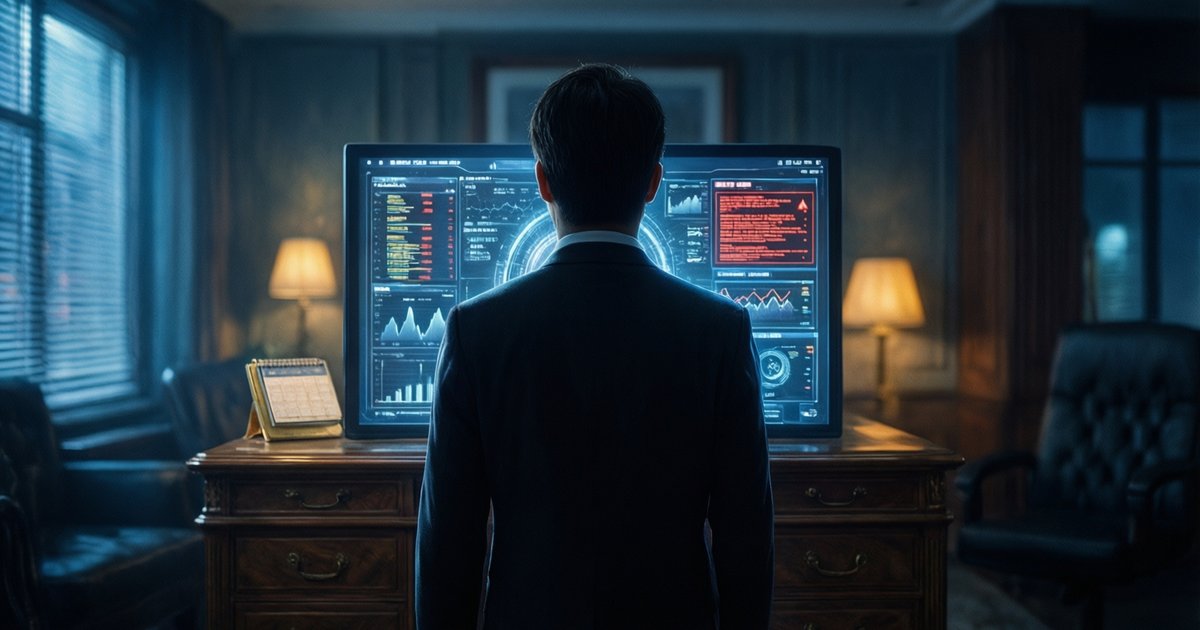
I walked into Greg Sterling’s office, the cloying musk of his expensive cologne fighting the metallic tang of the heavy-duty printers humming in the hallway. Greg didn't look up from his gold-plated desk calendar. He was a man who thrived on the optics of leadership while having long since forgotten how to actually lead.
'It's done, Greg,' I said, sliding the tablet across the mahogany surface. 'The Q4 projections are locked. We're looking at a twelve percent efficiency increase if we pivot to the new logistics model.'
Greg finally looked at me, his eyes scanning the summary page with a bored expression. He didn't ask about the methodology or the risks. Instead, he leaned back, a condescending smirk playing on his lips. 'Good, Curtis. You’ve been working hard. It’s cute how much passion you put into the clerical side of things.'
Clerical. I felt a familiar tighten in my chest, a ghost of the day five years ago when I was fired from my first firm for pointing out a senior partner's accounting error. I had learned my lesson then: don't fight the hierarchy; just document everything. I had built a digital fortress of version controls and timestamps, a habit my colleagues called OCD, but I called survival.
'The final file is in the shared drive, Greg,' I added quietly. 'In the folder labeled Zenith_Final.'
'I'll take it from here,' Greg snapped, dismissing me with a flick of his wrist. 'Go get some sleep, Curtis. Leave the presentation to the adults.'
Chapter 2
An hour after leaving Greg's office, a notification popped up on my screen. A file modification in the shared drive. I clicked into the Zenith folder and felt my stomach drop.
Greg hadn't just reviewed the report; he had scrubbed it. My name was gone from the title page. The citations to my original research had been deleted. In their place was a single, bold header: 'Prepared by Greg Sterling, Senior Manager.'
For a moment, the old fear paralyzed me. My instinct was to send a polite, pleading email, to ask why he felt the need to remove my credit. But then I remembered the cold silence of my previous boss as I packed my desk. I realized that Greg wasn't just taking credit; he was erasing my existence to climb a ladder he didn't have the skills to scale.
I didn't send the email. Instead, I opened my private 'Archive_vFinal_Draft' folder. This was my sanctuary, a mirrored drive where every iteration of my work lived. I looked at the version currently in the shared drive—the one Greg was now claiming as his own.
I began to type. I didn't delete the data; that would be too obvious. Instead, I introduced a subtle, catastrophic flaw. I tweaked a few formulas in the projection tab, creating a fifteen percent discrepancy in the Zenith output. To an untrained eye, the numbers still looked impressive, but to anyone who actually understood the logic, it was a mathematical hallucination.
I renamed the flawed file 'Zenith_Final_v2_Approved' and uploaded it to the shared drive, replacing the clean version. I then moved the actual, correct report to a password-protected USB drive in my pocket.
I sat back, the humming of the office air conditioner filling the silence. I wasn't sabotaging the company; I was simply providing Greg with exactly what he wanted: a version of the project that looked perfect on the surface, but lacked a foundation. I just wondered if he would be arrogant enough to ignore the red flags.
Chapter 3
The day before the Board meeting, the office felt like a pressure cooker. The cold Chicago wind rattled the glass walls of the twentieth floor, making the sleek interior feel fragile. Greg was in high spirits, strutting through the cubicles with a confidence that bordered on delusional.
'Morning, Curtis!' he boomed, stopping by my desk. He didn't look at me; he looked at the reflection of himself in the glass partition. 'I've spent the morning polishing the narrative. The Board is going to love the "Sterling Vision" for Zenith. It's the kind of breakthrough that secures a VP seat.'
I kept my voice neutral, my fingers tapping rhythmically on the desk. 'Greg, I noticed you updated the file to version two. I'd be happy to double-check the final numbers for you. Just to ensure there are no formatting glitches before the presentation.'
Greg stopped. He turned to me, his eyes narrowing. The mask of the 'mentor' slipped, revealing the insecurity beneath. He hated that I knew the data better than he did. He saw my offer not as help, but as an attempt to reclaim territory.
'Double-check?' he sneered, his voice dropping to a cold whisper. 'I don't pay you to double-check my work, Curtis. I pay you to provide the raw materials. I am the architect here. You are the bricklayer. Stay in your lane, or you'll find yourself looking for a new lane in a different city.'
He reached into his pocket and pulled out his tablet, tapping the screen with a proprietary air. 'I've locked the file version. No more edits. No more "checks." Just stay out of my way and be ready to take notes during the meeting.'
As he walked away, Tessa, a junior analyst I had been mentoring, leaned over the partition. She had a look of genuine concern on her face. 'He's out of control, Curtis. I've been keeping a log of his "directives" for HR. Are you okay?'
'I'm fine, Tessa,' I said, feeling a strange, calm clarity. 'In fact, I think Greg is about to have the most successful presentation of his life.'
Chapter 4
The morning of the Q4 review arrived with a heavy gray sky and a biting frost that coated the city. Inside the conference room, the atmosphere was electric. The air was thick with the richness of expensive roast coffee and the sharp ozone of a high-end projector.
Sylvia Jenkins, the COO, sat at the head of the table. She was a legend in the firm—a woman who could spot a rounding error from across a room and who had a notorious reputation for 'live audits.' She didn't care for slides or storytelling; she cared for the raw truth of the data. If a manager couldn't explain the 'why' behind a number, Sylvia viewed them as dead wood that needed to be pruned.
Greg was pacing at the front of the room, clutching his tablet like a shield. He looked polished in his charcoal suit, but I noticed the slight tremor in his hands and the way he kept adjusting his tie. He was nervous, but his arrogance was acting as a suit of armor.
I sat at the far end of the table, ostensibly there to 'provide technical support' if needed. Tessa sat next to me, her eyes darting between Greg and Sylvia.
'Before we begin,' Greg announced, his voice booming with a forced charisma, 'I want to emphasize that Project Zenith was a solo vision. I spent the last quarter synthesizing disparate data streams into a unified strategy. It required a level of high-level conceptual thinking that usually takes years to master.'
Tessa leaned in and whispered, 'He actually told the Board members in the hallway that you only helped with the data entry. He’s completely erased you.'
I didn't feel the surge of anger I expected. Instead, I felt a clinical curiosity. I watched as Greg clicked the first slide. The screen glowed with a beautifully designed chart—the 'dummy' version. The numbers looked soaring, the curves looked perfect, and the projected growth was breathtaking. The Board members leaned in, impressed by the sheer scale of the success Greg was claiming.
'Now,' Sylvia Jenkins said, her voice cutting through the admiration like a blade, 'let's get into the specifics.'
Chapter 5
Greg launched into his pitch, his voice sliding into a rehearsed, melodic cadence. He spoke about 'synergies,' 'market penetration,' and 'strategic pivots.' He was playing the part of the visionary leader perfectly, using the polished visuals of the report to distract from the lack of substance in his words.
I watched the screen, tracking the flow of the presentation. He was reading the talking points I had written for the *real* report, but he was applying them to the numbers in the dummy file. Because he didn't actually understand the underlying math, he didn't realize the narrative and the data were now contradicting each other. He was praising a 'conservative estimate' while the screen showed an impossible spike in growth.
'The brilliance of this model,' Greg claimed, gesturing to a graph, 'is how we've mitigated the volatility in the supply chain. As you can see, the Zenith projection remains stable even under stress.'
I felt a flicker of anticipation. We had reached the slide with the 15% discrepancy. On the screen, the projected revenue for the next quarter was listed at $42 million, but the operational costs listed in the footnotes—which I had intentionally left skewed—only supported a revenue of $27 million. It was a glaring hole in the logic, a mathematical impossibility that screamed for attention.
Most of the Board members were nodding, swept up in Greg's confidence. They saw the $42 million and liked the color of the ink. But Sylvia Jenkins wasn't nodding. She was squinting at the screen, her pen tapping a rhythmic, menacing beat on the table.
She didn't interrupt him. She let Greg continue for another five minutes, letting him bury himself deeper into the lie, letting him claim full ownership of every single decimal point on that screen. He was leaning into the victory, a smug smile plastered on his face, convinced that he had just secured his promotion.
'Greg,' Sylvia finally interrupted, her voice devoid of emotion. 'I'm looking at your Zenith projections. Specifically, the delta between the operational spend and the revenue output on slide twelve. There's a fifteen percent discrepancy that doesn't make any sense. Explain the logic.'
Chapter 6
The silence that followed was absolute. Greg stopped mid-sentence, his arm still frozen in a sweeping gesture. He blinked, looking at the screen as if he were seeing the numbers for the first time.
'The... the logic?' he stammered, his charisma evaporating in real-time. 'Well, as I mentioned, the model accounts for various market fluctuations. The fifteen percent is... it's a buffer. A strategic overhead.'
Sylvia didn't blink. 'A buffer doesn't work that way in a projection model, Greg. This isn't a buffer; it's a fundamental error in the calculation. It suggests we're generating revenue out of thin air. Either your math is wrong, or you don't understand the report you're presenting.'
Greg's face turned a mottled shade of purple. He tried to pivot, his voice climbing an octave. 'I assure you, the model is sound. It's a complex algorithm. Perhaps the visual representation on the slide is slightly misleading, but the core data is—'
'Don't give me a narrative, Greg,' Sylvia snapped, her patience finally snapping. 'Give me the proof. Open the raw data source. Right now. I want to see the formulas in the cells.'
Panic set in. Greg began fumbling with his tablet, his fingers sliding across the screen. He opened the shared drive and pulled up the 'Zenith_Final_v2_Approved' file. He clicked into the projection tab, but as he scrolled, he realized he had no idea which cell contained the error. He was staring at a wall of numbers that looked like a foreign language to him.
He tried to click through the tabs, his breathing becoming shallow and audible in the quiet room. The Board members were no longer nodding; they were exchanging looks of skepticism. The 'visionary' was suddenly a man lost in his own map.
'I... I think there's a technical glitch with the tablet,' Greg muttered, his voice trembling. 'The file might have corrupted during the upload.'
'The file isn't corrupted, Greg,' Sylvia said, standing up. 'You're just incompetent. Now, who actually compiled this data?'
Chapter 7
The room shifted. The predatory energy of the Board was now focused entirely on Greg. He looked around the table, trapped by his own theft. He knew that admitting he had stolen the work would be professional suicide, but staying silent was leading to the same destination.
In a final, desperate attempt to save face, Greg did the one thing I had hoped he would do: he tried to throw me under the bus. He pointed a shaking finger toward the end of the table.
'Curtis!' Greg shouted, his voice cracking. 'Curtis compiled the raw data. He must have left a legacy error in the sheet. I warned him to be thorough, but it seems he's been sloppy with the final version. I apologize to the Board; I should have scrutinized his clerical work more closely.'
I felt the eyes of the room swing toward me. Tessa looked horrified. The Board members looked confused. Greg was panting, a look of manic hope in his eyes, believing that by framing me as the 'sloppy assistant,' he could pivot back to being the manager who simply 'missed a detail.'
I didn't flinch. I didn't look at Greg with anger. I didn't even look surprised. I simply stood up slowly, the movement deliberate and calm. I reached into my pocket and pulled out the small, silver USB drive.
'It's interesting that you mention the "clerical" errors, Greg,' I said, my voice steady and clear, projecting to every corner of the room. 'Because the version you're presenting is indeed flawed. It's a draft I kept in the shared folder specifically to test for internal consistency—a version I purposely left broken to see if anyone actually reviewing it would notice the discrepancies.'
Greg's jaw dropped. 'What are you talking about?'
'I'm talking about the fact that the real Zenith Report—the one with the verified data and the correct projections—is right here,' I replied, stepping toward the projector. 'And unlike the version you chose to present as your own, this one actually works.'
Chapter 8
The room was stunned into a heavy silence as I plugged the USB drive into the console. With a few keystrokes, the screen flickered and changed. The 'dummy' version vanished, replaced by the true final report.
I didn't just show the slides; I opened the live workbook. I navigated to the projection tab and, with a few clicks, demonstrated exactly how the formulas worked. I explained the logic, the risk mitigation, and the actual twelve percent efficiency gain, speaking with a confidence I hadn't known I possessed. I wasn't just presenting data; I was presenting my mastery of it.
As I spoke, I watched Greg. He had shrunk in his chair, his face pale, his eyes wide. He looked like a man who had just watched his own execution. He had spent months treating me as a tool, a ghost in the machine, and now the ghost was the only person in the room who knew how to turn the lights on.
When I finished, I looked at Sylvia Jenkins. She wasn't smiling—she rarely did—but there was a glimmer of respect in her eyes. She looked at the correct data, then looked at Greg, then back to me.
'The logic is sound,' Sylvia stated. 'The data is impeccable. And more importantly, it's clear who actually understands this business.'
She turned to Greg, her voice turning to ice. 'Greg, your lack of technical competence is a liability. But your dishonesty is a fireable offense. You didn't just fail a presentation; you attempted to deceive the Board and scapegoat a subordinate to cover your tracks.'
'Sylvia, please,' Greg whispered, 'I just wanted the project to look its best—'
'Get out,' Sylvia interrupted. 'Clear your desk. Now.'
As Greg stood up, his legs shaking, the Board members began to whisper. The 'Sterling Vision' had lasted exactly forty-five minutes. He had spent his entire career building a facade of brilliance, and in his greed, he had walked straight into the only trap that could actually catch him.
Chapter 9
The walk to the elevator was the quietest three minutes of my professional life. I carried Greg's packed cardboard box—a courtesy he had never shown anyone. The box was light, containing mostly gold-plated desk accessories and a few framed photos of himself.
As the elevator doors slid shut, Greg looked at me. There was no longer any arrogance, only a hollow, confused sadness. 'Why did you do it, Curtis? You could have just told me the file was wrong. We could have fixed it together.'
'We couldn't have fixed it, Greg,' I replied. 'Because you didn't want a partner. You wanted a ghostwriter. I just decided to stop being invisible.'
I stepped out of the elevator and walked back to the conference room. Sylvia Jenkins was waiting for me. She didn't offer a handshake; instead, she slid a piece of paper across the table. It was the offer letter for the Director of Strategy position, with a salary and benefits package that would comfortably cover my father's care and then some.
'You have a habit of keeping paper trails, Curtis,' Sylvia said. 'I like that. But as a Director, you'll need to learn how to lead people, not just manage data. I expect you to start by fixing the culture of that department. Start with Tessa; she’s got a sharp eye for detail and a level of integrity that your predecessor lacked.'
I took the letter, feeling a weight lift off my shoulders that I hadn't even realized I was carrying. I wasn't just securing my family's future; I was reclaiming my own voice. I realized that for years, I had used my archives and my folders as a shield, a way to hide from confrontation. But the truth didn't need a shield. It just needed to be presented at the right moment.
Chapter 10
I spent the first hour in my new office simply staring at the view. The Chicago skyline glowed in the late afternoon sun, the glass towers reflecting a deep, bruised purple. The office was larger than Greg's had been, with windows that stretched from the floor to the ceiling, making the city feel like it was inside the room.
I sat down at my desk and opened my laptop. I navigated to the 'Archive_vFinal_Draft' folder. I scrolled through the hundreds of versions, the timestamps of a man who had been terrified of being erased. I found the file: 'Zenith_Dummy_Flawed.'
With a single click, I moved it to the trash. Then, I emptied the bin.
I didn't need a safety net anymore. I didn't need to build digital fortresses or keep secret logs of every slight. The fear that had governed my career since that first firing had finally evaporated, replaced by a quiet, steady confidence. I had learned that the most effective way to fight a bully isn't to shout louder, but to be so indispensable that their failure becomes their own responsibility.
I picked up a fresh cup of coffee—actually brewed this time, not the burnt sludge from the breakroom. I took a sip and leaned back in my chair. For the first time in my life, the data didn't just add up on the screen; it added up in my life.
I looked at the empty desk across the hall where Greg used to sit. It was already being cleaned by the janitorial staff. A few gold-plated paperweights had been left behind, forgotten and useless. I smiled, took another sip of my coffee, and began to draft the strategy for the new year. This time, my name was right at the top, and it was exactly where it belonged.
The End