 Porchlight Tales
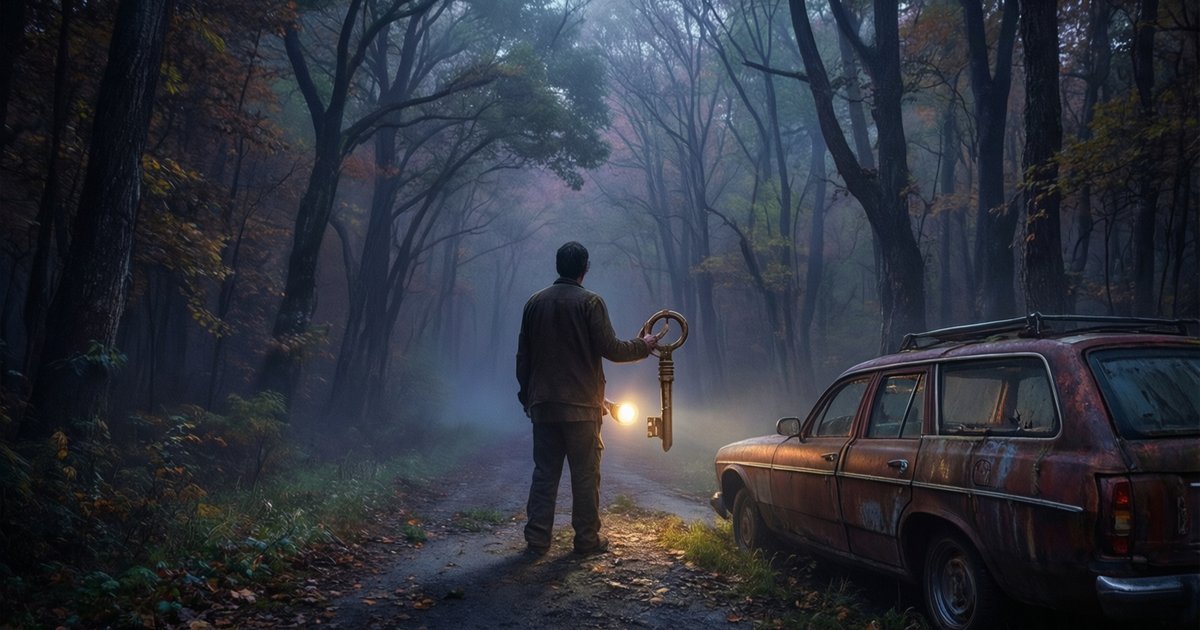
The Brass Key in the 1972 Station Wagon
Fiction. This is an original, made-up story: names, characters and events are invented, and any resemblance to real people or events is coincidental.
Full story · 8 chapters · Read in 4 parts instead
Listen to this story (4 parts)
Part 1 · 5 min
Part 2 · 5 min
Part 3 · 5 min
Part 4 · 5 min
Chapter 1
The auction house smelled of damp wool and desperation. Gideon Kincaid stood in the rain, his boots sinking into the Appalachian mud, staring at a 1972 station wagon that looked more like a rusted coffin than a vehicle. To anyone else, it was a heap of oxidized steel. To Gideon, it was a puzzle. He spent his life fixing things—broken transmissions, cracked windshields, fractured legacies—because he couldn't fix the hole his father had left in his life twenty-eight years ago.
He won the bid for a paltry sum. Back in his garage, as the autumn wind rattled the corrugated tin roof, Gideon began the painstaking process of cleaning the interior. He scrubbed the vinyl seats, which gave off a sharp, electric tang mixed with a hint of wintergreen, a jarring contrast to the expected mildew. While wiping the underside of the dashboard, his cloth caught on something metallic.
Gideon reached under the plastic trim and peeled away a strip of yellowed duct tape. Taped there was a heavy brass key, its bow intricately carved with a symbol resembling a closed eye. Attached to the key was a scrap of parchment with coordinates handwritten in fading blue ink: 38.4N, 82.1W.
Gideon stared at the numbers. He didn't believe in treasure hunts, but the key felt heavy with intent, almost urgent. He checked the glovebox and found a small, hand-drawn map. It showed a winding road that ended abruptly at a dead end, marked only with a small, handwritten X. There was no town name, no landmark, just a path leading into the dense forest of the valley. Gideon felt a familiar obsession ignite. He didn't know where these coordinates led, but the silence in his chest finally felt like a question instead of a void. He grabbed his flashlight and his coat, the brass key cold against his palm, wondering why someone would hide a map to nowhere inside a forgotten car.
Chapter 2
The coordinates led Gideon deep into a stretch of wilderness where the GPS on his phone began to flicker and spin. The road narrowed until the asphalt crumbled into gravel, and the towering maples closed in like a canopy of orange and gold. According to every official map Gideon had studied, this area was nothing but state-protected forest.
He stopped at a small general store on the outskirts of the nearest hamlet to ask for directions. The woman behind the counter, Esther Higgins, was a retired librarian with eyes that looked like they had seen too many winters. When Gideon showed her the hand-drawn map, her face didn't just pale; it tightened, as if she were physically bracing for a blow.
"You're looking for Hollow Creek," she whispered, her voice like dry leaves. "That place was erased in 1960. The government didn't just remove it from the maps, Mr. Kincaid; they treated it like a contagion. There was a disaster—something the records won't tell you. A localized collapse, they called it."
Gideon frowned. "A collapse? You mean a landslide?"
"I mean the town stopped fitting into our version of the world," Esther replied, leaning in. A sudden waft of wintergreen drifted from her tea, though she had no mint in her cup. "People don't go looking for Hollow Creek because once you find the road, the road doesn't always let you leave. Some things are erased for a reason. Leave that key in your pocket and drive back to the city while you still remember who you are."
Gideon thanked her and stepped back into the chilly air. He should have listened. He knew the feeling of being erased; he had lived it since he was six years old. The warning didn't deter him; it acted as a catalyst. He climbed back into the station wagon, the electric tang stronger now, and drove toward the dead end on the map, determined to find the place that didn't exist.
Chapter 3
The road didn't end so much as it dissolved. As Gideon drove further, the sunlight seemed to drain out of the sky, replaced by a perpetual, heavy gray twilight. He passed through a veil of fog so thick it felt like driving through wet wool. Then, the trees parted, and Gideon slammed on the brakes.
Hollow Creek lay before him, a ghost shell of a village. The houses were perfectly preserved but drained of color, as if a giant sponge had soaked up every pigment of red, blue, and yellow. The architecture was mid-century, the lawns neatly trimmed but gray as ash. There was no wind. No birdsong. Just an oppressive, ringing silence that pressed against his eardrums.
He stepped out of the car, and the electric tang and wintergreen hit him like a physical wall. It was suffocatingly sweet. He walked toward the center of town, passing a storefront with a faded sign that read 'Kaufman’s Clock Shop.' Inside, hundreds of clocks lined the walls, their pendulums frozen mid-swing. Every single one of them was stopped at exactly 4:12.
Gideon felt a prickle of anxiety. He checked his own watch; the second hand was twitching violently, unable to move forward. He felt as though he were stepping through a photograph, a frozen moment of a life that had been interrupted. He followed the coordinates on the parchment, walking past a gray playground where a swing set hung motionless in the air.
At the edge of the town, nestled against a limestone cliff, he found a small, stone cottage. It looked more sturdy than the others, less like a memory and more like a fortress. In the backyard, half-hidden by overgrown gray vines, was a heavy wooden door set directly into the earth. A cellar. Gideon approached the door, the brass key in his hand beginning to vibrate with a low, humming frequency. He reached for the lock, but as he leaned in, he realized something was wrong. The lock wasn't just metal; it was fused with a strange, translucent, glass-like substance that looked like frozen smoke.
Chapter 4
Gideon knelt in the dirt, touching the glass-like substance surrounding the lock. It was ice-cold, nearly freezing his fingertips, yet it didn't melt. It felt organic, as if the house itself had grown a scab over the keyhole to prevent anyone from entering.
He tried to insert the brass key, but the glass blocked the way. He spent an hour scrubbing at it with a pocketknife, but the substance was harder than diamond. Every time the metal blade scraped the surface, a faint, melodic chime echoed through the silent town, as if he were playing a giant, invisible tuning fork.
"It doesn't like to be disturbed," a voice boomed from behind him.
Gideon jumped, nearly dropping his flashlight. Standing a few yards away was a man in a brown deputy's uniform that looked thirty years out of date. He had a weathered face and eyes that looked exhausted, as if he hadn't slept since the fifties. His badge read 'Officer Jasper Rowe.'
"Who are you?" Gideon demanded, his chest tightening with a sharp, jagged panic. "How long have you been standing there?"
Rowe didn't answer the question. Instead, he looked at the station wagon parked at the edge of the fog. "That car. It's a tether. Someone spent a long time making sure that specific vehicle would find its way back here. You're the first one to actually bring the key."
Gideon stepped away from the cellar door. "I don't know what you're talking about. I bought this car at an auction."
Rowe sighed, a sound like wind through a graveyard. "The auction was just the delivery system, son. Hollow Creek didn't suffer a disaster in the way you think. The people here didn't die, and they didn't leave. They just... stopped being seen. They slipped into a fold in the world, and the door was locked from the outside to keep the void from leaking into your world. Now, I suggest you turn that car around before the fog decides you belong here too."
Chapter 5
Gideon stared at Officer Rowe. The man didn't seem ghostly; he felt solid, yet he lacked the vibrancy of a living person. He was a grayscale version of a human being.
"Why was the door locked?" Gideon asked, his voice trembling. "And why is my father's scent—this wintergreen and ozone—all over this place?"
Rowe’s expression softened, a flicker of pity crossing his face. "Your father was one of the few who understood the bridge. He didn't vanish, Gideon. He volunteered. He knew that if the seal on this cellar broke without a proper anchor, Hollow Creek wouldn't just stay hidden—it would expand. It would start erasing other towns, other people, until everything was just... gray."
Gideon felt a surge of anger. "He left me! He left a six-year-old boy alone because he wanted to play guardian of a ghost town?"
"He did it so you could grow up in a world with color," Rowe replied quietly. "He traded his existence for your future. That's the price of the bridge. But the seal is weakening. That's why the key found its way to you. The tether—the car—was designed to bring a blood relative back to reinforce the lock or close it forever."
Gideon looked back at the glass-covered lock. He didn't want to believe in voids or bridges; he wanted a father he could hug, a man who could explain why he wasn't enough to stay for. He pushed past Rowe, ignoring the officer's warnings. He began searching the ruins of the nearby cottage, driven by a desperate need for proof. In a collapsed bedroom, beneath a layer of gray dust, he found a leather-bound diary.
He opened the book, and his breath hitched. The handwriting was identical to the letters his father had sent him for the first few years of his absence—the letters that had slowly stopped coming until the silence became absolute. The diary spoke of a 'Collector' who offered a way to preserve things forever in exchange for memories. It was the same phrasing Gideon had seen in his father's old notes. The more Gideon read, the more he realized his father hadn't just been a guard; he had been a prisoner of his own choice.
Chapter 6
The air in the ruins grew thick, the wintergreen becoming so potent it tasted like copper in Gideon's mouth. The ozone smell triggered a memory—a flash of his father's old workshop, the scent of solder and old engines. He realized the station wagon wasn't just a lucky find. It was a precision tool, a mechanical bridge built by his father to guide Gideon back to this exact spot.
"The Collector is gone, but the void remains," Rowe warned, stepping closer. "If you open that cellar, you're not just finding a room. You're opening a valve. You have to decide right now: do you want the truth, or do you want the world to stay bright?"
Gideon looked at the diary. His father had written about the agony of being forgotten, the way his face faded from Gideon's mind as the years passed. He had written that the only way to stop the erasure was to maintain the anchor from the inside. His father had been living in a timeless, colorless purgatory to ensure that Gideon could have a life of color.
Gideon's obsession with fixing things screamed at him. He couldn't leave this broken. He couldn't leave his father in that gray silence. He believed he could find a way to pull him out, to fix the family tree that had been snapped in two.
"I can fix it," Gideon whispered, though he didn't know how.
"You can't fix a void, Gideon," Rowe said, his voice heavy. "You can only seal it. If you open that door and try to take him back, the bridge will collapse. The erasure will start again, and this time, there will be no one left to stop it. You are the only one with the key. The choice is yours."
Gideon looked at the brass key. It was humming now, a vibration that synchronized with his own heartbeat. He thought of his lonely childhood, the empty chair at every graduation, the silence of a house that never felt like a home. He wanted his father. He wanted the answer to 'why.' Even if it meant risking everything, the need for closure outweighed the fear of the gray.
Chapter 7
Gideon stepped toward the cellar door. He didn't use a tool this time. He pressed the brass key directly against the glass-like substance. The moment the metal touched the surface, the glass didn't shatter—it dissolved, melting away like sugar in water. The humming reached a crescendo, a vibrating note that shook the very ground beneath his boots.
With a heavy grunt, Gideon turned the key. The lock clicked with a sound that echoed across the entire silent town, waking the frozen clocks in the distance. He pushed the heavy wooden door open, and a rush of warm, stale air hit him.
He descended the stone steps, his flashlight cutting through the gloom. At the bottom, he found something that defied logic. It wasn't a damp basement; it was a perfectly preserved room from 1960. A mahogany desk, a spinning reel-to-reel tape recorder, and a small lamp that cast a warm, golden glow. It was the only place in Hollow Creek that still had color.
On the desk sat a framed photograph. It was his father, looking exactly as he had at thirty-four—the same age Gideon was now. He was smiling, holding a six-year-old Gideon on his shoulders. Beside the photo was a tape recorder with a single button: PLAY.
Gideon's hand trembled as he pressed it. The audio was grainy, filled with the hiss of old magnetic tape.
"Gideon," the voice said, and Gideon nearly collapsed. It was him. "If you're hearing this, you've found the car. You've found the key. I'm sorry I couldn't be there to teach you how to drive, or to tell you that I love you every single day. I chose this because I saw the void opening. I saw it starting to eat the edges of our town, and then I saw it reaching for you. I made a deal to stay, to be the anchor, so that the gray would stop at the border of Hollow Creek. Please, Gideon... don't try to save me. The bridge only works one way. If you stay, or if you try to pull me out, the seal breaks. Leave the key. Lock the door. Go back to the colors."
Chapter 8
Gideon sat in the golden light of the cellar, the tape looping in a haunting silence. He looked at the photo of his father, the man who had traded his entire existence for a son who spent his adulthood trying to fix things.
He realized that for years, he had viewed his father's disappearance as a failure—a broken piece of his life. But this wasn't a break; it was a sacrifice. The ultimate 'fix.' His father had fixed the world by removing himself from it.
Gideon stood up. He looked at the stairs leading back to the gray, lifeless town. He felt a sudden, overwhelming peace. The void wasn't a hole anymore; it was a boundary. He understood now that some things are not meant to be repaired. Some things are meant to be accepted as they are, even in their brokenness.
He walked back up the stairs and stepped out into the twilight of Hollow Creek. Officer Rowe was waiting, his expression neutral, though his eyes seemed less tired.
"You heard him," Rowe said.
"I did," Gideon replied.
Gideon didn't take the key with him. He inserted it into the lock one last time and turned it with a final, decisive click. He felt the connection snap. He didn't just lock the door; he severed the tether. He took the hand-drawn map from his pocket and tore it into a dozen small pieces, letting the wind—which had finally begun to blow—scatter the scraps across the gray grass.
As he walked back to the station wagon, the oppressive pressure of the town seemed to lift. He climbed into the driver's seat and started the engine. As he drove away, he looked in the rearview mirror. The fog was swallowing Hollow Creek, erasing the gray houses and the frozen clocks, pulling the town back into the folds of history where it belonged.
He noticed the smell in the car had changed. The electric tang and wintergreen were gone, replaced by the honest, simple smell of old vinyl and gasoline. Gideon reached over and touched the photo of his father, which he had taken from the desk. He drove toward the horizon, the autumn sun finally breaking through the clouds, bathing the road in a brilliant, blinding gold.
The End