 Porchlight Tales
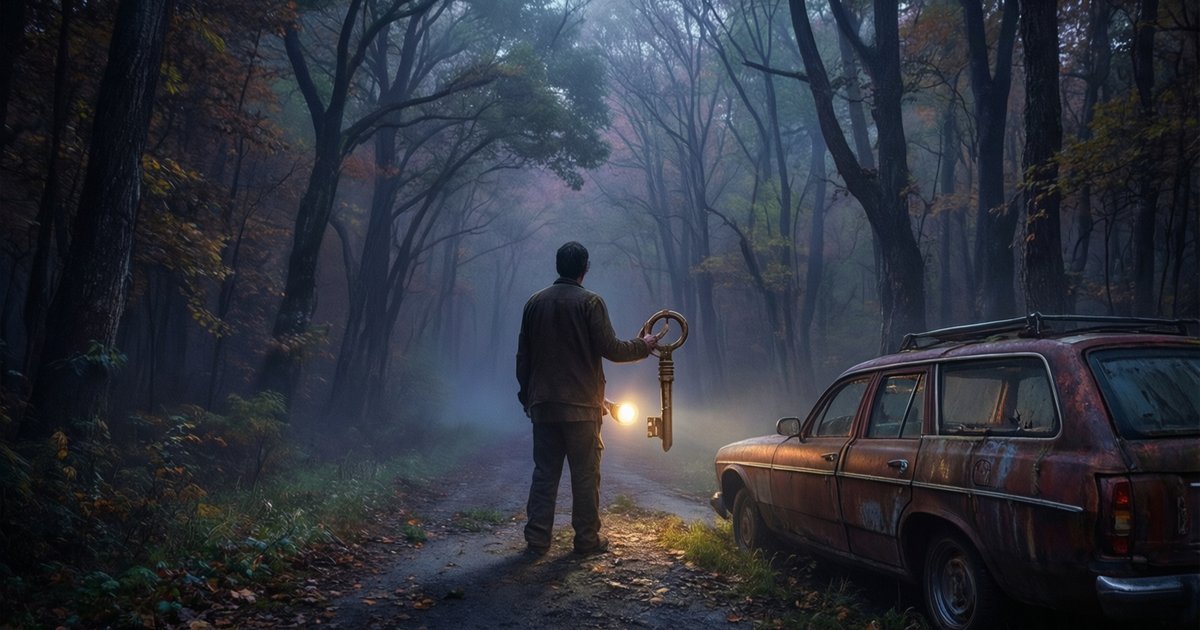
The Brass Key in the 1972 Station Wagon
Fiction. This is an original, made-up story: names, characters and events are invented, and any resemblance to real people or events is coincidental.
Part 1 of 4 · Chapters 1–2 of 8
Listen to Part 1 · 5 min
Chapter 1
The auction house smelled of damp wool and desperation. Gideon Kincaid stood in the rain, his boots sinking into the Appalachian mud, staring at a 1972 station wagon that looked more like a rusted coffin than a vehicle. To anyone else, it was a heap of oxidized steel. To Gideon, it was a puzzle. He spent his life fixing things—broken transmissions, cracked windshields, fractured legacies—because he couldn't fix the hole his father had left in his life twenty-eight years ago.
He won the bid for a paltry sum. Back in his garage, as the autumn wind rattled the corrugated tin roof, Gideon began the painstaking process of cleaning the interior. He scrubbed the vinyl seats, which gave off a sharp, electric tang mixed with a hint of wintergreen, a jarring contrast to the expected mildew. While wiping the underside of the dashboard, his cloth caught on something metallic.
Gideon reached under the plastic trim and peeled away a strip of yellowed duct tape. Taped there was a heavy brass key, its bow intricately carved with a symbol resembling a closed eye. Attached to the key was a scrap of parchment with coordinates handwritten in fading blue ink: 38.4N, 82.1W.
Gideon stared at the numbers. He didn't believe in treasure hunts, but the key felt heavy with intent, almost urgent. He checked the glovebox and found a small, hand-drawn map. It showed a winding road that ended abruptly at a dead end, marked only with a small, handwritten X. There was no town name, no landmark, just a path leading into the dense forest of the valley. Gideon felt a familiar obsession ignite. He didn't know where these coordinates led, but the silence in his chest finally felt like a question instead of a void. He grabbed his flashlight and his coat, the brass key cold against his palm, wondering why someone would hide a map to nowhere inside a forgotten car.
Chapter 2
The coordinates led Gideon deep into a stretch of wilderness where the GPS on his phone began to flicker and spin. The road narrowed until the asphalt crumbled into gravel, and the towering maples closed in like a canopy of orange and gold. According to every official map Gideon had studied, this area was nothing but state-protected forest.
He stopped at a small general store on the outskirts of the nearest hamlet to ask for directions. The woman behind the counter, Esther Higgins, was a retired librarian with eyes that looked like they had seen too many winters. When Gideon showed her the hand-drawn map, her face didn't just pale; it tightened, as if she were physically bracing for a blow.
"You're looking for Hollow Creek," she whispered, her voice like dry leaves. "That place was erased in 1960. The government didn't just remove it from the maps, Mr. Kincaid; they treated it like a contagion. There was a disaster—something the records won't tell you. A localized collapse, they called it."
Gideon frowned. "A collapse? You mean a landslide?"
"I mean the town stopped fitting into our version of the world," Esther replied, leaning in. A sudden waft of wintergreen drifted from her tea, though she had no mint in her cup. "People don't go looking for Hollow Creek because once you find the road, the road doesn't always let you leave. Some things are erased for a reason. Leave that key in your pocket and drive back to the city while you still remember who you are."
Gideon thanked her and stepped back into the chilly air. He should have listened. He knew the feeling of being erased; he had lived it since he was six years old. The warning didn't deter him; it acted as a catalyst. He climbed back into the station wagon, the electric tang stronger now, and drove toward the dead end on the map, determined to find the place that didn't exist.
Coming up in Part 2“The road didn't end so much as it dissolved. As Gideon drove further, the sunlight seemed to drain out of…”