 Porchlight Tales
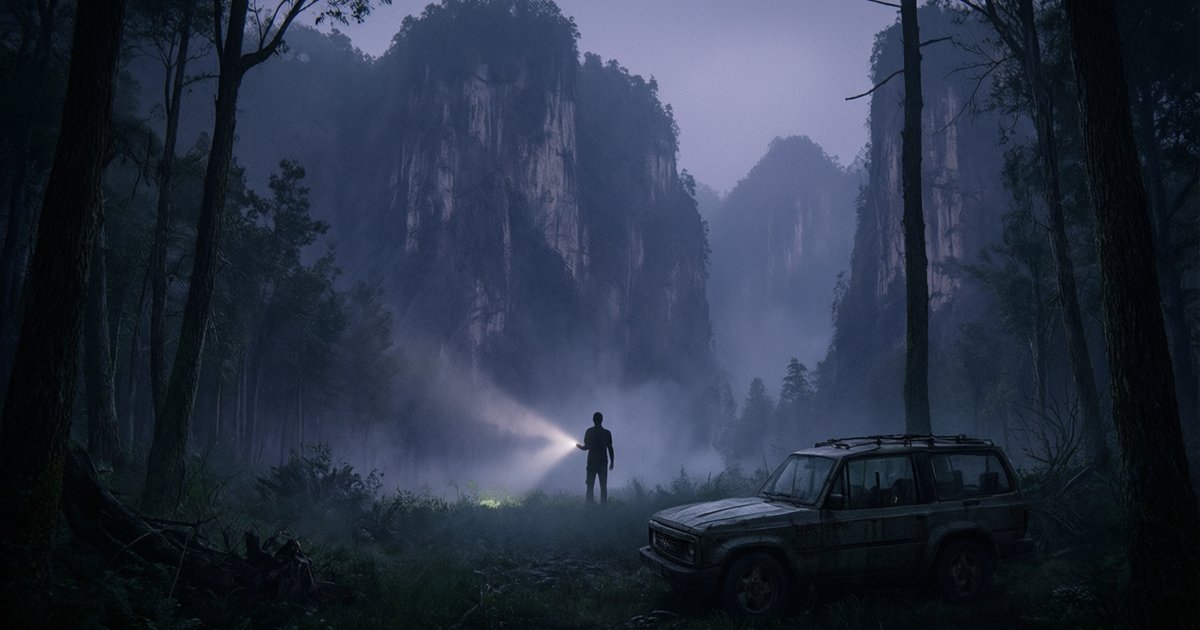
The Brass Key Under the Bronco's Seat
Fiction. This is an original, made-up story: names, characters and events are invented, and any resemblance to real people or events is coincidental.
Full story · 7 chapters · Read in 4 parts instead
Listen to this story (4 parts)
Part 1 · 2 min
Part 2 · 2 min
Part 3 · 2 min
Part 4 · 2 min
Chapter 1
The 1992 Ford Bronco sat in the driveway like a rusted monument to my Uncle Silas's eccentricity. Silas had been a man of few words and many maps, a wanderer who disappeared into the Appalachian foothills for months at a time. Now that he was gone, the task of clearing out his estate fell to me. The air in the driveway smelled of damp pine and old gasoline, the kind of scent that sticks to your clothes for days.
I spent the afternoon scrubbing the interior, hauling out moth-eaten blankets and old cassettes. As I vacuumed under the passenger seat, my hand brushed against something cold and metallic. Taped firmly to the floorboard was a heavy brass key, aged to a dull gold. Wrapped around it was a strip of yellowed masking tape with a set of GPS coordinates scribbled in faded blue ink. My pulse quickened. Silas never did anything by accident, and he certainly didn't leave clues for just anyone.
Chapter 2
I spent the next two days obsessing over those numbers. The coordinates pointed to a dense patch of woodland about forty miles north of town, an area known locally as Blackwood Creek. It wasn't a hiking spot; it was a tangle of limestone cliffs and overgrown thickets where the cell service died long before you hit the trailhead.
I packed a bag with water, a flashlight, and a heavy coat, despite it being a mild October afternoon. The drive took me past crumbling barns and fence lines that seemed to lean inward, as if trying to hide the road. As I parked my truck at the edge of the forest, the silence was absolute. No birds, no wind—just the rhythmic ticking of my cooling engine. I held the brass key in my palm, its weight feeling strangely significant, like a promise or a warning. I stepped into the woods, following the digital needle of my phone toward a destination Silas had kept secret for decades.
Chapter 3
The trek was grueling. I pushed through brambles that clawed at my jeans and stepped over rotted logs that crumbled like ash under my boots. After three miles, the terrain leveled out into a small, hidden clearing. In the center stood a structure that didn't belong in the wilderness: a small, freestanding iron door set into a concrete slab, flush with the ground.
It looked like a storm cellar, but there were no stairs leading down—just the heavy door and a single, ornate keyhole. My breath hitched. I knelt in the dirt, the smell of wet earth and ozone filling my nose. I slid the brass key into the lock. It fit perfectly, the mechanism turning with a heavy, satisfying click that echoed through the trees. As I heaved the door open, a gust of stale, cold air rushed out, carrying the faint, metallic scent of old paper and ink. I shone my flashlight into the dark, and my beam landed on a metal chest.
Chapter 4
The chest was bolted to the floor of a tiny, concrete room—more of a vault than a cellar. I reached inside and unlocked the lid, expecting gold, or perhaps old deeds to land. Instead, I found a stack of leather-bound journals and a series of sealed envelopes dated from 1992 to 2012.
I opened the first journal. The handwriting was Silas's, but the tone was different—paranoid, urgent. He wrote about 'The Watchers of the Creek' and a discovery he had made while surveying the land for the state. He claimed he had found evidence of a town that had been erased from every official map in the county, a place called Oakhaven. According to his notes, Oakhaven hadn't been destroyed by fire or flood; it had simply stopped being recognized by the government. As I flipped through the pages, I found a photograph of a street sign for Oakhaven, dated November 12, 1992. The image was crisp, but the people in the background looked blurred, as if they were vibrating.
Chapter 5
The more I read, the more I realized Silas hadn't been wandering for pleasure; he had been guarding something. He believed that Oakhaven existed in a pocket of time, a glitch in the geography of the valley. The journals described a 'threshold' that opened only when the atmospheric pressure hit a specific point, usually during the first frost of autumn.
I looked at my watch. It was nearly sunset, and the temperature was plummeting. Suddenly, I heard it—a sound that didn't belong in the woods. It was the distant, muffled chime of a church bell, clear and rhythmic. But there were no churches for twenty miles. I looked back at the iron door, and then toward the dense trees. The fog was rolling in fast, thick and gray, swallowing the trail I had used to get here. I felt a sudden, prickling sensation on the back of my neck, the distinct feeling of being watched by a dozen unseen eyes.
Chapter 6
I scrambled to close the vault, but as I reached for the handle, I saw something in the dirt. A set of footprints leading away from the vault—fresh footprints. They were large, identical to the boots Silas used to wear, but Silas had been buried three weeks ago.
Panic surged through me. I slammed the door shut and locked it, the metallic clang sounding like a gunshot in the silence. I turned to run back to my truck, but the forest had changed. The trees seemed closer together, the path gone. I walked for an hour, my flashlight flickering, until I stumbled upon a paved road. It wasn't the road I had parked on. It was a pristine, two-lane street lined with white picket fences and Victorian houses, all perfectly preserved in a style from the early nineties. A sign at the corner read: 'Welcome to Oakhaven.'
Chapter 7
The town was silent, but the porch lights were all humming with a low, electric buzz. I stood in the center of the street, my heart hammering against my ribs. That's when I saw him. Standing on the porch of a gray house was Uncle Silas. He looked exactly as he had ten years ago—strong, alert, wearing his favorite flannel shirt. He didn't look surprised to see me; he looked relieved.
'You found the key, Mark,' he said, his voice echoing as if he were speaking through a long tunnel. 'I was wondering when you'd finally clean out that Bronco.' He stepped down the stairs, but as he entered the light of the streetlamp, I noticed his shadow. It didn't match his movement. His shadow stayed perfectly still, watching me with a hunger that made my blood run cold. Silas smiled, but the shadow reached out toward my feet, and I realized the key hadn't been a gift—it was a replacement. The vault wasn't meant to keep something in; it was meant to keep the vacancy filled.
The End