 Porchlight Tales
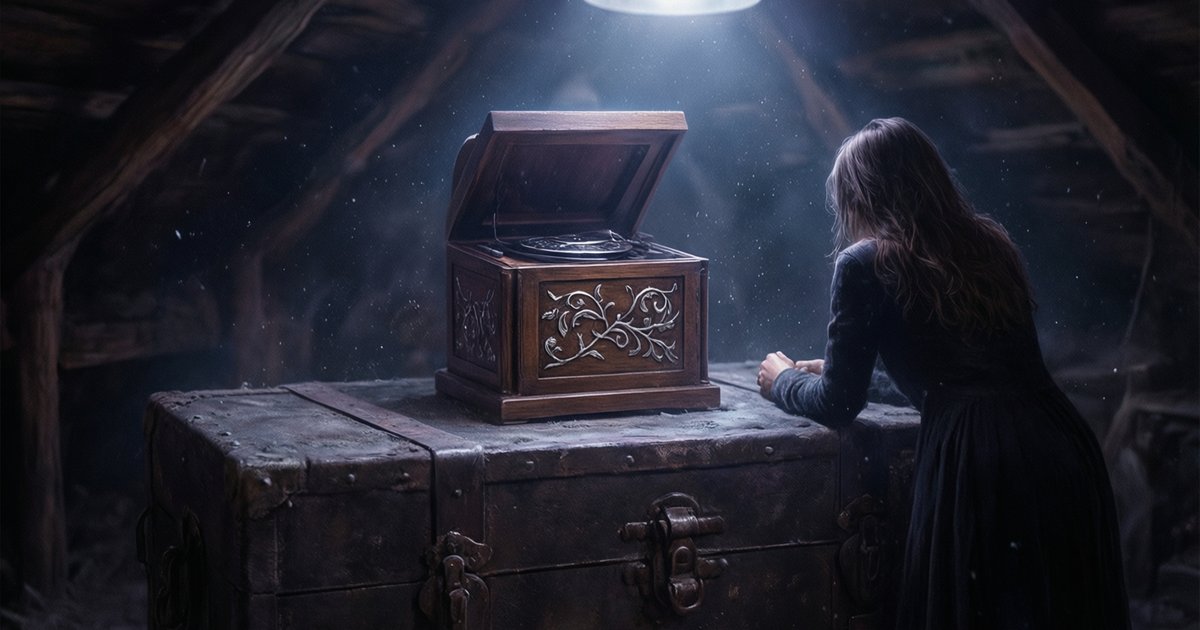
The Clockwork Melody of the Briarwood Trunk
Fiction. This is an original, made-up story: names, characters and events are invented, and any resemblance to real people or events is coincidental.
Full story · 10 chapters · Read in 5 parts instead
Listen to this story (5 parts)
Part 1 · 4 min
Part 2 · 4 min
Part 3 · 4 min
Part 4 · 4 min
Part 5 · 3 min
Chapter 1
The air in Briarwood, Vermont, tasted of damp earth and decaying maple leaves. I stepped into my grandmother’s attic, my boots clicking against the uneven floorboards. As a professional archivist, I was used to the scent of parchment and cedar, but this place felt claustrophobic, hemmed in by heavy velvet curtains that blocked the November gray. My grandmother, Odette, had been a woman of silences and sharp edges, leaving me with a lifelong feeling of being an outsider in my own bloodline. I had spent thirty-two years trying to bridge the gap between us, but she had always remained an enigma.
In the farthest corner of the attic, beneath a layer of dust that looked like gray snow, sat a heavy iron-bound trunk. It looked out of place among the lace doilies and floral vases. When I pried the lid open, the metallic tang of oxidized iron and dried lavender hit me. Resting atop a pile of moth-eaten wool blankets was a clockwork music box. It was crafted from a dark, dense wood I didn’t recognize, inlaid with intricate silver vines that seemed to writhe under the dim light of the single overhead bulb.
I wound the key slowly. The mechanism groaned, then settled into a haunting, melancholic rhythm. The moment the first note hit the air, my breath hitched. I knew this melody. Not from a record or a movie, but from my dreams. For years, a fragmented tune had echoed in the back of my mind during those long, sleepless nights of chronic insomnia. Hearing it now, in the physical world, felt like a door slamming shut behind me, locking me into a room I had never visited but somehow remembered. I sat on the cold floor, the music wrapping around me like a shroud, wondering why a woman who claimed to be from a small town in Ohio owned a piece of art that felt like it belonged in a cathedral.
Chapter 2
I spent the next three days obsessing over the box. The craftsmanship was far too sophisticated for a rural Ohio origin. The silver inlay wasn't just decorative; it followed a pattern of alpine flowers and jagged peaks. I ran my fingers over the cool metal, feeling the precision of the gears. This wasn't a mass-produced trinket; it was a masterpiece of European horology. My grandmother had always insisted her roots were firmly planted in the American Midwest, yet this object screamed of a different continent entirely.
As I played the melody on loop, the fragmented memories began to solidify. I didn't see images, but I felt sensations: the bite of glacial wind on my cheeks, the sharp sting of pine needles crushed under heavy boots, and the suffocating feeling of being watched from a distance. It was as if the music was a key, unlocking a sensory archive stored in my DNA. I found myself pacing the attic, my insomnia forgotten, replaced by a manic energy. I needed to know where this song came from.
I started digging through Odette's old journals, but they were meticulously curated. Every entry about her youth was a sanitized blur of county fairs and church socials in Ohio. There was a void where her true history should have been. The more I looked at the music box, the more I realized that the object was a liar's companion—a beautiful thing used to mask a deeper, colder truth. I felt a strange kinship with the box. Like me, it had been tucked away in a dark corner, holding onto a secret that it was finally forced to sing. I wondered if my grandmother had spent her whole life terrified that someone would eventually wind the key and listen closely to the gaps between the notes.
Chapter 3
While sorting through a shelf of leather-bound classics, I noticed a copy of Keats' poetry that felt unusually heavy. When I pulled it from the shelf, the pages didn't flip; they were a solid block. Someone had hollowed out the center of the book with surgical precision. Inside the cavity lay a small, silver key. It was delicate, with a bow shaped like a stylized eye.
My heart hammered against my ribs. I immediately rushed back to the music box and tried the key in the winding mechanism. It didn't fit. I tried the edges of the box, searching for a hidden lock, but the silver key remained useless against the dark wood. The frustration was immediate. I had found a tool, but I didn't have the lock. I spent hours probing the music box, convinced that the key was the final piece of the puzzle, but the box refused to give up any more than its song.
I sat back on my heels, staring at the key in my palm. If the key didn't belong to the music box, then who—or what—was it for? My grandmother had been a woman of secrets, and this key felt like a breadcrumb leading deeper into a forest I wasn't sure I wanted to enter. I looked around the attic, at the towering piles of trunks and crates. The silver key felt cold, almost vibrating with a hidden purpose. I realized then that the music box wasn't the only secret Odette had left behind; it was merely the invitation. The real answer was still hidden somewhere in this drafty house, waiting for the right turn of a lock. I felt a sudden, sharp prickle of anxiety. For the first time, I wondered if some things were hidden not to be found, but to be forgotten.
Chapter 4
The next morning, I drove into the center of Briarwood to visit Thaddeus Kessler. His shop was a cluttered sanctuary of ticking clocks and humming gears that smelled of machine oil and old brass. Thaddeus had been the town's clockmaker for forty years and had known my grandmother for most of them. When I placed the music box on his velvet counter, his expression shifted from polite curiosity to a sudden, visible tension. He didn't touch the box; he just stared at the silver vines.
"Where did you get this, Carol?" he asked, his voice a raspy whisper. He didn't use my name with warmth; it sounded like a warning.
"It was in my grandmother's trunk," I replied, watching his eyes. "Do you recognize the mechanism?"
Thaddeus sighed, leaning back in his creaky wooden chair. "Odette was a woman of many stories, most of them carefully edited. That box... it's not from Ohio. The gear work is a specific style from a remote region in the Alps. Very old, very exclusive. It's designed to play a melody that doesn't just entertain—it anchors."
I frowned. "Anchors what?"
"Memory. Loyalty. Belonging," Thaddeus said, his gaze hardening. "I made a promise to your grandmother a long time ago to keep the origin of that piece quiet. Some melodies are meant to stay silent, Carol. There is always a price for digging up the dead, and usually, the person who pays it is the one who finds the shovel." He pushed the box back toward me with a trembling hand. "My advice? Wind it one last time, then bury it in the woods. Some truths don't set you free; they just give you a different kind of cage."
Chapter 5
I returned home to find my mother, Diane, waiting for me in the kitchen. She was sipping tea, her face a mask of practiced composure. When I told her about my visit to Thaddeus and the European origin of the box, her expression didn't soften; it tightened. She stood up abruptly, the tea splashing onto the linoleum floor.
"It's a flea-market trinket, Carol," she snapped, her voice trembling. "Your grandmother probably picked it up during a trip she never told us about. It's meaningless. Why are you so obsessed with this?"
"Thaddeus knows it's from the Alps, Mom. He's afraid of it. Why are you afraid of it?" I stepped closer, the floral notes of her perfume clashing with the musty air of the house.
Diane’s eyes flashed with anger and grief. "Because your grandmother spent her entire life trying to erase where she came from! She didn't want us to be part of that darkness. She wanted a clean slate, a normal American life. By digging this up, you're not finding 'truth,' you're just reopening a wound she spent forty years stitching shut."
"What darkness?" I demanded.
"The kind that makes a woman change her name and flee across an ocean without looking back!" Diane shouted. She pointed toward the attic. "Throw that cursed thing away, Carol. Do it for the sake of the peace we have left." She turned away, her shoulders shaking. For the first time, I saw the cracks in my mother's sanitized version of our history. She wasn't protecting the family's legacy; she was protecting herself from the terror of knowing who her mother actually was.
Chapter 6
That night, the insomnia returned with a vengeance. At exactly 3:00 AM, I was jolted awake not by a sound, but by a vibration. I walked into the hallway and followed a faint, crystalline melody. The music box, which I had left closed and unwound on the attic table, was playing. The lid was open, the gears turning with a rhythmic, metallic click that sounded like a heartbeat.
I approached the table, my heart racing. The music felt heavier now, more insistent, as if it were trying to tell me something specific. As I reached out to stop the mechanism, I noticed a sliver of light reflecting off the inside of the lid. I grabbed a magnifying glass from my grandmother's desk and leaned in. There, etched into the dark wood in letters so small they were almost invisible, was a date and a location: *October 12, 1944 — Oberwald, Switzerland*.
Oberwald. I had never heard of it, but the name felt like a cold stone in my stomach. The melody reached a haunting crescendo, and for a fleeting second, I saw a flash of an image: a circle of people in gray wool coats, standing in a snowy courtyard, humming the same tune in unison. It wasn't a song of joy; it was a song of submission. The music box wasn't just playing a song; it was echoing a command. I realized then that the box hadn't played on its own by magic. The mechanism had been engineered with a precision that allowed it to trigger under specific atmospheric conditions—or perhaps it was simply a timer that had finally run out after decades of silence.
Chapter 7
The memory of the silver key returned to me. I climbed back into the attic and dragged the iron-bound trunk into the center of the room. I had searched the lid and the sides, but I hadn't looked at the base. I ran my fingers along the bottom seams and felt a slight indentation. I pressed a hidden spring, and a thin wooden panel popped open, revealing a false bottom.
Inside lay a weathered leather passport and a bundle of letters tied with a fraying black ribbon. I opened the passport first. The photograph was of a young woman who looked exactly like me—the same wide eyes, the same stubborn chin. But the name wasn't Odette Barlow. It was *Elsa Von Heist*.
I read the letters, my eyes scanning the frantic, elegant script. Elsa hadn't just moved to America; she had escaped. She had been a member of a restrictive, secretive commune in the mountains of Switzerland—a cult of personality that used music and isolation to control its members. The commune, called *The Silent Chord*, believed that a specific set of frequencies could bind a person's will to the leader of the village. Elsa had been the daughter of the village clockmaker, the one tasked with creating the devices that kept the members tethered to their home, even in their dreams.
She had fled in the middle of the night, stealing her father's most potent creation—the music box—as a way to remember the people she had left behind, or perhaps as a trophy of her liberation. The 'darkness' my mother feared wasn't a crime; it was the psychological shackle of a place that didn't allow people to leave. The silver key had opened the truth, and the truth was a blueprint of exile.
Chapter 8
As I read the final letter, the music box on the table began to play again. This time, it didn't sound like a melody; it sounded like a recording. I realized the brilliance—and the horror—of the design. The box wasn't just playing notes; it was a mnemonic tool. The specific intervals and rhythms were designed to trigger deep-seated emotional responses, a form of sonic conditioning used by the commune to ensure that no matter how far a member traveled, the song would eventually pull them back to a state of longing and obedience.
My grandmother hadn't just been hiding her past; she had been fighting a war against a song. Every time she had been emotionally distant, every time she had shut me out, she was likely fighting the urge to succumb to the melody that whispered of a home that was actually a prison. The insomnia I had suffered my whole life wasn't a medical fluke—it was the residue of this sonic legacy, a frequency passed down through blood and memory.
I looked at the letters and the passport. If I kept them, I would finally know where I came from. I would have a map of my lineage, a reason for my feeling of displacement. But I would also be accepting the burden of that darkness. I would be acknowledging that my family's peace was built on a foundation of flight and fear. I felt the music box pulsing on the table, the melody reaching a fever pitch, demanding that I acknowledge the bond. I was the last descendant of the clockmaker, and the song was now calling to me, searching for a new place to root itself.
Chapter 9
I stood in the silence of the attic for a long time, the letters heavy in my hand. I thought of my mother’s terror and my grandmother’s lifelong silence. I could burn the documents, smash the box, and pretend we were just a boring family from Ohio. I could preserve the sanitized peace that Diane craved. But as I looked at the photograph of Elsa, I saw a woman who had fought for her freedom. To erase her history was to betray her victory.
I chose the truth. I didn't burn the letters. Instead, I carefully packed the passport and the correspondence back into the false bottom of the trunk. I closed the lid and locked it, not to hide the secret, but to archive it. I decided that I would be the one to carry the knowledge, so my mother wouldn't have to. I would accept the loneliness of my grandmother's exile as my own inheritance.
As I walked out of the house and locked the front door, a strange sensation washed over me. The wind was whistling through the maple trees, and as I stepped toward my car, I realized I was humming. It was the melody from the box—the haunting, alpine tune of Oberwald. It wasn't a command anymore; it was just a song. I realized the legacy wasn't just in the box or the papers; it was written into my very nerves. I drove away from Briarwood, feeling a strange, new sense of belonging. I belonged to a place that no longer existed, to a woman I had never known, and to a song that would never truly stop playing.
Chapter 10
Weeks later, I sat in my quiet apartment in the city. The music box sat silent on my mahogany table, its silver vines shimmering under the lamp. I no longer wound the key; I didn't need to. The silence of the room was filled by the ghost of the melody, drifting through my thoughts like a familiar friend.
I had spent my entire life feeling like an outsider, a puzzle piece from a different set. Now, I understood why. I wasn't a piece of the Ohio puzzle; I was a fragment of a mountain village lost to time. I looked at my reflection in the window and saw Elsa’s eyes looking back at me. The insomnia had finally faded, replaced by a deep, grounding peace. I knew that the 'price' Thaddeus had warned me about was simply the loss of a comfortable lie.
I leaned back in my chair and began to hum the foreign melody to myself, the notes flowing naturally from my throat. It was no longer a shackle; it was a bridge. I closed my eyes and could almost feel the bite of the glacial wind. I was alone in my apartment, but for the first time in thirty-two years, I didn't feel lonely. I had found my home in the music, a sanctuary built of secrets and silver, echoing softly in the quiet of the night.
The End