 Porchlight Tales
The Clockwork Melody of the Briarwood Trunk
Fiction. This is an original, made-up story: names, characters and events are invented, and any resemblance to real people or events is coincidental.
Part 1 of 5 · Chapters 1–2 of 10
Listen to Part 1 · 4 min
Chapter 1
The air in Briarwood, Vermont, tasted of damp earth and decaying maple leaves. I stepped into my grandmother’s attic, my boots clicking against the uneven floorboards. As a professional archivist, I was used to the scent of parchment and cedar, but this place felt claustrophobic, hemmed in by heavy velvet curtains that blocked the November gray. My grandmother, Odette, had been a woman of silences and sharp edges, leaving me with a lifelong feeling of being an outsider in my own bloodline. I had spent thirty-two years trying to bridge the gap between us, but she had always remained an enigma.
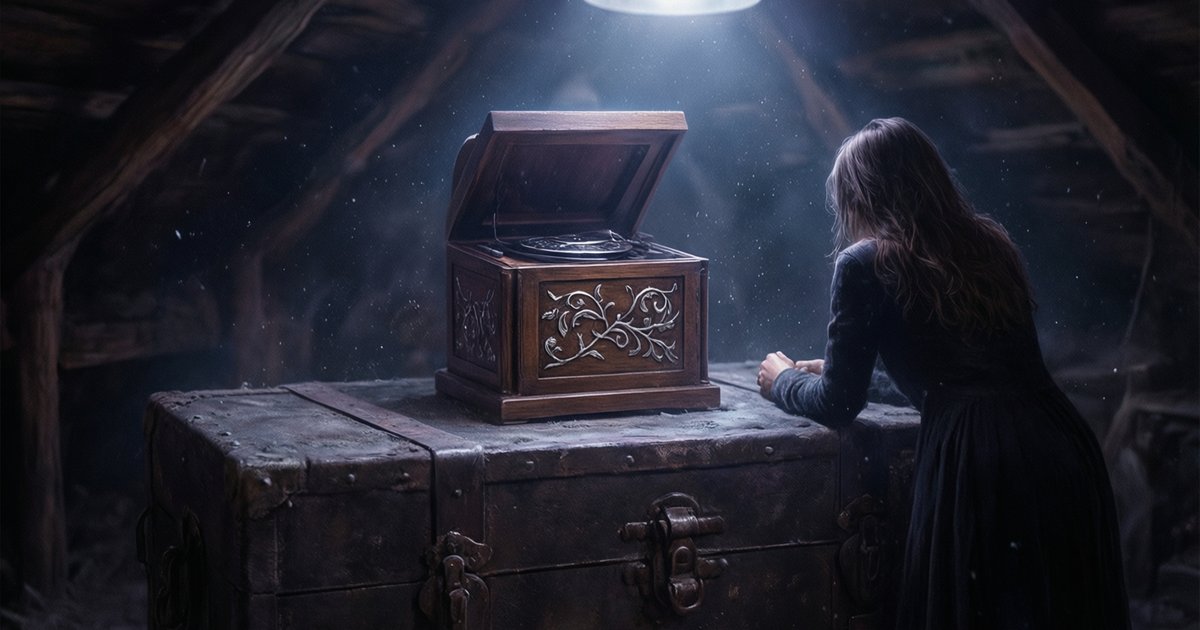
In the farthest corner of the attic, beneath a layer of dust that looked like gray snow, sat a heavy iron-bound trunk. It looked out of place among the lace doilies and floral vases. When I pried the lid open, the metallic tang of oxidized iron and dried lavender hit me. Resting atop a pile of moth-eaten wool blankets was a clockwork music box. It was crafted from a dark, dense wood I didn’t recognize, inlaid with intricate silver vines that seemed to writhe under the dim light of the single overhead bulb.
I wound the key slowly. The mechanism groaned, then settled into a haunting, melancholic rhythm. The moment the first note hit the air, my breath hitched. I knew this melody. Not from a record or a movie, but from my dreams. For years, a fragmented tune had echoed in the back of my mind during those long, sleepless nights of chronic insomnia. Hearing it now, in the physical world, felt like a door slamming shut behind me, locking me into a room I had never visited but somehow remembered. I sat on the cold floor, the music wrapping around me like a shroud, wondering why a woman who claimed to be from a small town in Ohio owned a piece of art that felt like it belonged in a cathedral.
Chapter 2
I spent the next three days obsessing over the box. The craftsmanship was far too sophisticated for a rural Ohio origin. The silver inlay wasn't just decorative; it followed a pattern of alpine flowers and jagged peaks. I ran my fingers over the cool metal, feeling the precision of the gears. This wasn't a mass-produced trinket; it was a masterpiece of European horology. My grandmother had always insisted her roots were firmly planted in the American Midwest, yet this object screamed of a different continent entirely.
As I played the melody on loop, the fragmented memories began to solidify. I didn't see images, but I felt sensations: the bite of glacial wind on my cheeks, the sharp sting of pine needles crushed under heavy boots, and the suffocating feeling of being watched from a distance. It was as if the music was a key, unlocking a sensory archive stored in my DNA. I found myself pacing the attic, my insomnia forgotten, replaced by a manic energy. I needed to know where this song came from.
I started digging through Odette's old journals, but they were meticulously curated. Every entry about her youth was a sanitized blur of county fairs and church socials in Ohio. There was a void where her true history should have been. The more I looked at the music box, the more I realized that the object was a liar's companion—a beautiful thing used to mask a deeper, colder truth. I felt a strange kinship with the box. Like me, it had been tucked away in a dark corner, holding onto a secret that it was finally forced to sing. I wondered if my grandmother had spent her whole life terrified that someone would eventually wind the key and listen closely to the gaps between the notes.
Coming up in Part 2“While sorting through a shelf of leather-bound classics, I noticed a copy of Keats' poetry that felt unusually heavy. When…”