 Porchlight Tales
The Empty Fourth Chair of Cedar Hollow
Fiction. This is an original, made-up story: names, characters and events are invented, and any resemblance to real people or events is coincidental.
Full story · 10 chapters · Read in 5 parts instead
Listen to this story (5 parts)
Part 1 · 5 min
Part 2 · 5 min
Part 3 · 5 min
Part 4 · 4 min
Part 5 · 4 min
Chapter 1
Cedar Hollow, Georgia, felt like damp pine needles and the sharp tang of old floor wax. I arrived in October, my suitcase heavy with a level of desperation I couldn't admit to anyone. At thirty-four, I was a freelance archivist whose academic reputation had vanished overnight after a failed project in Boston. I needed this contract at St. Jude’s community hall to prove I wasn't the fraud my peers believed I was.
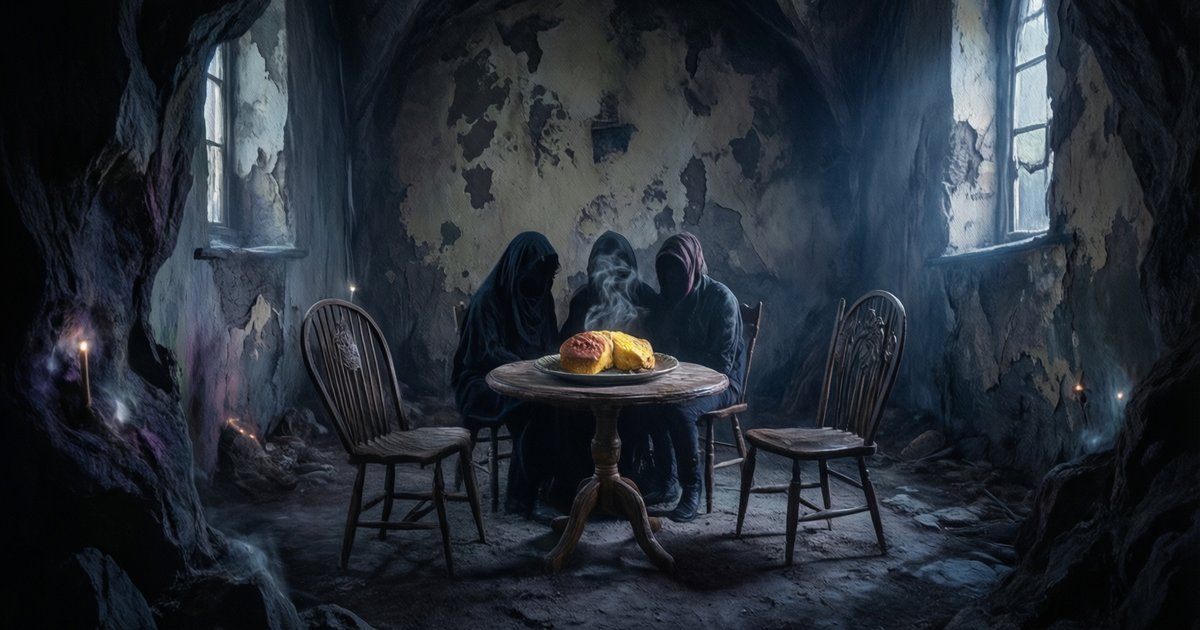
Sunday potlucks were the heartbeat of the town. The community hall was a cavernous room with peeling cream paint and heavy oak beams. As I settled into my seat, I noticed it: a small, circular table set for four, but only three people sat there. The fourth chair remained empty, tucked neatly against the tablecloth.
I checked my watch—12:15 PM. My thumb brushed the leather strap, a nervous habit that had plagued me since my university days. Just as the prayer ended, a plate appeared before the empty chair. It wasn't there a second ago. It was a thick slice of honey-butter corn bread, steaming hot, the aroma of caramelized sugar and salt cutting through the heavy humidity of the room.
I looked around. No one had walked past the table. The parishioners continued their conversations, their laughter echoing against the high ceiling, completely ignoring the steaming plate. To them, the empty chair wasn't a void; it was an invitation. I felt a prickle of curiosity that outweighed my usual anxiety. Who was this guest, and why did the town treat their absence as a presence?
I leaned in to get a better look at the corn bread. The steam rose in a delicate curl, reminding me of a kitchen I had never visited but felt I should know. As I glanced back at the clock, I realized that for the first time in years, I wasn't thinking about my failures. I was thinking about the ghost at the table.
Chapter 2
Monday morning found me in the dusty archives of St. Jude’s, surrounded by crumbling ledgers and the musk of mildew. I sought out Rosemary Sterling, the church’s matriarch. She was a woman of iron poise, wearing floral dresses that looked like they belonged in a 1950s catalog, her hair a rigid silver wave.
"Mrs. Sterling, I noticed the fourth chair at the potluck," I said, trying to keep my voice neutral. "It's a fascinating tradition. Who is it for?"
Rosemary didn't stop polishing the silver tea set. Her eyes, a sharp, piercing blue, flicked toward me for only a second. "It's just community spirit, Mr. Ruckert. We leave room for the unexpected. Cedar Hollow is a town of hospitality. Now, please, focus on the 1920s baptismal records. We aren't paying you to be a sociologist."
Her dismissal was cold, but her hands trembled slightly as she set the teapot down. I spent the rest of the afternoon cataloging, but the image of that steaming corn bread haunted me. I kept checking my watch, counting down the hours until I could retreat to my hotel room.
When I finally unlocked my hotel door at 6:00 PM, I stopped dead. The room was small, with a sharp chemical tang of lemon bleach and stale air. There, sitting precisely in the center of my bedside table, was a small porcelain plate. On it sat a slice of honey-butter corn bread, still warm to the touch.
I hadn't left the church archives since noon. My door had been locked from the inside. I didn't touch the food; instead, I stared at the golden crust, the butter glistening under the dim lamp. Someone had entered my room without a key, or perhaps someone didn't need one. The hospitality of Cedar Hollow was beginning to feel less like a welcome and more like a surveillance.
Chapter 3
The next day, I encountered Douglas Garrison. He was a reclusive carpenter with skin like cured leather and hands scarred by decades of chisels and saws. He was repairing a banister in the church foyer when I approached him.
"The corn bread," I whispered, glancing around to ensure Rosemary wasn't lurking. "Who puts it there?"
Douglas stopped sawing. He didn't look at me, but his voice was a low, gravelly warning. "That chair isn't for a guest, boy. It's for a debt. Some things in Cedar Hollow aren't meant to be archived. If I were you, I'd pack my bags and drive north before the leaves fully turn."
"A debt? What kind of debt?" I asked, my chest tightening as my pulse quickened.
Douglas finally looked at me, his eyes clouded with cataracts but filled with a genuine, raw fear. "The kind that doesn't go away with an apology. Just stay away from the basement."
Intrigued and stubborn, I spent the evening scouring the local historical society's digital files. I found a scanned photograph from 1954—a family of four standing in front of the very same community hall. The father, mother, and two children were dressed in their Sunday best. However, the face of the eldest daughter had been violently scratched out of the photo, leaving only a jagged white void where her smile should have been.
I checked my watch. 11:10 PM. I felt a sudden, irrational urge to check the locks on my windows. I remembered the way the corn bread smelled—honey and butter. It was a specific, old-fashioned recipe, the kind of comfort food that felt like a hug, yet in the silence of the hotel room, it felt like a threat. I realized then that Douglas wasn't trying to scare me for fun; he was trying to save me from a curiosity that had already cost someone their identity.
Chapter 4
Hannah Mercado was a twenty-something parishioner with a rebellious streak and a habit of chewing on the end of her pencil. She had been assisting me with the filing, and she had seen the way I looked at the fourth chair.
"Rosemary hates it when people ask about the '54 gap," Hannah whispered as we walked toward the vestry. "But the records aren't all in the main office. Some of the real history is kept downstairs."
Using a heavy iron key Hannah had 'borrowed' from the caretaker, she sneaked me into the church basement. The air was thick with a damp, earthy musk and rotting cardboard. We navigated through stacks of old hymnals and broken pews until Hannah pointed to a locked steel trunk in the corner.
Inside, I found a leather-bound ledger, its pages yellowed and brittle. I flipped through the entries until I hit November 1954. There, written in a precise, archaic hand, was a document titled 'The Silent Covenant.' It was signed by the town elders of that era, including Rosemary’s father.
I read the lines carefully: *'To ensure the prosperity of Cedar Hollow and the shielding of its borders from ruin, a sacrifice of presence is required. One shall vanish so that all may thrive.'*
There was no mention of a ghost, but there was a list of dates—intervals of exactly seventy years. I felt a cold sweat break across my neck. I checked my watch. 1954 to 2024. This year. The timing was too precise to be a coincidence.
"What does it say?" Hannah asked, her voice echoing in the subterranean gloom.
I didn't tell her everything. I just told her it looked like an old land agreement. But as I closed the book, I noticed a smudge of yellow grease on the corner of the page. It smelled faintly of honey-butter. Someone had been reading this ledger recently.
Chapter 5
The mystery of the appearing corn bread had driven me to a state of near-obsession. I couldn't sleep, and I spent my nights sketching the layout of the community hall. I noticed a discrepancy: the exterior measurements of the building were three feet wider than the interior walls of the main hall.
During the following Sunday potluck, I didn't sit with the guests. I stood by the wall, my eyes fixed on the fourth chair. I checked my watch: 12:14 PM. I waited.
At exactly 12:15 PM, I saw it. A floorboard beneath the tablecloth shifted almost imperceptibly. A small, hidden hatch, disguised by the heavy fabric of the table, slid open for a fraction of a second. A hand—thin, pale, and trembling—reached up and placed the steaming plate of corn bread on the table. The hatch clicked shut before anyone could blink.
It wasn't magic. It wasn't a ghost. It was a person.
My pulse raced. The cinematic tension of the moment felt overwhelming. I waited until the crowd moved toward the dessert table, then I knelt by the floor, feeling for the seam of the hatch. My fingers found the groove.
I realized the 'Silent Covenant' wasn't just a piece of paper; it was a physical operation. Someone was living beneath our feet, serving a phantom guest in a cycle of ritualized grief. The realization didn't bring me peace; it brought a new kind of terror. If the corn bread was being delivered by a living person, why was the town treating the chair as a sacred void?
I looked at Rosemary. She was watching me from across the room, her smile not reaching her eyes. She knew I had seen the hatch. She didn't look angry; she looked expectant, as if she were watching a piece of a puzzle finally click into place.
Chapter 6
I didn't wait for another Sunday. On Tuesday night, I returned to the hall with a flashlight and a crowbar. I forced the hatch open, the wood groaning in protest. I descended a narrow ladder into a crawlspace that smelled of old wool and cornmeal.
In the dim light, I found a small living area: a cot, a hot plate, and a stack of old newspapers. Sitting on the cot was a man who looked like a living skeleton. His skin was translucent, and his eyes were wide with a permanent, ingrained terror.
"Who are you?" I asked, my voice shaking.
"The Provider," he whispered. His voice sounded like dry leaves rubbing together. "I've been here for forty years. I serve the plate. I keep the memory warm. If the plate is empty, the town remembers the hunger."
He told me his name was Otis. He had been the 'guest' of a previous cycle, but he hadn't vanished completely. He had been kept in the walls, a servant to the Covenant, forced to maintain the illusion of the Fourth Chair to satisfy the town's psychological need for a scapegoat.
"Why do you do it?" I asked.
"Because they told me if I stopped, the town would burn," Otis replied, a tear tracking through the dust on his cheek. "And because I'm afraid to see what happens when the seventy years are up. The Covenant demands a replacement. The Provider doesn't live forever, and the chair cannot stay empty for long."
I checked my watch. The ticking felt louder than ever, like a countdown. Otis looked at me with a mixture of pity and horror. He knew what I didn't yet realize: I hadn't just stumbled upon a secret. I had been selected for a role.
Chapter 7
Otis gripped my wrist, his fingers cold as ice. "The corn bread isn't a gift, Mr. Ruckert. It's a lure. The town doesn't want a ghost; they want a living replacement. Every seventy years, the Covenant is renewed. The town’s prosperity—the businesses, the land, the peace—it's all tied to this ritual. They find someone who is 'unattached.' Someone the world has forgotten."
I recoiled. "I'm not unattached. I have a career, a life..."
"You have a failed reputation and a suitcase in a hotel room," Otis countered. "You're the perfect candidate. You're a man who wants to be seen, which makes you easy to trap."
He explained the truth of 1954. The girl who disappeared wasn't a sacrifice to a demon, but a victim of a land-grab. The town elders had stolen the Mercado family's valley to build the current town center, and they had used the 'Covenant' as a way to silence the dissent and justify the disappearance of anyone who questioned the ownership. The ritual was a psychological leash, a way to keep the townspeople in a state of superstitious fear and loyalty.
"The Provider is the one who knows where the bodies are buried," Otis whispered. "And once the new Provider is chosen, the old one is finally allowed to leave... or to stop breathing."
I felt a surge of nausea. My desire for professional redemption had led me straight into a trap. I had come to Cedar Hollow to fix my past, but the town wanted to erase my future. As I climbed back out of the hatch, I saw a shadow move in the hallway. I turned my flashlight toward the sound, catching a glimpse of Rosemary's floral dress disappearing around the corner. The hunt had already begun.
Chapter 8
The final Sunday potluck arrived. The atmosphere in the hall was different—electric, heavy with an unspoken anticipation. I walked in, feeling the eyes of the entire congregation on me. I wasn't a guest anymore; I was the main course.
As I approached the table with the fourth chair, Rosemary stepped in my path. She smiled, but her eyes were as cold as a winter morgue.
"You've been very curious, Wesley," she said, her voice a silky purr. "Curiosity is a trait of the displaced. You don't belong anywhere, do you? No one is looking for you. No one would miss you if you simply... decided to stay and serve the community."
I looked around. The other elders were closing in, forming a subtle semi-circle around me. They didn't use weapons; they didn't need to. The social pressure, the isolation, and the sheer weight of the town's collective will were the weapons.
"The debt is due, Wesley," Rosemary whispered. "You can fight us and leave Cedar Hollow as a disgraced failure, or you can accept the chair and ensure this town thrives for another seventy years. Think of the legacy. You'd be the secret heart of Cedar Hollow."
I checked my watch. 12:14 PM. My blood was drumming a frantic rhythm against my ribs. I looked at the empty chair, then at the hatch beneath the tablecloth. I realized that my 'imposter syndrome' had made me vulnerable, but my archival skills—the very things I thought had failed me—were my only way out. I didn't want to be the heart of Cedar Hollow; I wanted to be the one who stopped its cold, mechanical beat.
Chapter 9
I didn't flee. Instead, I reached into my bag and pulled out the photocopy of the 1954 ledger and a set of modern land deeds I had spent the last forty-eight hours cross-referencing with the county records.
"I found the loophole, Rosemary," I announced, my voice echoing through the silent hall. "The Covenant isn't a spiritual contract; it's a fraudulent property agreement. The land this church and your estates sit on was stolen from the Mercado family. According to the laws of adverse possession and the specific terms of the original deed, the 'debt' isn't a person—it's the land itself."
I held up the papers. "I've already emailed these documents to the state attorney and the Georgia Land Registry. If I 'disappear' into that crawlspace, the evidence goes public automatically. The only way to keep your estates is to dissolve the Covenant and return the stolen acreage to the Mercado heirs—starting with Hannah."
The color drained from Rosemary's face. The power of the Covenant relied on the secret. Once the secret became a legal liability, the superstition vanished. The elders looked at each other, the spell of seventy years breaking in a single moment of bureaucratic terror.
Rosemary didn't scream. She simply stepped aside, her poise finally shattering. "Get out," she whispered.
I didn't need to be told twice. I helped Otis out of the crawlspace, guiding the trembling man toward the exit. As we walked out, I glanced back at the fourth chair. For the first time in decades, the plate of corn bread remained empty. Without the ritual's fear to fuel it, the tradition died on the spot.
Chapter 10
I drove out of Cedar Hollow as the first frost of November touched the windshield. Beside me, Otis was wrapped in a heavy wool blanket, staring at the horizon with the expression of a man who had just woken up from a forty-year sleep.
I had lost the contract and my chance at a traditional academic comeback, but as I looked in the rearview mirror, I felt a weight lift that had been pressing on my chest since Boston. I wasn't an imposter; I was a historian who had actually changed history.
As the town limits sign faded behind me, I imagined the community hall. I pictured the fourth chair finally tipping over, crashing onto the hardwood floor, empty and useless. The scent of honey-butter, once so sweet and seductive, had finally faded into the crisp, clean autumn air.
I checked my watch one last time. 12:15 PM. I smiled and shifted the car into high gear, leaving the shadows of Cedar Hollow to the wind. I didn't need a legacy built on secrets. I just needed the open road and the truth.
The End