 Porchlight Tales
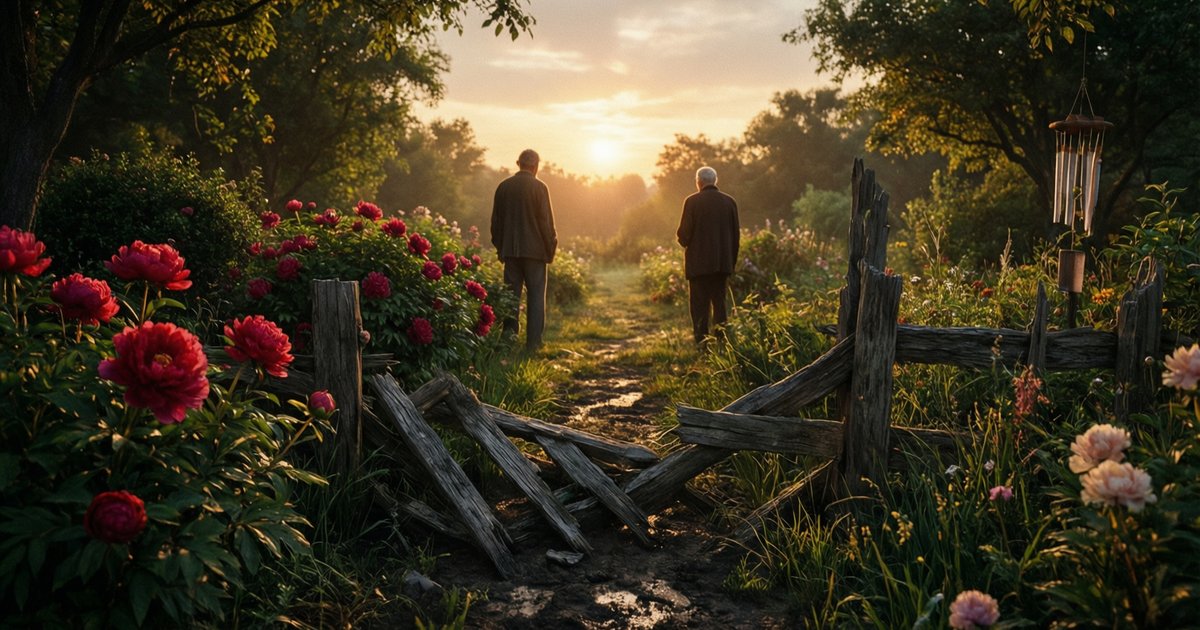
The Gate Where the Fence Used to Be
Fiction. This is an original, made-up story: names, characters and events are invented, and any resemblance to real people or events is coincidental.
Part 1 of 5 · Chapters 1–2 of 10
Listen to Part 1 · 5 min
Chapter 1
"GET YOUR DAMN HANDS OFF MY PROPERTY!"
I didn't blink. I just tightened my grip on the cedar plank, my skin stretching tight over my joints, staring into Vernon Delgado's wide, panicked eyes. The air between us tasted of ozone and wet dirt. For ten years, we had existed as ghosts in each other's periphery, separated by a wooden wall and a grudge that had grown as thick as the ivy climbing it.
Vernon was gesturing wildly toward a patch of crushed peonies, his voice cracking with a mix of anger and desperation. I wanted to scream back. I wanted to tell him that these flowers were all I had left of Loretta. Instead, I just stood there, frozen in a stalemate over a few inches of mud.
But to understand why a simple fallen fence could trigger a shouting match that woke up half the cul-de-sac, you need to know how it all began. Three weeks earlier, the silence was still perfectly intact.
I lived my life by the clock and the ruler. Every morning at 6:00 AM, I stepped into my garden in Oak Creek, Oregon. I didn't just garden; I curated. My peonies were the crown jewels of the neighborhood—deep, velvety reds and pale pinks that carried the sweetness of a memory from 1985.
I pruned them with surgical precision, always leaving exactly two inches of space between the stems and the fence line. That fence wasn't just cedar and nails; it was the border of my sanctuary. On the other side was Vernon, a man who treated his yard like a jungle gym for physics experiments and loud jazz music. We hadn't exchanged a word since the Great Boundary Dispute of 2014, a fight over a six-inch strip of land that neither of us actually needed, but both of us refused to yield.
I kept my distance. I kept my pride. And on my nightstand, I kept a rusted brass key that I never used, a relic from a time when the fence didn't exist.
Chapter 2
The cold war of Oak Creek was a quiet affair. I didn't throw rocks or call the city council; I simply erased Vernon from my reality. When I saw him hauling a bag of mulch, I suddenly found a very interesting weed to pull. When he waved—which he did occasionally, the optimist—I looked through him as if he were made of glass.
My routine was my armor. After thirty years as a postal worker, I appreciated the comfort of a set route. Wake up, coffee, prune the peonies, read the paper. The two-inch gap between my flowers and the fence was a sacred law. If a petal dared to lean over the boundary, I clipped it back. It wasn't about the plant; it was about control. Since Loretta passed four years ago, the world had felt like a series of things slipping through my fingers. The garden was the only thing that stayed where I put it.
Vernon, meanwhile, was the embodiment of chaos. He was a high school physics teacher who seemed to believe that gravity was merely a suggestion. His yard was a riot of mismatched perennials and oversized wind chimes that clattered in the breeze. He wore sandals with socks and hummed songs that didn't have a discernible melody.
Occasionally, I'd catch him staring at my peonies. He didn't look with envy, but with a sort of puzzled longing. I’d immediately turn my back, my shoulders rigid. I remembered the day the silence started. A surveyor's map, a heated argument about a fence post, and a sentence I couldn't take back. I had told him he was as disorganized in his soul as he was in his yard.
He hadn't spoken to me since. Neither had I. We existed in a state of balanced hostility, two old men pretending that the other didn't exist, while sharing a wall that held back a decade of unspoken apologies.
Coming up in Part 2“The storm hit on a Tuesday in late June. It wasn't the usual Oregon drizzle; it was a violent, howling…”