 Porchlight Tales
The Hidden Letter of Maple Street Farm
Fiction. This is an original, made-up story: names, characters and events are invented, and any resemblance to real people or events is coincidental.
Full story · 9 chapters · Read in 5 parts instead
Listen to this story (5 parts)
Part 1 · 5 min
Part 2 · 4 min
Part 3 · 4 min
Part 4 · 4 min
Part 5 · 2 min
Chapter 1
"I HAVE THE PAPERWORK, PEGGY!"
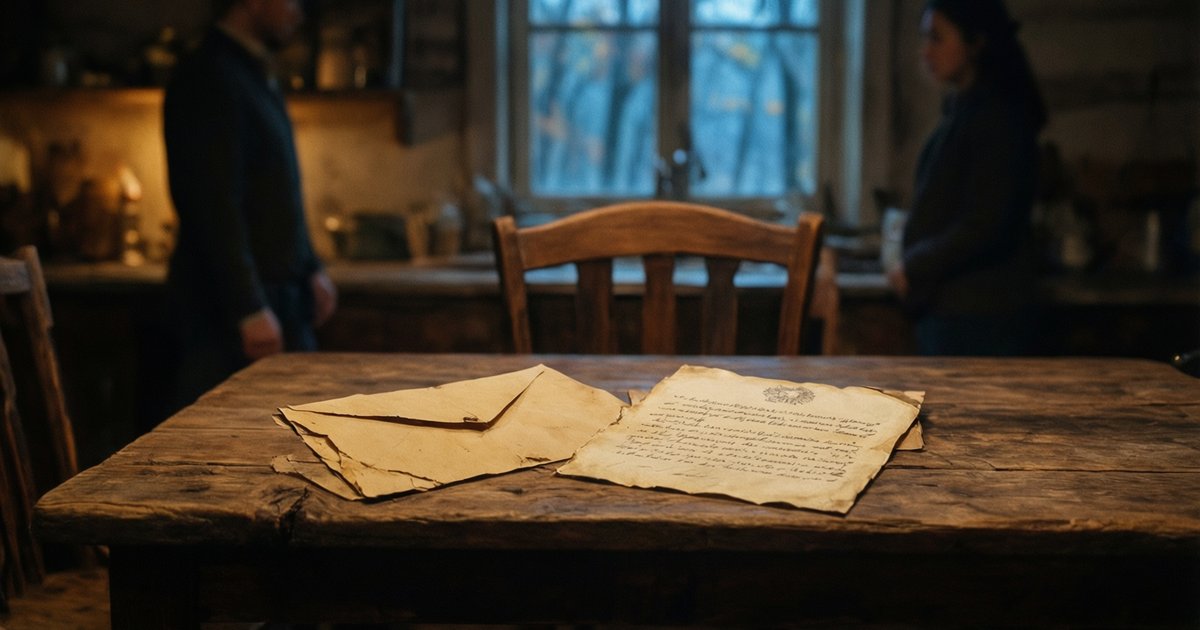
Wayne's voice rattled the windows of the old farmhouse, his face a blotchy red. He slammed a manila envelope onto the oak table, the sound like a gunshot in the quiet kitchen.
I didn't scream back. I just looked at the smudge of dirt under my fingernails and the way the autumn light hit the dust motes dancing between us. A hollow chill settled in my chest that had nothing to do with the Vermont wind.
But to understand why we were screaming, you need to know how it all began. Three weeks earlier, the world had gone silent.
My father, Otis Haskins, had passed away in his sleep. No dramatic goodbye. No final whispers of wisdom. Just a stubborn old man finally surrendering to a heart that had worked too hard for too long.
I had spent the last twenty years as his shadow. I was the one who woke up at 4:00 AM to check the heaters in the barns. I was the one who spent my weekends patching the sagging fences and negotiating with the bank to keep the foreclosure notices at bay.
I had been a librarian in town, but my real vocation was this dirt. This land was my heartbeat, and I believed, in the quiet way a devoted daughter does, that Otis knew that.
Wayne had been a ghost. A name on a Christmas card from Chicago. A vague voice on the phone every few months talking about 'development' and 'scaling.' He hadn't stepped foot on Maple Street Farm in a decade. He didn't know the scent of wet soil after a rain or the way the east pasture dipped into a marsh during April.
I thought the transition would be simple. I was the caretaker; I was the daughter who stayed. I expected the deed to be a formality, a final 'thank you' from a father who rarely used words to show affection.
I was wrong. Dead men leave the most complicated maps, and my father had left a trail of breadcrumbs that led straight to a cliff.
Chapter 2
The farm didn't just require labor; it required a kind of devotion that bordered on martyrdom. I remember the winter of 2012, when a pipe burst in the main barn. I spent six hours in freezing slush, shivering in a coat that was too thin, fighting to save the livestock from the cold.
Otis had watched me from the porch, leaning on his cane, his eyes unreadable. He never said 'thank you,' but he had handed me a thermos of coffee afterward. That was our language. Minimal. Functional.
I had given up my thirties and forties to this place. My friends in the city had bought condos and traveled to Tuscany. I had bought a new tractor and a bulk shipment of organic feed.
There was a specific kind of invisibility that comes with being the child who stays. You become part of the furniture. You are the reliable one, whose sacrifice is so expected that it becomes invisible.
I didn't mind it at first. I loved the aroma of the cider press in October and the way the maple trees turned a violent, beautiful red. I felt a kinship with the land that Wayne could never understand. To him, land was a commodity. To me, it was an archive of my family's sweat.
But there was always the cedar chest. It sat in the attic, heavy and locked, tucked behind a stack of old almanacs. Otis had forbidden me from touching it for twenty years. 'Not your business, Peg,' he'd grumble whenever I wandered too close.
I used to think it held old journals or perhaps the deed to the neighboring plot we'd lost years ago. I didn't realize it held the reason why my father had always looked at me with a gaze of gratitude and profound guilt.
I spent two decades building a sanctuary, thinking I was securing my future. I didn't know I was merely tending a garden for someone else to harvest.
Chapter 3
Beulah Sterling didn't look like a lawyer. She looked like a grandmother who might offer you a lemon square and a pat on the head. But as she sat in the living room, her glasses perched on the tip of her nose, her voice was as clinical as a scalpel.
"Otis's will is straightforward," Beulah said, her voice echoing in the high-ceilinged room. "However, it is modified by a codicil—a written promise—dated August 14, 1984."
I leaned forward, my pulse thrumming in my throat. "A promise? About what?"
Beulah cleared her throat and read the document. It was a handwritten letter from Otis to Wayne. In it, Otis explicitly promised that the entirety of the Maple Street Farm would belong to Wayne upon Otis's passing.
I felt the air leave the room. "That's impossible. Wayne hasn't been here in ten years. I've run this farm! I've saved it from bankruptcy!"
"The law doesn't prioritize labor over a written deed of promise, Peggy," Beulah replied softly. "The 1984 letter is legally binding. The land, the house, and the livestock go to Wayne."
I looked at the walls of the house—the peeling wallpaper I had spent a summer stripping, the floorboards I had polished until they shone. Suddenly, I felt like a squatter in my own home.
"Why?" I whispered. "Why would he do this?"
Beulah didn't answer. She just closed the folder. She had seen this kind of family wreckage before. She knew that the 'why' was often a ghost that didn't like to be summoned.
I walked out onto the porch. The wind was picking up, swirling dead leaves around my boots. For twenty years, I had been the anchor. Now, I discovered I was just the rope, and someone had finally decided to cut me loose.
Chapter 4
Wayne arrived three days later in a black SUV that looked like it belonged in a corporate parking lot, not a gravel driveway. He didn't hug me. He gave me a brief, awkward pat on the shoulder and immediately stepped out of the car with a laser measuring tool in his hand.
"The acreage is impressive," he said, squinting at the horizon. "If we parcel out the north ridge for luxury cabins and sell the valley to a developer, we could clear a few million. Maybe more if the zoning holds."
I stared at him, genuinely stunned. "You're talking about selling it? Now? Dad just died, Wayne."
"Dad is gone, Peg. The farm is a liability. Look at this place—it's a relic," he said, gesturing vaguely at the weathered barn. "I've got debts in Chicago that aren't going to pay themselves. This is a windfall. We should be celebrating."
He walked through the house like a stranger inspecting a hotel room. He touched the curtains with a look of distaste and complained about the draft in the hallway. He didn't see the memories; he saw square footage. He didn't see the soil; he saw a paycheck.
"I can't let you do it," I said, my voice trembling. "This land is a legacy."
"It's my legacy now," he snapped, his tone shifting from salesman to owner. "I have the paperwork. You're just the help who got a free place to live for twenty years."
That was the knife. To Wayne, my sacrifice wasn't love; it was a convenience. He saw my devotion as a lack of ambition.
I watched him drive away to a hotel in town, leaving me in the silence of a house that no longer belonged to me. I went to the kitchen and saw my father's old tobacco tin on the counter. Inside, buried under a layer of dried leaves, was a small, rusted brass key.
He had left it there. He knew I would find it once the storm broke.
Chapter 5
The attic had a scent of old cedar and mothballs. I climbed the creaky stairs, the brass key heavy in my palm. The cedar chest was exactly where it had always been, shrouded in a gray canvas sheet.
I knelt before it, my breath hitching. I remembered Otis's voice from twenty years ago: *'Not your business, Peg.'*
I turned the key. The lock clicked with a heavy, metallic thud. Inside, the chest was filled with old ledgers, a few faded photographs, and a single, yellowed envelope dated 1984.
I pulled out the letter. It wasn't the one Beulah had read in the will. This was a personal letter from Otis to himself—a confession.
As I read, the pieces of my childhood began to shift. I remembered 1984. That was the year the farm almost collapsed. Dad had told me he'd lost a massive livestock investment in a bad market. He'd spent years grumbling about that 'lost money,' using it as a reason why we couldn't afford a new car or why I had to work two jobs to help with the taxes.
But the letter told a different story.
Wayne hadn't just 'gone to college' in the city. He had been involved in a legal disaster—a reckless accident that had almost landed him in prison. To keep his record clean and his future intact, Otis had secretly paid off a massive settlement to a victim.
He hadn't lost the money in the market. He had spent it to buy Wayne's freedom.
Otis had lived with the guilt of that secret for decades. He had let me believe the farm was failing because of bad luck, while he secretly drained the accounts to protect the son who had failed him.
The deed wasn't a gift of love. It was a payment. Otis had promised the farm to Wayne as a way to ensure the son he'd 'saved' would finally have something to fall back on, a way to make amends for a debt of honor that could never be repaid.
Chapter 6
I didn't sleep that night. I sat in the dark, holding the letter, feeling a clash of anger and pity. My father had loved Wayne with a desperate, shielding kind of love—the kind that lies to the 'good child' to protect the 'broken one.'
I had been the invisible child because I was the only one who didn't need saving. I was the reliable one, so I was the one who could be lied to.
When Wayne returned the next morning, he was already on the phone with a real estate agent. He looked energized, his eyes gleaming with the prospect of an easy exit.
"I'm thinking of listing the whole plot by Monday," he said, not looking at me. "I can be out of here by the end of the month."
I walked over to him and placed the 1984 letter on the table.
Wayne stopped talking. He looked at the paper, and for the first time in a decade, I saw the mask slip. He didn't look triumphant. He looked terrified.
"Where did you find this?" he whispered.
"In the chest Dad told me never to open," I said. "He didn't give you this farm because he wanted you to have it, Wayne. He gave it to you because he spent our life savings to keep you out of a jail cell in '84. He felt he owed you a safety net because he'd covered up your crime."
Wayne sank into a kitchen chair, the air leaving him in a long, jagged sigh. He didn't deny it. He didn't even try to argue.
"I've spent twenty years trying to outrun that mistake," Wayne admitted, his voice cracking. "I thought if I became a big-shot developer, I could erase it. But the debts... the mistakes just kept piling up. I'm not a success, Peg. I'm drowning."
He looked at me, and I didn't see the arrogant businessman. I saw the frightened boy who had broken something he couldn't fix.
Chapter 7
The silence in the kitchen was thick, smelling of old coffee and damp wool. Wayne put his head in his hands.
"I hate this place," he whispered. "I've always hated the smell of the barns and the way the wind howls through the eaves. I just... I need the money to survive, Peg. If I don't pay my creditors, I lose everything."
I looked at my brother. I had spent twenty years resenting him for leaving, and another three weeks resenting him for taking the land. But seeing him broken was almost worse than seeing him arrogant.
"How much?" I asked.
"Enough to start over," he replied. "A few million if we sell the whole thing."
He looked up, his eyes hopeful. "Look, I can buy you out. I'll give you a percentage of the sale. It won't be everything, but it'll be enough for you to buy a nice house in town. You can finally retire. You can stop scrubbing floors and fixing fences."
He was offering me a fraction of the land's value—a payout that would be a pittance compared to what the developers would pay. He wanted me to walk away quietly so he could cash out and disappear again.
I looked around the room. I thought about the years of invisibility. I thought about the way Dad had lied to me, treating my stability as a reason to neglect my needs.
I realized then that the deed was just a piece of paper. The real struggle wasn't about who owned the dirt; it was about who owned the truth. If I took the money and left, I would be continuing the cycle of secrets. I would be the 'good girl' again, smoothing things over while the truth remained buried in a cedar chest.
I didn't want a house in town. I wanted the land to be what it was meant to be: a sanctuary, not a transaction.
Chapter 8
This was the moment we had reached. This was the scene that had started with Wayne shouting about paperwork.
"I HAVE THE PAPERWORK, PEGGY!" he had yelled, trying to use the law to bully me into submission.
But the law is a blunt instrument. Family is a scalpel.
I looked at the envelope in his hand and then at the letter from 1984. I had spent the last hour thinking about the most efficient way to save the farm without destroying my brother entirely.
"I'm not taking a buyout, Wayne," I said calmly.
His face fell. "What? Then what do you want? A court battle? You'll spend every cent you have on lawyers and we'll both end up with nothing."
"I don't want a battle," I replied. "I want a compromise. There is a twenty-acre plot on the south end—the rocky part that isn't good for crops but is perfect for those luxury cabins you mentioned. It's a separate parcel in the old survey."
Wayne frowned. "And?"
"You sign a quitclaim deed for the core farm—the house, the barns, and the valley—over to a conservation trust that I will manage. In exchange, I'll help you carve out that south plot. You can sell that piece to the developers. It'll give you a significant payout—enough to clear your debts and start over—but it ensures the heart of the farm can never be sold."
Wayne stared at me. "You'd do that? After everything?"
"I'm not doing it for you," I said. "I'm doing it for the land. And maybe because I'm tired of being the only one in this family who knows how to fix things."
He didn't smile, but the tension in his shoulders vanished. He reached out and took my hand, his grip tight and trembling. For the first time in thirty years, we weren't a caretaker and a ghost. We were just siblings.
Chapter 9
The legal process took three months. Beulah Sterling handled the paperwork with a satisfied smile, noting that a conservation trust was a much cleaner solution than a probate war.
Wayne sold the south plot in November. He didn't stay for the closing; he left for Chicago the next morning, but he sent me a letter. It wasn't a legal document. It was a short note: *'Thank you for seeing me, Peg.'*
I spent the first snowfall of the year sitting on the porch, wrapped in a heavy wool blanket. The air was crisp, carrying the scent of pine and incoming frost.
I had the cedar chest beside me. I didn't lock it this time. I left it open, the 1984 letter resting on top, its yellowed edges curling in the wind.
I thought about my father. I realized that his love was flawed—clumsy, secretive, and unfair. He had tried to protect one child by erasing the other. He had loved me by trusting me to be strong enough to handle the burden of his silence.
I didn't need his apology. I didn't even need his recognition. As I watched the first white flakes settle on the red maple leaves, I felt a warmth that had nothing to do with the blanket.
I looked at my hands—rough, calloused, and stained with the earth of this place. For twenty years, I had waited for someone to tell me that I belonged here.
I finally realized that the only person who needed to tell me was myself.
I stood up and walked inside, closing the door against the cold. The house was quiet, but for the first time, it didn't feel empty. It felt like home.
The End