 Porchlight Tales
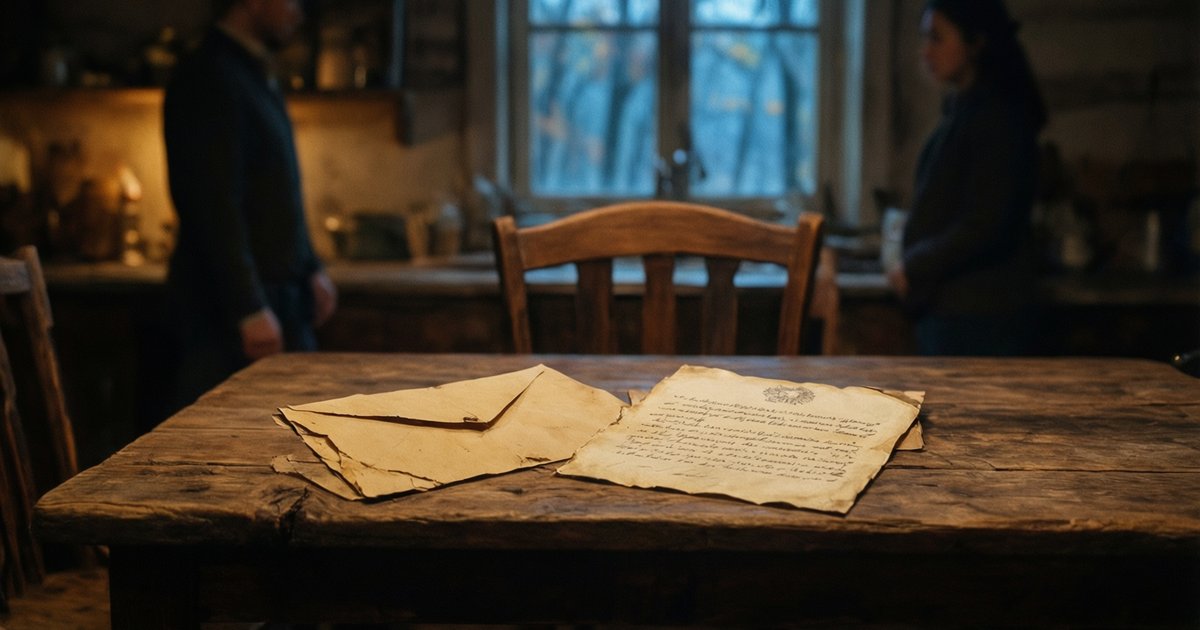
The Hidden Letter of Maple Street Farm
Fiction. This is an original, made-up story: names, characters and events are invented, and any resemblance to real people or events is coincidental.
Part 1 of 5 · Chapters 1–2 of 9
Listen to Part 1 · 5 min
Chapter 1
"I HAVE THE PAPERWORK, PEGGY!"
Wayne's voice rattled the windows of the old farmhouse, his face a blotchy red. He slammed a manila envelope onto the oak table, the sound like a gunshot in the quiet kitchen.
I didn't scream back. I just looked at the smudge of dirt under my fingernails and the way the autumn light hit the dust motes dancing between us. A hollow chill settled in my chest that had nothing to do with the Vermont wind.
But to understand why we were screaming, you need to know how it all began. Three weeks earlier, the world had gone silent.
My father, Otis Haskins, had passed away in his sleep. No dramatic goodbye. No final whispers of wisdom. Just a stubborn old man finally surrendering to a heart that had worked too hard for too long.
I had spent the last twenty years as his shadow. I was the one who woke up at 4:00 AM to check the heaters in the barns. I was the one who spent my weekends patching the sagging fences and negotiating with the bank to keep the foreclosure notices at bay.
I had been a librarian in town, but my real vocation was this dirt. This land was my heartbeat, and I believed, in the quiet way a devoted daughter does, that Otis knew that.
Wayne had been a ghost. A name on a Christmas card from Chicago. A vague voice on the phone every few months talking about 'development' and 'scaling.' He hadn't stepped foot on Maple Street Farm in a decade. He didn't know the scent of wet soil after a rain or the way the east pasture dipped into a marsh during April.
I thought the transition would be simple. I was the caretaker; I was the daughter who stayed. I expected the deed to be a formality, a final 'thank you' from a father who rarely used words to show affection.
I was wrong. Dead men leave the most complicated maps, and my father had left a trail of breadcrumbs that led straight to a cliff.
Chapter 2
The farm didn't just require labor; it required a kind of devotion that bordered on martyrdom. I remember the winter of 2012, when a pipe burst in the main barn. I spent six hours in freezing slush, shivering in a coat that was too thin, fighting to save the livestock from the cold.
Otis had watched me from the porch, leaning on his cane, his eyes unreadable. He never said 'thank you,' but he had handed me a thermos of coffee afterward. That was our language. Minimal. Functional.
I had given up my thirties and forties to this place. My friends in the city had bought condos and traveled to Tuscany. I had bought a new tractor and a bulk shipment of organic feed.
There was a specific kind of invisibility that comes with being the child who stays. You become part of the furniture. You are the reliable one, whose sacrifice is so expected that it becomes invisible.
I didn't mind it at first. I loved the aroma of the cider press in October and the way the maple trees turned a violent, beautiful red. I felt a kinship with the land that Wayne could never understand. To him, land was a commodity. To me, it was an archive of my family's sweat.
But there was always the cedar chest. It sat in the attic, heavy and locked, tucked behind a stack of old almanacs. Otis had forbidden me from touching it for twenty years. 'Not your business, Peg,' he'd grumble whenever I wandered too close.
I used to think it held old journals or perhaps the deed to the neighboring plot we'd lost years ago. I didn't realize it held the reason why my father had always looked at me with a gaze of gratitude and profound guilt.
I spent two decades building a sanctuary, thinking I was securing my future. I didn't know I was merely tending a garden for someone else to harvest.
Coming up in Part 2“Beulah Sterling didn't look like a lawyer. She looked like a grandmother who might offer you a lemon square and…”