 Porchlight Tales
The Secret of the Lake Oconee Cabin
Fiction. This is an original, made-up story: names, characters and events are invented, and any resemblance to real people or events is coincidental.
Part 1 of 5 · Chapters 1–2 of 9
Listen to Part 1 · 5 min
Chapter 1
"WE JUST SIGN THE PAPERS, CLEAR THE JUNK, AND LEAVE," I snapped, my voice tight enough to snap.
Callum didn't even look at me. He just stood there, staring at the peeling gray paint of the porch like it held the secrets to the universe.
I adjusted my cufflinks, feeling the oppressive Georgia heat warp the crisp lines of my suit. The humidity of Lake Oconee clung to my skin like a wet wool blanket the moment I stepped out of my leased Audi. Beside me, my brother looked like he’d just rolled out of a van, wearing a faded flannel shirt and clutching a sketchbook.
We hadn't spoken in ten years—not since a blowout fight at our mother's funeral—and now we were here to liquidate the only thing we had left: a weathered cedar cabin that carried the sharp scent of damp pine and old mothballs.
"The buyer wants it closed by November," I added. "I don't have time for a trip down memory lane, Callum."
"Some of us actually value things that can't be measured in a billable hour, Garrett," he replied softly.
The tension was a living thing between us, thick as the stagnant water lapping against the shore. Inside, the cabin was a time capsule of 1992. Dust motes danced in the shafts of afternoon light, settling on moth-eaten curtains and a heavy oak table. While I began aggressively bagging old magazines, my foot caught on a loose floorboard near the hearth.
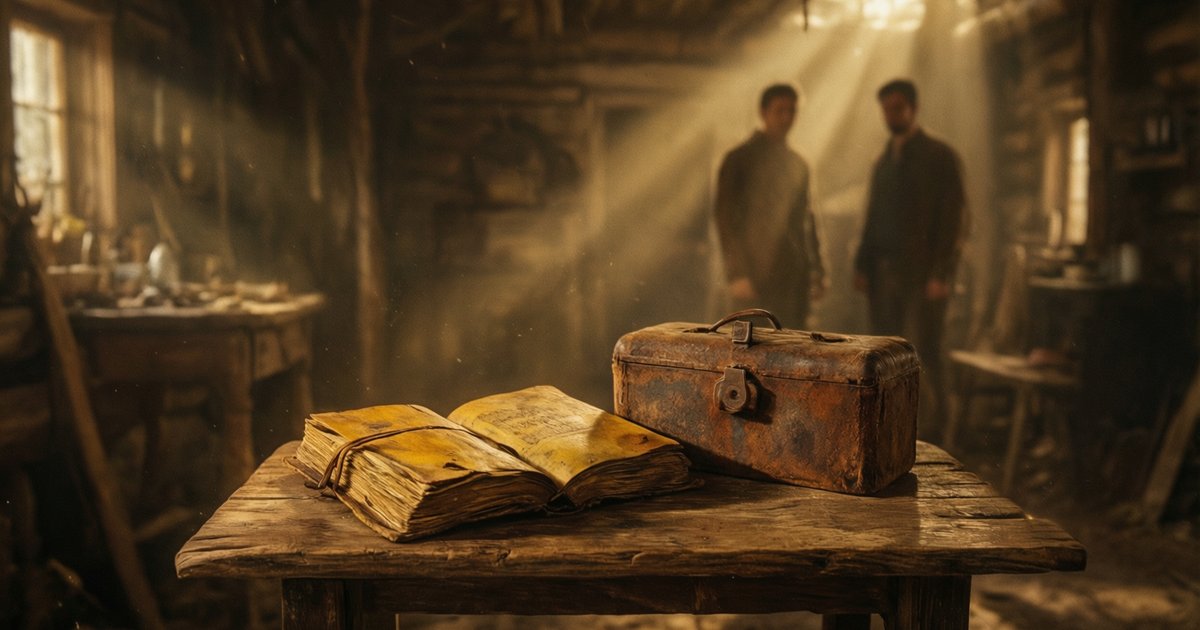
I paused, kneeling to pry the wood up, expecting a termite nest. Instead, I found a rusted, locked metal tackle box. It was heavy, its surface pitted with corrosion, looking as if it had been intentionally buried.
I stared at the lock. For a second, a surge of childhood longing hit me—the desperate need for the man who had walked out on us to have left something behind. But the feeling was quickly replaced by a cold, corporate pragmatism. I shoved the box into a corner, refusing to acknowledge the drumming of my heart.
"Just more junk," I muttered, though I didn't move it toward the trash pile.
Chapter 2
The second day began with the oppressive sound of cicadas screaming in the trees. Callum had spent the morning sketching the porch, his pencil scratching rhythmically against the paper. I, meanwhile, was attacking the old study, determined to strip the room bare.
I pulled open a heavy mahogany desk, its drawers sticking with age, until I noticed a false back in the bottom compartment. With a sharp tug, a leather-bound journal slid out. The cover was cracked, the pages yellowed and carrying the stale musk of old tobacco.
I opened it to the first entry, dated July 14, 1992. The handwriting was frantic, a sharp contrast to the steady hand I remembered from my father's few remaining postcards.
'I can't breathe in this house anymore,' the entry read. 'The pressure is mounting, and I can see the look in the old man's eyes. He thinks he can fix me, but he's just pushing me toward the edge. If I stay, I'll destroy the boys. If I leave, I might save them.'
I froze. The official story had always been that our father, Harlan, had simply grown tired of the burden of fatherhood and vanished into the ether of the American West. He was the villain of our childhood, the man who decided that a corporate law degree and a freelance photography career weren't enough reasons to stay.
"Find something?" Callum asked, leaning against the doorframe. He noticed the book in my hand and walked over, his expression shifting from curiosity to intensity.
We sat on the dusty floor, shoulder to shoulder for the first time in a decade, reading the early entries. The words suggested a different narrative: Harlan hadn't walked away from us; he had been pushed. The 'old man' mentioned in the diary was our grandfather, the patriarch of the family whose shadow still loomed over our lives.
I felt a flicker of doubt. All my life, I had chased success to prove I was 'enough' to make my father stay, but the diary suggested the exit was a forced move.
Coming up in Part 2“By mid-afternoon, the air grew thick and heavy, mirroring the mood in the cabin. We had found an old Polaroid…”