 Porchlight Tales
The Uninvited Guest at the Thanksgiving Table
Fiction. This is an original, made-up story: names, characters and events are invented, and any resemblance to real people or events is coincidental.
Full story · 6 chapters · Read in 3 parts instead
Listen to this story (3 parts)
Part 1 · 3 min
Part 2 · 2 min
Part 3 · 3 min
Chapter 1
The scent of cinnamon and roasted turkey always felt like a sanctuary in our house in Oakhaven, Maine. But this year, the air felt heavy, charged with a static that made the hair on my arms stand up. I was adjusting the linen napkins when the screen door slammed—a sharp, metallic crack that echoed through the hallway. I looked up to see Julian standing there. He looked older, his face weathered by years of wandering, but his eyes were still the same restless gray as our father's. He wasn't alone. In his arms, wrapped in a blue wool blanket, was a sleeping baby.
My mother dropped a ceramic bowl of cranberry sauce. It shattered across the hardwood floor, a splash of vivid crimson that looked far too much like a wound. For ten years, Julian had been a ghost, a name we only mentioned in hushed tones or during heated arguments. Now, he was standing in our entryway, smelling of cold rain and old leather, holding a child we didn't know existed.
Chapter 2
Dinner was a masterclass in suffocating silence. We sat in the dining room, the golden light of the chandelier casting long shadows across the mahogany table. My father sat at the head, his jaw tight, refusing to look at the son who had vanished without a word a decade ago. The baby, whom Julian called Leo, was asleep in a bassinet by the radiator, his soft breathing the only sound in the room besides the clinking of silverware.
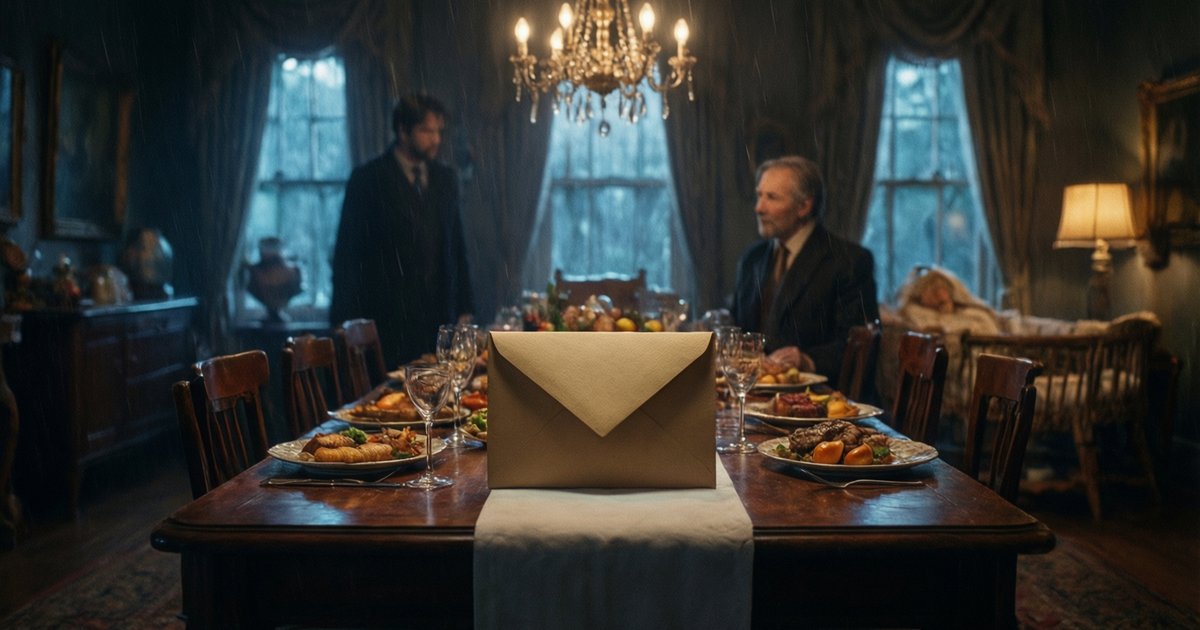
I tried to bridge the gap, asking about his travels, but Julian’s answers were clipped, almost rehearsed. He didn't reach for the stuffing or the mashed potatoes; he just stared at my father. Every time our eyes met, I saw a flicker of something—fear, perhaps, or a desperate need for forgiveness. Then, as my father cleared his throat to deliver the traditional grace, Julian reached into his coat pocket and placed a manila envelope on the table. The cream-colored paper looked stark and clinical against the festive tablecloth.
Chapter 3
The envelope didn't contain a letter of apology or a photo album. It was a legal notice from a firm in Portland. My father’s face went pale, the color draining from his cheeks until he looked as gray as the November sky outside. The document claimed a portion of the family estate—the ancestral acreage that had been in our name for four generations—was legally tied to a trust that Julian had managed in secret.
'What is the meaning of this?' my father rasped, his voice trembling. He didn't look at the paper; he looked at Julian as if he were a stranger who had broken into his home. Julian finally spoke, his voice low and steady. 'It’s not about the money, Dad. It’s about the land. The part with the creek, the part you told me was sold years ago to pay for the taxes.' The revelation hit me like a physical blow. I had grown up believing we were barely holding onto the farm, while Julian had been holding the key to our survival all along.
Chapter 4
The argument erupted before the turkey was even carved. My mother was weeping, her hands fluttering like wounded birds, while my father shouted about betrayal and abandonment. I stood in the middle, the mediator I had always been, trying to find a middle ground that didn't exist. Julian didn't shout back. He just sat there, absorbing the rage, his hand resting protectively on the edge of the bassinet.
'I left because I couldn't breathe in this house!' Julian finally exploded, his voice cracking. 'You wanted a soldier, a mirror image of yourself, not a son who loved poetry and painting. I didn't take the land to spite you; I kept it safe because I knew you'd sell it the moment things got hard.' He looked at me, his eyes brimming with tears. 'I wanted to come back when I was someone you could actually respect.' As the shouting died down, the baby began to cry—a thin, piercing wail that sliced through the tension of the room.
Chapter 5
The next morning, the house was cold. The fire in the hearth had burned down to white ash. I found my father sitting on the back porch, wrapped in a heavy flannel robe, staring out at the frost-covered fields. Beside him sat a small, hand-drawn map of the property. Julian had left it there. It wasn't a legal claim, but a proposal: a way to divide the land so that the creek area could become a protected nature preserve, ensuring it would never be sold to developers.
My father didn't speak for a long time. He just traced the lines of the map with a calloused finger. 'He has my temper,' he whispered, almost to himself. 'But he has his mother's heart.' It was the first time he had acknowledged Julian's humanity in ten years. He told me a secret then—that he had secretly sent money to Julian's old address for years, though the checks always came back unmarked. He had been waiting for a sign, any sign, that Julian was still alive.
Chapter 6
The resolution didn't happen with a cinematic hug or a sudden erasure of a decade of pain. It happened in the kitchen, over a pot of strong black coffee. My father reached out and awkwardly patted Leo’s head, his rough hand contrasting with the baby's velvet skin. He looked at Julian and said, 'The guest room is still your room. It's dusty, and the heater rattles, but it's yours.'
Julian didn't smile, but the tension in his shoulders finally dropped. We spent the rest of the weekend not talking about the land or the legal papers, but about the small things—the way the maples turned red in October, the old dog that had died while Julian was gone. We didn't fix everything, and the scars were still visible, but as I watched my father hold his grandson, I realized that family isn't about the absence of conflict. It's about the decision to stay at the table, even when the conversation is hard, and the courage to leave a chair open for those who finally find their way home.
The End