 Porchlight Tales
The Unmarked Tape in the 1988 VCR
Fiction. This is an original, made-up story: names, characters and events are invented, and any resemblance to real people or events is coincidental.
Full story · 10 chapters · Read in 5 parts instead
Listen to this story (5 parts)
Part 1 · 4 min
Part 2 · 4 min
Part 3 · 4 min
Part 4 · 4 min
Part 5 · 4 min
Chapter 1
The attic of the Oakhaven house smelled of cedar, mothballs, and the kind of stillness that only settles after someone has been gone for a month. Mark, forty-two and perpetually precise, moved through the dust motes with a label maker in his pocket. He was an archivist by trade; he lived for the order of things. His father, Arthur, had been a man of silence and sharp edges, a father who provided everything except affection. Now that Arthur was dead, the house felt less like a home and more like a museum of emotional distance.
While shifting a stack of yellowed National Geographics, Mark found it: a bulky, black Panasonic VCR from the late eighties, tucked behind a moth-eaten velvet curtain. Beside it lay a single VHS tape. It wasn't in a plastic case. Instead, a piece of masking tape was slapped across the spine with a command written in his father's rigid, architectural handwriting: DO NOT PLAY.
Mark paused. He felt a strange prickle at the base of his neck. On the nearby side table, a silver pocket watch—an heirloom he’d found earlier that morning—sat atop a lace doily. He noticed the second hand wasn't sweeping smoothly. It would tick forward twice, pause, then jump backward once. It was ticking out of sync with the rest of the world, a rhythmic glitch in the silence of the attic.
He looked at the tape again. For twenty years, Mark had played the role of the obedient son, avoiding the conflicts his father thrived on. But Arthur was gone, and the authority that had governed Mark's life had evaporated. He didn't want to be the perfect son anymore; he wanted to know who his father actually was when the doors were closed. He picked up the tape, the plastic cold and gritty in his palm, and carried it downstairs to the living room.
Chapter 2
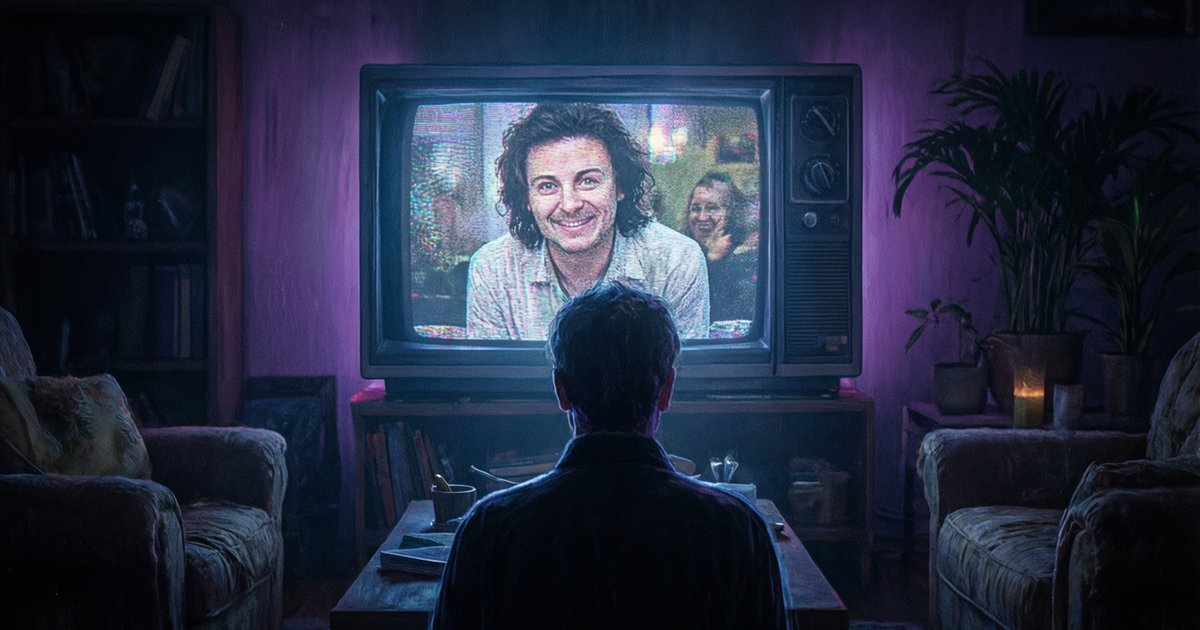
The VCR groaned as it swallowed the tape, the mechanical whir sounding like a throat clearing itself after a long sleep. The television flickered, a storm of static filling the screen before the image snapped into focus. It was 1987. The quality was grainy, the colors bleeding into warm, oversaturated oranges and yellows.
The camera was handheld, panning across the dining room. Mark gasped. It was his own dining room, though the wallpaper was a hideous floral print he’d helped his father strip away in the nineties. There was a dinner party in full swing. He saw his mother, looking younger and softer than he ever remembered, laughing with a glass of chardonnay in her hand. Beside her sat Arthur.
Mark froze. His father was smiling. It wasn't the tight, forced smile of a family photo; it was a genuine, beaming expression of joy. Arthur looked relaxed, almost light. But as the camera panned further down the table, Mark saw him—a man he didn't recognize. The stranger was perhaps in his late thirties, wearing a charcoal suit that seemed slightly too large for his frame. He had a vacant, porcelain smile and eyes that didn't quite reach the corners of his mouth.
The stranger was engaging in conversation, gesturing with a fork, but he didn't seem to be eating. He just sat there, a ghost in a well-tailored suit, fitting perfectly into the scene yet feeling entirely alien. Mark leaned closer to the screen, searching for any clue. He had seen every family album, every old slide project, and every holiday video. This man existed in the footage, but he didn't exist in the history of the family. Who was he, and why was the happiest version of his father sitting next to a man who had been completely erased from the record?
Chapter 3
"Who is this?" Mark asked, holding the TV screen's frozen image up to his sister.
Elena didn't even look up from her clipboard. She was in 'estate mode,' calculating the square footage of the bedrooms and checking the condition of the hardwood floors. She wanted this house sold by September. To her, the Oakhaven estate wasn't a sanctuary of memories; it was a monument to the childhood trauma of being ignored by a cold father.
"I don't know, Mark. Probably some old business partner," she said, her voice flat. She finally glanced at the screen, her eyes skimming over the vacant smile of the man in the charcoal suit. She didn't blink. She didn't gasp. She just sighed and stepped back, as if the image were something unpleasant she'd found on the bottom of her shoe.
"He's sitting right next to Dad. They look... close," Mark pressed. "Look at how Dad is leaning in. He's laughing. I've never seen him laugh like that."
Elena’s expression shifted. A flicker of irritation, or perhaps something deeper—fear—crossed her face. She snatched the remote and clicked the TV off, plunging the room into a sudden, oppressive gray.
"Stop this," she snapped. "Dad was a difficult man. He had secrets. That’s why we’re selling this place—to get away from the secrets. Burn the tape, Mark. Just burn it and let's finish the attic. We have a realtor coming on Friday, and I am not spending my vacation digging through a dead man's delusions."
She walked out of the room, the click of her heels echoing like a countdown. Mark stood in the silence, the ghost of that vacant smile still burned into his retinas. Elena didn't remember the man, but her reaction wasn't one of confusion. It was a desperate attempt to shut a door that Mark had just nudged open.
Chapter 4
The next morning, Mark returned to the attic, but he wasn't looking for boxes. He was looking for the gaps. If his father had gone to the trouble of labeling a tape 'Do Not Play,' there had to be more.
He spent hours digging through a cedar chest in the far corner, beneath a pile of moth-eaten wool blankets. At the bottom, he found a leather-bound photo album. It was small, weathered, and lacked a title. When he opened it, he felt a jolt of nausea.
The album was full of group photos—family vacations, Christmas mornings, neighborhood barbecues. But almost every single photo had been mutilated. Someone had taken a pair of scissors and meticulously cut out a specific person from every frame. There were jagged white holes where a man should have been.
Mark traced the edge of one cutout. In a photo from a 1985 trip to the lake, the hole was positioned exactly where the stranger from the tape would have stood. The cuts were precise, almost surgical. It wasn't an act of anger; it was an act of erasure. It was as if Arthur had tried to perform a lobotomy on his own history, removing a piece of his life until the wound healed over into a scar of silence.
As he flipped the pages, he found one photo that hadn't been cut. It was a candid shot of Arthur and the stranger standing back-to-back in front of the house. They looked identical—the same jawline, the same slope of the nose, the same height. The only difference was the expression. Arthur looked terrified, while the stranger wore that same vacant, haunting smile.
Mark felt the air in the attic grow thick and humid. He looked at the silver pocket watch on the table. It had stopped ticking entirely. The second hand was frozen, pointing straight up, as if waiting for a signal.
Chapter 5
Mark drove three blocks over to the small, weathered bungalow of Mr. Henderson. Henderson had been Arthur's only remaining friend, a retired actuary who spent his days tending to a garden of oversized hydrangeas.
When Henderson opened the door, the smell of peppermint and old paper drifted out. Mark didn't waste time. He held up his phone, showing a high-resolution screenshot of the stranger from the VHS tape.
The change in Henderson was instantaneous. The old man’s face didn't just pale; it seemed to collapse. He stepped back, his hand gripping the doorframe so hard his knuckles turned white. He didn't ask where Mark got the photo. He didn't ask who the man was.
"You shouldn't have looked for that, Mark," Henderson whispered, his voice trembling. "Some things are erased for a reason. Your father... he spent thirty years trying to build a wall around that memory. He did it to protect you. He did it to protect all of you."
"Protect us from what?" Mark asked, stepping forward. "He's my father's twin, isn't he? Why was he erased? Why is there a room in this house that feels like a tomb?"
Henderson’s eyes darted toward the Oakhaven house, visible in the distance. He looked exhausted, as if a burden he’d been carrying for decades had suddenly doubled in weight.
"The accident happened when they were nineteen," Henderson said softly. "A mistake. A moment of carelessness that changed everything. Arthur couldn't live with the guilt, and the other... the other couldn't live with the truth. They made a pact, but Arthur's version of a pact was to pretend the other half of his soul never existed. Go home, Mark. Burn the tape. Some ghosts are better left without a name."
Before Mark could ask another question, Henderson closed the door. The click of the lock sounded final, leaving Mark standing on the porch in the sweltering August heat.
Chapter 6
Mark returned to the living room and pushed the VHS tape back into the machine. He didn't watch the party this time; he scrubbed through the footage, frame by frame, searching for something Henderson had missed.
Near the end of the tape, the camera stopped panning. The person filming—likely his mother—had set the camera down on a sideboard. The shot was static, capturing the dinner table in a wide angle. For five minutes, the guests talked and laughed in a blur of background noise.
Then, the stranger did something.
He stood up and walked toward the camera. He didn't look at the other guests; he looked directly into the lens. His vacant smile vanished, replaced by a look of intense, focused urgency. He leaned in so close that his face blurred, his breath fogging the lens. He didn't shout; he whispered.
Mark turned the volume up to the maximum, straining to hear through the hiss of the old magnetic tape. The stranger's voice was a raspy mirror of Arthur's.
"August 14, 1988," the stranger whispered. "The heavy door. Beneath the floor. I am still waiting in the cellar."
Mark froze. August 14 was only three days away. He looked toward the hallway that led to the back of the house. At the end of that hall was the basement door. For his entire childhood, that door had been the one boundary he was never allowed to cross. Arthur had kept it locked with a heavy, industrial deadbolt, claiming the foundation was unstable and the air was toxic with mold.
He had believed it for twenty years. He had accepted the boundary because that was the rule of the house. But as Mark looked at the screen, he realized the stranger wasn't talking to the camera. He was talking to whoever found the tape. He was talking to Mark.
Chapter 7
The deadbolt didn't stand a chance against a heavy-duty crowbar. With a screech of twisting metal, the lock snapped, and the door swung open with a heavy, ominous groan.
Mark descended the stairs, the air growing colder with every step. He expected cobwebs and damp concrete. Instead, when he reached the bottom and flicked the switch, he gasped.
It wasn't a basement; it was a shrine.
There, in the center of the concrete floor, was a meticulously preserved recreation of the dinner party from the tape. The same floral wallpaper had been glued to the cinderblock walls. The same mahogany table was set with the same fine china and crystal glasses. Even the food—wax replicas of roast beef and carrots—sat untouched on the platters.
It was a frozen moment in time, a physical manifestation of 1987. The room was spotless, devoid of dust, as if someone had been coming down here every day for decades to polish the silver and straighten the napkins.
In the corner, a small desk held a single lamp and a stack of journals. Mark walked toward the desk, his footsteps echoing in the oppressive silence. He felt a wave of vertigo. This wasn't just a secret; it was an obsession. His father hadn't just erased his brother from the photos; he had built a prison for the memory of him, a place where he could visit the ghost of his twin without letting the world know he was haunted.
As he reached for the first journal, he noticed something on the desk. The silver pocket watch. It was there, ticking. But it wasn't glitching anymore. It was ticking in perfect, rhythmic synchronization with the beating of Mark's own heart.
Chapter 8
Mark opened the diary. The handwriting was Arthur's, but it was different—raw, frantic, stripped of the architectural precision of his later years.
*June 12, 1968,* the first entry read. *The brakes failed on the ridge. I was driving. Elias was in the passenger seat. I walked away with a scratch. Elias... Elias didn't walk away. But he didn't die. Not entirely.*
Mark read on, his breath hitching. The 'accident' hadn't been a death, but a devastating injury that left Elias with severe cognitive impairment and a fragmented personality. He had become the 'vacant' version of himself, a man who existed in a blur of confusion and sudden, lucid flashes.
Arthur, driven by a toxic mix of guilt and a desperate need for a 'perfect' life, had struck a deal with his parents. They would hide Elias, treating him as a secret shame, while Arthur would carry the family name and the burden of the lie. Elias had lived in a facility for years, then in the shadows of the house, until he finally passed away in 1988.
Arthur couldn't let go. He had created this room as a way to keep Elias 'present' but controlled. The coldness Mark had felt his entire life wasn't a lack of love; it was the weight of a thousand lies. Arthur had become a statue of a man because he was terrified that if he moved, the truth about Elias would shatter the facade.
Mark sat on the edge of the wax-food table, feeling a profound sense of grief. His father hadn't been a monster; he had been a coward, trapped in a loop of penance and erasure. He had spent his life trying to delete a human being, only to find that the more you erase, the more the void demands to be filled.
Chapter 9
In the back of the final journal, Mark found a small cassette tape labeled 'The Truth.' He took it upstairs and played it through an old player.
It wasn't a recording of a party. It was a recording of Arthur, his voice breaking, speaking to his deceased brother. *'I can't tell Mark. I can't tell him that his father is a thief who stole your identity. I'll keep the secret, Elias. I'll be the cold one, the hard one, so they never look deep enough to find you.'*
Mark stood in the center of the living room, the tape spinning. He looked at the house—the polished floors, the expensive art, the sterile atmosphere of a 'perfect' home. He realized that the polished lie was the only thing he had ever known. If he kept the secret, he would be continuing Arthur's legacy of erasure. If he revealed it, he would destroy the image of the father he had spent forty years trying to respect.
But for the first time in his life, Mark didn't want to be the archivist of a lie.
He spent the next week working. He didn't sell the house immediately. Instead, he brought Elena down into the basement. He didn't tell her; he showed her. He showed her the table, the journals, and the photos of the man with the vacant smile.
Elena didn't scream or argue. She sat down at the wax table and wept—not for the mystery, but for the realization that the coldness they had suffered was actually a distorted form of love and guilt. Together, they began the process of dismantling the shrine. They didn't throw everything away; they kept the journals and the tapes. They gave Elias a name again.
Chapter 10
The final day in Oakhaven was a bright, crisp Tuesday. Mark stood in the living room, the windows thrown wide open to let the autumn breeze sweep away the smell of mothballs and cedar.
He walked over to the mantle and placed the silver pocket watch there. He had spent hours cleaning it, winding it carefully. As he set it down, he noticed the second hand. It gave one final, slow tick, and then it stopped completely.
The ticking that had haunted the house for decades—the rhythmic glitch of a frozen life—was over. The time for secrets had run out.
Mark looked at a new photo he had placed next to the watch. It was a restored version of the lake trip from 1985. He had used his archivist skills to digitally recreate the missing piece of the photo, blending the jagged white hole back into a portrait of two brothers standing back-to-back.
He didn't feel the need to be the perfect son anymore. He felt like a man who had finally found the truth, even if that truth was broken. As he turned off the lights and locked the front door for the last time, the house didn't feel like a museum or a tomb. For the first time, it felt warm.
Mark walked toward his car, leaving the house to the sunlight, carrying the diary and the tapes in his bag. He wasn't erasing anything anymore. He was finally moving forward, leaving the ghosts of Oakhaven to finally rest in the silence they had earned.
The End