 Porchlight Tales
What If the 1918 Pandemic Never Happened?
Speculative fiction · Alternate history. Characters, documents and events in this story are imagined; real people, places and institutions appear only as historical backdrop.
Full story · 10 chapters · Read in 5 parts instead
Listen to this story (5 parts)
Part 1 · 5 min
Part 2 · 6 min
Part 3 · 5 min
Part 4 · 5 min
Part 5 · 5 min
Chapter 1
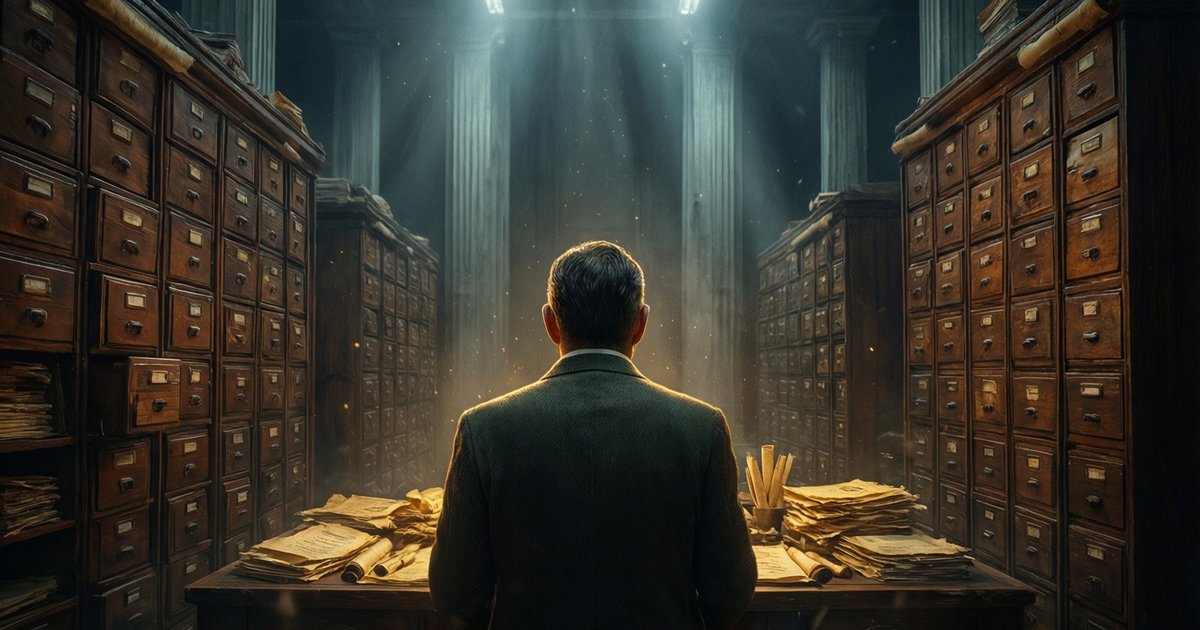
Alaric Finch adjusted his glasses, the bridge of his nose aching from twelve hours of leaning over yellowed vellum. The National Records Administration was a cathedral of bureaucracy, a windowless monolith of Art Deco concrete in the heart of Washington D.C. It was 1955, and the city outside was a hive of steel and neon, housing twenty million souls in a density that made the air feel thick, like breathing warm wool.
Alaric lived for the order of the archives. He categorized the chaos of human existence into mahogany drawers, a habit born from the jagged hole his father had left behind in 1934. His father hadn't just left; he had evaporated, leaving only a silver locket and a void that Alaric tried to fill with facts.
While cross-referencing the 1918-1922 census records for a government audit, Alaric froze. The numbers didn't add up. In his textbooks, the post-WWI era was a golden age of survival—no great plague had come to claim the youth. The world had surged forward, an explosion of vitality that fueled the Great Expansion. But as he compared the raw intake logs with the finalized public records, he noticed a pattern of deletions.
Thousands of names were being systematically erased from the 1920 registries. Not deaths—there were no death certificates—just gaps where people used to be. Tucked inside a misplaced folder, he found a single, crimson-stamped document. It was a memo from the Department of Social Stability, dated November 12, 1921. It spoke of 'The Surplus Project' and the need to 'curate the biological load' to avoid a systemic collapse.
Alaric felt a prickle of heat on the back of his neck. The world was told that humanity had simply been lucky in 1918, avoiding a natural catastrophe. But the redacted ink suggested that the survival of the many had been managed by the disappearance of the few. Who decided who was surplus? And why was the government still altering records thirty years later?
Chapter 2
The rain in D.C. tasted of sulfur and charcoal. Alaric met Maren Holt in a dim basement cafe in the Anacostia district, where the Art Deco grandeur of the city center dissolved into crumbling tenements. Maren was a journalist with a gaze that could cut through reinforced steel and a habit of chewing on an unlit cigarette.
'You're the first person from the NRA to actually look at the gaps,' Maren said, her voice a low rasp. She slid a manila envelope across the sticky table. Inside were grainy, high-contrast photographs of the Midwest. They showed towns—entire grids of houses, storefronts, and schools—that looked perfectly preserved, yet they were devoid of a single human soul.
'These are Ghost Towns,' Maren explained. 'Officially, they're thriving agricultural hubs. The census says they're booming. But my brother tried to visit one in Nebraska three years ago. He found a city of empty chairs and open doors. He was arrested for trespassing on 'protected soil' and exiled to the fringes. He hasn't written in six months.'
Alaric looked at the photos, then at the silver locket resting against his chest. He felt a sudden, irrational surge of nausea. If the population had grown unchecked after 1918, the resources should have failed decades ago. The global economy shouldn't be this stable; the cities shouldn't be this efficient.
'The population didn't just grow, Alaric,' Maren whispered, leaning in. 'It was curated. Like a garden. The weeds were pulled so the roses could bloom.'
As she spoke, Alaric noticed a black sedan idling at the curb, its headlights cutting through the gray drizzle. The driver didn't move, but the gaze of the vehicle felt predatory. Maren noticed it too, her expression hardening. She didn't look scared; she looked like someone who had been hunted for a long time and had finally stopped running. 'They know you're asking,' she warned. 'And in this city, curiosity is a terminal illness.'
Chapter 3
The following Monday, Director Percival Graves called Alaric into the top-floor office. The room was an altar to power: polished obsidian desks, panoramic views of the overcrowded skyline, and a silence so heavy it felt artificial. Graves had been Alaric's mentor for a decade, the man who had taught him that history was not about what happened, but about how it was remembered.
'Alaric, your dedication to the 1920s archives is commendable,' Graves said, his voice smooth as river stone. He stepped closer, the pungent aroma of sandalwood clinging to his wool coat. 'In fact, your eye for detail has not gone unnoticed. I'm offering you a promotion to Chief Curator of the Heritage Wing. A private office, a salary increase, and access to the Restricted Vaults.'
It was the dream Alaric had chased since he was twenty. Yet, as Graves reached out to pat his shoulder, Alaric saw it: a small, gold lapel pin. It was a stylized scale balancing a seed and a scythe. The symbol of the Society of Equilibrium.
Alaric stepped back instinctively, his chest tightening as his pulse quickened. He had seen that symbol in the margins of the 'Surplus Project' files. The Society wasn't just a club; it was the invisible hand guiding the demographics of the planet.
'Is there a problem, Alaric?' Graves asked. The warmth in his eyes hadn't changed, but the tone had shifted. It was no longer an offer; it was a boundary.
'No, sir,' Alaric lied, his voice trembling slightly. 'I'm just... overwhelmed by the generosity.'
Graves smiled, but his eyes remained cold, calculating the risk of the man standing before him. 'Remember, Alaric, the archives are for preservation, not for excavation. Some things are buried because the air would poison us if they were brought to light. Take the promotion. Stop looking for ghosts. For your own sake.'
As Alaric left the office, he realized the promotion was a gilded cage. Graves wasn't rewarding him; he was attempting to buy his silence, or perhaps, move him to a place where his movements could be monitored twenty-four hours a day.
Chapter 4
The coordinates in the silver locket had haunted Alaric for years. His father had etched them into the back of the casing with a needle, a cryptic set of numbers that looked like a mistake until Alaric mapped them against the 1930s land-use charts. They pointed to a nameless stretch of woodland in Virginia, far from the urban sprawl.
Driving his rusted sedan through the pines, Alaric felt the oppressive city atmosphere lift, replaced by a silence that felt wrong. He found the site: a concrete slab disguised as an old forestry outpost. Using a heavy crowbar, he forced open a rusted hatch, descending into a damp, subterranean bunker where the air tasted of lime and old copper.
He didn't find documents. He found bones.
Thousands of them. They were stacked in neat, industrial rows, bleached white and stripped of identity. There were no coffins, no names, only numbered tags. This was a Culling Center. He found a ledger on a rotting table, the ink faded but legible. It detailed the '1934 Correction.' It wasn't a plague or a war; it was a logistical operation. People were brought here under the guise of 'Work Colonies' during the Great Expansion, only to be processed as surplus.
Alaric collapsed against the cold wall, his breath coming in ragged gasps. He looked at the date on the ledger. The 1934 Correction had peaked in October. His father had disappeared in November.
He realized the terrifying truth: the world hadn't avoided the 1918 pandemic through luck. The virus had likely existed, but the Society of Equilibrium had realized that a natural pandemic was too chaotic, too unpredictable. They had chosen instead to replace a random biological disaster with a calculated, administrative purge. They didn't want a plague; they wanted a ledger.
As he climbed back to the surface, the sunlight felt blinding and fake. He looked at his hands and saw the dust of his father's generation. He wasn't just an archivist anymore; he was a witness to a crime that spanned half a century. The 'Silent Spring' protocols he'd seen in the 1920s weren't about farming—they were about deciding who got to eat and who had to die.
Chapter 5
The fall was sudden and absolute. By Tuesday afternoon, Alaric was no longer the Senior Archivist. He was a traitor.
Graves hadn't used a scalpel; he had used a sledgehammer. Evidence of 'espionage'—forged documents suggesting Alaric was selling national secrets to foreign powers—appeared on Graves's desk. Within two hours, the security detail had escorted Alaric out of the building. They didn't just fire him; they stripped him. His pension was frozen, his apartment lease was revoked under the 'Social Stability Act,' and his credentials were wiped from every database in the city.
'You chose the wrong side of history, Alaric,' Graves had whispered as the guards pushed him toward the exit.
Alaric found himself in the 'Sinks,' the subterranean slums of D.C. where the people the Society deemed 'marginal' were shoved. Here, the Art Deco dream turned into a nightmare of dripping pipes and neon flicker. The population density here was suffocating; families lived in shipping containers stacked five high, fighting over scraps of synthetic protein.
He walked through the crowds, seeing the faces of the 'surplus' who had survived the culls but were kept in a state of permanent poverty to keep the numbers manageable. He saw children with hollow cheeks and old men coughing into gray rags.
He met Maren in a hidden cellar, her face bruised, her spirit frayed. 'They're tightening the grip,' she told him. 'The Society is preparing for another Correction. They can't sustain the Sinks anymore. The growth rate is too high.'
Alaric looked around the dim room. For the first time, his obsessive need for order felt like a sickness. He had spent his life organizing the records of a utopia, never realizing that the order he loved was built on a foundation of mass graves. He had the coordinates, he had the evidence, but he no longer had a voice. He was now just another number in the surplus, waiting for the ledger to be closed.
Chapter 6
The blow that broke Alaric didn't come from Graves, but from a file Maren had managed to steal before her capture.
Two days after Alaric entered the Sinks, the Society's enforcers raided Maren's safehouse. Alaric had been away searching for a contact in the underground press. When he returned, the door was hanging off its hinges. Maren was gone. On the floor lay a single, leather-bound dossier.
Alaric opened it with trembling fingers. It was a personnel file from 1934. He found his father's name: Silvan Finch. But he wasn't listed as a worker or a citizen. He was listed as 'Case 774-B: Resistance Participant.'
His father hadn't been a random victim of the purge. He had been an auditor, just like Alaric. He had found the discrepancy in the numbers and had tried to leak it to the press. The 'disappearance' wasn't an accident of administration; it was an execution for heresy. The last entry in the file was a cold, clinical note: 'Subject terminated via chemical sedation. Remains processed at Site 12.'
Alaric clutched the silver locket, the metal digging into his palm. The void in his heart, which he had tried to fill with archival order, suddenly flared into a white-hot rage. He realized that his entire life—his career, his obsession with truth, his distrust of authority—was a subconscious echo of his father's struggle.
He sat in the dark, surrounded by the damp smell of concrete and desperation. He had lost everything: his job, his home, and now the only ally he had left. He was stripped of his status, his dignity, and his hope.
But as he stared at the dossier, he noticed something. His father had left a note in the margin of the final page, a series of numbers that corresponded to the National Records vault's emergency override. Silvan Finch had known his son might one day follow the trail. He hadn't just left a locket; he had left a key. The low point had become a pivot. Alaric no longer wanted to find the truth; he wanted to weaponize it.
Chapter 7
The Centennial Gala was the event of the decade, a decadent display of wealth and power held in the Grand Hall of the National Records Administration. The elite of the Society of Equilibrium danced in gold-threaded gowns, sipping champagne while the city outside groaned under its own weight.
Alaric didn't enter through the front door. He used the service tunnels, the blind spots he had mapped during his years as Senior Archivist. He knew where the cameras didn't reach, where the guards grew bored, and where the ventilation shafts leaked cold air.
He moved like a shadow through the guts of the building, his ribs tight with anxiety. He reached the Restricted Vault, a fortress of steel and biometric locks. Using the override code his father had hidden in the dossier, he bypassed the primary security gate. The door hissed open, revealing the inner sanctum of the Society.
Inside was the 'Final Ledger.' It wasn't a book, but a massive, humming mainframe of vacuum tubes and punch cards. It was the algorithm of death. Alaric began to scroll through the active lists, his eyes widening as he saw the names.
It wasn't just the Sinks. The list included professors, journalists, mid-level bureaucrats—anyone whose 'utility score' had dropped below the threshold. The next Correction was scheduled for the following month. Millions of people were slated for 'processing' to ensure the utopia remained sustainable.
He saw Maren's name on the list. He saw names of people he had worked with for years.
As he began to download the data onto a series of magnetic tapes, the lights in the vault flickered. A soft, rhythmic clapping echoed through the chamber. Alaric spun around. Director Graves was standing in the doorway, silhouetted by the gold light of the gala. He wasn't wearing his glasses, and for the first time, he looked tired.
'I knew you couldn't resist the archives, Alaric,' Graves said, his voice devoid of its usual warmth. 'The compulsion for order is a powerful thing. It's what makes you a perfect archivist, and what makes you so predictable.'
Chapter 8
Graves didn't call the guards. He walked toward Alaric, gesturing to the humming mainframe.
'Look at the numbers, Alaric,' Graves commanded. 'Do the math. If we hadn't curated the population since 1918, we would have hit two billion people by 1950. The soil would be dead. The water would be poison. We would be living in a global wasteland, fighting over the last handfuls of grain. There would be no Art Deco cities, no music, no medicine. Just a slow, screaming starvation for everyone.'
'You don't get to decide who lives!' Alaric shouted, clutching the magnetic tapes to his chest.
'Someone has to,' Graves countered, his voice rising. 'Nature is cruel and haphazard. We replaced the randomness of a plague with the precision of a scale. We created a world of stability. Yes, the cost is high. Yes, it is monstrous. But it is a managed monster. The alternative is total extinction.'
Graves stepped closer, extending a hand. 'You are a man of order, Alaric. You understand the necessity of the system. Join us. We need someone with your intellect to manage the next cycle. I can bring Maren back. I can give you your life back, and more. You can be the architect of the balance instead of the victim of it.'
Alaric looked at the hand, then at the Final Ledger. He thought of the mass graves in Virginia and the hollow eyes of the children in the Sinks. He thought of his father, terminated for wanting the world to know the truth.
Graves's offer was the ultimate temptation: the return of his status and the power to save a few lives by sacrificing millions. It was the 'order' he had always craved—a world where everything had a place and a purpose.
'The only order that matters,' Alaric whispered, 'is the one that doesn't require a massacre to exist.'
He didn't take the hand. Instead, he lunged for the emergency broadcast console, a relic of the Cold War era designed to alert the city of an atomic strike.
Chapter 9
Graves lunged, his fingers clawing at Alaric's collar, but Alaric was fueled by a decade of repressed grief. He slammed his fist onto the manual override, triggering the emergency broadcast system.
Across Washington D.C., every radio, every public loudspeaker, and every newspaper printing press connected to the national grid suddenly jolted to life. The Final Ledger—the names, the dates, the locations of the Culling Centers, and the recorded confessions of the Society's founders—began to stream out in a torrent of raw data.
'You've killed us all!' Graves screamed, his face contorted in horror. 'You've destroyed the peace!'
'No,' Alaric gasped, pushing Graves away. 'I've just given the world back its grief.'
As the data flooded the city, the reaction was instantaneous. In the Sinks, the silence was broken by a roar of realization. In the Grand Hall, the music stopped as guests looked at their devices in terror. The illusion of the utopia didn't crack; it shattered.
Alaric didn't fight the guards who eventually swarmed the vault. He didn't run. He simply sat on the floor, leaning against the mainframe that had dictated so many deaths, and waited.
He watched as Graves was dragged away, not by the police, but by his own security detail, who had just seen their own names on the 'surplus' list. The hierarchy of the Society had collapsed in a matter of minutes. The 'order' was gone, replaced by a chaotic, screaming tide of human emotion.
As he was led out of the building in handcuffs, Alaric looked up at the sky. For the first time in his life, the air felt lighter. The suffocating density of the city was still there, but the lie that held it together had vanished. The world was now a dangerous, unstable place, but it was a place where the dead were finally acknowledged. The curated peace was over, and the honest war for survival had begun.
Chapter 10
The revolution didn't happen overnight, but the world changed in a heartbeat. The Society of Equilibrium fell, and the 'Population Control Acts' were burned in the streets. D.C. became a battlefield of ideologies, a city trying to figure out how to breathe without a master.
Alaric sat on a weathered park bench in the center of the city, watching the sunrise. He was no longer an archivist; he was a pariah to some and a saint to others. He didn't care for either title. He felt an immense, crushing pressure in his chest, but it was a pressure he welcomed. It was the weight of the truth.
He looked at the silver locket in his palm. He remembered the way his father's name had looked in that cold, clinical file. He realized that by destroying the 'order' of the world, he had finally found the only piece of order that mattered: the resolution of his father's story.
Around him, the sirens of the city continued to wail, and the sound of breaking glass echoed from the distant avenues. The utopia was crumbling, and the future was a terrifying blank page. There would be famines, there would be riots, and there would be a desperate struggle to redistribute the world's resources. It would be brutal. It would be messy.
But it would be real.
Alaric clicked the locket open one last time. He looked at the faded photograph of Silvan Finch—a man who had loved the truth more than his own safety. With a slow, deliberate motion, Alaric tilted the locket. The photograph fluttered out, caught by a sudden gust of wind, and danced away over the gray pavement, disappearing into the crowd of people fighting for their lives.
He closed the empty locket and let out a long, shaking breath. He was no longer searching for his father. He was finally walking beside him into an uncertain, honest morning.
The End