 Porchlight Tales
What If the 1918 Pandemic Never Happened?
Speculative fiction · Alternate history. Characters, documents and events in this story are imagined; real people, places and institutions appear only as historical backdrop.
Part 1 of 5 · Chapters 1–2 of 10
Listen to Part 1 · 5 min
Chapter 1
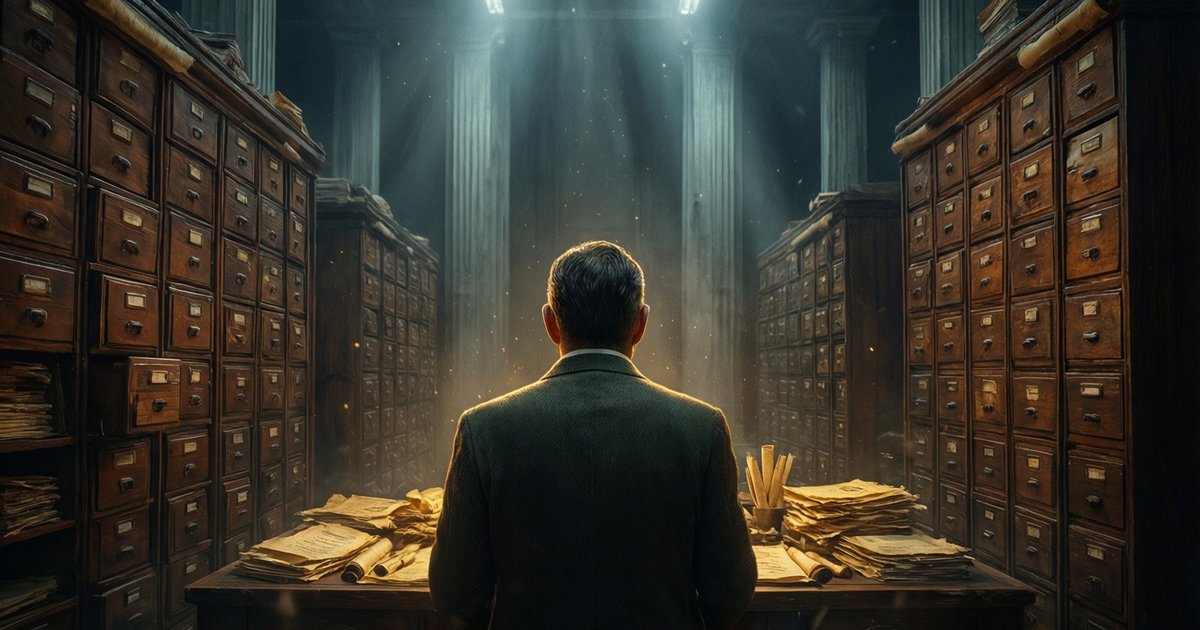
Alaric Finch adjusted his glasses, the bridge of his nose aching from twelve hours of leaning over yellowed vellum. The National Records Administration was a cathedral of bureaucracy, a windowless monolith of Art Deco concrete in the heart of Washington D.C. It was 1955, and the city outside was a hive of steel and neon, housing twenty million souls in a density that made the air feel thick, like breathing warm wool.
Alaric lived for the order of the archives. He categorized the chaos of human existence into mahogany drawers, a habit born from the jagged hole his father had left behind in 1934. His father hadn't just left; he had evaporated, leaving only a silver locket and a void that Alaric tried to fill with facts.
While cross-referencing the 1918-1922 census records for a government audit, Alaric froze. The numbers didn't add up. In his textbooks, the post-WWI era was a golden age of survival—no great plague had come to claim the youth. The world had surged forward, an explosion of vitality that fueled the Great Expansion. But as he compared the raw intake logs with the finalized public records, he noticed a pattern of deletions.
Thousands of names were being systematically erased from the 1920 registries. Not deaths—there were no death certificates—just gaps where people used to be. Tucked inside a misplaced folder, he found a single, crimson-stamped document. It was a memo from the Department of Social Stability, dated November 12, 1921. It spoke of 'The Surplus Project' and the need to 'curate the biological load' to avoid a systemic collapse.
Alaric felt a prickle of heat on the back of his neck. The world was told that humanity had simply been lucky in 1918, avoiding a natural catastrophe. But the redacted ink suggested that the survival of the many had been managed by the disappearance of the few. Who decided who was surplus? And why was the government still altering records thirty years later?
Chapter 2
The rain in D.C. tasted of sulfur and charcoal. Alaric met Maren Holt in a dim basement cafe in the Anacostia district, where the Art Deco grandeur of the city center dissolved into crumbling tenements. Maren was a journalist with a gaze that could cut through reinforced steel and a habit of chewing on an unlit cigarette.
'You're the first person from the NRA to actually look at the gaps,' Maren said, her voice a low rasp. She slid a manila envelope across the sticky table. Inside were grainy, high-contrast photographs of the Midwest. They showed towns—entire grids of houses, storefronts, and schools—that looked perfectly preserved, yet they were devoid of a single human soul.
'These are Ghost Towns,' Maren explained. 'Officially, they're thriving agricultural hubs. The census says they're booming. But my brother tried to visit one in Nebraska three years ago. He found a city of empty chairs and open doors. He was arrested for trespassing on 'protected soil' and exiled to the fringes. He hasn't written in six months.'
Alaric looked at the photos, then at the silver locket resting against his chest. He felt a sudden, irrational surge of nausea. If the population had grown unchecked after 1918, the resources should have failed decades ago. The global economy shouldn't be this stable; the cities shouldn't be this efficient.
'The population didn't just grow, Alaric,' Maren whispered, leaning in. 'It was curated. Like a garden. The weeds were pulled so the roses could bloom.'
As she spoke, Alaric noticed a black sedan idling at the curb, its headlights cutting through the gray drizzle. The driver didn't move, but the gaze of the vehicle felt predatory. Maren noticed it too, her expression hardening. She didn't look scared; she looked like someone who had been hunted for a long time and had finally stopped running. 'They know you're asking,' she warned. 'And in this city, curiosity is a terminal illness.'
Coming up in Part 2“The following Monday, Director Percival Graves called Alaric into the top-floor office. The room was an altar to power: polished…”