 Porchlight Tales
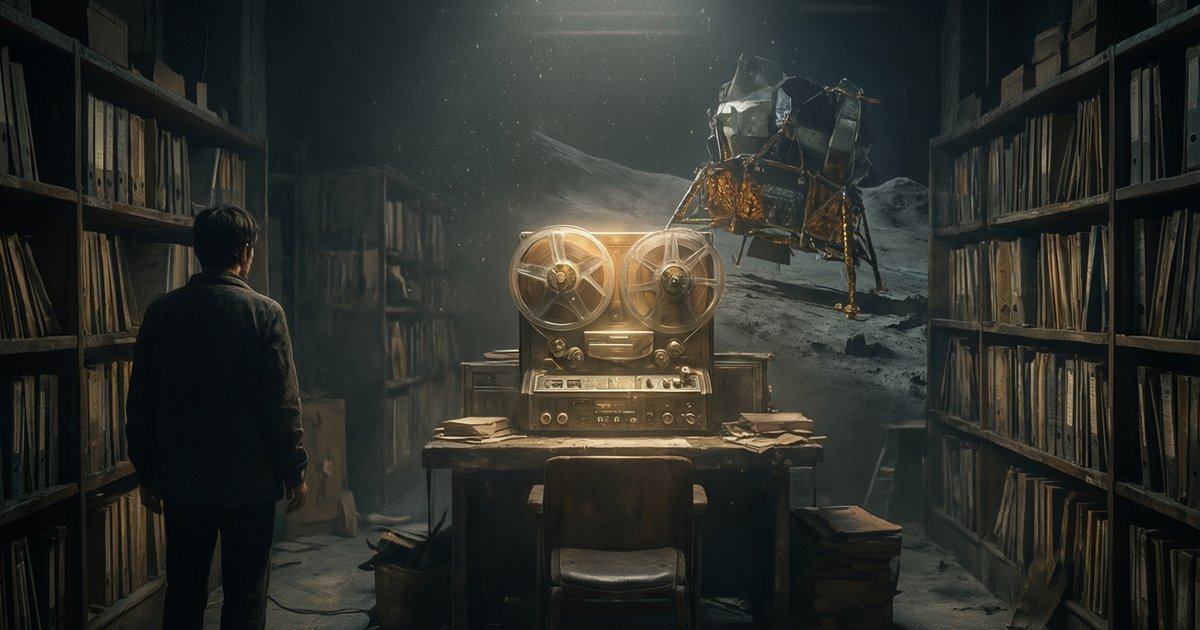
What If the Apollo 11 Mission Had Failed?
Speculative fiction · Alternate history. Characters, documents and events in this story are imagined; real people, places and institutions appear only as historical backdrop.
Part 1 of 5 · Chapters 1–2 of 9
Listen to Part 1 · 5 min
Chapter 1
The basement of the National Archives stung with the sharp tang of ionized air and the musk of decaying cellulose. Sterling Penhaligon, 52, moved through the stacks with a precision that bordered on the pathological. He lived for the order of the files, a sanctuary from a world that had spent twenty-five years weeping for three dead heroes. Since the Lunar Module's engine failed during descent in July 1969, the United States had transformed. The 'Sacred Tragedy' wasn't just a memory; it was the cornerstone of the Lunar Mourning Act, a law that granted the federal government sweeping surveillance powers in the name of national resilience.
Sterling adjusted the 'Broken Eagle' medal pinned to his lapel, a heavy bronze piece given to the children of the Apollo support staff. His father had been a communications officer during the crisis, a man Sterling remembered as a shell of a human, haunted by a cowardice he never explained. Sterling’s obsession with objective truth was his only armor against that inherited shame. While his peers socialized, Sterling cataloged the silence of the dead.
While auditing a misfiled crate from the late sixties, Sterling found a reel of magnetic tape labeled 'Telemetry Backup - Restricted.' He fed it into the reel-to-reel player, the machine clicking with a mechanical rhythm. At first, there was only the hiss of cosmic radiation. Then, a voice broke through—distorted, breathless, but unmistakably human. It wasn't the sound of a crash; it was the sound of a man describing the lunar horizon. The transmission ended abruptly, replaced by a rhythmic, static-filled heartbeat that pulsed with an unnatural regularity. Below the recording, a handwritten note scribbled a set of coordinates: 37.2431° N, 115.7930° W. Nevada. Sterling felt a jolt of adrenaline. The official narrative stated that total signal loss occurred seconds before impact. If this voice existed, the history books were lying.
Chapter 2
Rain slicked the pavement of the D.C. alleyway, reflecting the gray, brutalist slabs of the surrounding government buildings. Sterling waited in the shadows, clutching the tape reel to his chest. Cassian Reed, a twenty-eight-year-old journalist with a hunger for a Pulitzer that outweighed his caution, arrived leaning against a brick wall, trailing the acrid haze of cheap cigarettes and the sharp bite of expensive cologne.
'You're risking a lot of pension funds for a few minutes of audio, Sterling,' Cassian said, his voice echoing in the narrow space. He looked at the tape with a look of greedy skepticism. He had spent his career chasing ghosts in the bureaucracy, but Sterling was the first source who actually had the keys to the vault.
Sterling didn't smile. He spoke in the clipped tones of a man who viewed conversation as a necessary evil. 'The Lunar Mourning Act didn't happen because we were sad, Cassian. It happened because the government needed a reason to institutionalize grief. If the crew survived, even for a moment, the narrative of the "Perfect Sacrifice" collapses.' He played a snippet of the tape on a handheld recorder. The heartbeat sound filled the alley, a rhythmic thrum that felt less like a biological heart and more like a beacon.
Cassian's expression shifted from doubt to intense focus. 'If this is real, it's not just a story. It's a regime change.' As Cassian reached for the tape, a black sedan with tinted windows rounded the corner, slowing to a crawl. The headlights cut through the rain like searchlights. Sterling grabbed the recorder and pulled Cassian deeper into the darkness. They weren't just being watched; they were being hunted. The realization hit Sterling with a cold clarity: the secret wasn't just buried in the archives; it was actively being guarded.
Coming up in Part 2“The office of Director Margot Kinsley was a cathedral of mahogany and surveillance monitors. She sat behind a desk that…”