 Porchlight Tales
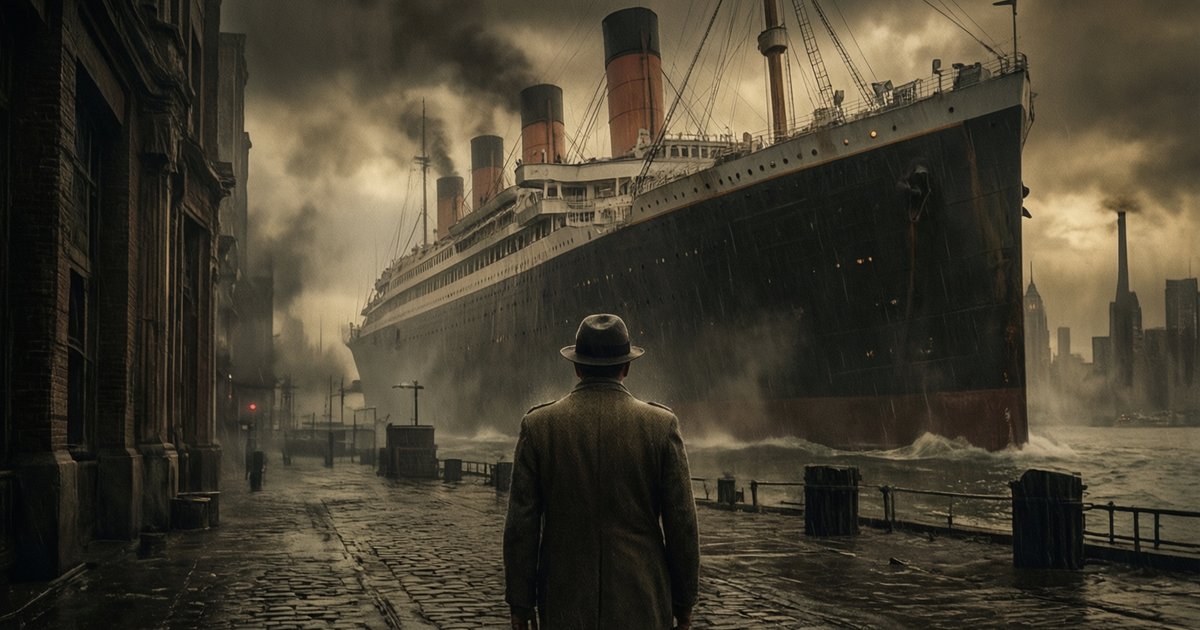
What If the Titanic Had Docked Safely in New York in 1912?
Speculative fiction · Alternate history. Characters, documents and events in this story are imagined; real people, places and institutions appear only as historical backdrop.
Full story · 9 chapters · Read in 5 parts instead
Listen to this story (5 parts)
Part 1 · 4 min
Part 2 · 4 min
Part 3 · 4 min
Part 4 · 4 min
Part 5 · 2 min
Chapter 1
The rain in New York City didn't wash things clean; it only smeared the industrial soot across the Art Deco facades. Arthur Penhaligon sat in his cramped office, the smell of stale coffee and old parchment clinging to his tweed jacket. At forty-two, he looked ten years older, his eyes underlined by the deep purple bruises of chronic insomnia. He stared at his father's gold pocket watch on the desk. Every night, without fail, the second hand shuddered and stopped exactly at 11:40 PM. For years, he'd treated it as a mechanical quirk, a ghost in the gears, but as he traced the patterns of his father's ruined reputation, the coincidence felt like a taunt.
His solitude was interrupted by a man in a charcoal suit who didn't bother to knock. The visitor represented a subsidiary of the White Star Line, hiring Arthur to investigate the suspicious sinking of the Olympic II, a behemoth that made the original Titanic look like a tugboat. The Olympic II had vanished in the North Atlantic three days prior, leaving behind a trail of contradictory manifests. As Arthur pored over the recovered telegraph fragments, one phrase leaped from the page, handwritten in a frantic scrawl: 'The 11:40 Ghost'.
It was a reference to the night of April 14, 1912. In this world, the lookouts had spotted the iceberg thirty seconds earlier. The Titanic had steered clear, arriving at Pier 59 to a roar of triumph that had fundamentally altered the psyche of the West. The 'Miracle of the Atlantic' had birthed an era of Gigantism, where ships grew larger and safety protocols grew smaller, fueled by the delusion that the ocean had been conquered. Arthur felt a familiar, compulsive itch in his mind. He didn't see a tragic accident; he saw a pattern. If the Olympic II had sunk, it wasn't a failure of engineering, but a calculated repetition of something that had happened twelve years ago. Why was a ghost from 1912 haunting a ship in 1924?
Chapter 2
The Lower East Side diner smelled of fried onions and desperation. Arthur slid into a vinyl booth opposite Clara Thorne, a woman whose eyes held the haunted stillness of someone who had seen the void and been told to forget it. She had been a telegraph operator on the Titanic's maiden voyage, one of the few survivors of a different kind of wreckage—the kind that happened in the boardroom.
'The bridge was a madhouse,' Clara whispered, her voice raspy from years of silence. 'When we missed that berg, the relief was momentary. Then the orders came down. Not from the Captain, but from the owners. We were told to scrub the logs. There was a period of two hours where the ship slowed to a crawl for reasons that had nothing to do with ice.' She leaned in, the fluorescent light flickering above them. 'The Titanic didn't just survive, Mr. Penhaligon. It was used as a Trojan Horse. Something entered New York harbor on that ship—something that didn't belong in any official manifest, and something that paid very well to remain invisible.'
Arthur felt the air grow heavy. He thought of his father, a maritime insurance agent who had been branded a fraud and cast out of society in 1913. His father had spent his final years obsessed with the Titanic's arrival, claiming the 'miracle' was a mask for a crime. Clara reached into her handbag and pulled out a heavy, rusted iron key. It was an antique, devoid of the sleek carvings of the Art Deco era. 'I was paid to keep this for a decade,' she said, sliding it across the grease-stained table. 'It doesn't fit any lock in the modern city. It fits a door that the White Star Line spent a million dollars trying to erase from the blueprints.' Arthur took the key, its cold metal biting into his palm, wondering what could be so dangerous that it required a key to a ghost door.
Chapter 3
The White Star headquarters was a temple to hubris. Gilded elevators ascended through halls of white marble and mahogany, where portraits of 'invincible' captains looked down with stern approval. Julian Vane, the executive in charge of naval expansion, sat behind a desk carved from a single piece of obsidian. He was a man of sharp angles and a sharper smile, embodying the arrogance of the Gigantism era.
'Mr. Penhaligon,' Vane said, his voice like velvet over gravel. 'You have a reputation for finding patterns. But be careful. Some patterns are merely coincidences, and some legacies are better left undisturbed for the sake of the public's faith in our fleet.' Vane stood up, walking toward the floor-to-ceiling window that overlooked the harbor. Outside, three monstrous liners sat docked, their hulls casting shadows that seemed to swallow the city streets. The scale was obscene, a testament to a world that believed it had outgrown the laws of nature.
As Vane reached for a crystal decanter of brandy, Arthur's breath hitched. On Vane's right ring finger was a heavy signet ring—a blackened silver band with a crest of a coiled serpent and an anchor. Arthur had seen that exact ring in his father's secret journals, sketched in a frantic hand with the caption: 'The mark of the Gilded Registry.' The ring wasn't a piece of jewelry; it was a badge of membership. Vane wasn't just running a shipping company; he was presiding over a secret society of architects and politicians who viewed the sea as a private ledger. 'Is there something on my hand, Arthur?' Vane asked, his smile not reaching his eyes. Arthur forced a nod, his mind racing. The key in his pocket suddenly felt like a detonator, and he realized that Vane didn't just want the Olympic II investigation closed—he wanted Arthur silenced.
Chapter 4
Pier 59 was a skeletal remain of the old harbor, a place where the salt air ate through iron and hope. Arthur spent hours wandering the fog-drenched docks, the rusted key weighing down his coat. He found it tucked behind a facade of rotting crates: a heavy steel door, half-hidden by a curtain of ivy. The key turned with a guttural screech, opening into a warehouse that smelled of ozone and damp ink.
Inside, the space was filled with drafting tables and massive rolls of vellum. Arthur flicked on a flashlight, the beam cutting through the dust. These weren't just ship designs; they were blueprints for disaster. He found a series of schematics for the 'Olympic class' vessels, but these versions had critical flaws intentionally built into the hull—weak points in the bulkheads that could be triggered by specific stresses. The documents detailed a systemic insurance fraud on a global scale. The Titanic's survival had provided the perfect cover; because the 'unsinkable' ship had docked, the world stopped questioning the safety of the fleet. This allowed the cabal to build 'expendable' ships, sailing them into calculated accidents to claim astronomical payouts while the elite profited from the chaos.
'A bit too curious for your own good, aren't you?' a voice boomed from the entrance. Arthur spun around to see three men in heavy wool coats, their faces obscured by shadows. They didn't carry badges, only lead pipes and brass knuckles. He scrambled backward, knocking over a stack of blueprints. As the first man lunged, Arthur swung a heavy drafting lamp, the glass shattering across the attacker's face. He dove through a side window, the shards tearing his palms, and sprinted into the labyrinth of the docks. He could hear their heavy boots echoing behind him, the sound of predators who knew exactly where their prey was cornered. He had the evidence, but in a city owned by the White Star Line, evidence was just another word for a death warrant.
Chapter 5
Detective Silas Reed looked at Arthur with a mixture of pity and disgust as he patched a cut on Arthur's forehead in a dim precinct office. Reed was a man of the NYPD who had seen too many bribes change hands at the piers. He viewed Arthur as a neurotic nuisance, but he had a lingering hatred for the corporate lords of the harbor who treated the police like their personal security detail.
'You're playing a dangerous game, Penhaligon,' Reed grunted, taping a bandage to Arthur's skin. 'The people you're chasing don't just own the ships; they own the judges and the commissioners. You can't fight a ghost with a few pieces of paper.' Arthur leaned forward, his voice urgent. 'It's not about ghosts, Reed. It's about the Gilded Registry. My father spent his life trying to find it. It's a ledger of every politician, every admiral, and every banker who was paid to ignore the safety flaws of the fleet since 1912.'
Reed froze. His cynical expression softened into something resembling shock. 'Your father? Elias Penhaligon?' Reed sighed, leaning back in his creaking chair. 'I knew your old man. He didn't just disappear into a bottle of gin, kid. He was close. He had a lead on a private club—The Aegis—where the Registry is kept. He tried to bring it to the DA in 1913, but the DA was on the list. Your father wasn't a fraud; he was a man who tried to scream in a room where everyone was paid to be deaf.' The realization hit Arthur like a physical blow. His father's disgrace hadn't been a failure of character, but a victory of the cabal. The insomnia, the patterns, the obsession—it wasn't madness. It was an inheritance. Together, the disgraced investigator and the cynical cop began to map the movements of the city's elite, tracking the Registry to a fortress of Art Deco opulence where the city's true rulers gathered to toast their invincibility.
Chapter 6
The Aegis club was a sanctuary of velvet and gold, hidden behind a nondescript brownstone. Arthur and Reed infiltrated the gala under the cover of a catering crew, the air thick with the scent of expensive cigars and Chanel No. 5. Arthur's heart hammered against his ribs as he slipped into the private library, his fingers trembling as he cracked the safe hidden behind a painting of the North Atlantic.
He found it: a leather-bound volume with gold-leaf edges. The Gilded Registry. As he flipped through the pages, Arthur expected to find only the names of the corrupt. But then he stopped. There, in the entries for late 1912, was his father's name. Elias Penhaligon had received a payment of ten thousand dollars—a fortune at the time—to remain silent about the Titanic's secret cargo for exactly one year. The entry noted that the payment was accepted before Elias attempted to turn whistleblower.
Arthur felt the world tilt. His entire identity was built on the image of his father as a martyr, a pure soul crushed by a corrupt system. To find out that his father had played the game, had tasted the blood-money before trying to cleanse his conscience, felt like a second betrayal. He stared at the names, the ink blurring. He wasn't the son of a saint; he was the son of a man who had been compromised.
'A tragic discovery, isn't it?' Julian Vane's voice echoed through the library. He stepped out from the shadows, flanked by two guards. In his hand, he held a telephone. 'Your father had a moment of weakness, Arthur. Just like you're having now. By the way, Clara Thorne has a very lovely singing voice, though she sounds much more melodic when she's screaming.' Vane smiled, the serpent ring glinting in the lamplight. 'Bring the Registry to the Titanic's hold by midnight, or the girl becomes part of the ocean's history.'
Chapter 7
The Titanic, now a floating museum and luxury hotel docked at the harbor, loomed over Arthur like a prehistoric beast. He had been lured into the belly of the ship, stripped of his coat and his tools, and shoved into the cold, damp hold. The air here was different—heavy with the scent of brine and old iron. Julian Vane stood before him, looking impeccably dressed even in the grime of the lower decks.
'Look around you, Arthur,' Vane whispered, gesturing to the massive rivets of the hull. 'This ship is the foundation of our world. Its survival taught us that we can rewrite the rules. We can build bigger, risk more, and erase the mistakes.' Vane held out a hand, the Registry lying on a crate between them. 'Join us. Your father almost did. We can restore the Penhaligon name. We can give you the sleep you've craved for twenty years. All you have to do is sign the nondisclosure agreement and forget the Olympic II ever existed.'
Arthur looked at the Registry, then at Vane. He thought of the 'expendable' ships, the lives lost in calculated accidents, and the lie that had poisoned the city's architecture for a decade. He felt a surge of clarity. The patterns weren't there to be solved; they were there to be broken.
'You're right about one thing, Vane,' Arthur said, his voice steady for the first time in years. 'The Titanic is a foundation. But foundations can crumble.'
Vane's expression shifted from smugness to confusion. 'What are you talking about?'
'The blueprints in the warehouse,' Arthur replied. 'The flaws you built into the later ships? You kept the original design for the Titanic as the gold standard. But you forgot that the 'miracle' survival in 1912 required a series of emergency patches that were never permanently fixed. This ship is a shell.' Vane laughed, but then he noticed the remote detonator in Arthur's hand—not a bomb, but a trigger for the ship's antiquated emergency flare and alarm system, which Arthur had rigged during his walk in.
Chapter 8
The alarms erupted in a deafening, dissonant scream, shaking the very marrow of the ship. Arthur didn't run for the exit; instead, he smashed the glass of the emergency ventilation valves, triggering a sequence of pressure releases that sent plumes of steam screaming into the upper decks. The panic was instantaneous. Guests in the ballroom above began to scream as the 'invincible' relic began to shudder.
'You're insane!' Vane shrieked, lunging at him. 'You'll sink us all!'
'I'm just completing the story,' Arthur countered, dodging Vane's grasp and slamming him against a bulkhead. As the ship began to list, the structural flaws Arthur had identified in the blueprints began to manifest. The 'miracle' ship was failing, its patched hull unable to withstand the sudden pressure shifts. In the chaos, Arthur found Clara, bound and gagged in a nearby locker. He sliced her ropes with a piece of jagged metal, the two of them fighting through the tilting corridors as the luxury carpets became rivers of seawater.
Arthur reached the deck just as the Coast Guard and a swarm of press boats arrived, alerted by the flares. He didn't flee. He stood on the railing, holding the Gilded Registry high above his head, shouting the truth to the reporters below. He watched as the press cameras flashed, capturing the image of the 'Unsinkable' ship finally surrendering to the Atlantic. He chose the truth over his own safety, and as the deck tilted at a forty-five-degree angle, he felt a weight lift from his chest that had been there since childhood. The myth was dying, and for the first time, Arthur felt he could breathe.
Chapter 9
The Titanic sank for real this time, disappearing into the gray waters of the harbor in a slow, majestic collapse. It wasn't a tragedy; it was an exorcism. The Gilded Registry was published the following morning, sparking a series of trials that dismantled the White Star Line and sent Julian Vane to a federal prison for the rest of his life. The era of Gigantism ended overnight, replaced by a cautious, human-centric approach to engineering.
Arthur stood on the pier a month later, the morning sun warming his face. Beside him, Clara Thorne was preparing to leave for Europe, a look of peace on her face. They didn't speak much; the silence between them was finally a comfortable one. Arthur reached into his pocket and pulled out the rusted iron key from the warehouse. He looked at it for a long moment, thinking of the doors it had opened and the secrets it had guarded. With a flick of his wrist, he tossed the key into the Atlantic, watching it vanish into the wake of a modest, safely-built ferry.
He pulled out his father's gold pocket watch. He waited. The second hand approached the dreaded mark. 11:38... 11:39... 11:40. The hand didn't shudder. It didn't stop. It ticked forward with a crisp, rhythmic click, moving steadily toward 11:41. Arthur closed the watch and leaned against the railing, looking at the New York skyline. The monstrous shadows of the great liners were gone, and the city finally felt small enough to live in. He closed his eyes, and for the first time in twelve years, he fell fast asleep.
The End