 Porchlight Tales
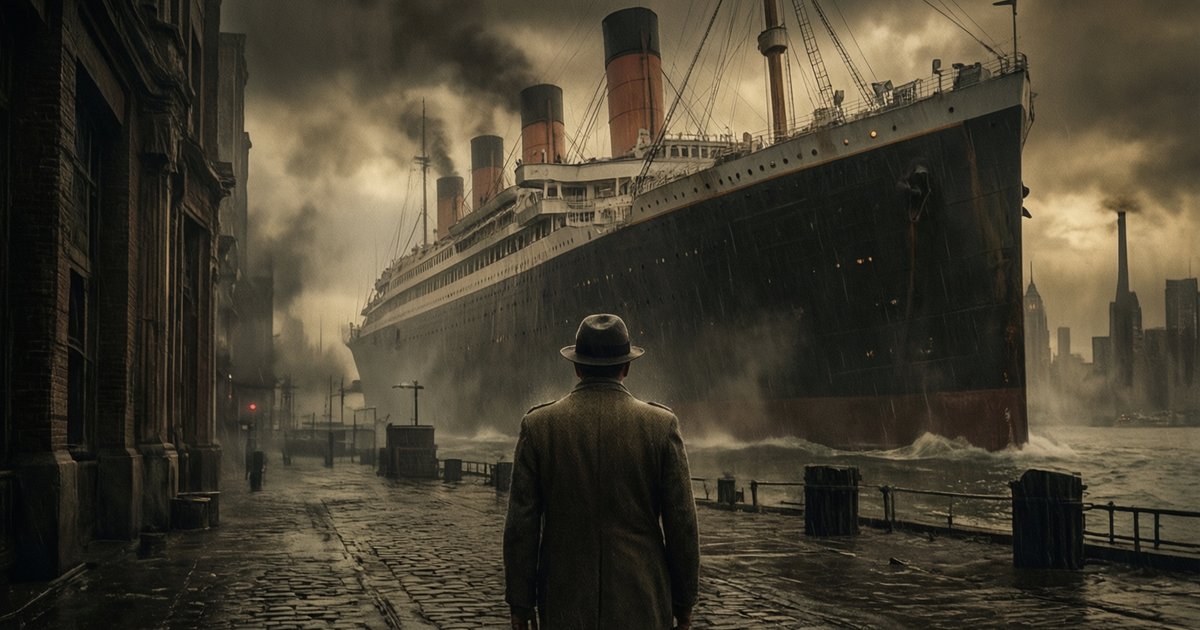
What If the Titanic Had Docked Safely in New York in 1912?
Speculative fiction · Alternate history. Characters, documents and events in this story are imagined; real people, places and institutions appear only as historical backdrop.
Part 1 of 5 · Chapters 1–2 of 9
Listen to Part 1 · 4 min
Chapter 1
The rain in New York City didn't wash things clean; it only smeared the industrial soot across the Art Deco facades. Arthur Penhaligon sat in his cramped office, the smell of stale coffee and old parchment clinging to his tweed jacket. At forty-two, he looked ten years older, his eyes underlined by the deep purple bruises of chronic insomnia. He stared at his father's gold pocket watch on the desk. Every night, without fail, the second hand shuddered and stopped exactly at 11:40 PM. For years, he'd treated it as a mechanical quirk, a ghost in the gears, but as he traced the patterns of his father's ruined reputation, the coincidence felt like a taunt.
His solitude was interrupted by a man in a charcoal suit who didn't bother to knock. The visitor represented a subsidiary of the White Star Line, hiring Arthur to investigate the suspicious sinking of the Olympic II, a behemoth that made the original Titanic look like a tugboat. The Olympic II had vanished in the North Atlantic three days prior, leaving behind a trail of contradictory manifests. As Arthur pored over the recovered telegraph fragments, one phrase leaped from the page, handwritten in a frantic scrawl: 'The 11:40 Ghost'.
It was a reference to the night of April 14, 1912. In this world, the lookouts had spotted the iceberg thirty seconds earlier. The Titanic had steered clear, arriving at Pier 59 to a roar of triumph that had fundamentally altered the psyche of the West. The 'Miracle of the Atlantic' had birthed an era of Gigantism, where ships grew larger and safety protocols grew smaller, fueled by the delusion that the ocean had been conquered. Arthur felt a familiar, compulsive itch in his mind. He didn't see a tragic accident; he saw a pattern. If the Olympic II had sunk, it wasn't a failure of engineering, but a calculated repetition of something that had happened twelve years ago. Why was a ghost from 1912 haunting a ship in 1924?
Chapter 2
The Lower East Side diner smelled of fried onions and desperation. Arthur slid into a vinyl booth opposite Clara Thorne, a woman whose eyes held the haunted stillness of someone who had seen the void and been told to forget it. She had been a telegraph operator on the Titanic's maiden voyage, one of the few survivors of a different kind of wreckage—the kind that happened in the boardroom.
'The bridge was a madhouse,' Clara whispered, her voice raspy from years of silence. 'When we missed that berg, the relief was momentary. Then the orders came down. Not from the Captain, but from the owners. We were told to scrub the logs. There was a period of two hours where the ship slowed to a crawl for reasons that had nothing to do with ice.' She leaned in, the fluorescent light flickering above them. 'The Titanic didn't just survive, Mr. Penhaligon. It was used as a Trojan Horse. Something entered New York harbor on that ship—something that didn't belong in any official manifest, and something that paid very well to remain invisible.'
Arthur felt the air grow heavy. He thought of his father, a maritime insurance agent who had been branded a fraud and cast out of society in 1913. His father had spent his final years obsessed with the Titanic's arrival, claiming the 'miracle' was a mask for a crime. Clara reached into her handbag and pulled out a heavy, rusted iron key. It was an antique, devoid of the sleek carvings of the Art Deco era. 'I was paid to keep this for a decade,' she said, sliding it across the grease-stained table. 'It doesn't fit any lock in the modern city. It fits a door that the White Star Line spent a million dollars trying to erase from the blueprints.' Arthur took the key, its cold metal biting into his palm, wondering what could be so dangerous that it required a key to a ghost door.
Coming up in Part 2“The White Star headquarters was a temple to hubris. Gilded elevators ascended through halls of white marble and mahogany, where…”