 Porchlight Tales
What If the Transcontinental Railroad Had Been Completed in 1859?
Speculative fiction · Alternate history. Characters, documents and events in this story are imagined; real people, places and institutions appear only as historical backdrop.
Full story · 6 chapters · Read in 3 parts instead
Listen to this story (3 parts)
Part 1 · 3 min
Part 2 · 3 min
Part 3 · 2 min
Chapter 1
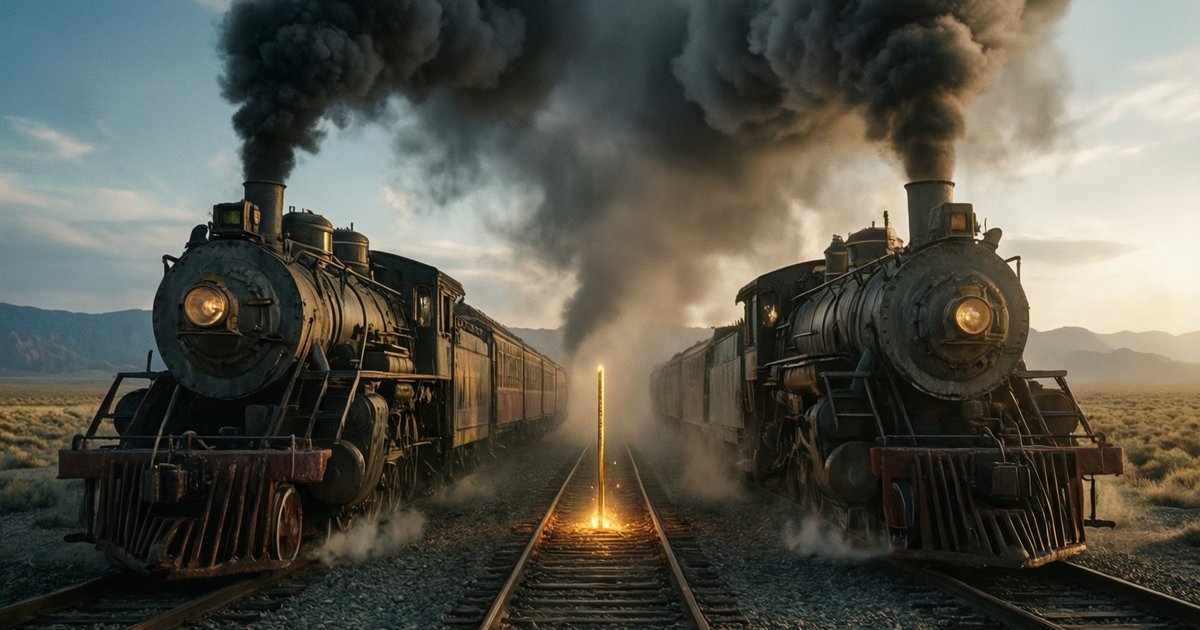
Imagine the sound of a single hammer blow echoing across the salt flats of Utah in May 1859. In our timeline, the Golden Spike wasn't driven until 1869, but here, a frantic surge of federal subsidies and an unprecedented labor boom pushed the rails together ten years early. I can still see the archival sketches: locomotives from the Union Pacific and Central Pacific facing each other, belching thick, black coal smoke into a pale blue western sky. The air smelled of hot iron and alkaline dust. For a brief moment, the nation exhaled in triumph, believing that a physical bond of steel could weld together a country that was socially and politically tearing itself apart at the seams.
But as the champagne flowed, a silent tension remained. The rails didn't just transport passengers; they transported ideologies. The question was no longer if the West could be reached, but who would own the dirt the tracks rested upon.
Chapter 2
The immediate domino effect was an economic explosion that outpaced the law. With the journey from New York to San Francisco slashed from six months to six days, the 'Rush to the West' became a torrent. Towns didn't grow; they erupted. I've read the diaries of settlers who arrived in 1860 to find cities of 50,000 people appearing where there had been only sagebrush a year prior. This rapid urbanization created a vacuum of governance. The federal government in Washington D.C. was too paralyzed by the slavery debate to establish formal territories.
Consequently, the railroad companies became the de facto sovereign powers. The 'Railroad Baronies' emerged, exercising judicial and executive control over thousands of miles of track. They built their own police forces and minted their own scrip, creating a corporate feudalism that mirrored the very plantations the North despised. As the wealth of California gold flooded east via rail, the economic center of gravity shifted, but the moral divide only deepened. Who would control these new, wealthy territories?
Chapter 3
By 1861, the tipping point arrived. In our history, the Civil War was largely a conflict over the future of the South and the fringes of the West. But in this reality, the Transcontinental Railroad acted as a high-speed conveyor belt for political instability. Southern legislators, seeing the immense profitability of the rail corridors, demanded the extension of slavery into the newly accessible western plains. The 'Steel Compromise' failed spectacularly. The North, terrified of a Southern empire stretching from Virginia to the Pacific, moved to seize the rail hubs as strategic military assets.
The railroad, designed to unify the nation, instead became the primary target of the war. The conflict didn't just happen in the forests of Virginia; it surged across the prairies. The war became a struggle for the 'Iron Arteries.' If you controlled the rail, you controlled the food, the gold, and the movement of armies. The scale of the war expanded exponentially, turning a regional rebellion into a continental struggle for total logistical dominance.
Chapter 4
The war played out with a brutal, industrial efficiency previously unseen. Imagine armored trains—massive, iron-plated behemoths—clashing in the wide-open spaces of Nebraska and Kansas. The sound of artillery was joined by the screeching of twisted steel as sabotaged tracks sent entire regiments plunging into ravines. The logistics of the war shifted from marching columns to rapid deployments. Battles were won not by tactical brilliance on a field, but by the ability to keep the boilers running and the lines open.
Because the infrastructure existed, the Union could project power into the West with terrifying speed, but the Confederacy, utilizing their own rail spurs, attempted to carve out a 'Pacific Confederacy' by aligning with disgruntled settlers in the West. The conflict dragged on, fueled by the endless resources of the Pacific coast. The war didn't end in a sudden surrender; it evolved into a grinding war of attrition centered on the hubs of the great rail network. What happens to a society when its primary tool of progress becomes its primary weapon of destruction?
Chapter 5
By the time a fragile peace was brokered in the late 1860s, the map of North America was unrecognizable. The United States didn't emerge as a single, unified superpower, but as a loose confederation of regional economic zones. The 'Railroad States' had become so powerful that they functioned as autonomous city-states, their loyalty lying with the boardrooms of the rail companies rather than a distant capital. The federal government was a shadow of its former self, relegated to managing the diplomacy between these corporate entities.
Socially, the acceleration of the West led to the near-total erasure of indigenous cultures decades earlier than in our timeline. The 'Iron Tide' moved too fast for treaties or diplomacy; the sheer volume of settlers arriving daily made the genocide of the Plains Indians an industrial process. The silence of the prairies was replaced by the rhythmic thumping of steam pistons, a heartbeat of a new, cold, mechanical civilization that valued efficiency over humanity.
Chapter 6
Standing in the ruins of an old depot in this alternate 1880, one realizes the paradox of the Golden Spike. The dream of a connected continent was achieved, but the cost was the soul of the republic. The railroad didn't save the Union; it provided the machinery for its fragmentation. America became a land of silver rails and iron walls, where wealth was measured in miles of track and power was held by those who controlled the switches.
We often think of technology as a neutral tool, but as this reality proves, the timing of an innovation can change the destiny of a species. A decade of difference shifted the world from a democratic experiment to a corporate oligarchy. The rails didn't just connect two oceans; they bridged the gap between an age of idealism and an age of industrial coldness, leaving us to wonder: is progress always a straight line, or is it a track that can lead us toward our own undoing?
The End