 Porchlight Tales
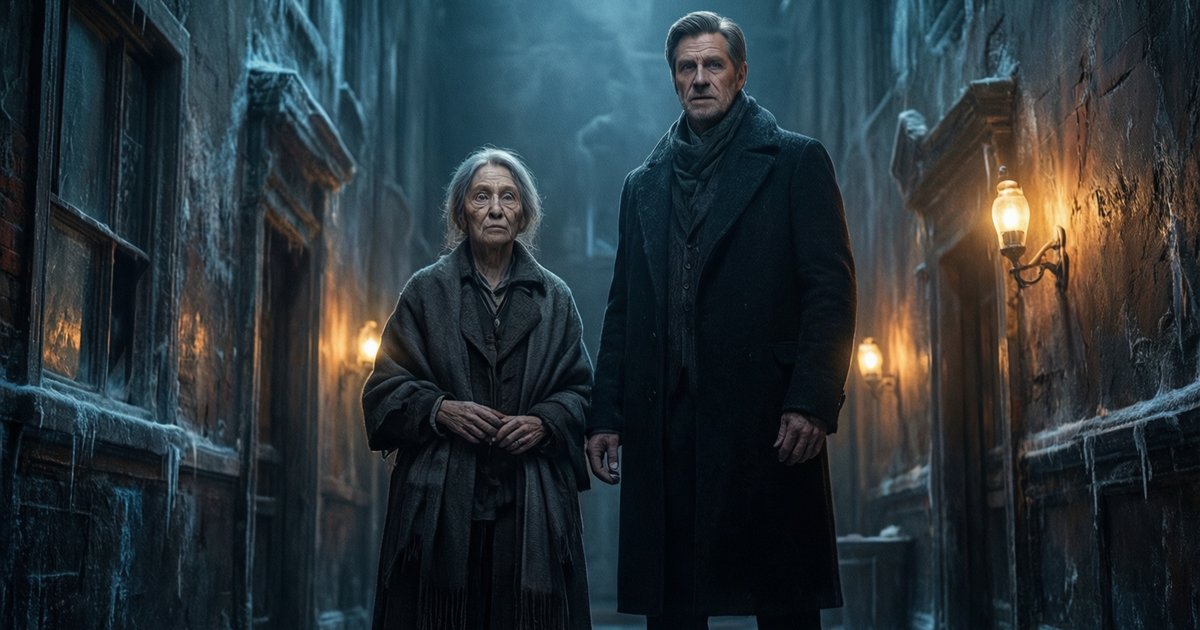
My Landlord Tried to Evict Me in a Freeze. He Didn't Know I Bought the Block.
Fiction. This is an original, made-up story: names, characters and events are invented, and any resemblance to real people or events is coincidental.
Full story · 10 chapters · Read in 5 parts instead
Listen to this story (5 parts)
Part 1 · 5 min
Part 2 · 5 min
Part 3 · 4 min
Part 4 · 5 min
Part 5 · 4 min
Chapter 1
"GET OUT OF MY SIGHT AND OUT OF THIS BUILDING!"
Mr. Sterling’s face was a shade of purple I hadn't seen since a bad beet salad in 1984. He was towering over me, his breath smelling of expensive espresso and arrogance.
I didn't flinch. I didn't scream back. I simply stood there in my living room, the air so cold I could see my own breath frosting in the air, clutching a manila folder to my chest.
He thought he had won. He thought I was just another fragile old woman who had run out of options. He was wrong.
But to understand why, you need to know how it all began. Three weeks earlier, the temperature in Boston plummeted to a brutal 8°F, and my radiator went silent.
It started as a faint clicking sound, like a dying clock. Then, the pipes grew cold to the touch. By Tuesday, the interior of my apartment felt less like a home and more like a walk-in freezer.
I reached for the phone, my fingers stiff. I called the management office. No answer. I called again. Voicemail.
I looked around my small, historic brownstone unit. I loved the crown molding and the wide windows, but they were useless against a New England January. I wrapped my father's old vintage wool shawl tighter around my shoulders. It was heavy, charcoal gray, and smelled faintly of cedar and old libraries.
My father had been a carpenter who built half the houses in this neighborhood. He always told me, "Bonnie, the only way to truly be safe is to own the ground you stand on."
I had spent forty years as a corporate archivist, the woman who organized the files and kept the secrets. I was the invisible gear in the machine, the person people forgot to invite to lunch but relied on to find every missing contract from 1972. I had learned the art of being unseen.
I didn't mind the invisibility. It allowed me to observe. And as I watched the frost creep across my windowpane, I realized Mr. Sterling wasn't just negligent. He was predatory.
Chapter 2
I caught Mr. Sterling in the hallway on Thursday. He was wearing a cashmere overcoat that probably cost more than my first car. He was walking briskly toward the elevator, his phone pressed to his ear.
"Mr. Sterling!" I called out, my voice raspy from the cold.
He stopped, looking at me as if I were a smudge of dirt on his polished Italian loafers. He didn't lower the phone, just signaled for me to speak with a flick of his wrist.
"The heat is completely out in 4B," I said, trying to keep my tone steady. "It's twenty degrees in my bedroom. I've left three messages."
Sterling sighed, a long, dramatic sound of boredom. He finally lowered the phone, but his eyes remained cold.
"Mrs. Pennington, let's be realistic. These buildings are old. They have quirks," he replied.
"A quirk is a squeaky floorboard, Mr. Sterling. Frozen pipes are a liability," I countered.
He let out a short, mocking laugh. "You're complaining about a little breeze? Most people would be grateful to live in a historic district. Maybe you're just getting too old for the climate. Buy a space heater. Stop bothering me with trivialities."
He stepped into the elevator and the doors slid shut, cutting off the sight of his smirk.
I stood in the hallway, the silence echoing around me. I wasn't just cold; I was vibrating with a quiet, controlled anger. For years, I had let people talk over me in boardrooms. I had let managers take credit for my filing systems.
I walked back into my apartment and opened a sturdy archivist's box under my desk. Inside were not just memories, but records. I pulled out a stack of certified mail receipts.
Every single request for repair had been sent via certified mail. Every single one had been signed for by his office and ignored.
I carefully filed the latest receipt. I knew how to build a paper trail. In my world, a paper trail was a map to a person's downfall.
Chapter 3
A soft knock sounded at my door on Friday evening. I opened it to find Marcus, the twenty-four-year-old artist from 4C. He was wearing two hoodies and a beanie pulled low over his ears, his nose bright red.
"Hey, Ms. Bonnie," he shivered. "Is your heat out too? I thought maybe it was just my unit."
"It's out here too, Marcus. How are you holding up?"
"I'm painting with a space heater that keeps tripping the circuit breaker," he said, his voice trembling. "I can't afford a new one, and I've got a gallery showing in two weeks. I can't let my canvases freeze."
I felt a pang of protectiveness. Marcus was talented and kind, the kind of young man who helped me carry my groceries without being asked.
"Come in," I told him. "I have some tea."
As we sat in the dim light, Marcus mentioned something interesting. He had seen contractors coming and going from the penthouse—Sterling's personal unit.
"I saw them bringing in Italian marble slabs yesterday," Marcus whispered. "And those fancy gold-leaf fixtures. He's completely gutting the top floor while the rest of us are wearing coats inside."
I nodded slowly. It was a classic move. Sterling was diverting the building's maintenance fund into his own equity, upgrading his unit to flip the entire property for a massive profit. He wasn't just ignoring the heat; he was intentionally letting the building degrade to justify a 'redevelopment' project that would push out the long-term tenants.
I looked at my father's shawl. I thought about the ground I stood on.
"Marcus," I said softly, "have you noticed any changes in the building's ownership records? Any new names on the tax liens?"
Marcus looked confused. "I don't know about tax liens. Why?"
I smiled, though it didn't reach my eyes. "Just curious. Go home and stay warm, Marcus. I think things are about to change."
Chapter 4
Monday morning brought a white envelope slid under my door. It wasn't a repair notice. It was an 'Intent to Vacate.'
Sterling claimed that a technicality in my original lease from twelve years ago—a clause regarding 'unauthorized modifications'—gave him the right to terminate my tenancy. He didn't specify what the modification was; he didn't have to. He just wanted me out.
I called his office. This time, his assistant, Linda, answered. She sounded exhausted, her voice strained.
"Ms. Pennington, I'm so sorry," Linda whispered. "Mr. Sterling is very insistent on this. He's... he's pushing for all the legacy leases to be cleared by February."
"Is he in a hurry, Linda?" I asked calmly.
There was a long pause. I could hear the sound of papers shuffling in the background.
"He's under a lot of pressure," she admitted. "The management firm is... struggling. He's leveraged everything to the hilt to fund the penthouse and the new acquisitions. He needs the cash flow from new, higher-paying tenants immediately."
I thanked her and hung up. The puzzle pieces were clicking into place. Sterling wasn't just a jerk; he was drowning. He had overextended himself, betting everything on a market spike that hadn't happened yet.
I spent the afternoon in my study, the air so cold I had to wear gloves to type. I opened my laptop and logged into my private investment portal.
For the last five years, I hadn't just been saving; I had been hunting. I had used my archival skills to track distressed real estate portfolios in the city. I had created a holding company—Blue Spruce LLC.
I had been quietly buying up the debt of Sterling's management firm through third-party creditors. I owned his mortgages. I owned his lines of credit. I owned the very air he breathed in that penthouse.
I just hadn't told him yet. I wanted to see exactly how far he was willing to go.
Chapter 5
The invisibility I had cultivated for forty years was now my greatest weapon.
Sterling viewed me as a relic, a quiet old woman who would likely just pack her bags and cry when faced with a legal notice. He didn't realize that the woman he was trying to evict was the silent partner who had spent the last month absorbing his entire real estate empire.
Blue Spruce LLC wasn't just a name on a piece of paper; it was a vacuum. I had acquired the debt of his management company, and because he had defaulted on several high-interest bridge loans, the ownership of the properties had begun to shift.
I had the legal authority to trigger a foreclosure on his management company at any second. I held the keys to his kingdom, and all I had to do was turn the lock.
But I didn't do it immediately. I wanted to ensure that when I hit him, it wasn't just about me. I wanted a record of his negligence that would make it impossible for him to ever manage another property in this state.
I spent my nights documenting everything. I recorded the temperature in my apartment every four hours. I kept a log of every ignored call. I gathered testimonies from Marcus and the other tenants.
I felt a strange sense of peace. It was the same feeling I got when I finally found a missing document from a century ago—the click of a perfect fit.
I looked at the 'Intent to Vacate' notice on my table. I didn't feel fear. I felt a cold, hard certainty.
I knew Sterling's move. He would try to intimidate me. He would try to break my spirit so I wouldn't fight the eviction. He thought he was playing a game of chess against a pigeon.
He didn't realize the pigeon had already bought the chessboard, the table it sat on, and the building they were sitting in.
Chapter 6
The 'Darkest Hour' arrived on a Tuesday night. A fresh layer of snow had fallen, blanketing Boston in a suffocating white silence.
Suddenly, the few lights I had left flickered and died. The hum of my small space heater vanished. I sat in total darkness, the silence pressing in on me.
I walked to the window and looked down. A utility truck was pulling away from the curb.
I called the electric company. They told me the service had been disconnected due to a 'requested penalty' and an alleged unpaid late fee from three months ago—a fee I had paid twice, with receipts to prove it.
Sterling had done it. He had cut my power to freeze me out, literally and figuratively. He wanted me to break. He wanted me to beg for my lease back so he could force me into a predatory new contract or simply scare me into leaving without a fight.
I sat in my armchair, wrapped in my father's shawl. The temperature in the room dropped rapidly. I could feel the chill seeping into my bones, making my joints ache.
I didn't cry. I didn't panic. I simply reached for my flashlight and my archivist's box.
I spent the night in the dark, writing letters by the dim beam of a LED light. I wrote to Marcus. I wrote to Mrs. Gable in 2A. I wrote to the young couple in 3B.
I told them that I was organizing a meeting in the lobby the next morning. I told them I had the documentation to stop the evictions and restore the heat, but I needed them to stand with me.
I spent the rest of the night staring at the ceiling, listening to the wind howl against the bricks. I had never been this cold in my life, but for the first time in decades, I felt a fire burning in my chest that no January freeze could touch.
Chapter 7
Wednesday morning was gray and oppressive. I stood in the lobby, my shawl draped over my shoulders like a cape. Marcus was there, looking exhausted. Mrs. Gable and the couple from 3B arrived shortly after, their faces etched with worry.
"Bonnie, what's going on?" Marcus asked, his voice shivering. "I got your note. You said you have a plan?"
I didn't tell them I owned the building. Not yet. If I did, they might see me as just another landlord, another authority figure to fear. I wanted them to feel the power of their own rights first.
I opened my archivist's box and began handing out photocopies. I gave them the records of the failed repair requests, the copies of the certified mail receipts Sterling had ignored, and a draft of a collective grievance filed with the city's housing board.
"He's counting on us being fragmented," I told them, my voice low and steady. "He thinks we're just 'revenue streams.' But the law says we have a right to habitable housing. He has breached every single term of our leases."
"He'll just evict us all!" Mrs. Gable cried, clutching her cardigan.
"He can't," I said. "Not if we file this as a class action for negligence and habitability. It freezes all eviction proceedings until a judge reviews the conditions of the building."
They looked at the papers, then at me. For the first time, they didn't see a quiet retiree. They saw a strategist.
"Will it actually work?" Marcus asked.
"It will work because I've ensured the paper trail is bulletproof," I replied.
As we were signing the documents, the heavy glass door of the lobby swung open. Sterling marched in, his face set in a mask of contempt. He didn't see the papers in their hands; he only saw me.
He looked at his watch and sneered. "Time's up, Bonnie. I'm here to make sure you're gone."
Chapter 8
Sterling strode across the lobby, his footsteps echoing on the marble. He didn't even glance at the other tenants, treating them like furniture.
"I gave you the notice," he barked, stopping inches from my face. "You're overstaying your welcome. I've already contacted the sheriff's office for a forced removal if you don't vacate by noon."
I stayed perfectly still. I didn't move back an inch.
"The conditions of this building are illegal, Mr. Sterling," I said calmly. "The lack of heat, the cutting of utilities—these are serious violations."
Sterling let out a loud, barking laugh. "Illegal? I own the building, you senile old woman! I decide what's legal here!"
He leaned in, his voice dropping to a menacing hiss. "You have nothing. No money, no lawyer, and no place to go. Now, GET OUT OF MY SIGHT AND OUT OF THIS BUILDING!"
The lobby went silent. Marcus stepped forward, but I put a hand on his arm, signaling him to wait.
I slowly reached into my folder. I didn't pull out a grievance form or a complaint. I pulled out a thick, gold-embossed set of documents.
"You're right about one thing, Mr. Sterling," I said, my voice echoing in the quiet room. "Ownership is everything."
I handed him the first page. It was the deed of transfer for the property.
Sterling glanced at it, his brow furrowed. "What is this? Some kind of joke?"
"Read the name of the holding company," I commanded. "Blue Spruce LLC."
He scanned the page. His eyes widened. He flipped to the second page—the acquisition papers for his own management firm.
"This... this is impossible," he stammered. "I have a loan from the city bank..."
"You had a loan," I corrected him. "But the bank sold your debt to Blue Spruce LLC three weeks ago. I bought your defaults, Sterling. I bought your mortgages. And as of midnight last night, I officially exercised the right to foreclose on your management company for gross negligence and financial instability."
Chapter 9
The silence that followed was the most satisfying sound I had ever heard.
Sterling’s face went from purple to a ghostly, sickly gray. He looked at the papers, then at me, then at the tenants who were now staring at him with a mixture of shock and triumph.
"You... you're the owner?" he whispered.
"I am," I said. "Which means you no longer have a job. And more importantly, you no longer have a penthouse."
Sterling tried to bluster, to find some legal loophole, but I held up my hand.
"I'm not going to evict you immediately," I told him. "That would be too simple. Instead, you are going to sign a full confession of negligence. You will sign a settlement agreement that pays every tenant in this building for the damages and the cold they suffered this month. And you will vacate your unit by the end of the week."
"I'll sue!" he yelled, though his voice lacked conviction.
"With what money?" I asked. "I own your accounts. If you fight this, I'll hand over every single one of these certified mail receipts and your 'Intent to Vacate' fraud to the District Attorney. You won't just be broke; you'll be in a cell."
Sterling collapsed into one of the lobby chairs, his arrogance evaporating like steam. He signed the papers with a shaking hand.
As he walked out the door for the last time, not looking back, I felt a weight lift off my shoulders that I had been carrying for forty years. I wasn't invisible anymore.
I turned to the tenants. "The heat will be back on in two hours. I've already called the emergency contractors."
Chapter 10
Two weeks later, the brownstone felt like a different place. The radiators were humming a steady, warm song, and the air smelled of fresh paint and old wood.
I walked through the lobby, where Marcus was finishing a vibrant mural of the city's skyline, adding splashes of gold and deep blue. The other tenants were chatting, the tension of the winter finally breaking.
I retreated to my apartment and brewed a pot of Earl Gray tea. I sat in my favorite chair, feeling the wonderful, radiating heat against my ankles.
I reached under my desk and pulled out the old archivist's box. I removed the certified mail receipts and the grievance forms. In their place, I carefully filed the deed to the building.
I looked at my father's wool shawl, draped over the back of the chair. He had taught me that owning the ground you stand on was the only way to be safe.
I had spent my life organizing the histories of other people, filing away their successes and failures. Now, for the first time, I was writing my own.
I took a sip of my tea and looked out the window. The snow was still falling, but for the first time in a long time, I was perfectly warm.
The End