 Porchlight Tales
What If the US Had Successfully Colonized Venus in 2060?
Speculative fiction · Alternate history. Characters, documents and events in this story are imagined; real people, places and institutions appear only as historical backdrop.
Part 1 of 5 · Chapters 1–2 of 9
Listen to Part 1 · 5 min
Chapter 1
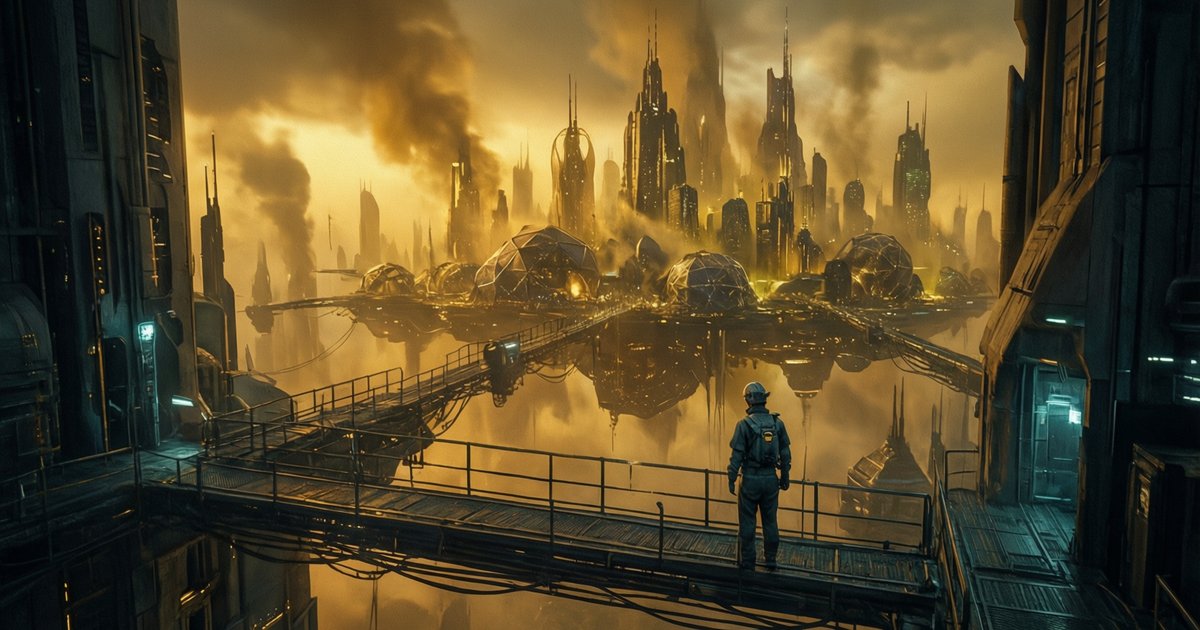
The amber haze of Venus didn't just block the sun; it stained everything. Kiran Voss stood on the gantries of Sector 4, the acrid sting of sulfur clinging to his jumpsuit like a second skin. Below his boots, the geodesic floor of Aurelia Station hummed with the constant, bone-deep vibration of the massive lift-fans. It was a claustrophobic beauty, a sprawling web of carbon-fiber spheres drifting in a sea of gold and acid. Kiran checked his gauge, his eyes narrowing. The pressure readings were fluctuating in a rhythmic pattern that defied every textbook he'd ever read.
He knelt, pressing his palm against the cold alloy of the buoyancy shield. There it was—a micro-leak, a hairline fracture spitting a thin stream of precious lifting gas into the atmosphere. According to the official NASA-Corporate logs, this section had been reinforced last quarter. The logs were lying. Kiran felt a familiar itch of obsession; he didn't just want to fix the leak, he wanted to know why the record had been scrubbed. He reached into his pocket, fingering the vintage mechanical chronometer his father had left him. The watch ticked irregularly, a stuttering heartbeat that mirrored Kiran's own anxiety.
He plugged his tablet into the local node, bypassing the primary firewall with a sequence his father had taught him years ago. The screen flickered, revealing a terrifying truth. Sector 4 wasn't just leaking; it was losing altitude. The sensor reading scrolled across the screen in a stark, clinical red: the city was sinking at a rate of 10 feet per hour. In a world where altitude was the only thing separating survival from a pressurized oven, ten feet was a death sentence. Kiran looked up at the luxury spires of the Apex sector, gleaming and distant in the clouds, and wondered if they could feel the tilt.
Chapter 2
Kiran didn't wait for the shift change. He marched straight to the Command Hub, the air growing thinner and colder as he ascended toward the administrative levels. Director Hera Sterling sat behind a desk of synthetic mahogany, her expression as polished and impenetrable as the reinforced glass overlooking the sulfuric clouds. She didn't look up from her holographic display when Kiran slammed the telemetry data onto her desk.
"Sector 4 is dropping, Director. We have a structural compromise and the logs were falsified," Kiran stated, his voice tight. He hated how he sounded—desperate, like the 'unstable' engineer the agency had branded him after his father's death.
Sterling finally looked at him, her eyes cold. "Calibration errors, Kiran. The atmospheric density in the lower strata is shifting. Your sensors are simply reacting to the turbulence. Go back to your station and recalibrate your equipment."
"It's not a calibration error! We're losing altitude!"
"That is enough," she snapped, the authority in her voice cutting through the hum of the station. "Your obsession with precision is becoming a liability. Leave. Now."
Kiran retreated, the metallic tang of ozone bitter in his mouth. He descended into the under-city, the dark, humid veins of the station where the workers lived in cramped pods. There, he met Jace Merrick, a cloud-diver with skin tanned a strange shade of orange from radiation exposure. Jace leaned against a rusted pipe, tossing a salvaged data-chip in the air.
"You're not the only one seeing ghosts, Voss," Jace whispered, sliding the chip across the metal table. "Sectors 7 and 9 are shivering too. The whole base is leaning." Kiran took the chip and retreated to his quarters, opening his father's old journal. On a page stained with coffee and grease, a single sentence was underlined three times: 'The burden of secrets is heavier than the atmosphere.'
Coming up in Part 2“The alarm sirens wailed, a discordant scream that ripped through the low-frequency hum of the station. An Acid Storm had…”