 Porchlight Tales
What If the US Had Successfully Colonized Venus in 2060?
Speculative fiction · Alternate history. Characters, documents and events in this story are imagined; real people, places and institutions appear only as historical backdrop.
Full story · 9 chapters · Read in 5 parts instead
Listen to this story (5 parts)
Part 1 · 5 min
Part 2 · 5 min
Part 3 · 5 min
Part 4 · 5 min
Part 5 · 2 min
Chapter 1
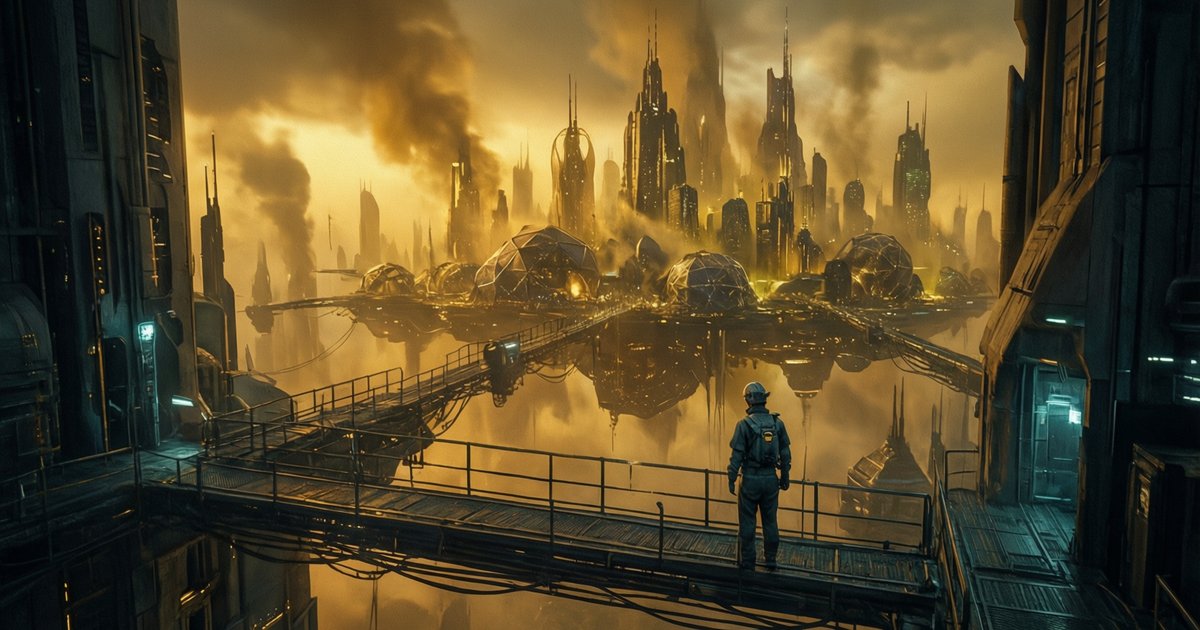
The amber haze of Venus didn't just block the sun; it stained everything. Kiran Voss stood on the gantries of Sector 4, the acrid sting of sulfur clinging to his jumpsuit like a second skin. Below his boots, the geodesic floor of Aurelia Station hummed with the constant, bone-deep vibration of the massive lift-fans. It was a claustrophobic beauty, a sprawling web of carbon-fiber spheres drifting in a sea of gold and acid. Kiran checked his gauge, his eyes narrowing. The pressure readings were fluctuating in a rhythmic pattern that defied every textbook he'd ever read.
He knelt, pressing his palm against the cold alloy of the buoyancy shield. There it was—a micro-leak, a hairline fracture spitting a thin stream of precious lifting gas into the atmosphere. According to the official NASA-Corporate logs, this section had been reinforced last quarter. The logs were lying. Kiran felt a familiar itch of obsession; he didn't just want to fix the leak, he wanted to know why the record had been scrubbed. He reached into his pocket, fingering the vintage mechanical chronometer his father had left him. The watch ticked irregularly, a stuttering heartbeat that mirrored Kiran's own anxiety.
He plugged his tablet into the local node, bypassing the primary firewall with a sequence his father had taught him years ago. The screen flickered, revealing a terrifying truth. Sector 4 wasn't just leaking; it was losing altitude. The sensor reading scrolled across the screen in a stark, clinical red: the city was sinking at a rate of 10 feet per hour. In a world where altitude was the only thing separating survival from a pressurized oven, ten feet was a death sentence. Kiran looked up at the luxury spires of the Apex sector, gleaming and distant in the clouds, and wondered if they could feel the tilt.
Chapter 2
Kiran didn't wait for the shift change. He marched straight to the Command Hub, the air growing thinner and colder as he ascended toward the administrative levels. Director Hera Sterling sat behind a desk of synthetic mahogany, her expression as polished and impenetrable as the reinforced glass overlooking the sulfuric clouds. She didn't look up from her holographic display when Kiran slammed the telemetry data onto her desk.
"Sector 4 is dropping, Director. We have a structural compromise and the logs were falsified," Kiran stated, his voice tight. He hated how he sounded—desperate, like the 'unstable' engineer the agency had branded him after his father's death.
Sterling finally looked at him, her eyes cold. "Calibration errors, Kiran. The atmospheric density in the lower strata is shifting. Your sensors are simply reacting to the turbulence. Go back to your station and recalibrate your equipment."
"It's not a calibration error! We're losing altitude!"
"That is enough," she snapped, the authority in her voice cutting through the hum of the station. "Your obsession with precision is becoming a liability. Leave. Now."
Kiran retreated, the metallic tang of ozone bitter in his mouth. He descended into the under-city, the dark, humid veins of the station where the workers lived in cramped pods. There, he met Jace Merrick, a cloud-diver with skin tanned a strange shade of orange from radiation exposure. Jace leaned against a rusted pipe, tossing a salvaged data-chip in the air.
"You're not the only one seeing ghosts, Voss," Jace whispered, sliding the chip across the metal table. "Sectors 7 and 9 are shivering too. The whole base is leaning." Kiran took the chip and retreated to his quarters, opening his father's old journal. On a page stained with coffee and grease, a single sentence was underlined three times: 'The burden of secrets is heavier than the atmosphere.'
Chapter 3
The alarm sirens wailed, a discordant scream that ripped through the low-frequency hum of the station. An Acid Storm had hit. Outside the reinforced ports, the amber sky turned a bruised purple, and sheets of concentrated sulfuric acid lashed against the geodesic domes with the sound of a thousand drums. The colony entered lockdown, the heavy blast shutters slamming shut, plunging the corridors into a dim, emergency red glow.
In the chaos, Kiran didn't go to the shelters. He used Jace's diverted access codes to slip into the gas conduit tunnels, the narrow arteries that pumped buoyancy gas to the city's shields. He expected to find technicians scrambling to patch leaks. Instead, he saw something that turned his stomach.
A massive diversion valve had been manually overridden. A thick stream of high-grade lifting gas was being siphoned away from the residential sectors—including his own Sector 4—and pumped upward. He traced the line with his eyes, following the glowing pipes as they climbed higher and higher, bypassing the safety buffers, feeding directly into the luxury spires of the Apex sector.
He watched as the elite spires rose a few more feet, floating effortlessly above the storm, while the residential pods below groaned under the increased pressure. The sinking wasn't a technical failure or a natural disaster. It was a harvest. Director Sterling was stealing the buoyancy of the poor to ensure the ultra-rich stayed in the clearest air.
Kiran felt a surge of vertigo. He remembered the 'accident' that killed his father ten years ago—a sudden pressure blow-out in a testing lab. He had always been told it was a mistake in the calculations. Now, looking at the diverted gas, Kiran realized the calculations were probably perfect. The disaster had been designed. As a massive shudder rocked the floor, throwing him against the cold pipes, he realized the storm was just a cover for the theft.
Chapter 4
"We have to go lower," Jace said, checking the seals on his diving suit. "If the alloy is failing, the evidence will be in the Gray Zone."
Kiran hesitated. The Gray Zone was the lowest reach of the city, where the air was thick with corrosive mist and the pressure could crush a human lung in seconds. But the data from the siphoned gas wasn't enough; he needed proof of structural negligence. They descended in a rusted maintenance pod, the walls screaming as the external pressure mounted.
As they stepped out into the mist, the smell of rotting metal was overpowering. They moved through the skeletal underbelly of the city, installing a rogue sensor onto the primary buoyancy shield of Sector 4. Kiran ran a handheld scanner over the alloy, and the result made him freeze. The material wasn't the high-grade titanium-ceramic hybrid specified in the blueprints. It was a cheaper, substandard alloy that corroded ten times faster in the Venusian atmosphere.
"They cheated," Kiran whispered. "They used budget alloys to pad the corporate profits, knowing the shields would fail in twenty years. We're at year eighteen."
While Jace kept watch, Kiran found an old recording device embedded in a junction box—a hidden cache. He pressed play, and the voice of Dr. Soren Voss filled the cramped space, sounding tired but urgent.
"If you're hearing this, the corrosion has reached the critical threshold," his father's voice echoed. "The agency knows. They aren't planning to fix the shields; they're planning to migrate the 'essential personnel' to a new station and let the rest of Aurelia sink. I tried to warn them, but they've already decided who is expendable."
The recording cut off with a sharp burst of static. Suddenly, a loud metallic snap echoed through the Gray Zone. Above them, the ceiling of the sector groaned, and a rain of rust-colored debris began to fall.
Chapter 5
The collapse happened at 3:14 AM. A section of the Sector 4 residential ring buckled, the substandard alloy finally giving way to the crushing atmospheric pressure. The sound was like a mountain cracking in half. Screams echoed through the comms as three residential pods were ripped from their moorings and plummeted into the sulfuric clouds below.
In the aftermath, the Command Hub was a whirlwind of activity. Director Sterling stood before the colony's assembly, her face a mask of practiced grief. "A tragic accident," she announced, her voice amplified across every sector. "Preliminary reports indicate the collapse was caused by improper maintenance and operator error in the buoyancy technicians' wing."
She didn't have to name him. The gaze of the colony shifted to Kiran. Sterling had already leaked forged logs showing Kiran had ignored the very leaks he had tried to report. Within an hour, Kiran was stripped of his rank, his access codes revoked, and his belongings seized.
"You were always too obsessed with the wrong details, Kiran," Sterling whispered as security guards dragged him toward the maintenance vents. "Precision is only useful when it serves the objective."
He was exiled to the vents—the dark, suffocating spaces between the inner and outer hulls. It was a place for the forgotten, where the air was recycled and tasted of old copper. But as Kiran crawled through the dust, he noticed something strange. The vibrations in the walls weren't random. There was a rhythmic pulsing, a hidden frequency that didn't match the station's main engines. He followed the pulse, crawling through narrow shafts that weren't on any map, until he found a heavy, reinforced door with a familiar symbol etched into the steel: his father's personal insignia.
Chapter 6
The room was a ghost of a laboratory, preserved in a vacuum seal. Instruments that belonged to a previous decade sat frozen in time, and walls were covered in handwritten equations that looked like madness to anyone but a Voss. Kiran stepped inside, his breath hitching. This wasn't just a lab; it was a sanctuary of forbidden science.
He found a final log, a handwritten diary that detailed the truth of the 'accident.' His father hadn't made a mistake. Dr. Soren Voss had discovered a way to synthesize a permanent buoyancy catalyst from the Venusian atmosphere itself—a method that would make the floating cities independent of the corporate gas supply. It would have ended the corporate monopoly on survival.
"They can't allow the air to be free," the diary read. "If the people don't depend on the company for every breath, the company has no power."
Kiran realized the 'accident' in the lab ten years ago had been a calculated hit. His father had been murdered to protect a profit margin. The rage he had carried for a decade—the feeling of being the son of a failure—transformed into a cold, hard clarity.
He looked around the lab and found a prototype device, a stabilizer that looked like a massive tuning fork. It was designed to synchronize with the station's master clock to trigger a total redistribution of gas. But the device required a physical key—a precise mechanical timing mechanism to bypass the digital locks.
Kiran reached into his pocket and pulled out the vintage chronometer. He looked at the irregular ticking, the stuttering second hand. It wasn't broken. It was a code. The watch was the key his father had smuggled out of the lab before he died. But as he gripped the watch, a massive jolt rocked the station. The residential sector's shields had just hit the failure threshold. The city was no longer sinking; it was falling.
Chapter 7
Panic turned Aurelia into a madhouse. In the residential sectors, people were screaming, banging on the blast shutters as the pods tilted at a terrifying angle. The humming of the lift-fans had become a frantic whine, straining to hold up the weight of thousands.
In the Command Hub, Director Sterling was calm. She had already initiated the 'Lifeboat Protocol.' She was preparing to jettison Sector 4 entirely. By severing the docking clamps, she could shed the weight of the failing sector, allowing the Apex spires and the administrative core to rise back to safety. It was a clean, mathematical solution: sacrifice five thousand people to save five hundred.
"It's the only way to preserve the mission," Sterling told her officers.
Down in the vents, Jace found Kiran. He was breathless, his eyes wide with terror. "They're going to cut us loose, Kiran! My family is in Pod 12. We have twenty minutes before the clamps release."
Kiran looked at the prototype stabilizer and then at the distant, glowing lights of the Command Hub. He was an exile, a disgraced technician with no authority and a broken watch. He had spent his life wanting to restore his reputation, to be seen as the 'perfect engineer.' But looking at Jace's desperation, he realized that reputation was a luxury for people who weren't about to fall into an acid sea.
He knew the path to the Hub was guarded, and the evacuation ships were already boarding the elite. If he failed, he would be the one to pull the trigger on his own death. If he succeeded, he would be fighting a system designed to erase him. He gripped the chronometer and looked at Jace. "Get your family to the central pylon. I'm going to give this city a heartbeat."
Chapter 8
Kiran fought his way through the chaos, using the maintenance shafts to bypass the security cordons. He emerged into the Command Hub just as Sterling was reaching for the jettison switch.
"Stop!" Kiran roared, his voice cracking.
Sterling didn't even flinch. "You're a ghost, Kiran. You don't exist in the records anymore."
"My father existed," Kiran countered, lunging forward. He didn't attack her with a weapon; instead, he slammed the mechanical chronometer into the master clock's synchronization port.
For a second, nothing happened. Then, the irregular tick of the watch aligned with the station's digital pulse. The 'Sovereign Protocol' activated. A massive surge of energy ripped through the gas conduits. The diversion valves, designed to feed only the Apex, were forced open in reverse.
Gas roared back into the residential sectors. The sudden redistribution caused a violent, sickening surge that nearly flipped the entire station. People were thrown across rooms; glass shattered. But the descent stopped. The plummeting pods of Sector 4 groaned, shuddered, and then slowly began to rise.
Kiran didn't stop there. He entered the high-pressure chamber, the air screaming around him, and manually overrode the safety valves to lock the gas distribution equally across all sectors. He felt the pressure crushing his chest, the heat of the Venusian atmosphere leaking through the seals. He could have stepped back, but he stayed, holding the valve open with every ounce of his strength until the locks clicked into place.
When he finally collapsed, the station had stabilized. The corporate monopoly on buoyancy was broken; the gas was now shared, a common utility that no one person could steal. The citizens of Aurelia looked out their windows and saw that they were no longer falling. They were floating together.
Chapter 9
The transition was slow and painful, but the shift was permanent. Aurelia Station ceased to be a corporate outpost and became a true city-state. Director Sterling was removed from power, not by a trial, but by the collective refusal of the technicians to follow her orders. The 'essential personnel' were no longer the ones in the spires, but the ones who knew how to keep the city breathing.
Kiran stood on the observation deck of Sector 4, looking out at the amber clouds. He was no longer the Lead Technician, nor was he an exile. He was simply Kiran, a man who had found peace with the imperfection of his father's legacy.
He looked down at the console where he had left the mechanical chronometer. He didn't take it back. He left it there, ticking perfectly in sync with the heartbeat of the city, a monument to the man who had seen the truth and the son who had dared to act on it.
As the hour arrived, a rare atmospheric phenomenon occurred. The thick sulfuric clouds parted, a gap opening in the golden haze. For a while, a beam of pure, white sunlight pierced through, casting a brilliant golden light over the stabilized cities of Venus. It illuminated the rust, the carbon fiber, and the faces of thousands of people who were finally safe.
Kiran closed his eyes, feeling the warmth on his skin. He realized that the burden of secrets was indeed heavy, but the lightness of truth was the only thing that could truly keep them airborne. He turned away from the window, leaving the watch behind, and walked back into the humming heart of his home.
The End